The morning air at Teterboro Airport in New Jersey was biting and cold, carrying the heavy, industrial scent of jet fuel and damp asphalt. It was 6:45 a.m., and the sky was still a bruised canvas of deep purple and burnt orange from the early sunrise. Ground crews zipped between parked aircraft in bright neon vests, their breath pluming in small, freezing clouds. At the far end of the private aviation terminal, a black SUV pulled up silently. No chauffeur rushed around to open the door; no eager assistant scrambled to carry the luggage. A man simply stepped out alone, unhurried, with a worn leather weekender bag slung over one shoulder and a sleek tablet tucked securely under his arm.
His name was Harrison Taylor. If you were to search for him online, you would find almost nothing. There were no flashy social media profiles, no glossy magazine covers, and certainly no red-carpet appearances. Harrison was the kind of billionaire most people had never heard of, and that was exactly the way he meticulously engineered his life. At fifty-two years old, his journey had started far from the quiet luxury of private terminals. He grew up in West Baltimore, raised entirely by a single mother who worked grueling, back-to-back double shifts in a hospital laundry room just to keep the lights on. Academic scholarships had paved his way to Howard University, but sheer, unyielding discipline had taken him everywhere else. Over a span of twenty-five years, he had built Apex Horizon Enterprises from a cramped, one-room logistics office into a staggering $4.2 billion empire, spanning aerospace engineering, defense contracting, and commercial real estate across eleven different states.
Yet, observing Harrison that morning, one would never guess his net worth. He intentionally avoided the traditional uniform of the ultra-wealthy. There was no gleaming Rolex on his wrist, no bespoke Italian suit, no diamond cufflinks. Instead, he wore a plain black cotton hoodie, a pair of well-fitting but unremarkable dark jeans, and sneakers he had faithfully worn for the past three years. A pair of noise-canceling headphones rested casually around his neck. He dressed this way with explicit purpose. Harrison held a deeply ingrained philosophy that most wealthy people never dared to test: the way people treat you when they have no idea about your power or bank account tells you everything you will ever need to know about their fundamental character.
With a quiet nod to the woman at the private terminal’s front desk—who smiled warmly and waved him right through, having checked him in dozens of times—Harrison walked out onto the tarmac. His aircraft was waiting. It was a Gulfstream G700, tail number G-APEX. It was sixty-five million dollars of pure, aerodynamic perfection, entirely owned by Apex Horizon Enterprises, making Harrison the sole proprietor. He managed the aircraft’s crew and logistics through Lux Air Atlantic, a premium aviation management firm.
Climbing the stairs, Harrison stepped into the cabin and breathed in the familiar, comforting scent of fresh leather, polished mahogany wood, and a faint trace of vanilla. The interior was a masterpiece of cream and dark wood, featuring four oversized captain’s chairs, a state-of-the-art conference table, and a private bedroom suite enclosed behind frosted glass in the rear. Harrison settled into his usual spot: the second row, window side. He placed his leather bag on the seat beside him, opened his tablet, and began reviewing the dense financial documents for a $350 million acquisition he was finalizing in Savannah later that day. Just another Tuesday for a man who moved quietly and built empires in complete silence.
Enter Candace Moore. She was forty-four years old and had been a senior flight attendant with Lux Air Atlantic for twelve years. Her blonde hair was pulled back into a tight, severe bun, her uniform immaculately pressed, and she wore a thin, practiced smile that could freeze water. Candace possessed an ugly reputation among her peers. The polite co-workers called her “difficult.” The honest ones whispered about a distinct, venomous pattern: Candace treated passengers of color fundamentally differently. There were the colder greetings, the incredibly short patience, the lingering, judgmental stares. Three formal complaints had been filed against her over her tenure—all from Black or Latino passengers. All three had been “investigated” by the same compliant middle manager, and all three had been quietly closed with zero action taken.
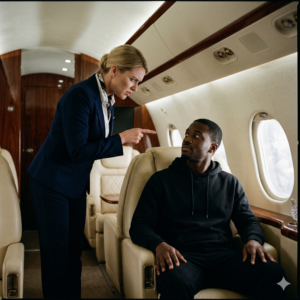
Candace was not even supposed to be on this flight. Her scheduled route had been grounded for emergency maintenance, and she was hastily reassigned to the Teterboro charter. Rushed and irritated, she neglected to review the flight manifest or the client profile. She boarded the jet, marched into the main cabin, and abruptly stopped. Sitting in the owner’s suite—the most expensive, exclusive seat on the aircraft—was a Black man in a plain black hoodie.
Her thin smile instantly vanished. Her back stiffened, her eyes narrowing with sharp suspicion. She didn’t radio the front desk. She didn’t check the digital manifest on her tablet. She simply assumed. And that single, deeply ingrained assumption was about to dismantle her entire life.
Candace didn’t walk toward Harrison; she marched. Her heels clicked sharply against the cabin floor, sounding like the ticking of a countdown clock. She stopped inches from him, crossing her arms defensively, looking down at him with the precise disdain one might reserve for a stain on an expensive carpet.
“Can I see your boarding confirmation?” she demanded. Her tone was completely devoid of professional courtesy. It was sharp, accusatory, and dripping with the presumption of guilt.
Harrison calmly looked up from his tablet. He didn’t react to her hostility. Without a word, he opened the Lux Air app on his phone and held the screen toward her. It clearly displayed the charter confirmation, his name, the tail number, and the date.
Candace barely offered it a passing glance. She tilted her head, letting out a dry, condescending laugh through her nose. “This just shows a booking. It doesn’t prove you’re supposed to be sitting here in this section.” She coated the words ‘this section’ in absolute poison.
Harrison lowered his phone. His voice remained perfectly level and measured, carrying the unique calm of a man who had spent decades being underestimated by people exactly like her. “I’m exactly where I’m supposed to be.”
Candace’s jaw tightened dangerously. She uncrossed her arms and planted both hands firmly on her hips. “Look, I don’t know what kind of mix-up happened at the desk, but this is the owner’s suite. It’s reserved. Maybe you got confused about which aircraft you were booked on. It happens.” She paused, flashing a chilling, dead-eyed smile. “There are standard seats in the back. Much more appropriate.”
Harrison did not reply. He simply held her intense gaze for a long, unblinking moment, before calmly slipping his noise-canceling headphones back over his ears and returning to his financial documents.
That impenetrable silence—his absolute refusal to engage or submit—shattered Candace’s composure. Her nostrils flared, her fingers curling into tight fists at her sides. She turned sharply, grabbed Harrison’s leather weekender bag from the adjacent seat with both hands, and sneered, “Let me help you relocate to the back. You’ll be more comfortable there.” She began marching down the aisle, acting as though she possessed absolute dominion over the aircraft.
Harrison stood up. The moment he rose to his full height of six-foot-two, his broad shoulders seeming to eclipse the aisle, the entire cabin seemed to shrink. He didn’t shout. He didn’t lunge. He spoke with a quiet, terrifying authority that required no volume at all. “Put my bag down. I’m not moving anywhere.”
Candace froze mid-step. She turned slowly. For a fleeting fraction of a second, genuine fear flickered behind her eyes, but her monstrous pride quickly swallowed it whole. Instead of handing it back, she dropped his bag unceremoniously, letting it hit the cabin floor with a heavy, disrespectful thud. Leaning in, she lowered her voice into a menacing hiss. “You don’t want to make this difficult. Trust me.” Turning back toward the galley, she muttered loud enough for anyone to hear, “This is exactly what happens when people don’t read the damn rules.”
Standing frozen in the galley doorway was Elaine Foster, a twenty-six-year-old junior flight attendant barely six months into the job. She held a tray of water glasses, her knuckles white, barely daring to breathe. She had heard the dark rumors about Candace, but witnessing this blatant, aggressive profiling firsthand was paralyzing. Elaine wanted to scream, to intervene, but Candace had seniority. Candace had connections that could—and had—ruined the careers of junior crew members who dared to cross her. So, Elaine remained a silent, horrified ghost in the doorway.
Harrison retook his seat, replaced his headphones, and stared at his screen. His face was an unreadable mask of absolute stillness. But Candace wasn’t finished. Her face flushed with crimson rage, she marched back up to him, her voice escalating to a near-shout.
“I’m going to say this one more time! You either show me a valid ID that proves you belong in this section, or I’m calling ground security and having you physically removed from this aircraft. Your choice.”
Harrison slowly removed his headphones, folding them meticulously on the armrest. “I’d like to speak to your captain.”
Candace scoffed theatrically, her eyes wide with manufactured disbelief. “You don’t get to make demands on my aircraft. You’re a passenger. I’m the crew. I decide who sits where. And I’m telling you, you do not belong here. Now move, or I make the call.”
“I’m not going anywhere,” Harrison replied, his voice barely a whisper. “Do what you need to do.”
Something inside Candace completely snapped. Perhaps it was his unwavering calm. Perhaps it was the unbearable reality that a Black man in a hoodie was occupying a space she believed she controlled, flatly refusing to bend to her fabricated authority. She lunged forward, her hands shooting out aggressively to confiscate his headphones like a teacher punishing a child.
Instinctively, Harrison pulled back to protect his property. As he moved, the back of his hand briefly brushed against her forearm—a fleeting, defensive contact.
Candace recoiled violently as if she had been struck by lightning. She stumbled back a full step, her mouth falling open in a grotesque mask of exaggerated shock. And then, she swung her arm back and slapped Harrison Taylor full force across the face with an open palm.
The crack of the impact sounded like a gunshot in a library. It echoed violently off the polished mahogany panels and sank into the heavy leather seats. In the galley, Elaine gasped, dropping a glass that shattered brilliantly across the floorboards.
Harrison’s head snapped to the side from the sheer force of the blow. A bright red welt bloomed instantly on his left cheek. He sat perfectly still for five agonizing seconds.
Candace was breathing heavily, her chest heaving, her pointing finger trembling as she aimed it at his face. “Don’t you ever put your hands on me! I saw what you did! You grabbed me! I have every right to defend myself!” Suddenly, she smoothed her uniform, her tone shifting into something terrifyingly calculated and rehearsed. “I’m calling security. You’re getting off this plane, and when they get here, I’m telling them exactly what you did. You assaulted a crew member.”
Harrison didn’t argue. He didn’t yell. Slowly, deliberately, he reached into the front pocket of his hoodie. Two fingers pulled out his smartphone. The screen was brightly lit. The recording app was open, and a red timer was actively counting.
14 minutes and 32 seconds.
He had been recording since the very moment she first stomped toward his seat. He placed the phone face-up on the armrest, the microphone icon pulsing rhythmically. He looked up at her, his voice devoid of any emotion. “Everything you’ve said. Everything you’ve done. The slap. The threat. The lie you’re about to tell security. It’s all right here. Audio and video.”
Most people, upon realizing they are caught on tape, immediately backpedal. They panic. Candace Moore simply stared at the pulsing red timer for three long seconds. And then, she smiled. It was a cold, venomous expression that betrayed her true nature. She lifted her chin defiantly. “Record all you want. When security gets here, we’ll see who they believe: a twelve-year senior crew member, or some random guy in a hoodie who forced his way into first class.”
She turned her back, marched to the intercom, and pressed the button for ground operations. Her voice instantly transformed, adopting a fragile, trembling pitch—a masterclass in malicious manipulation. “Ground Ops, this is Senior Attendant Moore on G-APEX. I need security immediately. We have an unruly passenger… he became physically aggressive. He grabbed my arm. I feel unsafe. Please send someone now.”
Two minutes later, heavy footsteps echoed up the air stairs. Two ground security officers boarded the jet. The older officer, a seasoned man named Sullivan, was immediately intercepted by Candace. She practically threw herself at him, her hands trembling as she pointed toward Harrison, weaving her web of victimhood. Sullivan nodded stoically, bypassing her theatrics, and walked down the aisle toward the silent man in the hoodie.
“Sir, I’m Officer Sullivan. Can I see some identification, please?”
Harrison smoothly produced his wallet and handed over his driver’s license. Sullivan looked at the card. Harrison Taylor. Something behind the veteran officer’s eyes clicked. He didn’t say a word to Harrison. Instead, he stepped back, turned his shoulder, and keyed the radio on his lapel.
“Ground Ops, this is Sullivan. I need a client verification on tail number Golf-Alpha-Papa-Echo-X-ray. Can you confirm the owner registered for today’s charter?”
The silence stretched for ten excruciating seconds. Then, the radio crackled to life, the dispatcher’s voice echoing loudly in the quiet cabin. “Sullivan, confirmed. Tail number G-APEX is registered to Apex Horizon Enterprises. Today’s sole charter client is Harrison Taylor, CEO and owner of the registering company. He is the principal client on file.”
Sullivan slowly lowered his radio. He didn’t look at Harrison; he turned slowly to look at Candace. The color drained from her face so rapidly she appeared carved from wax. Sullivan walked back to Harrison, his tone entirely shifted—soft, apologetic, respectful. “Mr. Taylor. I sincerely apologize for the disruption. Is there anything you need from us at this time?”
Harrison looked at the officer, his voice heavy as concrete. “I need her off my plane.”
Candace’s lips moved, but no sound escaped. She stammered, stepping backward. “Wait, what? No, that can’t be right. Look at him! There’s no way he’s…” She couldn’t even finish the racist sentiment. She didn’t have to. The truth hung suffocatingly in the air.
Before anyone could move, Elaine Foster stepped out of the galley. Her hands were shaking violently, but her voice grew stronger with every syllable. “Officers, I need to tell you what actually happened.” Ignoring Candace’s venomous glare and whispered threats of career sabotage, Elaine laid out the absolute truth: Candace’s unprovoked aggression, the stolen bag, the phantom assault, and the very real, brutal slap across the billionaire’s face.
At that exact moment, the heavily reinforced cockpit door swung open. Captain Gregory Adams, having monitored the security radio frequency, stepped into the cabin. It took him exactly thirty seconds to assess the battlefield. His face turned to stone. He looked directly at Candace. “Miss Moore, you are relieved of duty. Effective immediately. You have sixty seconds to collect your belongings and deplane.”
Candace tried to beg, but the Captain silenced her. Defeated, shattered, and utterly humiliated, she grabbed her bag and stumbled down the air stairs into the freezing morning air. The heavy cabin door sealed shut behind her, leaving her stranded on the tarmac, staring up at a $65 million jet she would never set foot on again.
As the aircraft smoothly breached the clouds, ascending into the bright blue sky, the true reckoning began. Harrison sipped a coffee brought by a tearful Elaine, thanked her for her immense courage, and picked up his phone to call his attorney, Derek Williams. Derek was a legal shark, and within thirty minutes, he had launched a catastrophic four-step offensive. Formal assault complaints were filed. Demand letters hit Lux Air’s legal department. And, most devastatingly, a formal notice was dispatched terminating Apex Horizon’s $12 million annual charter contract.
When Harrison’s wife, Vivian, heard the audio, her response was icy perfection: You have the power to make sure this never happens to anyone else. Use it. Harrison authorized the release of the recording to Sandra Coleman, an investigative journalist specializing in corporate racial bias.
The fallout was apocalyptic. Twenty-four hours later, Candace Moore was terminated with extreme prejudice. Lux Air’s HR files were subpoenaed, revealing the three prior racial complaints swept under the rug by middle management. The manager responsible was instantly fired. When Sandra Coleman published her devastating expose—complete with the horrifying audio of the slap and the racist vitriol—the internet detonated. The recording garnered fourteen million views in two days. Lux Air’s stock plummeted by eight percent. The CEO, Nathan Brooks, desperately offered half a million dollars in settlement money. Harrison’s lawyer politely informed him that Mr. Taylor’s dignity was not for sale. Instead, Harrison forced the airline into independent civil rights audits and mandatory anti-bias training, fundamentally restructuring their corporate DNA.
But the legal system wasn’t finished with Candace. The District Attorney filed criminal charges for simple assault and filing a false report. During the brutal three-day trial, the jury listened to the uncut audio. They listened to Elaine Foster’s unshakable testimony. Under cross-examination, Candace was asked why she assumed Harrison didn’t belong. She stuttered, “He didn’t look like… he wasn’t dressed like…” She couldn’t finish it. She was found guilty on all counts, sentenced to eighteen months of probation, heavy fines, and slapped with a permanent criminal record that rendered her unemployable in the aviation and hospitality sectors forever. She became a literal textbook case study in corporate compliance manuals on the devastating consequences of unchecked racial bias.
Harrison Taylor closed his Savannah acquisition without missing a step. But from the ashes of that ugly morning in New Jersey, he created the Taylor Equity Fund—a $10 million endowment dedicated to providing free, elite legal representation for marginalized individuals who face discrimination in the service industries but lack the power, the money, or the private jet to fight back. In its first year, the fund won dozens of cases, forcing major hotel chains and national airlines to overhaul their systemic biases.
Harrison never held a press conference. He never sought praise. He simply continued walking through airport terminals alone, dressed in a worn black hoodie, his headphones around his neck, and his phone always at the ready. Because Harrison Taylor knew an ugly truth that the rest of the world preferred to ignore: when society is hardwired to judge you the moment you walk into a room, having proof isn’t just about winning an argument. It is about survival.
Disclaimer : This content may be created by AI for entertainment purposes. Any resemblance to real persons, events, or places is coincidental.






