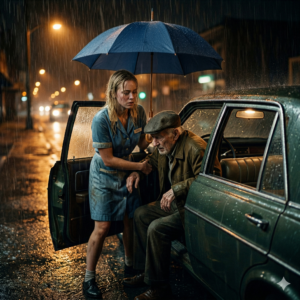
A Shelter in the Storm
The rain was coming down in sheets, slapping hard against the windshield of Laya Thompson’s old sedan like a rhythmic warning. Streetlights blurred in the relentless downpour, casting long, fractured shadows across the flooded asphalt. Her car groaned with every turn, the worn windshield wipers squealing in a losing battle to clear the glass.
It was approaching midnight. The silence in the car was heavy, broken only by the steady, soft breathing of her five-year-old daughter, Maya, who was curled up in the back seat. Dressed in her favorite pink dress, Maya was fast asleep, her small, scuffed shoes dangling over the edge of the worn upholstery.
Laya’s blonde hair was pulled back into a low, messy knot that spoke of a twelve-hour shift. Her waitress uniform still carried the stubborn, faint odors of diner grease and burnt coffee. Her back ached, a deep, radiating fatigue settling into her bones. As a single mother fighting just to keep the lights on in their cramped apartment, all she wanted was to get home, peel off her damp clothes, and steal a few hours of sleep before the punishing cycle started all over again.
Then, she saw him.
He was a shadow at the edge of the sidewalk, barely visible through the sheets of rain. An elderly man stood hunched beneath the weight of the storm, entirely unprotected. He had no umbrella and no raincoat, just a soaked wool blazer clinging desperately to his thin frame. One trembling hand gripped a streetlamp for balance; the other clutched a dark cell phone, clearly dead.
Laya’s foot instinctively eased off the gas. She hesitated. This part of town was quiet, but living on the margins had taught her to be relentlessly careful. Helping strangers in the middle of the night was a risk. Her hands tightened around the cracked leather of the steering wheel. But as her headlights swept over him, she saw his shoulders heave. It wasn’t just the freezing rain; it was sheer exhaustion. Maybe even fear.
Laya let out a soft sigh, the kind that carried the weight of her conscience, and pulled the car over to the curb.
She rolled the passenger window down halfway. A gust of freezing rain immediately whipped into the cabin. “Are you okay out here?” she called out over the roar of the storm.
The man turned slowly, blinking through the water dripping from his gray brow. When he spoke, his voice was remarkably calm, though fragile. “I… I got turned around. My phone died. I thought I could make it on foot, but I am not as young as I used to be.”
Laya studied him. His clothes were soaked through, his expensive leather shoes caked in street mud. Yet, there was a quiet dignity in the way he held himself—he wasn’t just an old man; he was someone’s father, someone’s grandfather, looking profoundly lost.
She reached over, popped the lock, and gave a firm nod. “Get in,” she said quietly. “Let me take you home.”
He hesitated for only a second before opening the heavy door and lowering himself into the passenger seat. Rainwater immediately pooled on the rubber floor mat beneath his feet. Laya cranked the heater dial all the way to the right, even though she knew it would only blow lukewarm air.
“You didn’t have to stop,” the man said softly, shivering.
“I know,” Laya replied, shifting the car back into drive. “But I couldn’t just drive past someone’s grandpa melting in the rain.”
That earned a faint, raspy chuckle. “Walter,” he said, offering a shaky hand. “My name is Walter.”
“Laya,” she responded, offering a warm smile. “And the sleeping beauty in the back is Maya.”
Walter turned slightly, his tired eyes softening as he looked at the little girl curled up peacefully. “She reminds me of someone from a long time ago.”
They drove in comfortable silence for a few blocks before Laya asked for his address. When he recited it, her eyebrows raised slightly. It was situated deep within one of the most affluent, gated neighborhoods on the far edge of town. She said nothing, merely following his quiet directions until they pulled up to a massive brick estate nestled behind impeccably manicured hedges and glowing porch sconces.
Laya parked the car. A wide, deep puddle had formed right at the base of the grand walkway. Walter reached for the door handle.
“Wait,” Laya instructed gently. She threw her door open, stepped directly into the ankle-deep water, and jogged around to open his door. She slipped her hand firmly under his arm, steadying his trembling frame, and carefully guided him around the flooding. She walked him up the grand stone steps, waiting under the portico until she heard the deadbolt click and saw the warm amber lights of the foyer flick on.
Before stepping inside, Walter turned back. His eyes, though weary, were piercingly kind. “You never asked who I was,” he noted softly.
Laya shrugged, wiping rain from her cheek. “Didn’t seem important.”
Walter smiled, deeply moved. Laya nodded, turned on her heel, and walked back to her rusted sedan, the rain soaking through to her skin. It had been a brutal night, but as she put the car in gear, she felt a rare, quiet warmth in her chest. She had done something right.
The Cost of Kindness
Morning arrived relentlessly.
After finally dragging herself into bed at 2:00 a.m., Laya managed only a few hours of fitful sleep. Her bones felt like lead. At 6:45 a.m., she was out the door again, tightly gripping Maya’s tiny hand and a bright pink umbrella. After a hurried drop-off at daycare—sealed with a lingering kiss on Maya’s forehead—Laya sprinted to her car. She was late.
The greasy-spoon diner where she had worked for four years stood on a chaotic corner of downtown. She knew the menu backward, could refill a coffee mug blindfolded, and had smiled through the agonizing pain of sore feet more times than she could count. She burst through the kitchen’s back door, her uniform still damp from the previous night, hastily tying her apron.
She was fifteen minutes late.
“Carter,” a voice snapped like a wet towel.
Laya froze. Steve Simmons, the diner manager, stood by the pickup window with his arms crossed tightly over his chest. His eyes were narrowed slits. “I warned you,” he said, his voice carrying out into the dining room.
“I know, Steve, I’m so sorry,” Laya rushed forward, breathless. “There was this elderly man last night. He was stranded in the storm, and I couldn’t just—”
Steve raised a hand, silencing her. A cruel smirk tugged at the corner of his mouth. “Save it. You think helping someone gives you a free pass to stroll in whenever you feel like it? This is a business, Carter, not a charity.”
“I’ve never been late before,” she pleaded, dropping her voice so the customers wouldn’t hear. “Please. Rent is due. It was just one time.”
“I said save it,” Steve barked, stepping into her space. “You want to tell sob stories? Go to church. You think good deeds fry eggs or clean booths? You’re done here. Hand over the apron.”
The diner went dead silent. The sizzling griddle seemed to hiss in the quiet. In a far corner booth, an older man sitting alone slowly lowered his coffee cup.
Laya’s jaw trembled. Slowly, she untied the apron from her waist and placed it onto the stainless-steel counter, refusing to let the tears spill while Steve was watching. She turned and walked out, moving past the booths she had served for years, past the regulars who awkwardly looked away.
She didn’t notice the man in the corner booth, watching her quietly from behind silver-rimmed glasses. Walter Weston stirred his tea, his sharp gaze fixed entirely on her retreating figure. As Laya stood under the diner’s awning, the sky overcast and bleak, she felt entirely defeated. She had done the right thing, and it had cost her everything.
Inside, Walter placed a crisp hundred-dollar bill on the table for his tea. Without a word to the management, he stood up, buttoned his coat, and walked out into the misty morning.
An Unexpected Caller
It was nearly noon when the knock came.
Laya was at the kitchen sink of her cramped apartment, staring blankly at a soapy spoon. Maya was at the tiny dinette table, happily humming as she aggressively colored outside the lines of a coloring book.
Laya dried her hands and opened the door cautiously.
A tall man in his early thirties stood on the peeling landing. He was clean-cut, wearing a tailored navy peacoat that carried the fresh scent of rain. He possessed a calm, grounded presence that instantly caught her off guard. His eyes, a shade of thoughtful, piercing blue, met hers directly.
“Ms. Thompson?” he asked.
“Yes,” she replied, keeping the door only halfway open.
“I’m Julian Weston. My father is Walter.”
Laya blinked. The man from the storm. Julian offered a soft, genuine smile. “I hope I’m not intruding. I just wanted to come personally to say thank you. My father told me everything. What you did for him… it meant more than I can explain.”
“I really didn’t do much,” Laya said quietly, shifting her weight. “Just gave him a ride.”
Julian shook his head. “You saw someone struggling and stepped in without asking for anything in return. That’s incredibly rare today.” He paused, glancing past her to where Maya was peeking out from behind a chair. “My father also mentioned that you had a rough morning.”
Laya’s cheeks flushed hotly. She looked down at the linoleum floor.
“He’s had a difficult few months,” Julian continued, his tone softening. “He recently returned from a hospital stay, and truthfully, he’s been fading. He’s quieter, more distant. But last night, he came home with a light in his eyes I haven’t seen in a long time. He asked me to invite you both for lunch. And… he was hoping you might consider working with us.”
Laya raised an eyebrow. “Doing what? I’m not a nurse.”
“Nothing medical,” Julian clarified quickly. “He doesn’t want a nurse. He wants a companion. Someone to sit with him, share a pot of tea, maybe read to him, and just keep him tethered to the world. He said being around you made him feel human again.” Julian pulled a folded piece of heavy cardstock from his pocket. “I’d pay you far better than the diner. Three afternoons a week, completely flexible.”
Laya looked back at Maya. Rent was due. Groceries were running dangerously low. But more than the financial lifeline, there was a quiet sincerity in Julian’s offer. No pity, just an earnest request for help.
“I can try,” she said softly.
Julian smiled, visibly relieved. “Thank you. He’ll be thrilled.” He handed her the cardstock. It was a handwritten invitation in elegant, sweeping cursive.
As Julian turned to walk down the hall, he paused and looked back. “You gave him hope, Laya. We don’t take that lightly.”
Waking the House
The Weston estate was vast, wrapped in crawling ivy and surrounded by ancient oak trees. But when Laya and Maya arrived that Saturday, it didn’t feel intimidating; it felt waiting.
Walter greeted them at the grand mahogany door in a cozy cardigan, beaming. Julian stood just behind him, his sleeves rolled up, a flour-dusted dish towel slung over his shoulder.
“I cooked,” Julian announced, looking slightly out of his element.
“By cooked, he means he supervised the oven,” Walter chuckled, ushering them inside.
The lunch was perfect in its simplicity. They sat at a long oak dining table. Julian instinctively pulled out a chair for Laya, and without making a show of it, he cut Maya’s roasted chicken into perfectly bite-sized pieces, checking the temperature of her mashed potatoes before placing the plate in front of her. Laya watched him, struck by the quiet, effortless way he cared for those around him.
Over the next few weeks, Laya and Maya settled into a beautiful rhythm at the estate. Laya’s job was beautifully simple: she read short stories aloud in the study, she made chamomile tea, and she listened. She listened as Walter spoke of his late wife, of the echoing loneliness that a massive house brings, and of his deep love for his son. In return, Walter listened to Laya talk about her love of gardening and the lullabies she sang to Maya when the world felt too heavy.
Julian was a silent observer to the house’s resurrection. He returned from work each evening just as the sun began to dip, leaning against the doorframe to watch Laya and Walter laughing over old stories. The estate, once a sterile museum of grief, now smelled of baked goods, Earl Grey, and crayons. There were pink shoes discarded by the back door and blankets tossed casually over velvet sofas.
And in the quiet moments, Julian found himself waiting by the window, anticipating the sound of Laya’s car crunching on the gravel driveway.
The Shattered Stones
It was a bright Saturday when the fragile peace fractured.
Julian had invited them over for a casual weekend meal, though the fresh flowers and linen napkins suggested he had put serious thought into it. While Julian was in the kitchen preparing lemonade, Maya wandered into Julian’s private study, with Walter trailing slowly behind her.
The room was a sanctuary of old books and leather. On Julian’s mahogany desk sat a small, polished wooden box with intricate carvings. Fascinated, Maya reached up on her tiptoes to touch it.
The lid was loose. Her small fingers slipped.
The box tumbled to the hardwood floor, cracking open with a sharp clack. A string of worn, greenish-blue stone beads spilled out, the fragile thread snapping on impact. The beads scattered violently across the floor.
Maya gasped, her eyes wide with instant terror. “I didn’t mean to,” she whispered.
Julian rushed into the room, wiping his hands on a towel. He stopped dead in his tracks. His eyes locked onto the broken string and the scattered stones. The color drained from his face.
He moved slowly, dropping to one knee. Gently, as if handling glass, he picked up a single blue bead.
Laya appeared in the doorway, her heart plummeting into her stomach. She saw the broken jewelry, saw Julian’s face, and immediately pulled Maya behind her legs. “Julian, I am so, so sorry. We’ll replace the string, I’ll pay for—”
“It was my mother’s,” Julian interrupted, his voice hollow and tight. He didn’t look up. “She made it for me when I turned ten. Her hands were failing from the illness, but she spent hours threading it. She said it was made of the strongest stone she could find.”
He placed the bead back into the splintered box and stood up. The silence in the room was suffocating. Walter reached out to touch his son’s arm, but Julian stepped back, his jaw clenched. He gave Laya a tight, forced nod. “It’s all right. Really. It was an accident.”
But his eyes were entirely closed off. The warmth was gone.
“We should go,” Laya whispered, fighting the burn of tears in her eyes. Julian didn’t ask them to stay.
Plastic Beads and Pure Love
Four days passed. The Weston house had reverted to a tomb.
Laya had texted Walter her resignation, stating it was best she didn’t return, knowing some things simply couldn’t be fixed. Walter had replied with only two words: You matter. Inside the vast estate, Julian sat in his study, staring blankly at the garden window. The silence was deafening. He realized too late that he hadn’t just lost a bracelet; he had let the only light in his life walk out the door.
Across town, Maya sat cross-legged on their apartment rug, her tongue poking out in intense concentration. She was threading cheap, brightly colored plastic beads onto a piece of elastic string.
“What are you making, baby?” Laya asked gently, watching from the kitchen.
“You said we can’t fix his old bracelet,” Maya said softly, not looking up. “But he looked so sad. I want to make him smile again.”
When it was finished—a chaotic, neon loop of mismatched plastic—Maya grabbed a purple crayon and a scrap of paper. With wobbly, uneven letters, she wrote: Im sory I broke your shiny braclet. I made this one for you. Its not shiny but its full of love. Maya, 5.
That evening, there was a knock on the Weston’s grand door. Walter answered it to find Laya standing in the rain, holding a small paper bag. “Maya asked me to bring this,” she said softly. “Will you give it to him?”
Walter promised he would.
When Julian opened the small paper bag at his desk, he found the neon plastic bracelet and the purple-crayon note. He read the wobbly letters. Its full of love. Julian’s hands began to shake. He leaned back in his leather chair, clutching the cheap plastic beads to his chest. A single tear slipped down his cheek, followed by another. For years, he had guarded his grief like a fortress. But looking at the plastic bracelet, the walls finally broke. He wasn’t crying because he missed his mother anymore; he was crying because pure, undeserved love had walked back into his life, and he had almost let it go.
The Shelter
It was dark when Julian knocked on Laya’s apartment door. When she opened it, she found him standing in the hallway, rain glistening on his navy coat.
He didn’t wait for an invitation. He reached out and gently took her hand. “I was angry,” he said, his voice thick with emotion. “But not at Maya. I was just afraid of losing the memories I had left.” He stepped closer, his blue eyes searching hers. “Objects are important. But people are more important. I missed you, Laya. Both of you.”
Maya peeked out from behind her mother’s legs. Julian crouched down to her eye level and pulled back his tailored coat sleeve. Resting against his expensive leather watch was a chaotic, neon plastic bracelet.
“I’m never taking it off,” Julian smiled. Maya squealed and threw her arms around his neck. Laya covered her mouth, the tears finally falling.
Months later, the rain returned on a lazy Sunday afternoon, tapping a soft rhythm against the sunroom windows.
Julian, Laya, and Maya were sitting on a picnic blanket spread across the plush living room rug, watching the storm roll over the estate. Walter sat nearby in his armchair, a forgotten book on his lap, beaming at the life that now filled his home.
Maya lay with her head resting comfortably on Julian’s chest. “Julian?” she asked quietly.
“Yeah, kiddo?”
“If we stayed here forever, would you be my daddy?”
The room went entirely still. The only sound was the patter of the rain. Laya froze, her heart hammering against her ribs. She looked at Julian, terrified of the pressure the question held.
Julian didn’t flinch. He looked down at the little girl, his expression shifting into something profoundly deep and certain. He brushed a stray curl from her forehead. “Maya,” he whispered, “that would be the greatest honor of my life.”
Laya let out a breath that was half-sob, half-laugh.
That evening, the dining room glowed with amber light. Friends and family crowded around the long oak table, the air thick with the scent of roasted food and the sound of joyous laughter. Walter tapped his glass, bringing the room to a hush.
“To my son,” Walter beamed, raising his wine. “Who found something far rarer than wealth. He found a family. To Laya and Maya, for bringing us back to life.”
As the glasses clinked, Julian stood up. He reached down and took Laya’s hand, pulling her gently to her feet. The room went silent.
“You walked into our lives during a storm,” Julian said, his voice steady, his eyes locked entirely on hers. “You stopped for a stranger when no one else would. You brought light into a house that had been dark for a very long time.” He reached into his pocket. “You changed my life, Laya. Let me spend the rest of mine making yours better.”
From her seat, Maya cupped her hands around her mouth and yelled, “Say yes, Mommy!”
The room erupted into laughter, but Laya only saw Julian. Tears spilled over her cheeks as she nodded, throwing her arms around his neck. It was a chaotic, beautiful embrace, sealing a promise made in the quietest corners of their hearts.
Later that night, the rain finally cleared, leaving the air crisp and clean. Julian drove them back to the apartment one last time to pack their overnight bags. As Laya stood on the sidewalk holding Maya’s hand, Julian stepped out and opened the passenger door.
He smiled, extending a hand to her. “Get in,” he said softly. “Let me take you home.”
Disclaimer : This content may be created by AI for entertainment purposes. Any resemblance to real persons, events, or places is coincidental.






