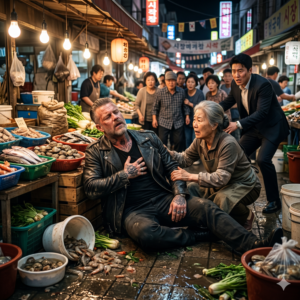
The market was loud. Friday morning. Vendors calling out prices. Hai Wat was arranging her herbs when he collapsed. Not dramatically. Not with a cry or a crash or a scene that made people turn. One moment he was walking past her stall. Tall man. Dark jacket. Moving with the careful, deliberate pace of someone who was trying not to be noticed.
The next moment, he was on the ground. She was beside him before she made the decision to move. Her hands found his pulse. His breathing. His color. Moving with the quiet efficiency of someone who had spent her whole life learning what a body did when it was in trouble. “Help me.” She called out. Not in a panic.
Just clearly. Two vendors from the neighboring stalls appeared immediately. They carried him inside without being asked. Laid him on the mat she kept at the back of the stall for exactly this kind of situation, because in a market this busy, someone always needed it. She knelt beside him. Opened his jacket. And stopped.
She had seen this before. Not often. But enough times to know. The specific color of the skin. The shallow, uneven breathing. The way the hands had curled slightly inward. The sequence of it. The way the body was shutting down from the outside in, like a light dimming from the edges of a room. This was not a heart attack.
Not heat. Not exhaustion. This was poison. Hai Wat moved fast. She pulled three jars from the shelf above her head without looking. 15 years in this stall meant she could reach for anything blindfolded. Ground the contents together with the small stone mortar she kept at the edge of the mat. Mixed it with water from the clay pot in the corner.
Then she lifted his head gently. Tilted it back just enough. Made him drink slowly, carefully, not rushing, because rushing with a poisoned body could close the throat and end everything in 60 seconds. Every drop. She made sure of every drop. When the last of it was gone, she laid his head back down on the mat.
And waited. The market continued outside. Loud and completely indifferent. A woman argued with a vendor over the price of tomatoes. Children ran past the entrance of the stall. A motorbike horn somewhere in the distance. Hai Wat sat beside the man and watched his face. She watched the color at his lips. Watched his chest.
Counted the rhythm of his breathing. 12 minutes. 14. 16. Then his breathing changed. It went from shallow and quick to something deeper. Slower. More even. The specific shift of a body deciding at the last moment to continue. She exhaled and did not realize until that moment how tight her entire chest had been. Then she heard voices outside.
Three men. Moving through the market with the specific energy of people who were not there to buy anything. No browsing. No slowing. Just moving. Eyes cutting between stalls. Talking loudly enough that she could hear every word. “Did anyone see a man come through here? Tall. Dark jacket. He was moving fast.
He may have looked unwell.” Hai Wat looked at the man on the mat. Then at the entrance. She stood up. Walked to the opening of the stall and stepped out just far enough to be seen. Not so far that she was blocking the entrance. Just standing. Like a woman with nothing to hide. Three men. Big. Dressed in a specific way that told her immediately these were not market people.
Not buyers. Not vendors. The shoes alone were enough. The one in front looked at her. A tall man. Dark jacket. “Did he come through this area?” Hai Wat looked at him. Then at the one on the left. Then at the one on the right. “No.” She said simply. “Nobody came through here.” The man in front studied her face. She held his gaze without blinking.
Not defiantly. Not nervously. Just steadily. The way an honest person holds a gaze. He looked past her into the stall. At the shelves of jars. At the hanging bundles of dried herbs. At the small mat visible at the back. She did not move. Did not shift her weight. Did not say anything extra. Because she had learned a long time ago that extra words were the thing that gave people away.
The man looked at the one on his left. Something passed between them. A small, private decision. Then he nodded and they moved on. Hai Wat watched them go. Watched until they had passed three stalls. Then she went back inside and sat down beside the man on her mat. She looked at his face for a moment. Then the sound of a motorbike moving slowly through the market.
A woman on it. Not asking questions. Not calling out to anyone. Just riding very slowly through the center of the market. Eyes moving carefully between every stall on both sides. With the practiced, patient attention of someone who was looking for something specific. Hai Wat watched her pass the entrance of the stall.
Said nothing. The woman moved on and the sound of the motorbike faded into the noise of the market. Hai Wat sat back down. She looked at this man on her mat. Tall. Well-dressed beneath the jacket. Hands that did not look like they belonged to anyone who had ever carried heavy things. She did not know his name. Did not know where he had come from or where he had been going.
Did not know whose men had just walked past her stall asking for him. Did not know what she had just stepped into. She sat beside him. And waited. He opened his eyes 2 hours later. Stared at the ceiling of the stall for a few seconds. Then turned his head slowly and found Hai Wat sitting against the opposite wall, threading dried herbs onto a line of string with the focused patience of someone who had done it a thousand times.
She looked up the moment he moved. “Where am I?” “My market stall.” She said. “You collapsed outside.” He sat up slowly. Took in the space around him. The shelves lined with jars. The hanging bundles of plants. The clay pots. The specific smell of herbs and earth and something he could not name. “What happened to me?” “You were poisoned.” She said simply.
He looked at her. “How do you know that?” “Because I have worked with herbs and remedies my entire life.” She said. “And I know what poison does to a body. I also know how to treat it. Which is what I did.” He was quiet for a moment. Processing. “You treated me.” “Yes.” He looked at his hands. Turned them over slowly.
Then looked back at her. “Who are you?” “Hai Wat.” “That is all you need.” He studied her for a long moment. The specific look of a man who was accustomed to knowing everything about everyone in his immediate vicinity and was working out how to respond to someone who had just told him, without apology, that he did not need more information than she had chosen to give.
“I need more than that.” He said. “No.” She said quietly. “You don’t. I did not save you so that you could know things about me. I saved you because you needed saving.” Something moved in his face. He reached into his jacket. Then to his other side. His phone was gone. “I need to make a call.” Without standing, without asking why, she reached beside her and handed him a phone.
He looked at it for a moment. Then dialed a number from memory. The only one he knew by heart. It rang once. Twice. His assistant picked up on the third ring. “Hello.” He opened his mouth to speak. And stopped. Because behind his assistant’s voice, in the background of wherever he was, there was another voice. A woman’s voice.
His wife. Saying his name. Not as a question. Not with the relief of someone who had been searching and had finally found. In the flat, quiet tone of someone receiving a confirmation they had been waiting for. The tone of a person whose question was not, is he alive, but is he gone? He ended the call. Sat completely still.
The market moved outside. A vendor laughed somewhere close by. A child called for her mother. Someone dropped something metal and the sound rang out sharp and then faded. All of it very far away from where he was. Hye-won put down the herbs in her hands. She did not speak immediately. She waited. Because she had enough experience with pain to know that some realizations needed space, needed a few seconds to land fully in a person’s chest before anything else could happen.
“What happened?” she said finally. Quietly. He looked at her. Not through her. Directly at her. “The people who poisoned me,” he said. “Yes.” “I just found out who they are.” He told her. Not all of it at once. In pieces. The way a person talks when the telling of something is the first time they have said it out loud, and the weight of it keeps stopping them mid-sentence.
His name was Kang Tae-joon. He ran one of the most powerful organizations in Seoul. Had built it from almost nothing over 20 years. The kind of organization that did not appear in newspapers and was never mentioned at official tables, but whose decisions moved through the city the way water moved through cracks in stone.
Quietly. Completely. Everywhere. Three weeks ago, he had started noticing things. Small things at first. A meeting where the other side had known his position before he stated it. A decision he had kept strictly internal that had somehow been undermined before it reached the table. Twice, information that only his inner circle possessed reached people it should never have reached.
A pattern. Specific. Deliberate. Patient. He had started investigating quietly. Without telling anyone what he was doing or why. Moving carefully because he understood that whoever was doing this was close, and alerting the wrong person would end the investigation before it found anything. And then, yesterday morning.
His coffee. Made by his assistant, the man who had been beside him for 30 years, since they were 11 years old sharing a school desk in a neighborhood where nothing came easy. Brought to him by his wife, the woman he had chosen above every other thing in his life, and forgiven things he had never spoken aloud because love had always felt to him like a decision and not just a feeling.
The two people with full access to everything he was. The two people he had never once had reason to doubt. “Your wife,” Hye-won said quietly. “And your assistant.” “Yes.” “They both knew.” “Yes.” She was quiet. “And now,” she said slowly, “they know you are alive.” “Or they will soon.” “The call was short, but” “But enough,” she said.
“Yes.” She looked at the entrance of the stall. At the market moving outside. At the completely ordinary world that had no idea what was sitting inside this small space right now. “Then your life is still in danger,” she said. “And so is mine.” “Because I looked those men in the face and lied.” He looked at her.
“I understand if you want me to leave,” he said. He stood up. Started toward the entrance. “Where are you going?” she said. “I will figure something out.” He said it with the automatic confidence of a man who had always figured things out. A man who had never in 20 years been without resources, without options, without a path forward.
But right now he had no phone of his own, no location anyone trusted knew about, no allies he could call without risking that the call would reach the wrong ears first. Hye-won looked at him standing at the entrance of her stall. This man, powerful, composed, controlled, with nowhere to go. “Sit down,” she said.
He turned. “I know what betrayal looks like,” she said. Not loudly. Not with drama. Just clearly. The way someone speaks a fact they have learned the hard way. “I have seen it before.” “And I know that right now you cannot think clearly.” “Because the pain of what you just realized is louder than everything else inside you.
” He looked at her. “Sit down,” she said again. “We will figure it out together.” He stood in the entrance for a long moment. The market moved loudly behind him. Then he turned around. And sat back down. The footsteps came 10 minutes later. More than before. Moving deliberately in a wide slow circle around the outside of the stall.
Not rushing. The specific patient movement of people who had done this kind of search before and understood that hurrying made noise. Tae-joon was on his feet immediately. His eyes moved around the stall, looking for something, anything usable. “Stop,” Hye-won said. He looked at her. She was already moving to the back of the stall.
She pulled a heavy wooden shelf sideways. Smooth and practiced, the movement of someone who had done it enough times that it had its own rhythm. Behind the shelf was a door. Small. Low. The kind you had to duck your head to pass through. “This was built for moments exactly like this one,” she said quietly. “For when things got dangerous.
” “Nobody outside knows it exists.” He looked at the door. Then at her. “Move,” she said. They went through. She pulled the shelf back behind them using a rope fixed to the inside. It slid back into place with a soft, solid sound. Complete darkness. They stood completely still. Listening. The men entered the stall.
Heavy footsteps, more than three. Moving through the space with the methodical efficiency of people who had been told what to look for and were going to find it. Jars coming off shelves. The sound of things hitting the ground. A shelf scraping hard against the wall. The specific sound of a search being done by people who did not care what broke because the breaking was part of the message.
“Check the back,” a voice said. More sounds. More breaking. A pause. “Then, not here.” A longer pause. “Spread out.” “Check the buildings on either side.” More footsteps. The sound of them leaving. Then silence. Tae-joon and Hye-won stood in the dark without moving. 1 minute. 2. 5. Hye-won put her hand on the rope and pulled slowly.
They came back out. The stall was destroyed. Every shelf cleared. Jars smashed on the floor. Herbs and powders and tinctures mixing together on the ground in a smell that would have been beautiful in any other moment. The mat pulled from the back and turned over. The clay pots shattered in pieces in the corner.
Everything she had arranged that morning. On the floor. She stood at the entrance and looked at it. Tae-joon stood behind her. He did not say anything immediately. Because right now there were no right words. The main market shop was worse. 15 years of work. Every jar. Every carefully maintained shelf. Every bundle of herbs she had dried and labeled in her own hand.
Every root and powder and remedy that her mother had taught her to prepare, scattered across the floor, broken, mixed together, destroyed. Hye-won walked in slowly. Stood in the center of all of it. She did not cry. Did not speak. Did not move. Just stood there, looking at what was left. Tae-joon stood at the entrance behind her.
“I will replace everything,” he said immediately. “Every single thing in this shop.” “Whatever it costs.” “I swear it. The moment I am back on my feet, the very first thing.” She turned and looked at him. And something in her eyes stopped him mid-sentence. Not anger. Not blame. Something quieter than both of those things.
Something that was more difficult to look at than either of them would have been. “You cannot replace this,” she said. “I can rebuild.” “My mother planted the first herb in this shop,” she said. “15 years ago.” “When I was 14 years old.” She looked at the broken shelf against the far wall. “She would come early every morning before the market opened.
” “Before any of the other vendors.” “She would check each plant, check the soil, check the light, check the moisture.” “She would tell me the name of every herb and its purpose and the right amount and the right time.” “She taught me everything I know, right here.” “In this space.” She paused. “She died 3 years ago.
” “And every morning since then, every single morning when I unlock this shop and step inside, I felt her here.” “In the smell of the herbs.” “In the way the jars were organized.” “In the way the light came through that gap in the roof at 8:00 in the morning and landed exactly on the shelf where she kept her favorites.
She looked at him directly. Clearly, “You cannot replace that,” she said. “No amount of money replaces that. Not because I do not believe you mean it, but because some things are not about money.” Taejun stood completely still. He did not try again. He understood, finally, that the only right thing right now was silence.
Hyewat down slowly, reached into the wreckage at her feet, moved pieces carefully aside, and picked up one small jar, cracked along the side, a long diagonal line running from lid to base, but still sealed, still whole. She turned it in her hands slowly. He watched her. This woman, in the middle of everything destroyed, holding the one thing that had survived, not asking him for anything, not pointing the damage at him, just holding it.
Like it was the most important thing in the room. Because right now, to her, it was. He sat down. Right there. On the floor. In the middle of all of it. She looked at him. Then slowly, without deciding to, she sat down beside him. Because the destruction around them felt too large to stand in. And the floor felt like the only honest place.
The market moved loudly outside. Vendors called out prices. A truck engine somewhere in the distance. Children laughing. The full, indifferent noise of the world continuing at full volume. In here, everything was very quiet. After a long time, he leaned slightly toward her. Not dramatically. Not with a word. Just the lean of a man whose body was tired in a way that sleep could not fix.
Tired of holding itself upright through everything. Tired of being in control. Tired of having no safe place to simply stop. She did not move away. He did not speak. She looked at the cracked jar still in her hands. Then set it down gently on the floor beside her. “What was in it?” he said. “Dried fenugreek,” she said.
“My mother said it was the first thing she ever learned to dry properly. She was 12. Her own mother taught her.” He was quiet. “She would have been pleased,” Hyewat said, “that it survived.” He looked at the jar. “Yes,” he said. “I think she would.” They sat together on the floor of everything lost for a long time, in silence.
They went to her house that night. Small. Clean. A place that had exactly what it needed and nothing extra. They sat across from each other for a long time without talking. The kind of silence that was not uncomfortable, just necessary. The silence of two people who had been through enough in one day that they had temporarily run out of words.
Then Hyewat straightened, looked at him. “We need to get into your building,” she said. “They will be watching every entrance,” he said. “Every camera. Every guard who answers to my assistant. Every door.” “Not every door,” she said. “And not every camera.” He looked at her. “Every camera has a blind spot,” she said.
“Not a large one, but enough. And the person who knows exactly where that blind spot is is not someone your assistant chose. Not someone connected to your wife. It is the person who has walked those rounds the longest. The one who has been there so many years that he knows every shadow in that building.” “What kind of person are we looking for?” he said.
“The one who never asked for anything,” she said. “Never pushed for promotion. Never complained about his position. Never appeared in any conversation about power or advancement. The one who just shows up every day. Does his job exactly as it was given to him. Goes home.” Taejun was quiet. His face moved slightly, the small shift of a memory surfacing.
“Sergeant Park,” he said, quietly, almost to himself. “Tell me.” “15 years,” he said. “He was there before I moved the organization to that building. He was already there when I arrived. I offered him a senior security position 4 years ago. He thanked me and said he preferred his rounds. Said large titles made him nervous.
” A pause. “I laughed when he said that. I remember laughing.” “That man,” Hyewat said, “we find the blind spot. We reach him there without being seen. You show him your face, and he gives you access to everything.” Taejun looked at her. “How do you know how to think like this?” She looked at him steadily for a moment.
“Because I grew up in a neighborhood where knowing who to trust and knowing how to move without being seen was not strategy,” she said. “It was survival. You learn it when you are young or you learn it the hard way. I learned it young.” He looked at this woman across from him, sitting in the dim light of a small house that the man who had destroyed her shop did not know existed, wearing the same clothes she had worn through a day that had taken everything she owned, having lost 15 years of her mother’s work because she chose to protect a
stranger who had collapsed outside her stall. And in less than 10 minutes, with nothing but calm and clarity, she had just outlined a plan that his most experienced people would have needed days and a meeting room and three whiteboards to develop. “Tonight,” he said. “Tonight,” she confirmed. They moved at midnight.
Hyewat led. He followed. Through streets she knew the way people only know streets they have walked in every kind of dark, not just at night, but in grief, in fear, in a particular loneliness of moving through a city when you feel invisible in it. Through the back corridors of blocks. Through the narrow gaps between buildings that did not appear on any map, but existed in the memory of everyone who had grown up needing them.
No cameras covered the route she chose. Not by luck. By years of observation. By the specific knowledge of someone who had spent a lifetime understanding how a city really worked, not from above, where it looked organized, but from the inside, where it was full of gaps. They reached his building at 12:10. She found the blind spot in 40 seconds.
A gap between two camera coverage angles at the northeast corner of the building. A shadow created by the position of the adjacent structure. Invisible in daylight unless you were standing in exactly the right position. Completely obvious if you have been walking past it for 15 years. They moved into the gap.
Waited. At 12:15 exactly, Sergeant Park appeared. On schedule. Like clockwork. The rounds of a man who had never once been late in 15 years. Hyewat stepped forward first. She moved quietly from the shadow and touched his arm, firm, steady, guiding him backward into the blind spot before he had fully processed what was happening.
He spun around. Ready. Body already in the posture of someone trained for exactly this situation. Weight forward, hands up, completely present. Then Taejun stepped forward from the shadow, removed the cap that had been covering his face. Sergeant Park looked at him. His entire body went still. Not the stillness of threat.
The stillness of recognition. Of something so unexpected that the body needed a full second to confirm what the eyes were telling it. Then, slowly, deeply, he bowed. When he came back up, his eyes were bright. “Sir.” His voice was not fully steady. “We were told, everyone was told that you had, that it was confirmed.
” “I know what everyone was told,” Taejun said quietly. “I need your help.” Sergeant Park looked at him for a moment. “Then, anything.” Without pause. Without asking what. “The full camera archive from the last 3 weeks,” Taejun said. “Everything. Not the edited version, the raw archive. And the personal contact numbers of every lieutenant who was not inside the building on Friday morning.
” Sergeant Park nodded. Then he looked at Hyewat. A careful, unhurried look. The specific expression of a man who paid attention to everything and forgot nothing. Then he turned back to Taejun. “12 hours,” he said. “I will have everything ready. Where do you want it delivered?” Taejun looked at Hyewat. She gave him an address.
Quietly. He repeated it to Sergeant Park. “Tell no one,” Taejun “No one.” Sergeant Park said. He said it simply. Not as a performance of loyalty. Just as a fact. He looked at his boss one last time. A look that carried something in it that was older than professional, something personal, something that had built up quietly over 15 years of early mornings and late nights and rounds walked in every kind of weather.
Then he turned and went back to his rounds. Exactly on schedule. Like nothing had happened. The package arrived before sunrise. A small drive. Left at the address Hye-won had given in a plain envelope without contact. They watched it on a small laptop in a room with the curtains drawn. Both of them completely still.
The footage was from inside his own boardroom. The security cameras he had installed himself. Cameras his assistant had access to manage and had apparently decided were no longer worth worrying about. Three weeks ago. His wife and his assistant. Sitting at the long boardroom table. Not nervously. Not rushed.
With the settled focused efficiency of two people who had already made their decision and were now working through the specific details of execution. The specific poison. Slow acting. Designed to look like a natural health episode in a busy public space. Undetectable by most standard tests. Sourced through a supplier his assistant had used before for other things.
Things Tae-joon had sanctioned. Things he had trusted his assistant to handle. The timing. Friday morning. The coffee first to begin the process. Then the market trip. A routine they both knew well. A pattern that had never varied. The men positioned to confirm he went down in a location with no cameras. No witnesses who would ask questions.
Nothing that could be traced back to the building or anyone in it. The method. Clean. Professional. Designed to leave nothing to follow. And then the reason. The footage confirmed it in documents they spread across the table between them. Numbers. Account records. Transfer histories. For two years his wife had been moving money out of his organization in amounts small enough not to trigger any internal alert but consistent enough.
Patient enough that over 24 months they added up to something staggering. His assistant had built the structure from the inside. Using access that Tae-joon had given freely because he had trusted this man with his life for 30 years. Account architectures that did not appear on any official record. Pathways that existed only because someone with full internal access had created them.
They had not simply tried to kill him. They had been quietly systematically dismantling everything he had built from the inside for two full years. Using his trust as the door. Tae-joon watched the footage without moving. Without speaking. When the last of it ended and the screen went dark he sat completely still.
The room was silent. Hye-won sat beside him. She did not offer words. Did not reach for anything comforting to say. Did not try to fill the silence with something that would make it smaller. Because this was the kind of silence that needed to be sat in fully. That needed to exist without interruption before anything else could happen.
After a long time he picked up the phone Sergeant Park had sent with the drive. He looked at the screen for a moment without pressing anything. “30 years.” he said. She looked at him. “30 years I trusted that man.” he said. “I thought I knew him better than I knew myself.” He paused. “I gave him everything. Every door.
Every key. Every secret.” He set the phone on the table. “And my wife.” He stopped again. “I forgave her things I never told anyone about. Because I believed she was worth it. Because I chose to believe.” He picked the phone back up. “It is a strange thing.” he said quietly. “To discover that you were wrong not once but twice.
At the same time. About the two people closest to you.” He looked at Hye-won. “How do you go on from that?” he said. She looked at him steadily. “The same way anyone goes on from anything.” she said. “You go on.” He held her gaze for a moment. Then he looked at the contact list and started making calls. They came one by one.
Six men. Each arriving separately. Each using a different route to the address Sergeant Park had confirmed was clean. None of them knowing who else had been called. And each of them when they walked through the door and saw Tae-joon sitting at the table alive in the same dark jacket he had been wearing since Friday stopped completely.
One of them said nothing at all for almost a full minute. Just stood in the doorway. His hand still on the handle. His face going through several different things before it settled into something he could hold. Then he sat down without being asked. They all did. Tae-joon told them everything. The poison. The footage.
The wife. The assistant. Two years of careful patient systematic theft built piece by piece from the inside using access he had given out of love. Out of trust. Out of the specific generosity of a man who had always believed the people closest to him deserved everything he had. Nobody interrupted. Nobody moved while he talked.
The room was absolutely completely still. The kind of stillness that a space fills with when everyone in it is listening with everything they have. When he finished he set the drive on the table. He did not have to say what was on it. They would look at it themselves later. They already understood. The silence held for a moment.
Then his most senior lieutenant. A man named Do-hyeon who had worked beside Tae-joon for 15 years. Who had seen him at his best and at his most difficult and at every complicated point in between looked across the table at him steadily. “What do you need?” he said. Not are you all right? Not how are you? Not I cannot believe it.
Just what do you need? In the voice of a man who had already decided before the question finished leaving his mouth that whatever the answer was it would be yes. Tae-joon looked around the room. At every face. At the six men who had not been in the building that morning. The six men the footage confirmed were clean.
The six men who were looking at him right now with the specific expression of people who were waiting quietly and completely to be told what to do. “I need this to end.” he said. “Tonight.” Nobody asked how. Nobody asked what that meant or requested clarification. They looked at each other. Then back at him. Do-hyeon nodded once.
And that was enough. They walked in at 7:00 in the morning. Through the front entrance. All of them. No hiding. No announcement. Just Tae-joon walking through the glass doors of his own building in the same clothes he had been wearing since Friday with Do-hyeon on his left and two lieutenants behind him. And Hye-won beside him.
The receptionist looked up and froze. A security guard near the elevator took one step forward and then stopped. Someone in the lobby dropped a phone. Nobody reached to pick it up. Tae-joon did not look at any of them. He walked directly to the elevator. Pressed the button for the top floor. The doors opened.
He walked in. Everyone else followed. The elevator was silent all the way up. When the doors opened he walked straight to the boardroom. Did not slow down. Did not hesitate. He pushed the door open. His wife and his assistant were sitting at the long table. Documents spread between them. Numbers. Account records.
Division of assets. Careful. Organized. Almost finished. The comfortable methodical work of two people who believed they had already won. Who were doing the quiet administrative work of everything that came after. They looked up. His wife’s face went completely white. His assistant’s chair scraped back so fast it fell over when he stood.
Neither of them made a sound. Tae-joon walked to the head of the table. The lieutenants filed in quietly behind him. Do-hyeon closed the door. Nobody sat down. The boardroom had never felt this small. Tae-joon stood at the head of the table and looked at them both. Not with fury. Not with any visible emotion that could be named easily.
With the specific stillness of a man who had already felt every feeling that needed to be felt. Who had sat with it on the floor of a destroyed shop and on the floor of a small house through the early morning hours, and who had come here with only one thing left to do. He placed the drive on the table between them.
“I am not here for explanations,” he said. His voice was completely level. “I am not here to hear reasons. I am here because some things deserve to be said out loud in front of witnesses.” He turned to his assistant first, looked at him for a long, unhurried moment. “Do you remember,” he said quietly, “when we were 11 years old and your mother could not pay your school fees?” The assistant stood with his hands flat on the table, not looking up, not meeting anyone’s eyes.
“I gave you mine,” Tae-joon said, “and told my father I had lost them. He beat me for it. I did not tell him why.” A pause. “Do you remember when we were 17 and you were in trouble with the men from the other side of the city and I stood in front of you?” He touched his side, briefly, just once. “I still have the scar, right here.
You cried that night. You held my face in your hands and you told me you would die before you let anything happen to me.” The room was absolutely silent. “I believed you,” Tae-joon said. “I believed you for 30 years.” He looked at him steadily. “Every position I gave you, I gave because I trusted you above every other person I have ever known.
Every secret I shared, I shared because I believed you were the one person on this earth who knew who I really was before the money, before the power, before the building and the title and any of this.” He gestured briefly at the room around them. “You knew me when I had nothing and I loved you for that, the way a man loves a brother, not the way he chooses, the way he simply does because some connections go that deep.
” Something very far behind his eyes was breaking, quietly, privately, while his face held steady. “And you used every single thing I ever told you. Every weakness I admitted. Every fear I let you see. Every moment I trusted you enough to let you see me clearly, you used it to take everything from me.” He stepped back slightly.
“We are done. Not with anger, with grief, because the man I called my brother died somewhere along the way and I did not notice. And I am sorry I did not notice because maybe if I had, we would not be standing here.” He looked at him one final time. “I hope you find whatever it was you were looking for because you will not find it here again.
” He turned away. He turned to his wife. She already had tears running down her face. He looked at them, then looked at her eyes, and something in his expression made it clear, quietly, unmistakably, that he had seen her cry before. Many times. Had believed every single tear. Had held her through all of it. Until now.
“I met you,” he said quietly, “when you had nothing. Not nothing the way people say it to be dramatic. Nothing. Your family’s house had no running water. Your father was sick. Your younger brother had dropped out of school because there was no money left after the medical bills.” He said it without cruelty, just the truth, stated plainly.
“I did not care. I saw you and I saw everything I wanted. Not what you had. Not what you came from. What you were.” He moved slightly. “I paid for your father’s treatment. Every hospital visit. Every surgery. Every specialist. Three years until he fully recovered. I never mentioned it to you. Not once. Not to make you feel small.
Not to hold it over you. Because that is not what love is.” The city outside was just waking up. Somewhere far below, the market was starting its day, vendors setting up, the first buyers arriving. The specific noise of ordinary life continuing in complete indifference. “I built your brother’s future. His school fees.
His university. His first position. He calls me uncle. He looks at me like I am the best thing in his world. He does not know what you did. He will never know from me.” He stopped, collected himself. “When I found out about the other man, a pause, just a breath, 3 years ago, another, his wife closed her eyes. Everyone told me to leave.
Do-hyeon told me to leave. My own mother called me and told me that I deserved better and that I should walk away. And I stayed because I loved you. Because I believed that people were capable of choosing differently. Because I thought what we had was worth more than my hurt. Because I thought you were worth more than the worst thing you had done.
” His voice dropped lower. “I forgave you, completely. Not partially. Not with conditions attached. Not in the way where forgiveness becomes something you hold above a person. Completely. I never brought it up again. Not in anger. Not in arguments. Not once in 3 years.” He looked at her directly. “And you took that forgiveness.
And you used it as cover to finish what you had already started.” She was crying openly now. Her whole face, her whole body. He watched her. “I am not angry,” he said. And the thing that made the room completely airless, the thing that was harder to hear than any anger would have been, was that he meant it. Entirely.
I am finished. Not because of what you took. Not because of the money. Not even because you tried to kill me.” He straightened slightly. “Because I would have given you anything. Anything at all. If you had come to me, if you had sat across from me and told me what you needed, I would have given it to you. Everything I had.
Everything I built. All you had to do was ask me. Nobody in the room was breathing. The divorce papers are on the table. You will sign them now.” She reached for them with shaking hands and signed. The assistant sat with his head down, not looking at anyone, not saying anything. There was nothing left to say. Tae-joon looked at them both one final time.
Then he turned to Do-hyeon, said nothing, just looked at him, the way two men look at each other when they have spent enough years working side by side that words have become the secondary language. Do-hyeon nodded once. Tae-joon turned away. Behind him, he heard Do-hyeon’s chair push back, heard him stand, heard the other lieutenants move into position.
He walked toward the door and did not look back. Some things you set in motion and then you walk away from and let justice finish itself. The room cleared slowly. Every signature witnessed. Every document verified. Every account that had been quietly moved or hidden, frozen, traced, returned. When the last lieutenant had finished and the boardroom was quiet, Tae-joon stood at the window.
He looked at the city, the city he had spent 20 years learning, building inside of, moving through and shaping from the inside, quietly, consistently, completely. He stood completely still. And in that stillness, something in his face, the composure that had held through every word of that room, through every memory, through every deliberate and devastating goodbye, started to crack.
Just slightly. Just at the very edges of it. Like a man who had been carrying something very heavy for a very long time, who had finally set it down and was only now, in the quiet, feeling the full weight of what it had cost him. He turned, slowly, not to Do-hyeon, not to the door. He turned to Hye-won, who had stood against the far wall through all of it, through every word, through every memory that had been laid out in that room, through every moment of deliberate, devastating honesty, without moving, without speaking,
just there, the way she had been there from the very beginning. He walked to her, stopped in front of her, and looked at her, really looked, in the way he had not allowed himself to look at anything since Friday morning. “I have known powerful people my entire life,” he said. His voice was completely different from the voice that had just addressed the room.
Lower. Unguarded. Without any of the control of the boardroom. People who said they would stand beside me in anything. People who built their whole identity around their loyalty to me. He stopped. And the person who actually saved my life did not know my name. Did not know what I was. Did not know what it would cost her.
His voice caught slightly on the last word. You lost everything because of me. Everything your mother built in that shop. Everything you spent 15 years creating. Gone. Because you chose to protect a stranger who collapsed outside your stall. She looked at him steadily. I have never He stopped. Tried again. In my entire life, nobody has ever He could not finish the sentence.
So he stepped forward. And held her. Not for the room. Not for the lieutenants who had already filed out. Just a man who had been completely alone through the most devastating thing that had ever happened to him, holding the one person who had stood beside him through all of it. Who had lied to dangerous men without hesitation.
Who had lost everything without asking him for anything. Who had sat with him on the floor of all that destruction and said, “Sit down. We will figure it out together.” His voice, when he spoke again, was very quiet. Just for her. If not for you, I would not be standing here. I would not be breathing. I would not have had the chance to say any of what needed to be said in that room.
He pulled back slightly. Looked at her directly. You did not just save my life. You gave me back my dignity. You sat with me on that floor when I had nothing, and you made me feel like that was enough. Like I was enough. He held her gaze. Your shop. Every shelf. Every jar. Every herb your mother planted and every remedy she taught you to make.
I will restore every single thing exactly as it was. Not because I owe you. Because some things should not be lost from this world. And what your mother left in that shop is one of them. Haiwat looked at him. She had words. Many of them. She kept them. Because some moments are bigger than any response. And the kindest thing you can do is let a person feel them fully without interruption.
So she simply held his gaze. And let him see clearly and completely that she understood. He looked at her one moment longer. Then he straightened. Buttoned his jacket. Turned toward the door. She fell into step beside him. And they walked out together into the morning. Into whatever came next. Into a future that neither of them had planned for.
But both of them were walking toward. Anyway.
Disclaimer : This content may be created by AI for entertainment purposes. Any resemblance to real persons, events, or places is coincidental.






