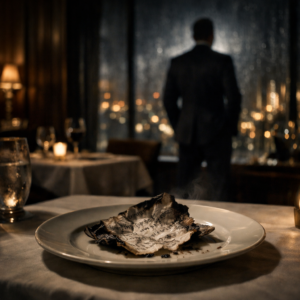
THE CHICAGO GHOST: AN EMPIRE OF SILENCE AND BETRAYAL
ACT 1: THE ANATOMY OF A BLEEDING CROWN
I have spent a lifetime watching men build monuments to their own vanity, only to be buried beneath the rubble when the foundation inevitably rots. In Chicago, power is not something you hold; it is a weather system you endure. When Grant Holloway decided to disappear, twelve people in this concrete labyrinth exhaled for the first time in years. They did not exhale out of relief. They exhaled because the sudden absence of a predator is far more terrifying than its presence. A man like Grant did not simply vanish without a reason, and in our world, his reasons were written in blood and consequence.
For six agonizing months, the Holloway empire had been suffering a slow, surgical exsanguination. Weapons shipments—steel that moved through the city’s veins like iron-rich blood—were evaporating into the night. Safe houses, guarded by silence and heavy doors, were being raided by rival crews within hours of activation. It was as if the enemy had been handed the architectural blueprints of Grant’s very soul.
Yet, Grant performed the theater of kingship flawlessly. He attended the heavy-linen dinners. He shook hands with politicians whose palms felt like wet dough. He smiled exactly when the flashbulbs demanded it. But I knew the truth of his nights. Behind closed doors, in the cavernous, suffocating silence of his office at three in the morning, Grant Holloway was a man dissecting his own autopsy.
He stood by the floor-to-ceiling windows, the city lights cutting across his sharp jaw, the faint scar at the left corner of his mouth pulled tight. The air in that office always smelled of aged leather, expensive scotch, and the metallic tang of impending violence.
I am feeding them, Grant thought, the internal monologue a relentless drumbeat against his temples. Someone who drinks my wine, someone who kisses my cheek at holidays, is handing my throat to the wolves. If I swing the axe blindly, I sever the arteries of my own house. If I accuse the wrong lieutenant, I ignite a civil war while the barbarians are already inside the gates. His uncurbed ambition, the grit that had pulled him from the gutters of the South Side to the penthouses of the Gold Coast, was suddenly his greatest liability. He realized that the only way to hunt a ghost was to become one. He made the move no one, absolutely no one, anticipated from a monarch. He abdicated. Not permanently. Not loudly. He simply shed the skin of Grant Holloway.
He told his capos he was flying to London for a private summit. He reassigned his security detail, sending his muscle to shadow phantoms. His phones went dark, swallowed by the Chicago River. He bought cheap wool coats. He learned to stoop his shoulders. He became “Cole,” a quiet man moving through the subterranean levels of the city where the powerful never dare to tread. He descended into the dirt to find the rat.
A king only learns the truth of his kingdom when he takes off the crown.
ACT 2: THREE WORDS IN BLUE INK
Lake View in the dead of winter is a place where secrets go to freeze. The restaurant was called Tempo. It was an establishment designed for deliberate unremarkability. Reclaimed wood tables, lighting soft enough to blur a suspect’s face, and a seasonal menu that distracted the culinary crowd while the real business happened in the margins. Criminal brokers used Tempo the way legitimate men use boardrooms. The clatter of the kitchen was a natural white noise generator.
Grant had been watching Tempo from a frozen alleyway across the street for two weeks, studying the rhythm of its sins, before he ever pushed through its doors. On a Tuesday evening, he chose a table near the frosted window, ordering nothing but a rare steak and a glass of ice water.
That was where he first saw Maria Knox.
Maria was twenty-eight, possessing a calm, almost maddeningly neutral face that made people instantly forget she had ever occupied their peripheral vision. She was a ghost in an apron. But this invisibility was not a genetic accident; it was a forged armor. I watched her work. She had learned early that curiosity in a place like Tempo was a terminal disease. Three years prior, she had watched a man leave a leather briefcase under a booth, only for two strangers to retrieve it an hour later. She had wiped the table and scrubbed her memory clean.
But Maria harbored a fatal flaw: she could not turn off her ears.
It’s a curse, this listening, Maria told herself as she navigated the floor. I don’t want to know the weight of the briefcases. I don’t want to know why the man in the corner is sweating through his Italian silk. But the voices… they crawl into my head. The tension, the half-swallowed names. I am a vault for sins I never committed.
By nine o’clock, the dining room had thinned to a bruised quiet. She was pouring a heavy Cabernet for a table of four men in a back booth. They were careful men. They spoke in clipped fragments, eyes constantly scanning the exits. But as the dark red liquid cascaded into the glass, the men leaned in, and the volume of their arrogance betrayed them.
“He’s been moving through the South Side for weeks,” one rasped, the smell of garlic and stale tobacco wafting up. “Nobody in his crew knows where he is. Going by a different name.”
“What does he look like?” the second man asked.
The description hit Maria like a physical blow, methodical and precise. “Mid-forties. Sharp jaw. A scar, small, almost invisible at the left corner of his mouth. Gray at his temples. Eyes that watch a room instead of looking at it.”
Maria’s hand, trained through years of suppressing terror, did not spill a single drop of wine. Don’t look, her mind screamed. Look away. Be the furniture. But the human soul is a treacherous thing. For exactly three seconds, her gaze drifted to the window table. To the quiet man drinking water.
Everything matched.
For the next eleven minutes, Maria moved like a beautifully calibrated machine. She cleared plates, dropped a dessert menu, smiled at a meaningless joke. But the air in the restaurant had fundamentally changed. The men in the back were no longer eating; they were hunting. The kinetic energy of impending violence made the hair on her arms stand up. When the man at the window stood, the four wolves would follow him into the frozen dark.
Maria walked to the POS terminal behind the bar. The receipt printed with a mechanical buzz. Table 7. One steak. One water. She picked up a cheap blue ballpoint pen. Her heart hammered against her ribs, a frantic bird trapped in a cage. She circled three words on the receipt, folded the paper once, and dropped the leather folio on his table.
“Whenever you’re ready,” she whispered to the air, moving away before he could blink.
Grant opened the folder. He saw the mundane numbers, and then, screaming in blue ink: They recognized you.
For two seconds, he was a statue. He exhaled a long, slow breath through his nose, absorbing the shockwave. He dropped uncounted hundred-dollar bills onto the table, stood, and walked out the front door with the casual, maddening stroll of a man with nowhere to be. Fifteen seconds later, the four men burst onto the sidewalk, hands deep in their coat pockets. But the street was empty. The ghost had dissolved back into the Chicago wind.
Survival is rarely a loud victory; it is usually a quiet exit.
ACT 3: THE GRAVEYARD OF GOOD INTENTIONS
The descent into the underworld does not begin with a trapdoor; it begins with a knock on glass.
It was 11:15 PM the following night. Tempo was dark, illuminated only by the amber glow of the bar pendant lights. The cooks were gone. The doors were locked. Maria was restocking heavy glass tumblers, the smell of industrial bleach and sour wine heavy in the air.
Tap. Tap. She turned. He was standing on the sidewalk, framed by the neon glow of a failing streetlamp. His jacket was dark, his hands visible, flat at his sides. His face held no threat, nor did it hold warmth. It was the face of a glacier—patient, immovable, willing to wait a thousand years.
Maria stared at the man whose life she had saved. Why did I do it? she thought, the fear finally bubbling up, tasting like copper in the back of her throat. I broke the only rule that keeps me alive. Now the monster is at my door. Slowly, her hands slick with nervous sweat, she walked over and unlocked the deadbolt.
They stood in the dim, humming silence of the empty restaurant.
“I wanted to thank you,” Grant said, his voice a low, gravelly baritone that seemed to vibrate in her chest.
“You didn’t have to.”
“I do.” He pulled out a chair and waited. She sat. He sat across from her, placing both hands flat on the reclaimed wood. An open gesture. A demonstration of disarmament. “Those men would have followed me for two more blocks and boxed me in at the corner of Mercer. I would have had no cover. No exit.”
Maria looked at his hands. “Why did you do it?” Grant asked.
She considered the lies she could tell. But sitting across from a man who breathed deception for a living, only the truth felt safe. “Because someone deserved to know,” she said quietly.
Grant analyzed her. He didn’t undress her with his eyes like the brokers who frequented the bar. He measured her spine. He weighed her soul. “You stayed calm,” he noted. “You didn’t panic. You read the situation and acted without drawing attention.”
“I pour wine. I’m not supposed to draw attention.”
“That kind of instinct isn’t trained,” Grant countered, leaning back into the shadows. “You either have it, or you don’t. I have a problem. And I think you might be someone who can help me solve it.”
He laid out the bleeding of his empire. The mole. The missing shipments. He needed a wraith. Someone who could move through the cigar-smoke filled rooms of his enemies without triggering an alarm. He needed her.
Maria listened, the silence stretching out until it threatened to snap. “No,” she said.
Grant nodded, unsurprised. He left a blank white card with a single phone number on the table and vanished into the night. For three days, the card sat on her kitchen counter, a silent accusation. Then, the wolves returned to Tempo. Different faces, same hungry eyes. For two hours, Maria poured their coffee and listened as they casually discussed the impending slaughter. They were moving crews to the West Side. A war was coming, a tidal wave of blood that would wash over the city, indifferent to who was standing in its way.
I can’t just pour the wine while the city burns, Maria realized, staring at the ceiling of her cramped apartment. Inaction is a choice. Silence is complicity. She picked up the card. Dialed. He answered on the second ring.
“I have conditions,” she demanded, her voice shaking but firm. “When you find whoever is doing this, you shut down the network. Not a reorganization. Not a power transfer. You dismantle it.”
A heavy, suffocating pause hung on the line. Then: “Yes,” Grant promised.
We do not fall into the darkness; we walk into it, demanding terms.
ACT 4: HEIRS TO A ROTTING KINGDOM
The burden of inheritance in Grant Holloway’s world is not passed down through legal trusts; it is transferred through the transmission of paranoia. Grant did not teach Maria how to fire a Glock or pick a lock. He taught her the architecture of deceit.
They met at two in the morning in the back corner of an insomniac coffee shop, the fluorescent lights buzzing like angry hornets. Over cups of bitter, scalding diner coffee, he mapped out the syntax of betrayal. He taught her to track the names that repeated too often, the dollar amounts that were unnervingly round, the sudden, unnatural drop in a man’s voice when a specific door opened.
Maria became the repository of his legacy. At Tempo, she was no longer just listening; she was weaponizing the ambient noise. She was the invisible thread stitching together the disparate conversations of men who thought they were kings.
I am changing, Maria thought, staring at her own reflection in the coffee shop window. I see the strings now. I see the greed dripping off their tailored lapels. I am carrying Grant’s empire in my apron pockets. It is a crushing, terrifying weight.
The puzzle pieces snapped together with horrifying clarity. The traitor wasn’t a street-level soldier. The leaks were too surgical, too perfect. It was someone at the absolute center of Grant’s universe.
“That narrows it significantly,” Grant whispered one night, turning a paper cup in his hands, his eyes dark hollows of exhaustion. He looked less like a mafia don and more like a man who had been awake for a decade. “How many people have that kind of access?” Maria asked. Grant didn’t answer. He couldn’t stomach the names on his own tongue.
To find the proof, Maria infiltrated the rival syndicate’s private gala. It took three weeks of manipulating catering schedules, but she found herself in a converted warehouse in Bridgeport, balancing trays of champagne among thirty men who carried guns under their tuxedos. The air smelled of expensive gin and raw testosterone.
She moved like a phantom. In a hallway near the kitchens, she paused, pretending to arrange crystal flutes. Two men were speaking in the shadows. One was Carver, the rival operations director. The other man had his back turned.
For four minutes, Maria stood frozen as the man dictated the exact handover coordinates for Grant’s Polk Street route. He used the word “replacement” with the casual cruelty of a man deciding what to have for lunch. Then, the man turned.
Maria’s blood turned to ice water. Dark hair going gray at the sides. A heavy, authoritative jaw. She had seen his face in Grant’s confidential files. It was Daniel Pierce. Grant’s operations chief. The man who sat at Grant’s right hand.
She walked away, flushing her notes down a warehouse toilet, her hands shaking violently. She found a payphone two blocks away in the freezing rain.
“Daniel Pierce,” she said into the receiver.
The silence on the other end of the line was the sound of a man’s heart breaking in the dark.
The deepest knife wounds always come from the hands that once poured your wine.
ACT 5: THE ARCHITECTURE OF A FALL
The modern conflict is not fought with Tommy guns on the steps of Union Station; it is a battle of logistics, fought with digital locks, surveillance feeds, and the absolute manipulation of trust.
Grant summoned Maria to the “North Address,” a sterile, brutalist safe house devoid of warmth. He met her at the door, his energy fundamentally altered. The exhausted man from the coffee shop was gone. In his place stood the Patriarch—cold, compressed, operating on a lethal frequency.
“Daniel has started to suspect a leak on his side,” Grant said, his voice flat. “He’s getting close to the right answer. Close to you.”
He knows, Maria realized, a spike of pure adrenaline piercing her chest. The invisible girl has a target on her back. If we don’t strike now, my body will be found in the lake before the snow melts.
“Then we move now,” she commanded.
They spent three hours engineering a trap of operatic cruelty. Grant would leak his return. He would call for a summit at a South Loop building, stepping into the open, a tethered goat meant to attract the lions. Daniel Pierce, unable to resist the ultimate opportunity to eradicate his boss, would signal the rival alliance.
But the building was a mousetrap. Grant’s tech team had laced the walls with hidden surveillance hardware. Maria’s role was the linchpin. She knew the building’s layout from a prior catering gig. The security doors ran on a centralized controller on the second floor.
“Forty seconds,” Maria stated, tracing the blueprint under the harsh overhead light. “If I move when you give the signal, I can reach the controller and lock every door in the building from the inside.”
Grant looked at her, his eyes stripping away the bravado. “Maria. If anything changes in that building… you walk out, and you don’t stop. You vanish.” It wasn’t a request; it was a desperate plea from a man who had forgotten how to care about someone.
The night of the summit, the air in the South Loop was thick with impending doom. Maria entered through the service door at 8:47 PM. Men with hard eyes and bulging jackets patrolled the main floor. She kept her head down, slipping up the back stairwell.
At 9:15 PM, the earpiece crackled. A single click. Daniel had made the call. The betrayal was complete.
Maria sprinted down the second-floor hallway, her pulse roaring in her ears. She punched the override code into the utility panel. The steel box swung open. At 9:22 PM, she found the master switch.
For the empire. For the silence. She pulled it down.
A massive, mechanical THUD echoed through the building as every heavy security door slammed shut and locked. Shouts of confusion drifted up through the floorboards. The rats were trapped in the maze.
Maria didn’t stay to gloat. She fled down the stairwell, bursting out into the freezing alley just as a fleet of black tactical vehicles screeched to a halt at the front entrance, blue and red strobes painting the brick walls.
A prison is just a fortress where the locks have been reversed.
ACT 6: THE LAST SUNSET OF THE HOLLOWAY ERA
Fame in the underworld is measured by the decibel level of your enemies’ screams. But when Daniel Pierce was dragged out of the South Loop building in handcuffs at 9:31 PM, the Holloway empire didn’t scream. It settled into a terrifying, unshakeable quiet. With Pierce neutralized and the surveillance footage firmly in the hands of the authorities, the rival alliance crumbled into dust within forty-eight hours.
Grant watched the empire restabilize from a distance. The hunger for violent retribution had burned out of him, replaced by the profound, hollow exhaustion of a man who had finally set down a mountain he had carried for twenty years.
The next afternoon, he stood at Maria’s apartment door. She answered in the same jacket she had worn the night before, clutching a coffee mug, looking gloriously, victoriously tired.
“It held,” she said, leaning against the doorframe.
“It held,” he confirmed.
That evening, he brought her to his estate. It wasn’t the gaudy palace of a mobster; it was a sanctuary of high ceilings, muted lights, and a sprawling, walled garden that overlooked the glowing grid of Chicago. The air smelled of damp earth and frostbitten boxwood hedges.
They walked the stone path in silence. The city hummed below them, but for the first time in her life, Maria didn’t hear the hum as a threat. It was just the sound of millions of people living oblivious to the war that had just been averted.
Grant stopped at a stone bench facing the skyline. He turned to her, shedding the last remnants of the Chicago Ghost.
“Six months ago, I was losing everything,” Grant said, his voice stripped of all armor. “Not to an enemy I could fight, but to a ghost I couldn’t locate. I was bleeding out alone. And then… a waitress circled three words on a receipt, and changed the entire equation.”
I am just a girl who poured wine, Maria thought, looking at his hands. But I am also the girl who locked the doors.
“You would have figured it out eventually,” she deflected gently.
“Maybe,” he admitted, the melancholic weight of his legacy heavy in his eyes. “But not before it cost me something I couldn’t recover. You were the bravest person in every room you walked into. And you did it without asking for a crown.”
The garden was suspended in absolute stillness. The final reflection of an era that was dying, making way for whatever came next.
“I’m asking you now,” Grant whispered, stepping closer, “to not disappear. Because for the first time in a very long time, ‘over’ doesn’t sound like relief to me. It sounds like something I don’t want.”
Maria looked at the city lights. She had spent her entire adulthood trying to be invisible, looking away to survive. But standing before this bruised, honest titan, she realized that looking away was no longer an option. She reached out, her fingers finding his in the cold air. Grant looked down at their joined hands, anchoring himself to the only real thing left in his world.
The last sunset of the Holloway era had faded into night, and from the ashes of betrayal, a new, quieter empire was born.
We survive the wars, only to surrender to the peace.
Disclaimer : This content may be created by AI for entertainment purposes. Any resemblance to real persons, events, or places is coincidental.






