The Hook (Prologue)
The metallic clack of a latch disengaging. It is a sharp, surgical sound, cutting through the heavy scent of bleach, warm kibble, and shedding fur. A cage door swings open, its hinges protesting with a faint, metallic whine. What emerges is not a threat. It is a creature so small it lacks the coordination to walk straight, its oversized paws skidding uselessly on the polished linoleum. It stumbles. It rights itself. It fixes its gaze.
How does a fortress fall? Does it collapse under the thunderous bombardment of artillery, or does it succumb to the relentless, imperceptible creeping of vines scaling its walls? How does a man who has spent a lifetime mastering the architecture of distance—a man who evaluates every room for exits and every shadow for intent—find himself undone by five weeks of life wrapped in black and tan fur?
He stands perfectly still. He is thirty years old, carved from the cold stone of military conditioning, waiting by a sunlit bench simply because his sister’s car broke down. He is ready to step back. He is ready to withdraw. But the tiny creature does not ask for permission. It crashes into the toe of his reinforced boot, wraps two clumsy paws around the thick denim of his pant leg, and holds on. It does not whine. It does not beg. It merely anchors itself, staring up with the profound, terrifying certainty of a being that has already made its choice. The man looks down. The lock turns. The breach has been made.
The Contrast (The Paradox)
To understand the absolute collapse of Caleb Ror, one must first examine the flawless, impenetrable architecture of the man he presented to the world. To the outside observer, Caleb was a monument to order. He was a retired Navy SEAL navigating his thirties as a night-shift security guard in Asheford, Montana. He was the man who walked the perimeters of half-finished construction sites, his eyes tracing the geometry of chain-link fences and floodlights. He was the man who logged license plates with mechanical precision, who tracked the exact rotation of security cameras, who existed in the negative space between society and danger.
He spoke in clipped, economical sentences. He wore his rough beard and short hair not as a stylistic choice, but as an armor of utility. He was respected by the foreman. He was feared by trespassers. He was a man who moved through the world without ever allowing the world to touch him. They speak of his reliability. They speak of his quiet competence. They speak of a man who never brought his work home, because his home was merely another empty perimeter to secure.
But beneath the hardened tactical exterior lay the private hell of profound, agonizing detachment. His internal life was a museum of echoes. The house he returned to was not a home; it was a holding cell. Unopened mail stacked like tombstones on the kitchen counter. A radio sat silent on a lower shelf. Rooms were kept dark to save the effort of turning on a light for a man who did not care to see what he was living in. The silence in his house did not hum with peace; it pressed down with the suffocating weight of deep water.
He thought he was surviving. He believed that by stripping his life of variables, of attachments, of anything that could bleed or leave, he had achieved absolute safety. He did not realize that a cage is still a cage, even when you hold the key. He had locked out the pain, but in doing so, he had locked himself inside a void. The paradox of Caleb Ror was the tragedy of the ultimate protector: he was strong enough to guard a fortune, but completely bankrupt of anything worth keeping.
The Roots (The Psychological Trap/Origin)
This paralyzing need for control was not born in a vacuum; it was forged in the crucible of his early years. From the moment he signed his name to the military, entering the brotherhood of the SEALs, Caleb was systematically trained to view the world through the lens of threat assessment. You survive by eliminating liabilities. You survive by calculating distance, trajectory, and risk. You survive by ensuring that nothing and no one holds enough leverage over your heart to make you hesitate when the objective demands movement.
His past was defined by the strict management of loss. He remembered the men from his old teams—men who drank coffee so toxic it could strip paint from steel just to stay upright. He remembered the necessity of numbness. When you exist in environments where the ground can shatter and the sky can burn, love becomes a tactical disadvantage. Attachment becomes a fatal flaw.
For a young man shaped entirely by the doctrine of emotional suppression, vulnerability was indistinguishable from failure. He learned to swallow his grief, to neatly categorize his traumas, to build iron walls around his psyche. He returned to civilian life carrying these habits like phantom limbs. He scanned corners. He sat with his back to solid walls. He kept his relationships, even with his vibrant sister Lily, carefully regulated. He was fundamentally trapped in the origin of his own survival mechanism, unable to realize that the war had ended, and the armor was slowly suffocating the man inside.
The Descent (Manipulation/Corruption)
The corruption of Caleb Ror did not happen in a violent coup; it was a slow, agonizingly beautiful process of psychological dismantling. It began with Clara. She stepped into the shelter hallway carrying a clipboard and the quiet, dangerous empathy of someone who understood soldiers. She was in her mid-thirties, her chestnut hair loosely tied, her clear brown eyes utterly devoid of pity but full of recognition. She did not humor him with the polite, vacuous smiles he was used to. She listened. When he spoke of his past, of the bitter military coffee, she met him in his reality. “My dad used to say military coffee had only one job. It wasn’t supposed to taste good. It was supposed to keep people upright.” With those words, she slipped a blade between the plates of his armor.
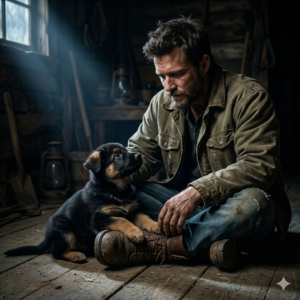
Then came the principal agent of his unmaking: Milo. A five-week-old German Shepherd puppy operating with a total disregard for Caleb’s boundaries. The descent into attachment was a masterclass in emotional gaslighting. Milo demanded nothing, yet required everything. The puppy assaulted Caleb’s defenses not with teeth, but with a terrifying, absolute trust. It climbed his boot. It seized the brass ring of keys on his belt with the serious dignity of a tiny soldier. It dragged crumpled construction receipts across the linoleum as if they were conquered flags.
Caleb was being manipulated by innocence. The glass cage of his stoicism began to show hairline fractures. He found himself missing camera rotations at the construction site. He found himself staring at his phone, waiting for Clara to send photos of a dog sleeping inside a stainless-steel food bowl. He was losing control. The cold, calculated rhythm of his nights was being corrupted by the intrusive, undeniable warmth of a creature that could not even walk in a straight line. The fortress was falling, not to an invading army, but to a clumsy bundle of fur that fell over laundry baskets and refused to let go.
The Collateral Damage
No revolution is bloodless, and Caleb’s emotional awakening left a trail of collateral damage in its wake. The primary casualty was his meticulously crafted identity. The cold, untouchable night-shift phantom was dead. In its place stood a man standing in the aisle of a rural supply store, smelling faintly of hay and rubber mats, blindly handing over his credit card for formula milk, blankets, and chew toys to a clerk who saw right through his lies about “just fostering.”
His professional reliability—the cornerstone of his isolated existence—was shattered. Denny, his foreman, became the victim of Caleb’s shifting allegiances. “Ror, where are you? You were supposed to be here forty minutes ago.” Caleb, standing in the animal shelter with a stolen receipt in his hand, casually detonated his pristine work record. “I’m taking the morning off. Personal.” The schedule was ruined. The perimeter was abandoned. The ghost had materialized into a flesh-and-blood man with obligations that superseded his spreadsheets.
Even Lily, his sister, was forced to witness the destruction of the brother she thought she knew. She had brought him to the shelter merely to drive her car; she watched in stunned silence as the impenetrable wall of her brother crumbled into genuine, unfiltered laughter over a tug-of-war with a shoelace. The old Caleb was gone, swept away by the undertow of a love he never asked for and could no longer fight.
The Climax & Decay
The ultimate collapse occurred in the dead of night, in a house wrapped in the heavy silence of Asheford, Montana. It was midnight. The air smelled of cardboard and stagnant history. Throughout the evening, Milo had ignored the plush blankets and the brand-new toys. Instead, he marched down the hallway and planted himself in front of the only closed door in the house.
Every man has a room he refuses to enter. For Caleb, it was the physical manifestation of his avoidance. It was the crypt of his old life, filled with boxes pushed back into the dark and left undisturbed so they would not disturb him in return. He had spent years moving around that door, treating it like a sleeping explosive. “No,” Caleb commanded, his voice trembling with an irritation that masked a profound terror. “You don’t even know what’s in there.”
But the puppy did not move. He lay down. He rested his chin on his paws. He waited with the infinite patience of grace.
The standoff broke the man. The decay of Caleb’s resistance was absolute. Defeated, exhausted, and strangely relieved, Caleb reached for the brass knob and turned it. The door creaked open. Milo walked in first, climbing onto an old folding chair bathed in moonlight, claiming the haunted space as if it were a throne. Caleb followed. He lowered his tall, thirty-year-old frame to the dusty floorboards. He pulled a box toward him. He lifted the lid. He did not need to weep; the shedding of his armor was silent. The fortress had fallen. The past was open. The isolation was dead.
The Silent Aftermath
How do they live now? The silence that once suffocated the house has been entirely rewritten. It is no longer the dead quiet of a holding cell; it is the peaceful stillness of an occupied home. The air smells of wet dirt, sawdust, and the sweet tang of puppy formula. The sterile, geometric order of the rooms has been violently, beautifully disrupted by half-chewed socks, scattered kibble, and the chaotic pacing of tiny paws.
Caleb no longer lingers at the construction site. He checks the locks once, logs the trucks, and drives home under the fading stars, pulled by a gravitational force stronger than duty. Clara occupies the kitchen now, bringing cornbread from the bakery, leaning against the counter with her chestnut hair falling over her shoulders, diagnosing his soul as easily as she diagnosed Milo’s diet. “Maybe you were the one who needed finding,” she tells him, an observation that hangs in the warm air, unchallenged and true.
Lily sits on the couch, drinking coffee, watching a retired, battle-hardened Navy SEAL sit on the floor while a five-week-old German Shepherd falls asleep across his lap, a tiny king who has successfully conquered the darkest corners of a broken man’s heart. The shell of the solitary man remains—the broad shoulders, the steady eyes, the tactical awareness—but it has been entirely hollowed out and filled with something devastatingly soft.
Final Reflection
We spend our lives constructing citadels. We gather the stones of our traumas, we mortar them with our fears, and we build walls so high that the sun itself can barely reach us. We call this safety. We call this survival. But the great, enduring tragedy of human isolation is that the armor we forge to keep the monsters out is exactly what starves the soul within.
Caleb Ror believed his power lay in his untouchability. Yet, true power does not reside in the rigid refusal to break; it lives in the terrifying courage to let the walls fall. Love is not a gentle guest. It is an invasive, relentless force. It does not wait for an invitation; it slips through the bars, wraps itself around our ankles, and refuses to let go. We cannot fight it with logic. We cannot shoot it down with discipline. In the end, we can only surrender, opening the locked doors of our past, and allowing ourselves the terrifying grace of being found.
Disclaimer : This content may be created by AI for entertainment purposes. Any resemblance to real persons, events, or places is coincidental.






