The Churchyard Secret
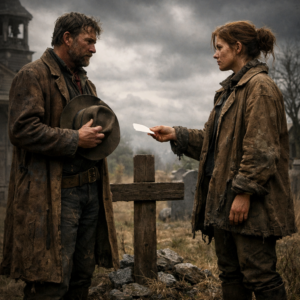
The churchyard in Harland’s Bluff was empty, just as it always was by Sunday afternoon. The townspeople had long since retreated to their homes, leaving the dead to their silence. Eli Callaway stood before a plain wooden marker, hat in his hands. He was not praying. He had stopped doing that in the spring when it became abundantly clear that nothing was listening. The marker bore only his wife’s name, Margaret, and the year. For eleven months, he had stood here, accepting her death because accepting it was easier than questioning the river that had supposedly taken her.
He was turning to leave when he heard the crunch of dry grass behind him.
A young woman stood just inside the gate. She wore an oversized, borrowed coat and boots caked in creek mud. She was not a face he recognized from the pews; she was someone who existed on the margins of the town, behind liveries and in alleyways.
“Mr. Callaway,” she said. Her voice held no nervous tremor, only the steady weight of someone who had decided to say a hard thing. “Your wife is still alive.”
The words struck the quiet churchyard like a physical blow. Eli froze. He looked at her, his jaw tightening. “That’s a serious thing to say.”
“I know it is,” she replied. “That’s why it took me this long to say it. I was sleeping in the drainage ditch east of Crow Creek the night of the storm. I saw what happened.”
“The body was never found,” Eli said, his voice dropping to a harsh whisper.
“Because there was no body,” the woman said plainly. “They pulled her out of the water. She was bleeding, but alive. Two men loaded her into a covered wagon. A third man, a man missing his right arm, gave the order to move.”
Eli stared at her. “And why should I believe that?”
The woman reached into her oversized coat and held out a small, torn piece of paper. Eli took it. It was a rough but precise pencil drawing of a woman’s wrist. On the wrist was a cuff-style bracelet with a very specific, distinct notch on the inner edge.
Eli went completely still. Margaret had caught that copper bracelet on a fence nail three summers ago. He had never mentioned the notch to anyone; it wasn’t in any sheriff’s report. It existed only in his memory.
“I drew it the morning after,” the woman explained. “I didn’t know what it meant then, but I knew it was specific enough to matter to someone. My name is Bess.”
Eli carefully folded the paper and slipped it into his pocket. Eleven months of forced grief shattered in an instant. “Come to my ranch tomorrow before sunrise,” he ordered. “Use the back door. Tell no one.”
The Geography of a Conspiracy
Before the sun broke the horizon the next morning, Bess sat at Eli’s kitchen table. In the harsh light of a single lamp, she detailed the night of the flood. The wagon belonged to the Harland & Voss land company. The one-armed man giving orders was Aldis Finn, a ruthless former militia captain who ran the company’s off-the-books security.
Eli’s blood ran cold. “Margaret was building a case before the flood,” he confessed, the horrible realization dawning on him. “She spent four months collecting testimony from settlers whose land Harland & Voss had stolen. She was going to bring it to the territorial judge.”
“They didn’t kill her,” Bess said softly. “They took her because she was carrying the documents. If she drowned, the proof was gone. If they kept her alive, they could find out who else knew.”
But Bess hadn’t just come with a story about the flood. From the lining of her coat, she produced a folded piece of oilskin. Inside was an official Harland & Voss document she had found in the mud near the creek—a “Medical Detainee Emergency Territorial Clause Authorization,” signed by Silas Greer, the company’s land agent. Below Greer’s signature was Margaret Callaway’s name.
And Bess had more. She produced a handwritten list of twelve names. For eight months, she had been quietly sorting files for the old clerk at the town assay office in exchange for a place to sleep. She had dug through thirty years of territorial filings and found a pattern: twelve people in active land disputes with Harland & Voss who had suddenly been transferred under the same “medical emergency” clause and vanished from the public record. Furthermore, Bess had overheard a company lawyer confirming that the specific emergency clause they were using to detain people had legally expired in 1881.
Harland & Voss wasn’t just hiding Margaret; they had been running an illegal prison camp for years.
“I need to go to Mercy Fork,” Eli said, his eyes hard. “Find the relay station. See what the telegraph wire records show. Finn has armed guards turning people away on the canyon road. They’ll be watching.”
The Wire Trail
Eli rode into town and cornered Ray Dugen, the telegraph operator who had sat at his desk for twenty-two years. Calling in an old, life-saving debt, Eli forced Ray to pull the private company logs.
Ray, trembling but finally breaking his silence, produced two hidden ledgers. He hadn’t just logged Margaret’s transfer the night of the flood; he had secretly logged seven illegal transfers over four years. “I was afraid, Callaway,” Ray admitted. “But I’m tired of telling myself things are not my business.”
Eli rode south to a remote way station run by a hardened woman named Ada. Ada confirmed she had seen a bruised, captive Margaret in a Harland & Voss wagon months ago. Eli instructed Ada to prepare to send a blind wire.
Back at the ranch, Eli and Bess drafted two separate telegraph messages. Sent alone, they looked like routine land inquiries. Sent together to Territorial Judge Orin Hail, they formed a desperate plea for federal intervention at the survey camp above Mercy Fork.
But as Eli prepared to send the wires, danger arrived at his doorstep.
At two in the morning, Captain Aldis Finn and four armed men breached Eli’s cabin. Finn handed Eli a fraudulent territorial notice demanding the surrender of all company documents. When Eli refused, Finn’s men beat him to the floor and tore the house apart.
They found nothing. Anticipating the raid, Eli had sent Bess away into the night with the documents sewn safely into her coat lining. Finn stared down at the bleeding Eli. “You can’t save a dead woman, Callaway,” he sneered, before leaving the wrecked kitchen.
The Judge’s Ledger
Judge Orin Hail arrived four days later, accompanied by federal deputies. A large, unhurried man who had spent decades listening to men lie, Hail commandeered the town’s telegraph office and convened a territorial court of record.
Eli and Bess laid out the evidence: the forged medical transfer, the telegraph ledgers, and Bess’s painstakingly researched list of the disappeared.
Silas Greer, arrogant and flanked by company lawyers, strolled into the makeshift courtroom, expecting to easily quash a local dispute. He was entirely unprepared for Judge Hail.
“The emergency territorial clause cited on this transfer document,” Judge Hail rumbled, his voice like grinding stone. “Counsel, what is the sunset date on that provision?”
Greer’s lawyers exchanged panicked glances. “The provision expired in 1881,” Hail answered his own question. “Every detention authorized under it since that date is not a protected medical transfer. It is unlawful imprisonment. Seven transfers over four years through a private wire with instructions to keep them off the public log is not an error, Mr. Greer. It is a system.”
Judge Hail slammed his ledger shut. “You are not under arrest at this moment, Mr. Greer. You will be within the hour.”
Hail immediately dispatched federal deputies to the survey camp above Mercy Fork with orders to dismantle the operation and rescue whoever was left inside.
The Return
They brought Margaret into town just after three in the afternoon.
Eli stood in the dusty road outside the telegraph office, his heart hammering against his ribs. The wagon approached slowly. When it stopped, Margaret climbed down without help. She was wrapped in a blanket, far thinner than he remembered, her face pale from eleven months without sunlight. The copper bracelet was gone, stolen by her captors. But as she looked around, her eyes held the same unbreakable steadiness he had always loved.
Eli crossed the distance and took her hand. They didn’t speak. There were no words large enough for the moment. He just held her, and she held him back, standing together in the afternoon light.
Margaret turned her head. Bess was standing at the edge of the road, holding herself in the margins, taking up as little space as possible.
“You’re the one,” Margaret said, her voice rough from disuse. “The men at the camp… they talked about a girl in Harland’s Bluff who kept asking questions and wouldn’t stop. I didn’t know your name, but I knew you were out there.” Margaret held Bess’s gaze. “Thank you.”
Bess nodded once. Her jaw was set, her expression caught somewhere between relief and the strange realization that the immense weight she had carried for eleven months was finally gone.
The Quiet Aftermath
In the weeks that followed, Silas Greer was taken north under federal escort to face trial. Captain Aldis Finn vanished into the vast, lawless territories, a ghost retreating into the shadows. Harland & Voss’s operation was shattered.
At the Callaway ranch, recovery was not a straight line. Margaret tired easily, navigating the physical and mental toll of her captivity. She and Eli moved around each other carefully, relearning the rhythms of a shared life. They sat together on the porch in the evenings, watching the plains darken, finding comfort in the simple, profound fact that they were both still there.
Bess remained at the ranch. No one had asked her to stay, but no one had asked her to leave, and soon her presence became an unspoken, vital part of the household. She repaired fences, organized the barn, and moved with a quiet utility that held the property together.
One morning, as Bess washed dishes, Margaret sat at the kitchen table holding a cup of coffee.
“What do you want, Bess?” Margaret asked suddenly. “Not what you need. What do you want?”
Bess dried her hands and turned around. It was the first time anyone had ever asked her that question. She thought about it with her usual careful precision. “To read better than I can,” Bess said finally. “I can read well enough to get through a territorial filing, but I want to read without working at it.”
Margaret nodded. “That is a completely reasonable thing to want.”
The next day, Margaret brought a book to the table. They sat across from each other, and Bess read aloud. Margaret gently corrected her stumbles, explaining words without judgment or ceremony. It was simply a thing that needed doing, so they did it.
That evening, Bess sat on the porch steps as the sun went down, casting a warm, golden light across the western plains. She had the book open in her lap, sounding out the harder words in a quiet murmur.
The town of Harland’s Bluff had not apologized to her. The world had not suddenly become a perfectly just place. But Bess had a room with a window that faced east. She had a porch to sit on, a book in her lap, and a woman inside who was willing to sit across a table from her and help her learn. She was not happy in a loud, dramatic way. She was settled.
She turned the page, the sound crisp in the quiet evening air, and kept reading.
Disclaimer : This content may be created by AI for entertainment purposes. Any resemblance to real persons, events, or places is coincidental.






