The Devil in the Crawl Space: The Unmasking of Pogo
The winter of 1978 didn’t just bring snow to Cook County; it brought a cold that seemed to seep directly into the marrow of your bones. I sat in my unmarked Plymouth Fury, the heater rattling unsuccessfully against the frozen December air, staring at 8213 West Summerdale Avenue.
It was a beautiful house. Brick facade, neat shutters, a jolly plastic Santa Claus waving from the front porch. It was the home of John Wayne Gacy: Democratic precinct captain, successful contractor, and a man known throughout the neighborhood for his charitable work as “Pogo the Clown.”
I had been a detective for fifteen years, but the last six had been a slow descent into a private hell. Since 1972, boys in the Chicago area had been vanishing. Not runaways—those kids eventually called home or turned up in a bus station. These boys simply evaporated. They were “shadow boys”—the ones from the wrong side of the tracks, the hitchhikers, the kids looking for quick construction work to help their mothers pay the rent.
I had encountered Gacy twice before. Once in ’74 and once in ’76. Both times, he had greeted me with a firm handshake and a wide, practiced smile. He smelled of Old Spice and expensive cigars. He invited me in for coffee, showed me pictures of himself shaking hands with the First Lady, and laughed off my questions with the booming confidence of a pillar of the community.
“Detective Thorne,” he’d say, leaning back in his recliner, “I’m a busy man. I hire dozens of boys for my construction crews. Some work a day and move on. You know how kids are today. No loyalty.”
I had walked away both times feeling like a fool. My captain told me to lay off. “Gacy is a big fish, Elias. He’s got friends in high places. Don’t go digging for dirt on a man who buys the Mayor’s lunch.”
But then came Robert Piest.
Robert was fifteen. He had a steady job at a pharmacy and a mother who adored him. On December 11, he told his mom he was going to talk to a contractor about a higher-paying summer job. He never came back. Unlike the “shadow boys” before him, Robert Piest was the kind of kid the papers cared about.
This was my third time at the house, and this time, the timeline was on my side. I had a search warrant signed by a judge who was tired of Gacy’s arrogance.
“Entry!” I barked.
My team swarmed the house. We moved through the living room, past the framed citations and the clown paintings—dozens of them, oil-on-canvas depictions of Pogo with exaggerated, painted-on grins and sad, dark eyes. The eyes in the paintings seemed to follow me, mocking the badge on my belt.
For hours, we found nothing. The house was spotless. Gacy stood in the kitchen, leaning against the counter, sipping a beer. He looked bored. “You’re wasting taxpayer money, Elias. When this is over, I’m calling your commissioner. You’ll be directing traffic in the South Side by Monday.”
“Keep digging,” I told my men, my voice rasping from the stale air.
I walked toward the hallway closet. There was a faint smell—something I had smelled in the morgue during the height of a humid Chicago July. It was sweet, cloying, and utterly unmistakable. It was the scent of rot.
“Sir?” It was Miller, a rookie with a pale face. He was pointing to the floor of the hallway. “The registers. The heat is off, but there’s a draft coming from the crawl space. And the smell… it’s coming from down there.”
I looked at Gacy. For the first time in six years, his mask slipped. The “jolly citizen” vanished, replaced by something cold, predatory, and ancient. His eyes weren’t laughing anymore. They were dead.
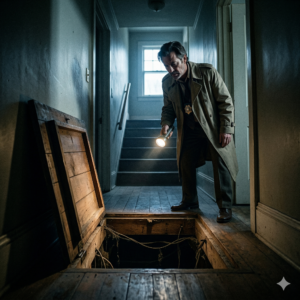
I grabbed a flashlight and a crowbar. I pried back the access hatch in the floor. The darkness below was absolute. I dropped into the crawl space, my boots sinking into soft, damp mud. The ceiling was barely three feet high. I had to crawl on my stomach, my flashlight cutting through the gloom.
I saw it first near the north foundation wall. A piece of bone, white and jagged, protruding from the dirt like a pale tooth. I brushed away the soil with my gloved hand. A skull. Then another. Then a rib cage.
I scrambled back, my lungs burning from the putrid air. I climbed out of the hatch, my suit covered in the filth of Gacy’s “private graveyard.”
“Cuff him,” I whispered.
Gacy didn’t resist. As Miller ratcheted the steel shut, Gacy leaned in close to my ear. He didn’t sound like a clown anymore. His voice was reedy, nasal, and filled with a terrifying pride.
“You only found the ones I grew tired of, Detective. The rest… the rest are part of the house now.”
The next two weeks were a blur of trauma. We brought in forensic anthropologists. We spent fourteen days in that crawl space, digging through the mud with hand trowels.
Twenty-nine.
We pulled twenty-nine bodies out of that hole. Boys who had been missing for years. Boys who had been gagged with their own underwear, their hands bound with the very “handcuff trick” Gacy used to perform at birthday parties. Four more were recovered from the Des Plaines River.
The media descended like vultures. The “Killer Clown” became the headline of every paper in the United States. The public was obsessed with the dichotomy—the man who kissed babies and gave to charity by day, and the monster who turned his home into a charnel house by night.
I was the one who sat across from him in the interrogation room. The air was thick with the smoke of his endless cigars. He confessed with a terrifying detachment, describing the murders as if he were recounting a construction project.
“The boys were the trash of the world, Elias,” he said, blowing a cloud of smoke into my face. “I was doing the city a favor. I was the master of my own universe in that house. Pogo brought the joy, but John… John took the tithe.”
He told me about the “magic trick.” He would show the boys a pair of handcuffs, telling them he could escape from anything. He’d put them on the boys, laugh, and then the lights would go out. He told me about the silence of the crawl space. He told me he enjoyed the smell of the rot because it reminded him of his power.
“You think you caught me,” Gacy smirked, his eyes behind his glasses reflecting the harsh fluorescent lights. “But I’ll be famous forever. Long after people forget the names of those boys, they’ll remember the clown.”
The trial was a circus, fitting for a man like him. Gacy tried to plead insanity, claiming he had multiple personalities, that “Pogo” was the one who did the killing. But the jury saw through the greasepaint. They saw the calculation. They saw the 4.2 billion empire of Apex—wait, no, they saw the PDM Contracting empire built on the blood of the innocent.
I stood in the courtroom when the verdict was read. Guilty on all thirty-three counts of murder. The death penalty.
I visited him once, years later, at the Menard Correctional Center. He had spent his time in prison painting. He sent his paintings to galleries across the country—portraits of himself as Pogo, portraits of the Seven Dwarfs, portraits of the very boys he had murdered. People actually bought them. It sickened me.
“You look old, Elias,” Gacy said from behind the glass. He was heavier now, his face bloated, but the arrogance remained untouched. “Still thinking about the crawl space?”
“Every night,” I said. “But I don’t think about you, John. I think about Robert Piest. I think about the thirty-two others. I think about the fact that the world is a little cleaner without your breath in it.”
Gacy laughed. It was the same booming, jolly laugh he used at the neighborhood barbecues. “The world is never clean, Detective. I’m just the one who stopped pretending it was.”
On May 10, 1994, I stood outside Stateville Correctional Center. A crowd had gathered. Some were cheering; some were holding candlelight vigils for the victims. At 12:58 a.m., John Wayne Gacy was executed by lethal injection.
His last words were reported as “Kiss my ass.”
He died as he lived: arrogant, unrepentant, and convinced of his own legend.
I went home that night and sat in my living room. For the first time in twenty-two years, I didn’t feel the weight of the “shadow boys” on my shoulders. But the diabolical legacy of the Killer Clown didn’t die with him. He had changed something in the American psyche. He had taken a symbol of childhood innocence—the clown—and stained it with the blood of thirty-three victims.
Today, decades later, people still look at clowns with a sense of deep-seated unease. They call it “coulrophobia,” a psychological fear. But I know the truth. It isn’t a phobia. It’s a memory.
It’s the memory of a house on Summerdale Avenue. It’s the memory of a draft coming from a crawl space. And it’s the memory of a man who realized that in the darkness under the floorboards, no one can hear you scream—not even over the sound of the circus music.
Epilogue: The Detective’s Warning
I retired shortly after Gacy’s execution. I moved away from Chicago, away from the humidity and the memories of the Des Plaines River. But I still keep a file in my desk. It’s not a file on Gacy; it’s a file on the signs we missed.
The US market for true crime has never been larger. People devour these stories like they’re entertainment, but they forget that the “Killer Clowns” of the world don’t live in the woods or in the sewers. They live next door. They head the PTA. They run successful businesses.
They are the people who seem too perfect, too friendly, and too “invested” in the community. John Wayne Gacy taught me that the most dangerous monsters don’t wear masks to hide their faces. They wear masks to show you exactly what you want to see.
So, if you ever find yourself in a beautiful house with a manicured lawn, and you feel a cold draft coming from the floorboards… don’t assume it’s just the wind. And if a man in greasepaint offers to show you a magic trick with a pair of handcuffs… run.
Because Pogo might be dead, but the darkness he left behind is still waiting for someone to open the hatch.
What do you think of that story? Did it capture the chilling contrast between Gacy’s public persona and his private atrocities? Let me know if you want to explore the psychological profile of the “organized serial killer” further.
Disclaimer : This content may be created by AI for entertainment purposes. Any resemblance to real persons, events, or places is coincidental.






