THE STORY: The Shaded Heart
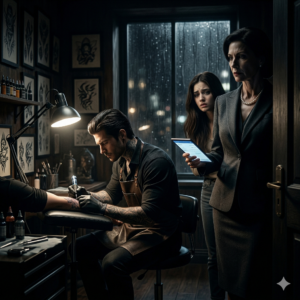
The tattoo machine hummed—a steady, hypnotic vibration that usually grounded Frank. But today, the air in the studio felt heavy, charged with the scent of rain and the expensive, suffocating perfume of a woman who shouldn’t be here.
“Make my son fall for you, and then crush him,” the woman said, her voice as cold as the diamonds on her throat.
Frank didn’t look up from the stencil he was prepping. He knew that voice. It was his mother, the matriarch of the White family—a dynasty built on high-frequency trading and the blood of anyone who got in their way. Three years ago, Frank had walked away from the “money machine,” trading a boardroom for a basement studio and a three-piece suit for ink-stained denim.
“Ten million is yours,” his mother continued, sliding a check onto the workstation.
Frank finally looked up. Not at his mother, but at the girl standing in the shadows behind her. Lucy Green. A waitress from the bar down the street. She looked pale, her eyes darting between the check and the man she had been serving coffee to for months.
“I don’t know,” Lucy whispered.
“Think of your parents, Lucy,” Mrs. White said, her smile sharp enough to draw blood. “Their bills at my nursing home are… mounting. You want them to have the best care, don’t you?”
Frank’s jaw tightened. He looked at Lucy, searching for a sign of the girl who always gave him an extra shot of espresso for free. Instead, he saw a desperate woman looking at a lifeline.
“I’ll do it,” Lucy said, her voice finally steady.
Frank turned back to his machine. “Come back in a few days, Lucy. I’ll finish your shading then.”
The next month was a masterpiece of manipulation. Lucy became Frank’s assistant at the shop. She ran the front desk, handled the clients, and sat for hours watching him work. She was “bold,” as Frank put it—always too close, her breath tickling his neck as she watched him ink intricate dragons and delicate lilies.
“You’re a bold client,” Frank murmured one evening, his needle hovering over her left shoulder. He was tattooing a koi fish—a symbol of strength and perseverance. “Your hair was just out of place.”
“I expected a better excuse from you,” Lucy teased, her eyes shining with a heat that felt too real to be part of the job.
But the secrets were corrosive. Frank carried the ghost of a car accident that had claimed his father and brother, leaving him with a right hand that trembled if he pushed it too hard. Lucy carried the weight of her parents’ lives, tucked away in a facility owned by the very woman paying her to destroy Frank.
The tension broke on a night when the rain turned the city into a watercolor blur. Lucy had arrived at the shop soaked to the bone, her heart beating like a trapped bird.
“Why did you leave the Whites if you were already the heir?” she asked, wrapped in one of Frank’s oversized shirts in the back of the studio.
“Because the White family doesn’t love,” Frank said, his eyes dark. “They own. They needed a puppet, not a son. I’m good out here. I have my ink. I have my silence.”
“And what about me?” Lucy asked, stepping into his space. “Am I just a colleague?”
Frank didn’t answer with words. He kissed her—a raw, desperate act that tasted of salt and rain. It was the moment the “deal” should have been sealed. She had won. He was falling.
But Lucy didn’t call Mrs. White that night. Instead, she sat in the dark, watching Frank sleep, her fingers tracing the “Frank” stencil she had secretly made for her own skin.
The crisis arrived in the form of a foreclosure notice taped to Lucy’s grandmother’s door. Mrs. White was done waiting.
“The deal is over, Lucy,” Mrs. White said, cornering her at the nursing home. “Frank still hasn’t returned to the company. You’ve failed to ‘crush’ him. In fact, it looks like you’re actually falling for him.”
“I won’t do it,” Lucy snapped. “I won’t break him.”
“Then watch your parents die in the street,” Mrs. White replied.
Lucy fled. She tried to end things with Frank the only way she knew how—by being the monster his mother wanted her to be.
“I never loved you,” Lucy lied, her voice shaking as she stood in the middle of his studio. “I only wanted the money. Ten million dollars, Frank. That’s what you’re worth to me.”
Frank stood motionless. For a second, his right hand began to tremor violently. “I knew,” he whispered. “I knew the moment I saw you with my mother that day.”
“Then why?”
“Because for a month, I got to pretend someone cared about the man, not the heir.”
Lucy turned and ran toward the airport, intending to vanish to Orlando, to get as far away from the White machine as possible. But Frank White was not a man who let go.
When Mrs. White locked him in his childhood bedroom to prevent him from following her, Frank didn’t wait for the guards. He took a “leap of faith,” literally jumping from the second-story window, his leg snapping as he hit the pavement. He crawled to his car, his vision blurring from the pain.
A week later, the studio was quiet. Lucy was there, not as an assistant, but as an intruder. She had come to leave the key when the door opened.
Frank was there, leaning heavily on a crutch, his leg in a cast, his right hand bandaged.
“You’re incredibly stupid and reckless,” Lucy sobbed, seeing the state of him.
“You care, don’t you?” Frank smiled, a tired, genuine look. “Tell me… if I ever see that girl again, do I still have a chance?”
“She lied to you, Frank.”
“Exactly. She needs to make it right. Be good. Make me happy, and then I’ll forgive her.”
He sat in his tattooing chair, gesturing to his arm. “Remove it.”
He pointed to a tattoo of her name she hadn’t known he’d gotten.
“I can’t remove it, Frank,” she whispered, her hands trembling as she took the needle. “I’m a food blogger. I only know how to hold a kitchen knife.”
“Then hold this,” he said, guiding her hand to his. “Give your hand a break. I know about the pins, Frank. I’ve always known.”
He looked at her—the girl who was supposed to crush him, and the girl who had saved him.
“Now I’m never letting you go,” he whispered.
The tattoo machine began to hum again, but this time, they weren’t marking skin. They were marking a future that no amount of money could ever buy back.
Disclaimer : This content may be created by AI for entertainment purposes. Any resemblance to real persons, events, or places is coincidental.






