The Wrong Car
I just needed sleep.
When I left my psychology classes, my eyes burned so badly I could barely keep my eyelids open. The neuropsychology books in my backpack weighed like bricks, and my feet were bleeding inside my old sneakers. Eight hours of serving coffee and sandwiches to grumpy people, followed by four hours of intense lectures on human behavior, was not the recipe for a peaceful existence.
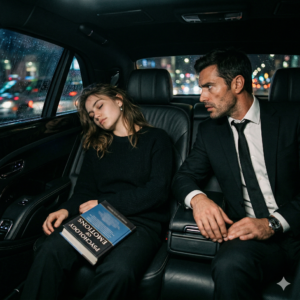
I saw the black car parked exactly where the rideshare app indicated. It was an elegant sedan with dark windows, reflecting the city lights. The driver was wearing a suit, which seemed strange for a second, but I was too exhausted to question anything that wasn’t the distance between me and my bed. I opened the back door and threw myself onto the soft leather seat with a sigh of relief that came from the depths of my soul.
The interior smelled of expensive wood and a masculine, spicy cologne—definitely not the cheap air freshener of a standard Uber.
“Hi, thanks for waiting,” I mumbled, my eyes already closing.
The driver didn’t answer, and I didn’t care. I rested my head against the seat and let the world slip away. I didn’t know it then, but I had just stepped into the wrong car.
Somewhere in the fog of my unconsciousness, another man entered the back seat. Rocco Marchetti, the boss of New York’s most feared mafia family, had expected to find business reports waiting for him. Instead, he found me: a chaotic, exhausted student sleeping soundly in his luxury vehicle.
“She got into the wrong car,” his deep voice murmured.
“I thought she was someone you arranged, sir,” Ivan, the driver, stammered.
Rocco could have thrown me out into the cold night. Instead, he looked at my peaceful, trusting face, felt a crack in the ice that had encased his heart for years, and gave a simple order: “Home, Ivan. Take her, too.”
The Awakening
The first thing I registered was a gentle, rhythmic sway. I was suspended in the air, held firmly by strong arms. I managed to open my eyes just a sliver, catching the glare of an immense, glittering crystal chandelier. I felt a broad chest beneath my cheek, rising and falling with controlled breathing. The scent of wood and spice was overpowering now.
Panic exploded in my chest like a firework.
“Put me down!” I screamed, thrashing in his arms. My fists pounded against his chest like I was hitting a concrete wall. “Who the hell do you think you are?”
“Stop moving before I drop you,” a deep voice ordered, laced with an irritating note of amusement. He finally set me down on a cold marble floor.
My knees buckled, but I scrambled backward to get a good look at my kidnapper. My brain simply short-circuited. He was at least six inches taller than me, his broad shoulders perfectly filling a custom-made dark suit. His hair was impeccably cut, and his eyes were so dark they looked black. They observed me with a predatory, controlled intensity. He was, objectively speaking, the most handsome man I had ever seen.
“Who are you? Where am I?” I demanded, crossing my arms.
“You’re in my home,” he answered, a faint Italian accent softening his words. “You got into my car by mistake and fell asleep immediately. I didn’t think it was safe to leave you on the street.”
His logic was frustratingly solid. Before I could interrogate him further, my stomach let out a thunderous, embarrassing growl that echoed through the palatial foyer.
His lips curved into a genuine smile. “Let’s do this. My housekeeper cooks very well. Eat something, and then I’ll have my driver take you wherever you want to go. No tricks.”
Every self-preservation instinct screamed at me to run. But my curiosity—the very trait that drove me to study psychology—won. I wanted to understand the dissonance between this imposing, dangerous-looking man and the gentle amusement in his eyes.
“Okay,” I said. “But only because I’m starving.”
Layers of Control
The dining table was absurdly long, illuminated by more crystal chandeliers. He pulled out a chair for me, sitting directly beside me rather than at the head of the table. A warm, maternal housekeeper named Senora Maria brought out plates of fresh, steaming pasta. The shock on her face when she saw me sitting next to her boss was palpable.
“I’m Aurora Valet,” I introduced myself.
“Rocco,” he said, the name rolling off his tongue.
The food was a work of art, but the conversation was the true feast. He was completely present, his phone nowhere in sight. He asked about my studies, my double shifts, and my dreams. He listened as if my words were the most important things in the world.
“You avoid eye contact when you talk about family,” I noted at one point, my psychological training kicking in. “You look away, you get tense. It suggests unresolved conflict or trauma, which you compensate for with excessive control in other areas of your life.”
He froze, his fork halfway to his mouth. Then, pure admiration lit up his features. “You really pay attention to everything, don’t you? You’re reading my soul, Aurora.”
We talked for hours. He told me about his mother, who had died of cancer when he was nineteen. He told me she had taught him how to cook, believing food was a way to express love when words failed. The vulnerability in his voice was raw and real.
When Ivan finally drove me home, Rocco stood on the sidewalk, his hands in his pockets, looking uncharacteristically shy. “Can I see you tomorrow?” he asked, his voice low.
“Yes,” I whispered.
The Shattering of the Illusion
The next two weeks were a blur of pure, intoxicating happiness. There were morning coffees, afternoon walks through the park where we debated philosophy, and private movie screenings. I was falling hopelessly in love, ignoring every red flag because the man in front of me was so gentle, so attentive.
Then, on a Tuesday, my world stopped spinning.
Professor Esposito, my forensic psychology professor and a former FBI consultant, pulled me into his office. He placed a manila folder on the desk. Inside were surveillance photos and newspaper clippings.
“Do you know who he is, Aurora?” Professor Esposito asked gently. “Rocco Marchetti is the Don of the Marchetti Familia. He’s the head of the Italian mafia in New York. He controls trafficking, illegal gambling, and extortion.”
I stared at the grainy photos of Rocco leaving a courthouse. Murder charges. Money laundering. Acquittals due to “lack of evidence.” The man who had tucked a stray hair behind my ear with trembling fingers was a ruthless criminal with blood on his hands.
I left the campus in a state of shock. When Rocco called, I demanded he meet me at his mansion. I wanted the truth.
I stood in his grand foyer, tears streaming down my face. “Do you kill people, Rocco? Tell me.”
The silence that followed was a confession in itself. He looked at me with deep pain and guilt. “I killed for the first time when I was seventeen,” he admitted, his voice breaking. “It was a test from my father. I didn’t know another path. But Aurora, my feelings for you… the man I am with you, that is who I really am.”
“I don’t know you,” I sobbed, backing toward the door. “I can’t be with someone who does what you do.”
I saw the brutal struggle on his face—the desire to command me to stay versus the love that demanded he let me go. “If that’s what you want,” he whispered, his voice shattered. “I will always respect your decisions.”
I ran, leaving my heart shattered on his marble floor.
The Mind of a Manipulator
For days, I existed as a ghost in my own apartment. My roommate, Bianca, tried to comfort me, but nothing could dull the ache.
Then, a knock on the door brought a blonde, impeccably dressed woman into our lives. Georgia De Beradino, a “friend” of the Marchetti family, sat in our cheap kitchen chairs and smiled a cruel, icy smile.
“Rocco has been different since you broke up,” she said smoothly. “I’ve known him for years. He’s a monster, Aurora. He has no conscience. You were just a distraction, another diversion. He’s already dating other people.”
She left a trail of toxic doubts in her wake. I spent the night agonizing over her words. But at 4:00 AM, my psychological training pierced through the grief. I pulled out my notebook and began to analyze.
Georgia’s motive: If Rocco had truly moved on, why would she go out of her way to ensure I stayed away? She wasn’t warning me; she was eliminating the competition.
I looked at the facts. Rocco’s vulnerability when he spoke of his mother wasn’t a manipulation tactic. His shyness wasn’t an act. People are not binary; they are layered contexts of their environment. He had been conditioned for violence, but that didn’t negate his capacity for genuine love.
I needed the truth directly from the source.
The Promise in the Dark
Before I could reach out to Rocco, the danger of his world found me. Leaving the campus library late one night, three men cornered me in the empty parking lot.
“You should have stayed away from Rocco Marchetti,” the leader sneered, grabbing me.
I pulled my pepper spray, screaming, but they were too strong. Suddenly, the roar of an engine shattered the night. Tires screeched, and a car door flew open.
Rocco moved like a storm. He was brutal, fast, and completely terrifying. He threw the first man against a hood and broke the second man’s wrist with a sickening crack. In thirty seconds, the attackers were groaning on the asphalt.
Rocco rushed to me, his hands frantically checking my face. “Are you hurt? Talk to me, Aurora.”
“How did you know?” I gasped.
“I kept protection on you since we broke up,” he confessed, guilt flashing in his eyes. “I never stopped protecting you.”
He hauled one of the bleeding men off the ground by his collar. The cold, ruthless Don emerged. “Who sent you?”
“Georgia,” the man stammered. “Paid us to scare the girl.”
Rocco’s jaw clenched. He dropped the man, pulled out his phone, and ordered his driver to find Georgia and arrange a “cleanup crew” for the parking lot. He turned back to me, the violent Don warring with the gentle man who loved me.
He took me back to his mansion to keep me safe. Later that night, I walked into his office just in time to see Georgia trembling before him. He was threatening to make her disappear.
“Don’t kill her, Rocco,” I intervened, stepping between them. “Not for me. I can’t carry the weight of adding another name to your list.”
Rocco stared at me, the tension slowly bleeding from his shoulders. He banished Georgia from New York forever. Once we were alone, he pulled me into his arms, burying his face in my hair.
“I can handle who you were,” I told him, looking deep into his dark eyes. “But I need total transparency. No secrets. And I need to know that you’re going to try to get out of this life.”
“For you,” he swore, “I will find another way. I will change everything.”
The Right Destiny
Two years later, I looked at the brass plaque on my office door: Aurora Valet-Marchetti, Family and Couples Therapy. I had set up my practice in a renovated wing of our mansion, keeping a strict boundary between my work and his.
Rocco had kept his promise. Over the past two years, he had slowly and methodically transferred the violent operations of the family to others, focusing entirely on legitimate businesses. It was a long, complex process, but he fought for it every single day.
“Still analyzing?” his deep, husky voice echoed from the doorway. He was wearing jeans and a simple shirt, leaning against the frame with that devastating smile.
“Always,” I replied, walking into his arms. “You’re my lifelong case study.”
Suddenly, Senora Maria appeared in the hallway, holding the hand of a terrified four-year-old girl clutching a teddy bear.
“She was lost near the gates,” Maria explained gently. “She says she got into the wrong car and ended up here by mistake.”
Rocco and I exchanged a look of pure astonishment and humor. The wrong car. I knelt down to comfort the little girl, assuring her we would find her parents. Rocco watched the scene with a profound tenderness in his eyes.
Later, as the sun set over the Chicago skyline, we stood on the terrace of our home. Rocco wrapped his arms around my waist, resting his chin on my shoulder.
“Sometimes,” he murmured, kissing my temple, “getting into the wrong car takes you exactly where you’re supposed to be.”
There is a cruel and beautiful irony in the concept of mistakes. My exhaustion, a mix-up of license plates, a black sedan—it was a simple accident. But love isn’t about finding the perfect person. It’s about finding an imperfect person and choosing to see their darkness alongside their light. It’s about believing that no one is beyond redemption if there is someone willing to believe in their capacity for change.
I got into the wrong car, and it drove me straight to my destiny.
Disclaimer : This content may be created by AI for entertainment purposes. Any resemblance to real persons, events, or places is coincidental.






