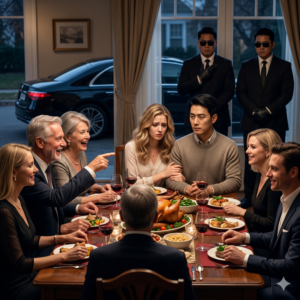
Imagine being humiliated in front of the entire world while your enemies laugh, thinking you’re powerless, not knowing your quiet husband sitting beside you is one of the most dangerous mafia bosses alive. And they’re about to find out the truth the hard way. There is a world that exists beneath the one most people see.
It has no official maps, no legal addresses, no names printed in newspapers. It runs on loyalty and fear, on silence and violence, on the kind of power that governments quietly acknowledge but can never touch. In that world, the name Chi-won was spoken carefully. If it was spoken at all. He was 34 years old, and by most measures of that hidden world, he was the king. Not a loud king.
Chi-won moved through rooms and people moved out of his way without fully understanding why. He made decisions that affected thousands of people across three continents, and not one of those people ever saw his face. He had built something strong and terrifying, and he had done it with patience, intelligence, and a coldness that he had decided to wear like a second skin.
He had learned it from necessity, from loss, from the years when he was young and vulnerable. The world he grew up on had shown him, repeatedly and without apology, that softness was a liability and fear was a weakness. So, he had buried his softness. He kept it somewhere deep and locked, and he told himself it was gone.
He was wrong about that. It took a woman named Mila Parker to prove it to him. The night that changed everything began with blood. Not his blood, not directly. But the bullet that was meant for him came close enough that Chi-won felt the heat of it pass through the air beside his face. He stood very still in the aftermath, the chaos of his bodyguards erupting around him, and he thought with perfect clarity, “Someone inside my circle tried to kill me tonight.
” That thought was more chilling than the bullet itself. He could survive an enemy. He had survived many enemies. But a betrayal from someone who sat at his table, who ate his food, who called him by name, that required a different kind of response. That required him to disappear. Within 48 hours, Chi-won was dead.
Not literally. But in every way that mattered to the world that knew him, the great and feared Chi-won had vanished. The rumors spread through the underground were carefully planted. An ambush, a body never recovered, a power vacuum opening like a wound. His enemies would celebrate. His allies would panic. And in the confusion, the real Chi-won, very much alive, is somewhere else entirely, watching, listening, hunting the traitor from the shadows.
He chose a city far from his empire, a place where his face was not known. He rented a small apartment with thin walls and a radiator that clanged through the night. He wore ordinary clothes. He drove an ordinary car. He bought groceries at an ordinary market and nodded at neighbors who never gave him a second look.
For a man who had spent a decade commanding rooms, the invisibility was strange. Sometimes it felt like peace. Sometimes it felt like suffocation. He spent his days doing what he did best, gathering intelligence, following threads, identifying the people who had wanted him dead, and one by one, quietly ensuring that they would never try again.
That was when he found her, or rather, that was when she came running P. Mila Parker had spent her whole life being underestimated. Brilliant, quietly fierce, she had spent a decade running her father’s company while he took the credit, and his new wife and stepdaughter took everything else. When her father tried to sell her into an arranged marriage to seal a business deal, Mila walked out the front door with one bag and didn’t look back.
The men her father sent found her 20 minutes later. She ran through rain-soaked streets, turned into a dead-end pathway, and felt the walls close in until a hand reached from a dark doorway and pulled her inside. “Stay still. They’ll pass.” She stayed still. The men moved on, and when she turned to look at the man who had saved her, she found dark, watchful eyes and an expression she couldn’t name.
Not threatening, not quite kind, simply steady. Like a man who has seen far worse than this and is not afraid of this. His name was Chi-won. He walked her four blocks through the rain, said almost nothing, gave her his jacket without being asked, and disappeared back into the night. She stood at the hotel entrance watching him go and thought, “I don’t know anything about that man.
” It felt comforting and pleasant like warmth. They found each other again, then again, then they stopped pretending it was coincidence. He listened the way no one in her life ever had, completely, unhurriedly, as if her words mattered more than whatever came next. She knew that he was controlled, that he chose every word with a care that most people never bothered with.
She knew that he noticed things, small things. The way she rubbed her left wrist when she was stressed. The coffee she preferred. The books she reached for when she was happy versus when she was sad. She knew that she was falling in love with him, and she filed that under interesting because she didn’t know what to do with it, and she had enough problems already.
She talked. He asked precise, intelligent questions. He offered almost nothing about himself, and she filed that under interesting as well without pushing. Their bond grew intense, and both could not hide it anymore. They married in the second year. A small ceremony, almost no guests. She didn’t want the display anymore.
She wanted what she got, a man who looked at her like she was the most remarkable thing in an otherwise comprehensible world. She didn’t know what she was marrying into. She knew only what was in front of her. What was in front of her was, by any measure, a good man. A quiet man who cooked and listened and never forgot anything she said.
Their daughter came in the third year. They named her Mercy because Mila said the world needed more of it. Chi-won held her in the evenings and told her stories in Korean and taught her, very early, the word for brave. He said it was the most important word. He said it the way a man says something he believes with his whole self.
Yet outside their home, Mila’s family continued their cruelty. Her father’s scorn, her stepmother’s manipulation, her sister’s venomous envy. They were relentless. They saw only her as weak, unworthy. They tortured her in different ways, especially the father. He once said he hates her and that he never loved her mother.
Both her and her mom irritated him. And she’s incapable of holding the power she had inherited in her own right. Through it all, Chi-won remained a shadow of protection. Every insult, every slight was met with invisible countermeasures. He eliminated threats quietly, efficiently, leaving Mila unaware of the danger that had been extinguished before it could touch her.
And yet, he never revealed himself, not his wealth, not his power, not the dangerous world he had walked away from. To her, he was the kind man who loved her, who saved her once in a stormy night and had never let go. The ultimatum came on a Tuesday in her father’s corner office. Gerald Parker told Mila the company was collapsing.
“Find new international suppliers in 3 days,” he said, “and controlling equity is yours. Fail, and you leave with nothing.” He said it pleasantly. The way you say something to someone whose failure you’ve already decided is inevitable. Because he has believed Mila to fail. It was a wild plan between him and his new wife, including the stepdaughter, to ruined Mila and finally kick her out of the company for good.
Mila worked through every night. Called every contact, hit every wall. By the second evening, every legitimate avenue was closed. She tried so hard because that company possession was all she had left to sustain her life. Chi-won watched her quietly, made tea, sat with her at midnight. He didn’t say you’ll be fine.
He never said things he wasn’t certain were true. She looked up and said, “I’m going to the press conference tomorrow, whatever happens. I know it’s over for me, and you’ve been a great husband and a good father to our daughter. If everything is taken from me tomorrow, I’ll have to start from nothing. It’s going to be hard, but I believe it will be better.
” Tears dropped from her eyes. He looked at her for a long moment. “I know,” he said. There was something in the way he said it, not quite certainty, but something very close that she didn’t have the energy to examine. The room was staged to watch her fall. Her father sat in the front row. Her stepmother glittered with quiet satisfaction.
Board members whose loyalties lay elsewhere waited with barely concealed pleasure. Mila stood at the podium straight-backed and answered every question. But she could feel the room pulling toward the story it had already decided to tell Mila Parker who overreached and failed. Mila had no new international suppliers.
But the believable happened. When they back doors opened, three men walked in. They were not young, and they were not small, and the rooms rearranged themselves around them the way rooms do around people who are accustomed to being obeyed. They carried documents, real documents, the kind with legal headers and many zeros.
One by one, they introduced themselves, names attached to companies at the very top of their industries, companies whose partnerships other businesses spent years pursuing. They announced, collectively and without drama, that they were partnering with Parker International on behalf of Mila Parker. They want to work with her.
The contracts were worth billions, structured across 5 years, effective immediately. The room went very quiet. Mila had not called these men. She had no idea who had. But they were here, the contracts were real, and the room’s expression was slowly, visibly transforming. Then Gerald Parker was shocked, but he had a plan B which he never knew he just step himself into fire.
Stood up and smiled his pleasant smile, the one with the blade in it. He said, “I’ve sold the controlling equity of Parker International to the Reston family.” And then turned to Mila. “Whether you win it doesn’t matter. You still have nothing.” Same family whose son Mila had refused to marry. “The arrangement,” he explained smoothly, “included a personal alignment between the two families.
” He had never stopped pursuing the marriage. He had simply waited until she had no leverage and manufactured the moment, and she had walked right into it. The Reston representative stood up. Smooth-voiced, practiced. He began speaking about the future using Mila’s name in a way that felt like possession. Then his eyes landed on Mercy, who was sitting quietly at the side of the room.
He made a comment, polished, surface-level pleasant, deeply cutting, about mixed family complications, about divided loyalties. He didn’t say anything directly cruel. He didn’t have to. Several people laughed. Finally, he said, “If Mila Parker should divorce the worthless husband and marry the heir of Reston International, she wouldn’t have to lose everything.
” And one last thing, put Mercy in an orphanage. Chiwon, who also attended the press conference, stood up aggressively and told the Reston representative that one more word from him, he will have to live the rest of his life without a tongue. The room went still, and then Chiwon turned to Mila’s family. “You all think you can humiliate and ruin her.
I’m going to make you all pay for your crimes toward my wife.” Whispers scatter across the room, guests whispering. Mila opened her mouth. She did not get to speak because she didn’t know what to say. She was shocked by the boldness of her quiet, ordinary husband challenging a room full of sharks. When I say sharks, I mean billionaires.
What she never knew was that the ordinary husband was more than all sharks put together. Then the main door opened. An old man and few bodyguards walked through them. Korean, neatly dressed, moving with the unhurried authority of someone for whom age has stripped away every concern except the essential ones.
He did not pause. He did not hurry. He walked directly to the side of the room, crouched down in front of Mercy, and looked at her seriously. “Are you all right, little one?” She nodded. He nodded back. Then he stood, turned to face the room, and looked at the Reston representative with an expression of controlled fury that was infinitely more alarming than shouting.
“You will stop speaking about this child. You will stop speaking about her mother. And you will leave this room.” The representative blinked. “Do you know who I am?” “Yes,” said the old man. “The more relevant question is whether you know who I am.” He paused. “I am Chairman Kang, chairman of Kang Holdings, interests in 43 countries.
” He let that land. Then, “And that little girl you just made the subject of a very unwise joke is my granddaughter.” The room stopped breathing. Chairman Kang. The name hit differently depending on how much people knew. But even those who knew little understood it by reading the faces of those who knew more. Journalists were already typing.
The Reston representative had gone the color of old paper. Gerald Parker gripped the back of a chair and said nothing. Chairman Kang turned and looked at Mila. His expression was complex, apology and pride and something that looked, underneath everything, like deep affection. “I am sorry,” he said quietly, “that this is how we meet.
” And finally, he said, “Your husband Chiwon is my son.” The room went very quiet and Gerald Parker trembled more. Chairman Kang ordered every investor on Reston International should withdraw all assets. He retrieved back the Parker International and gave to Mila including all equity. Her father, Gerald Parker, stepmother, and step-sister were left with nothing.
They all faced the fate they all planted for Mila. Chiwon came home that evening and told her everything. The empire, the assassination attempt, the disappearance, the year of living as someone ordinary in a city where no one knew his name, and the night she came running through an alley, how something in the way she carried herself through fear and danger had reached past every wall he’d spent years building.
He told her about the suppliers, that he had called them not to deceive her, but because he had watched her work herself to exhaustion over something she deserved to win, and he was in a position to make the winning possible. When he finished, the kitchen was quiet for a long time. “Why didn’t you tell me?” she asked.
He considered it the way he always considered questions. “Because I was afraid,” he said, “of what you might become to me if you knew what I was.” She understood then, the controlled, watchful man she had thought was simply reserved had been, in fact, just as frightened as she was. Not of the same things, but frightened of being known, of being wanted as exactly who he was.
She thought about every quiet thing he had ever done. The jacket in the rain, the midnight tea, the way he held their daughter like she was the most important thing that had ever existed. The way he had sat at her father’s table and absorbed contempt without flinching, not because he was powerless, but because protecting her mattered more than making them understand their mistake.
She stood, walked around the table, took his face in her hands. “You are the most complicated, infuriating, impossible person I have ever loved,” she said. He closed his eyes. “I know,” he said. “Tell me everything,” she said, “from the beginning.” He looked at her, and the expression on his face was one she had never seen before.
Not because it was new, because he had never let her see it. It was peace. The specific peace of a man who has been seen completely by someone who chose to stay. Mercy was laughing loudly, fully, with the abandon of a child who has never been given any reason to make herself small. Neither of them moved to quiet it.
Disclaimer : This content may be created by AI for entertainment purposes. Any resemblance to real persons, events, or places is coincidental.






