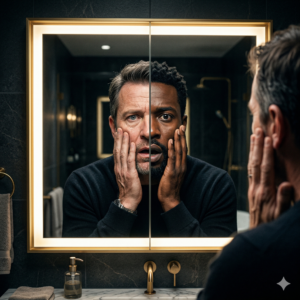
Arthur Pendelton had always navigated the world with the frictionless ease that accompanied his existence. As a twenty-eight-year-old junior vice president at a prestigious advertising firm in Chicago, doors opened for him before he even had to reach for the handle. He was ambitious, educated, and accustomed to a society that looked at his pale skin, sandy-blonde hair, and tailored suits with an inherent baseline of respect and presumed competence. He lived in a bubble of privilege so complete that he didn’t even know the bubble existed.
Until a crisp Tuesday morning in November shattered his reality completely.
Arthur woke up to the shrill sound of his alarm, threw off his heavy duvet, and padded into his en-suite bathroom. He flicked on the harsh fluorescent vanity lights, rubbed the sleep from his eyes, and looked into the mirror.
He froze. His breath hitched in his throat, and a cold, paralyzing shock washed over his entire body.
The man staring back at him was not the Arthur Pendelton he had known for twenty-eight years. The face in the mirror belonged to a Black man. His skin was a deep, rich shade of brown, his hair tightly coiled, his features entirely rearranged into a handsome but completely unfamiliar landscape. He touched his cheeks, his nose, his jawline. The reflection mimicked every frantic, terrified movement perfectly. This wasn’t a mask. It wasn’t a dream. Somehow, defying every known law of biology, logic, and physics, Arthur had woken up in a completely different body. His mind, his memories, and his consciousness remained entirely his own, but his physical vessel had transformed.
Panic set in. He spent three hours locked in his bathroom, scrubbing his skin until it was raw, researching bizarre medical anomalies, and staring at his dark hands in absolute disbelief. Eventually, realizing the transformation was absolute, he had no choice but to put on his custom-made suit and step out into a world he thought he knew.
The friction began before he even reached his office building.
Walking down his affluent street in Lincoln Park, a neighborhood he had lived in comfortably for three years, he noticed a woman crossing to the other side of the road as he approached. She pulled her purse tighter against her chest, her eyes darting away. Arthur stopped in his tracks, a hollow ache forming in his stomach. He was wearing a three-thousand-dollar suit, holding the same briefcase he carried yesterday, yet to her, he was a sudden threat.
At the corporate high-rise, the security guard—a man Arthur had exchanged friendly morning banter with every day for years—stepped abruptly in front of the turnstile.
“ID, please,” the guard demanded, his tone clipped, his hand resting uncomfortably close to his radio.
Arthur held up his badge. The guard squinted at the photo of the white Arthur, then looked back at him with narrowed, suspicious eyes. It took a frantic call to human resources and forty humiliating minutes of explaining to his bewildered boss that he was, indeed, Arthur Pendelton, suffering from an “unexplained, overnight dermatological anomaly,” just to be allowed to sit at his own desk.
Work rapidly became a daily battlefield. Before, Arthur’s confident pitches in boardrooms were praised as “assertive,” “visionary,” and “bold.” Now, when he spoke with the exact same passion and volume, his colleagues visibly stiffened. His boss pulled him aside after a meeting to warn him about coming across as “too aggressive” and “intimidating” to the clients. His ideas were routinely talked over, only to be repeated minutes later by white colleagues who were immediately praised for their brilliance. The benefit of the doubt, a luxury he had enjoyed his entire life, had vanished overnight.
Arthur began to experience the bitter, exhausting reality of being a Black man in America. He felt the heavy, invisible tax of systemic racism: the sudden spike of anxiety when a police cruiser trailed behind his car, the hyper-vigilance required when browsing a high-end department store while security guards shadowed his every move, and the sheer, soul-crushing exhaustion of having to constantly prove his intellect, his worth, and his innocence.
Yet, within this painful transition, Arthur also found unexpected warmth. He discovered profound advantages and beauties in his new identity that his previous life of privilege had blinded him to. He discovered the subtle, unspoken solidarity among Black people. The passing nod on the street from a stranger—a silent acknowledgment that said, I see you, I understand the struggle, and you are not alone. He found himself welcomed into a cultural vibrancy that offered a profound, resilient joy. He gained a newfound depth of empathy, entirely shedding the superficial ignorance he once held. He realized that the culture he had previously only consumed from afar was built on incredible strength, deep familial bonds, and a history of overcoming impossible odds. Looking in the mirror months later, he learned to love his new skin, recognizing its profound beauty and the rich legacy it represented, refusing to let society’s broken lens make it a burden. He was a better, deeper, more compassionate man now than he had ever been.
Six months into his new life, Arthur met Chloe.
It was a rainy Sunday afternoon in an independent bookstore in Wicker Park. Arthur was reaching for a rare edition of James Baldwin’s essays at the exact moment another hand reached for it. He looked down and met the bright green eyes of a woman with auburn curls and a warm, radiant smile.
“You can have it,” Chloe laughed, pulling her hand back. “I’ve already read it twice. I was just going to buy it to give to a friend.”
Arthur smiled back, his heart doing a sudden, unexpected leap. “If it’s that good, maybe you should let me buy you a coffee, and you can tell me all about it.”
Chloe was a pediatric nurse, bright, fiercely intelligent, and completely open-hearted. She was white, but unlike many of the people Arthur navigated daily, she didn’t look at him through a filter of stereotypes. She listened to him. She saw his humor, his intellect, and the deep, empathetic soul he had developed. She knew the bizarre story of his transformation—he had chosen to be honest with her from the beginning—and rather than running away, she held his hands and told him she loved the man he was today, regardless of how he got there.
They fell in love with a rapid, undeniable certainty. For a year, they built a beautiful, insulated world together. But eventually, the bubble had to pop. It was time for Arthur to meet her father.
Richard Harrington was a wealthy, old-money real estate developer who lived in a sprawling, gated estate in the affluent northern suburbs. He was a man of rigid traditions, deeply entrenched in conservative circles, and harbored deep-seated, quietly vicious racial prejudices.
The introductory dinner at the Harrington estate was an exercise in psychological endurance. From the moment Richard opened the oak front door and laid eyes on Arthur, the temperature in the room plummeted. Richard’s handshake was brief and cold. Throughout dinner, Richard weaponized his politeness, delivering a barrage of microaggressions disguised as curiosity.
“So, Arthur,” Richard said, swirling his expensive red wine. “Chloe tells me you’re a VP at an ad agency. That’s quite a leap. Did you utilize one of those diversity placement programs to get your foot in the door?”
Arthur felt Chloe tense beside him, her hand gripping his under the table. Arthur maintained his composure, his voice perfectly level. “No, sir. I worked my way up from an internship, consistently holding the highest billing record in my department for four years.”
Richard offered a thin, patronizing smile. “Fascinating. Well, you must understand, Arthur, I only want what’s best for my daughter. People from… different backgrounds often face insurmountable cultural frictions. I wouldn’t want Chloe’s future to be dragged down by unnecessary societal complications.”
“Dad!” Chloe snapped, her face flushed with anger. “That is enough.”
The evening ended in a tense, suffocating silence. As they were leaving, Richard pulled Arthur aside in the foyer, out of Chloe’s earshot.
“Listen to me carefully,” Richard whispered, his eyes entirely devoid of warmth. “You may have convinced my daughter that this little social experiment is romantic, but I will not allow you to marry into this family. You will walk away, or I will use every resource I possess to ensure your career in this city is over.”
Arthur looked at the older man, feeling a profound wave of pity rather than anger. “I love your daughter, Richard. And I am not going anywhere.”
The friction between them escalated over the next few months, reaching a boiling point during the Christmas holidays. Chloe had insisted they spend a weekend at the Harrington’s remote winter cabin in northern Wisconsin, hoping the isolation and holiday spirit might force a truce.
The atmosphere in the cabin was toxic. A massive blizzard had rolled in, dropping three feet of snow and cutting off the winding mountain roads. Cell service was completely dead. The three of them were trapped in a gilded, freezing cage.
On Saturday evening, the cabin’s primary generator failed, plunging them into darkness. The temperature inside began to drop rapidly.
“I’ll go out to the shed and switch on the backup,” Richard grumbled, grabbing a heavy flashlight and a thick coat, clearly eager for an excuse to get away from Arthur.
“Richard, it’s a whiteout out there,” Arthur warned, looking out the frosted window at the howling wind. “Let me go with you.”
“I don’t need your help,” Richard snapped, slamming the heavy wooden door behind him.
Twenty minutes passed. Then thirty.
Chloe began to pace nervously by the fireplace. “He should have been back by now. The shed is only fifty yards away.”
Arthur didn’t hesitate. He pulled on his boots, wrapped a thick wool scarf around his face, grabbed a spare lantern, and pushed out into the roaring blizzard. The cold was instantaneous and brutal, biting through his layers like thousands of tiny needles. The snow was thigh-deep, making every step an exhausting battle.
He fought his way toward the utility shed, shining the beam through the swirling white chaos. That’s when he saw it.
A massive, dead pine tree, weighed down by the heavy ice and snow, had snapped and crashed onto the pathway. Pinned beneath a heavy, jagged branch was Richard.
Arthur rushed forward, dropping to his knees in the snow. Richard was pale, his lips tinged blue, gasping for air. The heavy branch was crushing his chest, and his leg was pinned awkwardly beneath the trunk.
“Arthur,” Richard wheezed, his eyes wide with genuine terror. “I can’t… I can’t breathe.”
“Hold on! I’ve got you!” Arthur yelled over the screaming wind.
Arthur wedged his shoulder under the thickest part of the branch. He planted his boots deep into the snow, gritted his teeth, and pushed upward with every ounce of strength he possessed. His muscles screamed in agony, his vision spotting with black dots as the crushing weight resisted him. He thought of Chloe. He thought of the hatred in Richard’s eyes just hours ago. But the profound empathy Arthur had learned over the past year overrode everything else. He refused to let this man die.
With a guttural roar, Arthur heaved the wood upward just enough. “Crawl out! Now!”
Richard dragged himself backward, groaning in agony as his injured leg scraped through the snow. Arthur let the branch slam back down, collapsing into the snow beside him, gasping for freezing air.
But it wasn’t over. Richard clutched his chest, his eyes rolling back. “My heart,” he gasped out, his body going completely limp. The shock, the freezing cold, and the trauma had triggered a massive cardiac event.
“No, no, no! Richard, stay with me!” Arthur shouted. He checked for a pulse. It was erratic, fading fast.
Without a second thought, Arthur hoisted the heavy, unconscious man onto his shoulders in a fireman’s carry. He stood up, his legs trembling under the combined weight of the man and the deep snow. It was fifty yards back to the cabin. It felt like fifty miles. Every step was a brutal negotiation with his own exhaustion. The wind whipped at his face, blinding him, but Arthur kept moving forward, fueled by pure, unadulterated willpower.
He kicked the cabin door open, collapsing into the hallway with Richard. Chloe screamed, rushing forward with blankets.
“He’s having a heart attack! The roads are blocked, the phones are dead. I have to do CPR,” Arthur commanded, his adrenaline taking over.
For forty-five agonizing minutes, Arthur performed chest compressions on the man who despised him. Sweat poured down his dark skin, mixing with the melting snow. His arms felt like lead, his chest burning, but he refused to stop. He pumped life back into Richard Harrington’s chest, matching the rhythm of survival, refusing to let the darkness win.
Just as Arthur felt he had nothing left to give, the distinct, rhythmic thud of a snowplow and the flashing red lights of a mountain rescue ambulance breached the window. A neighbor had flagged them down hours ago.
Paramedics burst through the door, taking over. They shocked Richard’s heart, stabilized him, and loaded him onto a stretcher. One paramedic looked up at Arthur, who was collapsed against the wall, utterly exhausted.
“You kept the blood flowing to his brain,” the medic said, awe in his voice. “If you had stopped for even two minutes, he’d be dead. You saved his life, son.”
Three days later, Arthur walked into the bright, sterile room of the Chicago Cardiology Institute. Richard was sitting up in the hospital bed, looking older, fragile, and deeply subdued. Chloe sat beside him, holding his hand.
When Arthur entered, the room went quiet. Richard looked at the Black man standing at the foot of his bed. He looked at Arthur’s strong hands—the hands that had lifted a tree off his chest, the hands that had physically beaten death away from his door for nearly an hour in the freezing cold.
The bigotry, the pride, the decades of conditioned hatred—it all crumbled under the crushing weight of Arthur’s grace. Richard realized that while he had spent months trying to destroy Arthur, Arthur had sacrificed his own body to save him.
Tears welled in the older man’s eyes, spilling over his weathered cheeks. He reached out a trembling hand.
Arthur stepped forward and took it.
“I was wrong,” Richard whispered, his voice breaking. “I was so completely, unforgivably wrong. I looked at you and I only saw what my ignorance allowed me to see. I didn’t see the man you are. I am so sorry, Arthur. I owe you my life.”
Arthur held the man’s hand gently, offering a warm, forgiving smile. “You don’t owe me anything, Richard. We’re family.”
A year later, on a beautiful, sunlit afternoon in June, Arthur and Chloe stood under an arch of white roses. The world had challenged them, society had tested them, but the love they had forged was unbreakable.
As the music swelled, Richard Harrington walked his daughter down the aisle. When they reached the altar, Richard didn’t just give Chloe’s hand to Arthur. He pulled Arthur into a deep, emotional embrace, whispering his blessing to the son he was proud to claim.
Arthur looked at his beautiful wife, looked down at his own dark, strong hands, and smiled. He had lost his old life, but in the reflection of his new reality, he had found something infinitely better: the truth of the world, the resilience of his soul, and a love that transcended every boundary ever drawn.
Disclaimer : This content may be created by AI for entertainment purposes. Any resemblance to real persons, events, or places is coincidental.






