Some people leave fingerprints on your life.
Adrien Russo left a photograph.
And the moment his brother opened that old wallet at the funeral, my buried past came back to destroy us both.
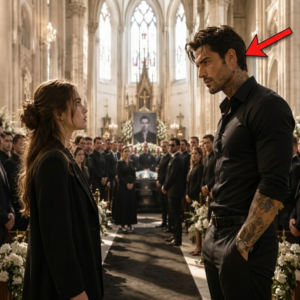
Rain slid down the stained-glass windows of St. Michael’s Cathedral in slow silver lines, turning Manhattan into a blurred watercolor of headlights, black umbrellas, and grief.
I stood near the back pew with an envelope clutched so tightly in my hand that the edges had bent into my palm. Funerals always smelled the same to me. Candles. Wet wool coats. Flowers that were already dying.
But this one carried something colder beneath it.
Power.
The kind that made grown men lower their voices without being told. The kind that sat in the front row wearing a black tailored suit and did not cry, even while his younger brother’s coffin rested a few feet away beneath white roses.
Dominic Russo looked like the storm outside had shaped itself into a man.
Tall, broad-shouldered, dark hair brushed neatly away from a face carved in sharp lines that belonged on old Roman statues. He sat perfectly still while priests spoke about heaven and mercy. But the tension in his jaw told another story entirely.
Everybody in New York knew the Russo name.
Restaurants. Real estate. Nightclubs. Charities.
And whispers.
Always whispers.
I should not have been there. People like me did not belong inside cathedrals filled with politicians, judges, bodyguards, and men wearing watches worth more than my yearly salary as an elementary art teacher in Brooklyn.
But three nights earlier, an elderly lawyer had appeared outside my apartment carrying a small box and one sentence that had not let me sleep since.
“Adrien Russo asked for this to reach you if anything ever happened to him.”
I barely remembered Adrien.
At least, that was what I had told myself for years.
Foster care teaches you how to bury memories deep enough to survive them. But the second I saw his name written across that envelope in faded blue ink, something old and aching cracked open inside my chest.
Emma Reynolds.
Adrien had written my name like it mattered.
Like I mattered.
The service ended in a silence so heavy it seemed to settle into the marble floor. People rose slowly from the pews. Expensive heels clicked. Bodyguards moved first, scanning exits with cold, practiced eyes.
Dominic Russo stood last.
The moment he rose, the room shifted around him like gravity had changed direction.
That was my chance.
If I lost my nerve now, I would never know why Adrien had carried my name into death.
I stepped forward.
“Excuse me.”
My voice barely sounded like mine.
One of Dominic’s men immediately moved between us. Six-four, earpiece, expressionless.
“Sir is busy.”
Dominic did not look at me at first. His gaze remained fixed ahead while people offered condolences he clearly did not want.
Then I held up the envelope.
“This belonged to Adrien.”
Everything stopped.
Not dramatically.
Not loudly.
Just suddenly, like the room inhaled and forgot how to breathe.
Dominic turned slowly toward me. His eyes were dark enough to look black beneath the cathedral lights, and when they landed on the envelope in my hand, something unreadable flickered across his face.
Recognition.
Pain.
Suspicion sharpened into a blade.
“Where did you get that?”
His voice was low and controlled, but exhaustion dragged beneath every word.
“A lawyer delivered it to me.”
For three long seconds, he stared at me. Not at my coat, not at my shoes, not at the envelope.
At my eyes.
As if he was searching for someone else standing behind them.
Then he held out his hand.
“Give it to me.”
I should have walked away.
Every instinct I had built in foster homes screamed at me not to trust powerful men with calm voices. But Adrien’s handwriting burned against my fingers, and something inside me needed answers more than safety.
I handed him the envelope.
Dominic opened it carefully, almost reluctantly, while rain thundered against the cathedral windows overhead.
Inside was a folded letter and an old brown leather wallet.
The wallet looked worn soft from years of use.
Dominic froze the second he saw it.
Real grief finally cracked through his expression. Tiny, barely visible, but real. One of the bodyguards looked away out of respect.
Dominic opened the wallet slowly.
A few business cards. Cash. An old subway card.
Then something slipped free and fluttered toward the marble floor.
A photograph.
Small.
Creased.
Old.
Dominic bent to pick it up before I could. His fingers stopped halfway there because the little girl smiling beside a rusted playground swing in that picture was me.
Seven years old.
Missing front tooth.
Red sweater too big for my shoulders.
The entire cathedral disappeared around us.
Dominic stared at the photo.
Then at me.
All the color drained from his face.
And for the first time since I had walked into St. Michael’s Cathedral, the most feared man in New York looked terrified.
People say grief makes you weak.
They are wrong.
Real grief makes people dangerous.
Dominic Russo held the photograph like it had just rewritten the laws of the universe. Rainwater glistened across the stained-glass windows behind him, casting pale reflections over his face. But it was the expression in his eyes that made my stomach sink.
Not curiosity.
Not surprise.
Shock so sharp it stripped every trace of control from him.
“Where was this taken?” he asked softly.
“I don’t know.”
His gaze snapped to mine.
“Do not lie to me.”
The words were quiet, but they landed with enough weight to make my pulse stumble.
I forced myself to breathe.
“It was a foster home in upstate New York. St. Agnes. I was seven, maybe eight.”
Dominic looked back down at the photo.
The little girl in the picture looked nothing like the woman standing before him now. My hair had been lighter then, my face rounder. But the eyes were unmistakable.
Gray-blue.
Storm-cloud eyes, one foster mother had called them.
“How long were you there?” he asked.
“At St. Agnes?”
“Yes.”
“Three years.”
“And Adrien knew you there.”
It was not a question.
I opened my mouth to deny it automatically.
But the memory arrived before the lie could.
A skinny boy sitting beside me under a broken basketball hoop during a thunderstorm. Dark hair falling into his eyes. A bruised knuckle wrapped in a bandage. Half a peanut butter sandwich held out to me without a word because he had noticed I had not eaten dinner.
My throat tightened.
“Maybe,” I whispered.
Dominic closed the wallet slowly.
“He kept this photograph for eighteen years.”
Eighteen years.
The number echoed through me strangely.
I tried to picture someone carrying my photograph through schools, cities, relationships, grief. Keeping it in his wallet until the leather turned soft and the edges wore down.
“Why?” I asked.
Dominic looked directly at me.
“That is what I intend to find out.”
A silver-haired woman approached from near the altar, diamonds glittering at her throat.
“Dominic, sweetheart, the press is gathering outside.”
He did not look away from me.
“Five minutes.”
The woman noticed the photograph in his hand. Confusion flickered across her face before she stepped away.
Dominic motioned toward a side hallway near the cathedral offices.
“Walk with me.”
Every instinct told me not to follow him.
Men like Dominic Russo did not enter your life quietly. They arrived like hurricanes and left destruction behind.
But Adrien’s name still echoed in my chest, tangled with memories I had spent years burying beneath lesson plans, overdue rent, and ordinary life.
So I followed.
The hallway was quieter, lined with old paintings and flickering wall sconces that smelled faintly of melted wax. Dominic stopped beside a stained-glass window overlooking the rain-soaked street.
Black SUVs waited outside the cathedral entrance. Security moved through the storm with umbrellas and earpieces.
Everything about his world looked controlled, organized, untouchable.
Dominic held the photograph toward me carefully.
“Tell me everything you remember about my brother.”
My fingers trembled as I took it back.
The edges were soft with age, worn from being touched over and over again.
Then another memory surfaced.
Adrien sitting on the floor beside my bunk after lights out, whispering so the staff would not hear.
“One day, my brother is coming back for me,” he had said. “And when he does, he is taking both of us away from here.”
I looked back up at Dominic.
“Adrien told me about you.”
For the first time since I met him, Dominic looked afraid to hear more.
The rain had softened into a steady drizzle by the time we stepped outside the cathedral.
Manhattan looked drowned in gray. Water shimmered across the sidewalks beneath streetlights, and black umbrellas moved through the crowd like shadows.
I should have left.
Any sane person would have walked away the second Dominic Russo’s attention settled on them.
But grief has gravity.
It pulls secrets toward the surface whether you are ready or not.
Dominic stood beside the cathedral steps with one hand in his coat pocket and Adrien’s wallet in the other.
“What exactly did Adrien say about me?”
“Not much.”
“Emma.”
Hearing my name in his voice felt unsettling. Too familiar for a man I had met less than an hour ago.
“He said you would come back for him someday.”
Something shifted across Dominic’s face.
Guilt.
“How old were you?”
“Seven. Maybe eight.”
“Adrien was eleven when he disappeared from St. Agnes.”
Disappeared.
The word landed strangely.
“Children in foster care do not disappear,” I said carefully. “They get transferred. Adopted. Forgotten.”
Dominic gave a quiet laugh without warmth.
“That is one way to describe it.”
“Why did he keep looking for me?”
“Because you mattered to him.”
The simplicity hurt more than it should have.
For most of my life, I believed nobody remembered me from St. Agnes. Nobody looked for children once they left the system. We learned that lesson early.
“What happened to him?” I asked.
Dominic’s jaw tightened.
“A car accident outside Queens three nights ago.”
A pause.
“Officially.”
My stomach dropped.
“And unofficially?”
“My brother was searching for someone before he died.”
“Me.”
Dominic did not answer.
He did not need to.
A black SUV rolled to the curb. One of his bodyguards opened the rear door without a word.
Dominic looked at me.
“You cannot go home tonight.”
Every muscle in my body tightened.
“Excuse me?”
“If Adrien found you before he died, other people may know he found you too.”
“I am just a teacher,” I said. “I do not know anything.”
Dominic stepped closer, lowering his voice so only I could hear him through the rain.
“My brother spent eighteen years trying to find you. Three days after he did, he ended up in a coffin.”
There is a specific kind of fear that arrives quietly.
Not screaming.
Not shaking.
Just a cold realization settling into your bones while rain falls and a stranger tells you your life may already be changing.
“You think somebody killed Adrien because he found me?”
“I think Adrien trusted the wrong people,” Dominic said. “And I think he died carrying your photograph for a reason.”
“I barely know you.”
“You know enough.”
“That is not comforting.”
“It was not meant to be.”
A bodyguard approached quickly, holding a phone.
“Sir.”
Dominic took it.
“What?”
I watched something change behind his eyes while he listened. Not panic. Dominic did not strike me as a man who panicked.
This was colder.
Calculation sharpening into certainty.
“When?” he asked.
A pause.
“Do not touch anything until I get there.”
He ended the call and looked at me.
“What happened?” I asked.
“Someone broke into your apartment twenty minutes ago.”
Every sound vanished.
Traffic. Rain. Thunder.
All of it disappeared beneath the roar of my heartbeat.
“What?”
“My men were checking the building after Adrien’s lawyer contacted you.”
“You had people watching me?”
“Yes.”
The honesty stunned me.
“Your front door was forced open. Nothing was taken.”
“Then what were they looking for?”
Dominic’s eyes lowered toward the old wallet.
“Probably the same thing Adrien spent eighteen years trying to protect.”
I wanted to call the police.
I wanted to run.
I wanted to go back to yesterday, when my biggest worry had been whether the art supplies budget would cover watercolor paper for twenty-six second graders.
Instead, I stood in the rain beside a mafia boss, wearing his coat, holding my own childhood photograph, and realizing my entire life might have been built around a lie.
Then Dominic unfolded one more paper from Adrien’s wallet.
There was one sentence written in faded blue ink.
Find out what happened to Emily Grace Parker.
I stared at the words.
“Who is Emily Grace Parker?”
Dominic’s eyes held mine.
“According to St. Agnes records, that was your birth name.”
The world tilted.
“No,” I whispered. “My name is Emma Reynolds.”
“That is the name listed after your foster transfer.”
My hands tightened around the paper.
Emily Grace Parker.
The name felt wrong and familiar at the same time, like hearing a song from childhood you had forgotten existed.
“You are lying.”
Dominic’s expression softened slightly.
“I wish I were.”
A memory flickered.
A social worker kneeling in front of me at St. Agnes, telling me there would be a new home, a new start, a new name.
Children in the system learned quickly that adults changed things without explanation.
“Why would someone change my name?”
Dominic glanced toward the men still lingering beneath the cathedral awning.
“That is probably why someone searched your apartment tonight.”
I went with him.
Not because I trusted him.
Because the alternative was returning to an apartment somebody had already violated.
The inside of Dominic’s SUV smelled like leather and cedarwood. Rain streaked across the tinted windows while Manhattan blurred past. Dominic sat across from me, silent, his phone buzzing unanswered beside him.
“You could be lying,” I said finally.
“That would be an unnecessary amount of effort just to frighten an elementary art teacher.”
Under different circumstances, I might have laughed.
Instead, I stared at the folded paper in my hand.
Emily Grace Parker.
My birth name, maybe.
The possibility alone made my chest ache.
Dominic took me to his penthouse, because of course men like him lived above ordinary floors and ordinary neighbors. The apartment opened directly from a private elevator into a space of dark wood, soft gray furniture, and floor-to-ceiling windows overlooking Manhattan beneath rain clouds.
Everything elegant.
Everything lonely.
“You can take the guest room,” he said.
“I should call the police.”
“And tell them what?”
I opened my mouth.
Then stopped.
I did not know who Emily Grace Parker was. I did not know why Adrien had searched for me. I did not know why Dominic looked at me like I carried pieces of his dead brother back from the grave.
Dominic poured a glass of water and set it near me.
“You do not have to trust me tonight,” he said. “But until we understand what Adrien discovered, you should not be alone.”
“What if Adrien found something terrible about me?”
Dominic’s expression changed instantly.
“Emma, the only terrible thing I see is that somebody spent years trying to erase who you were.”
Sleep felt impossible inside Dominic Russo’s penthouse.
Not because the room was uncomfortable. It looked like something from an architectural magazine, with cream walls, soft linens, and windows that turned the city into a field of lights.
The problem was my mind.
Every time I closed my eyes, I saw that photograph slipping from Adrien’s wallet.
Emily Grace Parker.
At two in the morning, I found Dominic in the kitchen, standing beside the windows with a coffee mug in one hand. He had changed into black slacks and a dark sweater. Exhaustion clung to him like another layer of clothing.
“You should be sleeping,” he said.
“I could say the same thing.”
One corner of his mouth moved faintly.
I poured water from the glass bottle on the counter.
“Did Adrien come here often?”
The question changed his face.
“He lived here for a while after college.”
“You were close.”
Dominic looked out at the skyline.
“Adrien was the only person in my life who still believed I could become someone better than what this city made me.”
“And were you?”
His eyes shifted toward mine.
For the first time all night, silence settled comfortably between us.
Then he picked up Adrien’s wallet.
“There is something else.”
He removed another folded paper hidden behind the photograph.
A list of names.
Children from St. Agnes.
Some marked transferred. Some relocated. Some deceased.
Others ended with one terrible word.
Missing.
My stomach twisted when I recognized a few of them.
Olivia Turner, who used to hide crackers beneath her mattress because she believed food would disappear overnight.
Marcus Hale, who drew airplanes on every scrap of paper he could find.
Gone.
Half the names triggered fragments of faces I had not thought about in years.
“This cannot be real.”
“Adrien believed the records at St. Agnes were altered,” Dominic said. “Children transferred without paperwork. Names changed. Files sealed.”
A memory surfaced.
A basement under the east wing.
Certain kids being taken downstairs for interviews.
Wealthy sponsors, they told us.
I remembered one girl screaming.
The next morning, they said she had been adopted.
Dominic’s face hardened.
Then his phone rang.
He answered in controlled Italian too fast for me to understand, but I caught one phrase in English.
“She was there that night.”
Dominic went completely still.
When he ended the call, every trace of softness had vanished.
“What happened?”
“Adrien’s investigator uploaded backup files before he died. Including security photos from the year you disappeared from the system.”
The room tilted.
Dominic slid one grainy image across the counter.
St. Agnes.
East wing.
A basement hallway.
And there I was, seven years old, clutching a stuffed rabbit to my chest.
Beside me stood a man in an expensive black coat and silver watch.
A man I recognized immediately, though he looked much younger.
Dominic’s father.
Some truths do not break your heart immediately.
They sit inside your chest for a few seconds first, letting your mind understand exactly how much damage they are about to do.
“Your father was there,” I whispered.
Dominic did not deny it.
“My father financed many things in this city that were never discussed publicly.”
“Did Adrien know?”
“He found this photograph last month.”
“And he never told you?”
“My brother stopped trusting people easily a long time ago.”
That answer hurt him. I could hear it beneath the calm.
Another call came.
Someone had accessed St. Agnes financial records through a private foundation once connected to Dominic’s father.
Then the penthouse security alarms activated.
Sharp electronic warnings exploded through the room.
Dominic moved instantly.
A guard rushed in.
“Someone entered the underground garage using Adrien Russo’s personal access code.”
Adrien was dead.
Dominic turned toward the dark windows overlooking Manhattan.
“My brother knew they would come for you.”
The next days blurred into security briefings, locked doors, federal agents, and pieces of memory returning so painfully I sometimes had to sit down before my knees gave out.
We moved to the Russo estate overlooking the Hudson after my apartment was searched again. Dominic did not leave me alone for long after that. He hovered without crowding, protected without softening the truth.
Federal agents arrived at the gates.
A former St. Agnes nun named Sister Catherine came with them and asked to speak with me alone.
Dominic refused.
For once, I was grateful.
Then the estate lost power during a storm.
The generators failed.
The cameras went black.
Somebody screamed downstairs.
By the time we reached the west sitting room, Sister Catherine was gone.
All she left behind was a silver cross necklace.
Dominic picked it up from the carpet.
Inside the cross was a folded note.
An address in Brooklyn.
And one date.
October 12th.
The night of the fire.
The night my mother died.
The night I stopped being Emily Grace Parker.
The address led us to a faded red door in Red Hook.
Rain followed us all the way there. The old apartment building looked like nothing special. Four stories. Rusted fire escapes. A broken porch light.
But the moment I saw the red door, memory struck.
A little girl sitting on apartment stairs holding a stuffed rabbit while her mother whispered frantically into a telephone.
“Please. If they find her before Adrien gets here, she dies too.”
I nearly fell.
Dominic caught my arm.
“My mother was waiting for Adrien here,” I whispered.
The apartment door was unlocked.
Inside, Apartment 4C looked frozen in time.
Floral wallpaper curling at the edges. An old record player covered in dust. A pair of pink child’s rain boots beside the door like someone expected me to return for them.
I knew the blue blanket.
The ceramic angel near the television.
The narrow kitchen.
The little bedroom at the end of the hall with faded stars painted across the ceiling.
A stuffed rabbit still sat in the corner near the tiny bed.
Tears burned behind my eyes.
“This was our apartment.”
Dominic stood in the doorway, watching me carefully.
“You were here too,” I whispered.
He did not answer.
The truth settled between us anyway.
A guard found the metal box behind the bedroom radiator.
Inside were photographs, newspaper clippings, a flash drive, and a cream envelope with Adrien’s handwriting across the front.
Emma, if you are reading this, they finally found you.
My hands trembled as I opened it.
Inside was a photograph of me at five years old, sitting on Dominic’s shoulders while Adrien laughed beside us at the Brooklyn pier. Sunshine. Summer clothes. Normal happiness.
I had no memory of that day.
But the happiness in the picture felt real enough to hurt.
Then came Adrien’s letter.
Emma,
If you are reading this, then I failed to keep my promise to your mother.
Fifteen years ago, your mother discovered information powerful men were willing to destroy families to bury. She trusted me because she believed I could protect you. Dominic warned me not to get involved. He was smarter than I was, but I could not walk away from a child.
The night of the fire was never supposed to happen. Your mother planned to meet federal investigators the following morning. She hid copies of everything before they arrived. When people learned she intended to cooperate, they came for her first.
Dominic got you out alive.
You need to understand that.
Whatever people say about him, whatever mistakes he made afterward, he carried you out of that apartment while the building burned around him. He was twenty-six years old and trying to keep our family alive. He saved you because I begged him to.
The letter blurred.
Smoke swallowed my mind.
A hallway.
Fire.
A man lifting me into strong arms.
My mother screaming somewhere behind us.
A younger Dominic carrying me through rain while sirens echoed across Brooklyn streets.
My knees weakened.
Dominic steadied me instantly.
“You carried me out,” I whispered.
He looked away.
“Emma—”
“You carried me out.”
The truth settled heavily between us.
Fifteen years of missing memory connected by one impossible image.
Then we opened the flash drive.
It held court records, financial statements, photographs, and finally, a grainy security video from the night of the fire.
The hallway outside Apartment 4C.
Smoke.
Chaos.
The door bursting open.
Dominic appeared, younger and terrified, carrying a little girl wrapped against his chest.
Me.
Adrien ran behind him.
“Go!” Adrien shouted on the video. “I’ll get Elena!”
Elena.
My mother.
Then another man stepped into frame downstairs.
Dominic froze beside me.
“I know him.”
“Who is he?”
“Marco Duca,” he said. “He worked for my father.”
Marco had disappeared after the fire.
Now Dominic’s men had found him watching the building for three days.
We did not reach him before he ran.
But he left one message on the apartment security screen.
She was never supposed to survive the fire.
I thought that would destroy me.
Instead, it did something stranger.
It made me angry.
Not frantic.
Not helpless.
Coldly angry.
For fifteen years, men in expensive coats and sealed offices had changed my name, buried my mother, erased children, killed Adrien, and watched me live an ordinary life they had never intended to let me keep.
Dominic saw the change in my face.
“You are thinking something reckless.”
“I am thinking I am tired of being protected by people who keep deciding what I am allowed to know.”
His jaw tightened.
“I hid you because I thought distance kept you alive.”
“And Adrien died because he could not keep carrying the truth alone.”
The words hurt him.
I knew they did.
But he did not look away.
“What do you want?”
I looked at the files.
“The truth in daylight.”
Dominic went very still.
“That is dangerous.”
“So is silence.”
For a long time, rain filled the room.
Then Dominic reached for the flash drive.
“Then we stop burying it.”
It took three weeks.
Dominic’s lawyers. Federal prosecutors. A journalist Adrien had secretly trusted. Survivors from St. Agnes who were no longer children. Financial records tied to the Russo foundation. Names. Transfers. Payments. Death certificates rewritten as accidents.
Sister Catherine reappeared two days later under federal protection.
She had not betrayed us.
She had run because Marco Duca threatened to kill her if she spoke.
She brought the final key.
A ledger written by my mother.
Elena Parker had been an accountant for a foundation tied to the Russo family. She discovered money moving through St. Agnes, money connected to illegal adoptions, missing children, bribes, sealed identities. She planned to expose it.
So they set the fire.
They killed her.
They erased me.
And Adrien spent eighteen years trying to undo what powerful men had buried.
Marco Duca was arrested at a private airstrip.
Dominic’s father was dead, but the empire he left behind finally cracked open. Politicians resigned. Judges were investigated. St. Agnes was shut down. Names of missing children returned to public record for the first time in decades.
Some were found.
Some were not.
But none of them were invisible anymore.
One year later, New York finally felt quiet again.
Not silent.
The city would never be silent. Sirens still echoed after midnight. Taxis still honked. Steam still curled from the streets beneath pale winter sunlight.
But the fear that had once followed the Russo name through every corner of my life softened into something distant.
I stood near the front windows of the art studio in Brooklyn, watching snow drift slowly onto the sidewalk outside while children laughed near the paint tables behind me.
Warm yellow light filled the room.
Paintings covered the walls. Crooked paper stars hung from the ceiling. A sign near the entrance read Elena House in small gold letters.
My mother’s name finally belonged somewhere peaceful.
Most of the children came from foster homes. Some barely spoke when they first arrived. Others flinched every time doors closed too loudly.
Broken children always recognized each other eventually.
I understood that now.
“Miss Emma,” a tiny voice called. “Can you help me?”
I smiled and crossed toward the art table.
The front door opened quietly around noon.
I did not need to turn around to know it was Dominic.
Some people carried presence the way storms carried thunder.
Even now, even after everything, Dominic Russo stepped inside brushing snow from the shoulders of his dark wool coat, and the room noticed before it relaxed again.
The children were no longer afraid of him.
That alone felt miraculous.
He looked different from the man I first met at St. Michael’s Cathedral. The sharp edges remained. Dominic Russo would probably carry darkness in his eyes for the rest of his life.
But grief no longer consumed him entirely.
He smiled more now. Slept occasionally. Sometimes even laughed when the children covered his expensive sleeves in glitter and pretended not to notice.
Today, he carried two coffees from the bakery down the street.
“You forgot lunch again,” he said.
“I was busy.”
He glanced toward the children hanging paper snowflakes on the wall.
“Clearly.”
A little girl near the fireplace looked up from her drawing.
“Mr. Russo, can you help me hang this?”
Dominic looked startled for half a second.
Then he walked toward her without hesitation.
She handed him a paper angel covered in silver glitter and crooked blue stars. Dominic studied it with complete seriousness, like she had given him something priceless.
“This goes on the wall?”
“Right there.”
I watched him lift the paper carefully toward the bulletin board.
Broad shoulders.
Gentle hands.
The same man who once terrified half the city now helped a seven-year-old hang crooked artwork beside a Christmas wreath.
Adrien would have smiled seeing him like this.
The thought hurt less now.
More bittersweet than painful.
Later that evening, we locked the studio together while snow blanketed Brooklyn in silver and white.
Dominic held the door open for me before pulling his scarf tighter against the cold wind outside.
The streetlights glowed softly across the sidewalk. Christmas decorations flickered warmly through apartment windows around us.
Peace looked ordinary in the end.
Not grand.
Not cinematic.
Just small moments nobody tried to steal anymore.
I slipped my hand into Dominic’s coat pocket while we walked slowly toward home through falling snow.
He looked down at me, then covered my fingers with his own inside the warmth of the pocket.
No bodyguards followed us tonight.
No sirens.
No fear.
Just winter air and quiet footsteps beside the man who once believed darkness was the only thing he deserved.
“What are you thinking about?” I asked softly.
Dominic looked toward the snow-covered street ahead.
“Adrien.”
His voice carried no bitterness now.
Only memory.
“He would have liked this life,” I said.
Dominic’s eyes softened.
“He is the reason we found it.”
“No,” I said. “He is the reason we stopped running from it.”
Dominic leaned down and pressed a kiss against my forehead beneath the falling snow.
New York glowed quietly around us.
For the first time in my life, my past no longer felt like a locked room.
It felt like a door I had finally opened.
And on the other side was not only the truth.
It was home.
THE END.
Disclaimer : This content may be created by AI for entertainment purposes. Any resemblance to real persons, events, or places is coincidental.






