At 2:13 in the morning, Vivian Hale stood in Caleb Mercer’s kitchen with rain in her hair and tears in her eyes.
She was the billionaire sister of the best friend he had lost three years ago.
And when she whispered, “Can we stop pretending this doesn’t matter?” Caleb knew his answer would either save them both or destroy the last safe thing they had left.
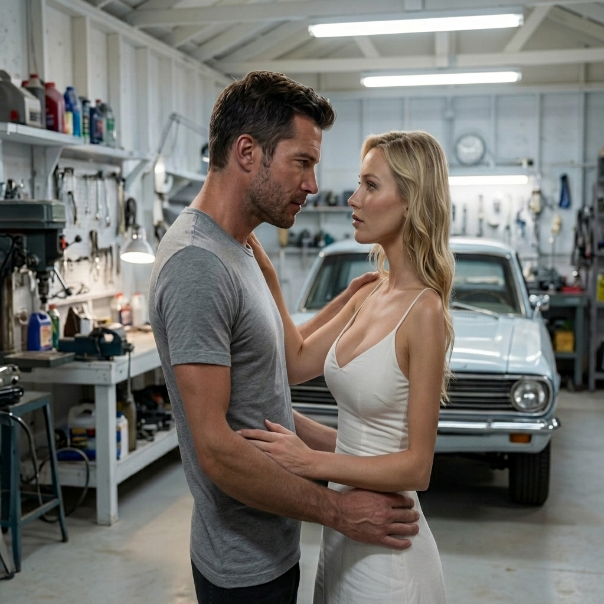
The Broken Light
The kitchen light had been flickering for two weeks.
Caleb Mercer kept meaning to fix it. He fixed things for a living. Copy machines. Printers. Broken office scanners. Cheap machines that jammed before important meetings and made people curse like the world was ending.
He could take apart a printer with a paperclip and a screwdriver. He could hear a broken motor and know exactly which part had failed.
But the light in his own kitchen kept blinking.
On.
Off.
On again.
Some things, Caleb had learned, simply stayed broken.
Light bulbs.
Promises.
Sleep.
The part of him that still heard Marcus Hale’s voice every time rain hit a window.
Vivian Hale stood near his counter, her expensive coat still wet from the storm outside. Her hair, usually polished and perfect in every business magazine photo, was loose around her face. Mascara was smudged beneath one eye. She looked nothing like the billionaire CEO who could silence a room with a single glance.
She looked tired.
Worse than tired.
She looked like someone who had been holding herself together for so long that one more breath might break her.
“You can’t keep doing this,” she said.
Caleb leaned against the refrigerator, arms crossed, jaw tight.
“Doing what?”
“Pretending I don’t exist.”
The words entered the kitchen and stayed there.
Caleb looked away first.
That was always the problem with Vivian. He could face overdue bills, angry clients, and the kind of grief that sat on his chest at night. But looking directly at Vivian Hale felt like looking at a memory he had no right to touch.
She had Marcus’s eyes.
The same dark intensity. The same stubborn set to her mouth when she was upset.
But Marcus had been loud, reckless, alive in every room. Vivian was quieter. The kind of person who felt everything and said half of it.
Until tonight.
Tonight, she had driven forty minutes through rain to stand in his kitchen at 2:13 in the morning.
“Vivian,” he said, “you shouldn’t be here.”
She laughed once, sharp and humorless.
“I know. I do a lot of things I shouldn’t.”
“Your mother would lose her mind if she knew.”
“My mother loses her mind if I breathe in a way she didn’t approve in advance.”
“That doesn’t make this right.”
“What is this, Caleb?”
He said nothing.
Vivian stepped closer.
“No. Don’t do that. Don’t disappear while standing right in front of me.”
He turned toward the sink, needing something to do with his hands. He took a glass from the dish rack and filled it with water he did not want.
“Go home,” he said quietly.
“Look at me and say that.”
He did not.
Because if he looked at her, she would see the truth.
And the truth was the thing he had spent three years burying.
The Ghost In The Room
Vivian’s heels clicked softly against the linoleum floor.
“Caleb.”
“Marcus was your brother.”
“I know who he was.”
“He was my best friend.”
“I know that too.”
“I was driving.”
The words dropped between them like broken glass.
The rain outside grew harder, tapping against the window over the sink. Caleb could see Vivian’s reflection in the glass, fractured by the water sliding down outside.
“I was driving when he died,” he said.
Vivian closed her eyes.
“Stop.”
“I was the one behind the wheel.”
“Stop doing this.”
“I heard him say my name after the crash.”
His voice broke there. He hated that it did. He hated that after three years, one sentence could still cut him open.
“He said my name, and then he just stopped.”
The kitchen light flickered again.
On.
Off.
On.
Three years ago, a truck had run a red light on a rainy Tuesday night and hit Caleb’s car on the passenger side.
Marcus died before midnight.
Caleb lived.
Police reports said Caleb was not at fault. Witnesses said the truck driver caused the crash. The insurance company, the investigators, even the therapist Caleb stopped seeing after four sessions, all said the same thing.
It was not your fault.
But none of them had been in the car.
None of them had heard Marcus gasp once, say Caleb’s name, and go silent.
None of them had stood at the funeral and watched Catherine Hale stare across her son’s coffin with the kind of grief that needed someone to blame.
Caleb had given her someone.
Himself.
“You disappeared after the funeral,” Vivian said.
Her voice was quieter now, but not softer.
“I couldn’t face you.”
“I needed you.”
That hurt worse than anger would have.
Vivian wrapped her arms around herself.
“I needed someone who remembered Marcus before everyone started turning him into a saint. I needed someone who knew he was late to everything, terrible with money, and still somehow the most loyal person in any room. I needed someone who understood what it meant to lose him.”
Caleb swallowed.
“I thought your family would be better without me.”
“No,” she said. “You were the only person who understood.”
He had no defense.
Because she was right.
He had run.
From Vivian. From Catherine. From every street and restaurant and memory where Marcus might appear without warning.
He took his daughter Emma and moved across town. Changed routines. Changed phone numbers. Avoided the old neighborhood. Avoided the Hale family. Avoided anything that might make him feel alive enough to remember what he had lost.
But grief always found him.
It sat in the passenger seat.
It stood in his kitchen.
Tonight, it wore Vivian Hale’s face.
The Woman Behind The Billionaire
Vivian sat down at the small kitchen table as if her legs had finally given up.
Caleb noticed then how pale she looked. How fine the tremor was in her hands. How the woman who appeared on magazine covers as untouchable had driven across the city in the rain because she was falling apart.
“I’m not perfect,” she said.
“I never said you were.”
“You look at me like I am.”
“You run a billion-dollar company.”
“I had a panic attack in a bathroom stall last week.”
Caleb froze.
“What?”
“Twenty minutes on the floor of the executive bathroom while my assistant told the board I was taking an emergency call.”
“Vivian.”
“I sleep four hours a night if I’m lucky. I take medication to make it through investor meetings. I give speeches about resilience while wondering if anyone would notice if I walked out and never came back.”
Her mouth twisted.
“Perfect? Caleb, I am a disaster in designer shoes.”
He moved to the table and pulled out the chair across from her, but did not sit.
“Why are you telling me this?”
“Because you’re the only person I don’t have to perform for.”
The sentence changed the room.
Caleb stared at her.
Vivian lifted her eyes.
“And because I can’t stop thinking about you.”
He stepped back.
“Don’t.”
“Don’t what?”
“Say things you will regret tomorrow.”
“I’m thirty years old. I think I know what I feel.”
“You’re Marcus’s sister.”
“I know.”
“You’re Vivian Hale.”
“I know that too.”
“I fix copy machines for a living.”
“And I run from my emotions in better shoes. Congratulations, Caleb. We both have issues.”
He almost laughed.
That was the dangerous thing about her. Even while crying, she could still make him feel like the world had room for something other than guilt.
Vivian stood.
“Do you have feelings for me?”
He looked away.
“Vivian.”
“Yes or no.”
He could lie.
He should lie.
He could tell her she was exhausted, grieving, confused. He could tell her he only thought of her as Marcus’s little sister. He could send her home and return to the half-life he had lived for three years.
But he was tired.
Tired of running.
Tired of punishing himself for surviving.
Tired of pretending he did not feel the exact thing that made him want to get up in the morning.
“Yes,” he said.
Vivian stopped breathing.
Caleb’s voice came out rough.
“I have feelings for you. I have had feelings for you since the day in that bookstore when you quoted Marcus’s favorite poem and I realized you remembered the small parts of him everyone else was forgetting.”
Her eyes filled.
“I have feelings for you when you text me pictures of terrible corporate lunches and complain about people using the word synergy. I have feelings for you when you show up at Emma’s school play even though I didn’t invite you because somehow you knew I needed someone there. I have feelings for you every time you look at me like I am not something broken you have to pity.”
His voice cracked.
“I have so many feelings for you that it terrifies me.”
Vivian crossed the small kitchen and kissed him.
It was not elegant.
Not soft.
Not careful.
It tasted like rain and tears and three years of grief finally breaking open.
When they pulled apart, Caleb rested his forehead against hers.
“This is a bad idea.”
“Probably.”
“People will talk.”
“Let them.”
“Your mother will hate me.”
“She already does.”
“That is not comforting.”
Vivian laughed through tears.
“No. But it is honest.”
The Morning After
Vivian slept on Caleb’s couch that night.
Nothing happened.
Nothing except the kind of closeness that changes a life anyway.
He gave her an old gray hoodie because her blouse was damp from the rain. It swallowed her, hanging almost to her knees.
Vivian Hale, billionaire CEO, sat on his secondhand couch in his faded college hoodie and looked more real than she ever had in any magazine.
“I’m keeping this,” she said.
“You’re a billionaire. Buy your own hoodie.”
“This one smells like you.”
Caleb did not know what to do with that sentence.
So he gave her a pillow and pretended his heart had not stumbled over itself.
In the morning, Emma found her.
Caleb’s seven-year-old daughter appeared at the living room entrance in unicorn pajamas, holding her stuffed elephant by one leg.
“Daddy,” she whispered loudly.
Caleb turned from the stove.
“What, bug?”
“Why is Miss Vivian on our couch?”
Vivian opened one eye.
“Good morning.”
Emma looked from Vivian to Caleb and back again.
Then, with the terrible directness of a child, she asked, “Is she your girlfriend now?”
Caleb almost dropped the spatula.
“What? No. I mean—”
“Riley at school says when grown-ups have sleepovers, they are dating.”
“Riley at school needs to mind her own business.”
Vivian buried a laugh in Caleb’s hoodie sleeve.
Emma walked over and climbed onto the couch beside her, as if this was the most natural thing in the world.
“You can stay for pancakes,” Emma said.
Vivian looked at Caleb.
Then at Emma.
“I would love to stay for pancakes.”
The pancakes burned.
Not terribly.
Just enough that the edges were dark and crisp.
Emma declared them “extra crunchy” and drowned them in syrup. Vivian ate hers without complaint, listening with intense seriousness while Emma told her a long story about a dragon that lived behind her school gym.
By the end of breakfast, Vivian had laughed twice, Emma had decided she could come back anytime, and Caleb felt something settle over the apartment.
Peace.
Not perfect.
Not safe.
But warm.
Dangerously warm.
The Warning
Catherine Hale called three days later.
Caleb knew the voice before she said her name.
“Mr. Mercer.”
His fingers tightened around the phone.
“Mrs. Hale.”
“I know you have been seeing my daughter.”
He closed his eyes.
“We have been spending time together.”
“Stop.”
Just one word.
Cold.
Commanding.
Caleb stood in the kitchen, Emma asleep down the hall.
“Vivian is an adult.”
“She is vulnerable.”
“She runs an international company.”
“She is grieving.”
“So am I.”
Catherine’s silence sharpened.
“You do not get to use my son’s death as a bridge to my daughter.”
The words struck exactly where she wanted them to.
“I never wanted to hurt your family.”
“You already did.”
His throat tightened.
“That accident was not my fault.”
“Perhaps not legally.”
The cruelty was quiet.
That made it worse.
“But every time I see your face, Mr. Mercer, I see the man who walked away from the car my son never left.”
He could not answer.
Catherine continued, voice controlled and merciless.
“Stay away from Vivian. If you care about her at all, let her build a life that is not chained to the night Marcus died.”
The line went dead.
Caleb stood there for a long time, phone still against his ear.
Emma found him in the dark.
“You look sad,” she said.
He crouched in front of her.
“I’m okay.”
“Is it about Miss Vivian?”
Children always knew.
“Kind of.”
Emma wrapped her arms around his neck.
“She makes you smile.”
He closed his eyes.
“Yeah.”
“Then don’t let mean people take her away.”
He held his daughter and wished life were as simple as she made it sound.
The First Date
Their first real date was at a small Italian restaurant in Wicker Park.
Not one of Vivian’s glittering business places. No valet line filled with black cars. No crystal chandeliers. Just checkered tablecloths, candles in old wine bottles, and food meant to be eaten instead of photographed.
Vivian arrived first.
For once, she looked nervous.
“You look beautiful,” Caleb said.
It sounded too simple the second he said it.
Vivian smiled anyway.
“I changed four times.”
“I wore my only clean shirt without a stain.”
“That feels fair.”
They laughed, but the silence came quickly after.
A heavy silence.
Caleb broke it because fear made him reckless.
“Your mother called me.”
Vivian’s face changed.
“What did she say?”
“That I should stay away from you.”
Vivian looked down.
“She had no right.”
“She is your mother.”
“She is trying to control me.”
“She thinks I am bad for you.”
“You are not bad for me.”
“I am a reminder of the worst thing that ever happened to your family.”
Vivian’s voice became firm.
“You are also the person who understands it.”
The waiter came with pasta. Neither of them touched it.
Caleb stared at his plate.
“What if she is right? What if this is too complicated?”
Vivian’s eyes filled.
“Are you breaking up with me on our first date?”
“We are not even together yet.”
“We had pancakes. Your daughter cuddled with me. You kissed me at two in the morning. I bought this dress because I thought you might like it.” She leaned forward. “We are absolutely together.”
He looked at her.
That was when he realized he did not want to escape.
He wanted to stay.
Even if staying terrified him.
“I am scared of losing you,” he admitted.
Vivian reached across the table and took his hand.
“Then don’t.”
“It is not that simple.”
“No,” she said. “But neither is living without you.”
He stayed.
They ate cold pasta.
They laughed about terrible corporate meetings, Emma’s school play, and a copy machine at Caleb’s job that had caught fire because someone tried to print labels on wax paper.
By the end of the night, the fear was still there.
But so was something stronger.
Choice.
The Collapse
Vivian collapsed two weeks later.
Her assistant called Caleb first.
Not Catherine.
Not the board.
Caleb.
He drove to Northwestern Memorial with his heart in his throat, speeding through wet streets while the smell of rain dragged him back to the night he had spent years trying to forget.
The hospital smelled the same.
Antiseptic.
Burnt coffee.
Fear.
He found Vivian pale in a hospital bed, angry with herself for needing help.
The doctor used careful words.
Stress.
Heart strain.
Exhaustion.
Dangerous.
“You are thirty years old,” he told her. “You should have decades ahead of you. But if you keep living this way, you may not see forty.”
Vivian stared at him.
The board meetings. The perfect image. The interviews. The sleepless nights. The legacy she had been trying to protect for Marcus.
All of it had become a machine.
And the machine had been eating her alive.
Caleb stayed that night in the uncomfortable chair beside her bed.
Around midnight, she woke up.
“You’re still here,” she whispered.
“Where else would I be?”
“Home with Emma. Being sensible.”
“I’m done being sensible.”
She looked at him.
“I’m scared.”
“I know.”
“What if I can’t run the company anymore?”
“Then you don’t.”
“My mother will say you ruined me.”
“Your mother is wrong about a lot of things.”
Vivian laughed weakly, then cried.
“I don’t know who I am without the company.”
Caleb took her hand carefully around the IV.
“Then we find out.”
“We?”
“Yes.”
He leaned closer.
“I love you.”
Vivian went still.
“What?”
“I love you. I tried not to. I tried to be noble and afraid and stupid. But I love you, Vivian Hale. If you are choosing us, then I am choosing us too.”
She covered her face.
The sob that came out of her sounded like surrender.
Caleb climbed carefully onto the edge of the hospital bed and held her while the machines beeped around them.
For the first time, the sound of a hospital monitor did not mean only loss.
It meant someone was still here.
The Empire She Lost
Catherine used Vivian’s health against her.
At first, she called it concern.
Then board members started asking questions.
Then investors did.
Then someone leaked to the business press that Vivian Hale was unstable, overwhelmed, and emotionally compromised.
Finally, there was a vote.
Vivian lost control of Hale Industries on a Thursday afternoon.
The company Marcus had built.
The legacy she had spent three years trying to protect.
The world called it a leadership transition.
Vivian called Caleb from the parking garage with a voice so empty it frightened him.
“I’m out.”
His chest tightened.
“Come home.”
“My mother wins.”
“No.”
“She pushed me out of my own company.”
“Vivian, come home.”
There was a silence.
Then she said the thing grief and shock pulled from the cruelest part of her.
“I gave up everything, Caleb.”
He went still.
She realized what she had said the moment it left her mouth.
“I didn’t mean that.”
He said nothing.
“I’m sorry. I’m so sorry. I was hurt and I wanted someone else to feel it.”
“Come home,” he repeated.
She did.
She arrived still in her suit, mascara running, pride shattered.
“I don’t regret you,” she said before he could speak. “I do not regret Emma. I do not regret us. I lost the company because my mother is vindictive and the board is weak. Not because of you.”
Caleb looked at her for a long moment.
Then opened his arms.
She fell into them.
When Emma came home from school and found them on the couch, she set down her backpack and frowned.
“What happened?”
Vivian wiped her eyes.
“Bad day.”
Emma thought about that.
“When Daddy has a bad day, we eat ice cream for dinner.”
Vivian looked at Caleb.
“Is that a rule?”
“It is science,” Emma said seriously.
So they ate ice cream for dinner.
Chocolate for Emma.
Vanilla for Caleb.
Mint for Vivian.
And somewhere in the middle of losing an empire, Vivian found something she had never found in her penthouse.
A family that did not need her to be powerful.
Only present.
The Five Million Dollar Offer
Catherine Hale requested a meeting with Caleb at the Langham Hotel.
Vivian told him not to go.
He went anyway.
Some part of him still believed grief could be reasoned with.
Catherine sat in the lobby like a queen without a throne, perfect hair, perfect pearls, grief hidden behind control.
“I will be direct,” she said.
“You usually are.”
“I will give you five million dollars to leave my daughter.”
Caleb stared at her.
“What?”
“Cash. Quietly. Move somewhere Vivian will not follow. Start over with your daughter. Never contact her again.”
The fountain behind them made a soft, expensive sound.
Five million dollars.
College for Emma.
Medical security.
A house.
No more rent panic.
No more cheap apartments.
No more worrying that one broken car would ruin the month.
For one second, Caleb understood how people sold pieces of themselves.
Then he thought of Vivian in his hoodie.
Emma saying, “Can we keep her?”
Marcus laughing in some memory far away.
“No,” Caleb said.
Catherine’s expression did not change.
“You have not heard the full offer.”
“I heard enough.”
“Think about your daughter.”
“I am.”
“Five million dollars could change her life.”
“Vivian changed our lives.” Caleb stood. “Emma does not need your money more than she needs the people who love her to stay.”
Catherine’s eyes hardened.
“You are making a mistake.”
“No,” Caleb said, and something in him finally loosened. “The mistake was letting you convince me I was responsible for everything your grief could not carry.”
For the first time, Catherine looked shaken.
“I did not kill Marcus,” he continued. “A truck driver ran a red light. I survived. I hated myself for it for three years, but I am done letting you punish me for living.”
He turned to leave, then stopped.
“Vivian is not Marcus. Loving her does not steal him from you.”
Catherine did not answer.
Caleb walked out with empty pockets.
And for the first time in three years, his chest felt lighter.
The Apology That Was Not Enough, But Was A Start
Vivian went to see her mother three days later.
No lawyers.
No assistants.
No board members.
Just mother and daughter in the house where Marcus’s room still remained exactly as it had been.
They screamed first.
Then cried.
Then spoke.
Catherine admitted the truth Vivian had always known but never heard.
“When Marcus died, I needed someone to blame. Caleb lived, so I chose him.”
Vivian wiped her face.
“You knew it wasn’t his fault.”
Catherine looked away.
“Yes.”
“And you punished him anyway.”
“Yes.”
“You punished me too.”
Catherine broke then.
Not elegantly.
Not quietly.
She fell into a chair and cried like a woman who had spent three years turning sorrow into control because the alternative was admitting her son was simply gone.
Vivian did not forgive everything that day.
But she understood enough to stop bleeding from wounds her mother refused to name.
When she returned to Caleb’s apartment, her eyes were red but her shoulders were straighter.
“She said she will try,” Vivian said.
“Do you believe her?”
“I believe she wants to.”
“That is something.”
“It is not enough.”
“No,” Caleb said. “But it is something.”
The Life They Built
Vivian moved in officially a month later.
The apartment was too small.
Her expensive furniture did not match Caleb’s secondhand chaos.
Emma’s drawings covered the refrigerator.
Vivian’s paint canvases leaned against the wall because she had started painting again, something she had not done since college.
The kitchen light finally got fixed.
Caleb did it one Sunday while Vivian and Emma made cookies and burned the first batch.
Life became ordinary.
School pickups.
Cheap pizza.
Consulting calls.
Homework.
Laundry.
Bills.
Arguments about whose turn it was to buy milk.
Vivian loved it with a desperation that frightened her at first.
She started consulting for small businesses. It paid almost nothing compared to her old salary, but she came home energized instead of empty. She helped struggling companies survive. She advised women who reminded her of her younger self. She learned that purpose did not always come with headlines.
Emma stopped calling her Miss Vivian.
One afternoon, she simply called her Viv.
Vivian cried in the bathroom for seven minutes and pretended she had allergies.
Six months after Vivian lost the company, Catherine showed up at the apartment.
Caleb opened the door and immediately stiffened.
“Mrs. Hale.”
“Mr. Mercer. Is my daughter home?”
Vivian appeared behind him.
“Mom?”
Catherine stepped inside and looked around.
At the mismatched furniture.
At Emma’s drawings.
At the life her daughter had chosen.
Something in her face softened.
“I wanted to talk.”
Caleb took Emma to the park and gave them space.
When he returned an hour later, both women had been crying.
Vivian stood in the kitchen, holding a mug of untouched tea.
“She apologized,” she said.
“Really?”
“Really.”
Caleb waited.
“She said Marcus would hate what she became.”
He reached for her hand.
“She may be right.”
Vivian gave a small, tired laugh.
“She said she wants to be invited to Sunday dinner.”
“And?”
“I told her we burn things sometimes.”
“That is only mostly true.”
“She said she would bring dessert.”
It was not a miracle.
But it was a beginning.
The Proposal On The Couch
One night, after Emma had fallen asleep, Vivian sat beside Caleb on the couch and twisted the sleeve of his hoodie between her fingers.
“I’ve been thinking.”
“That usually costs me money.”
She smiled.
“I want this.”
“The couch?”
“You. Emma. This apartment. Burnt pancakes. Bad days. Ordinary days. All of it.”
His breathing changed.
“Vivian.”
“I want to marry you.”
He stared at her.
She laughed nervously.
“I know it is fast. I know it is complicated. I know people will always have opinions. But I spent my whole life making decisions that looked good to other people. This one is for me.”
Caleb took her hands.
“You are sure?”
“I have never been more sure.”
“I do not have a ring.”
“I do not need one.”
“I do not have a plan.”
“That is very on brand for us.”
He laughed, then pulled her close.
“Yes.”
Vivian froze.
“Yes?”
“Yes. I will marry you. I want all of it too.”
Emma burst out of her bedroom.
“I knew it!”
Caleb jumped.
“You were supposed to be asleep.”
“I heard marriage.”
Vivian covered her mouth, laughing through tears.
Emma climbed between them on the couch.
“Can I wear a fancy dress?”
“Yes,” Vivian said.
“Can we have cake?”
“Yes.”
“Can we be a real family?”
Caleb kissed the top of her head.
“We already are, bug.”
Emma smiled.
“Then we will just make it official.”
The Wedding Marcus Would Have Laughed At
They married three months later.
Small ceremony.
No press.
No empire.
Only people who mattered.
Emma wore a pale yellow dress and took her flower girl duties with the seriousness of a royal appointment.
Catherine came.
She sat stiffly in the second row, but when Vivian walked down the aisle, her face softened in a way Caleb had never seen.
After the ceremony, Catherine approached him.
“Take care of her.”
“I will.”
“And if you do not, I still know people.”
Caleb could not tell if she was joking.
Vivian said she probably was.
Probably.
They spent a week at a quiet cabin in Wisconsin, the place Marcus used to drag Caleb to when they were younger.
It felt right.
Not to erase him.
To bring him with them.
One evening, Vivian sat beside Caleb on the dock, watching the sunset burn gold across the lake.
“Do you think Marcus would be angry?”
Caleb thought about his best friend.
The laugh.
The bad advice.
The way Marcus always believed life should be lived loudly and without apology.
“He would make jokes for at least a year.”
Vivian smiled.
“He would.”
“But no,” Caleb said. “I do not think he would be angry.”
She leaned against him.
“I miss him.”
“Me too.”
“But I am happy.”
“That is allowed.”
She looked up.
“Is it?”
Caleb took her hand.
“I think happiness after grief is how we prove grief did not win.”
Vivian cried quietly then.
Not because she was broken.
Because she was healing.
The Ending That Was Not An Ending
Years later, Emma would ask how it began.
She was older then, old enough to understand that adults carried stories children did not always see.
Caleb told her about the rain.
The kitchen light.
Vivian standing in his apartment at 2:13 in the morning.
The grief.
The guilt.
The fear.
The choice.
“So Uncle Marcus brought you and Mom together?” Emma asked.
Caleb looked across the room at Vivian, who was reading on the couch, gray just beginning to touch her hair, laugh lines around eyes that had once looked too tired to keep going.
“In a way,” Caleb said.
Emma frowned.
“That is sad and happy at the same time.”
He smiled.
“Most good stories are.”
That night, after Emma went to bed, Caleb stood in the kitchen watching Vivian wash paint from her fingers.
The light overhead glowed steadily now.
No flicker.
No darkness.
Vivian caught him staring.
“What?”
“Nothing.”
“You always say nothing when it is something.”
He crossed the kitchen and wrapped his arms around her.
“I was thinking about how lucky I am.”
She leaned back against him.
“We were not lucky, Caleb.”
“No?”
“We were broken. Then stubborn. Then terrified. Then brave.”
He kissed her hair.
“That sounds like us.”
Outside, rain began again.
Caleb listened to it hit the window.
For the first time in years, the sound did not take him back to the crash.
It brought him here.
To this kitchen.
This woman.
This life.
This family built from grief, choice, burnt pancakes, hospital rooms, hard conversations, and a love that refused to make sense on paper.
Marcus was still gone.
That wound never disappeared.
But it no longer became the end of every sentence.
Because loving Vivian did not betray Marcus.
It honored him.
It proved that the people we lose can still lead us toward the people we are meant to find.
And sometimes, the heart does not heal by forgetting.
Sometimes it heals when someone stands in your broken kitchen at 2:13 in the morning and asks you to stop pretending you are not alive.
Sometimes the bravest answer is not a speech.
Not a perfect promise.
Not a perfect plan.
Sometimes it is simply staying.
And Caleb stayed.
This time, he stayed.
THE END.
Disclaimer : This content may be created by AI for entertainment purposes. Any resemblance to real persons, events, or places is coincidental.






