“She Pushed My Mommy Down the Stairs!” — The Maid’s Toddler Exposed the Billionaire’s Fiancée
Trust me, you won’t forget this one.
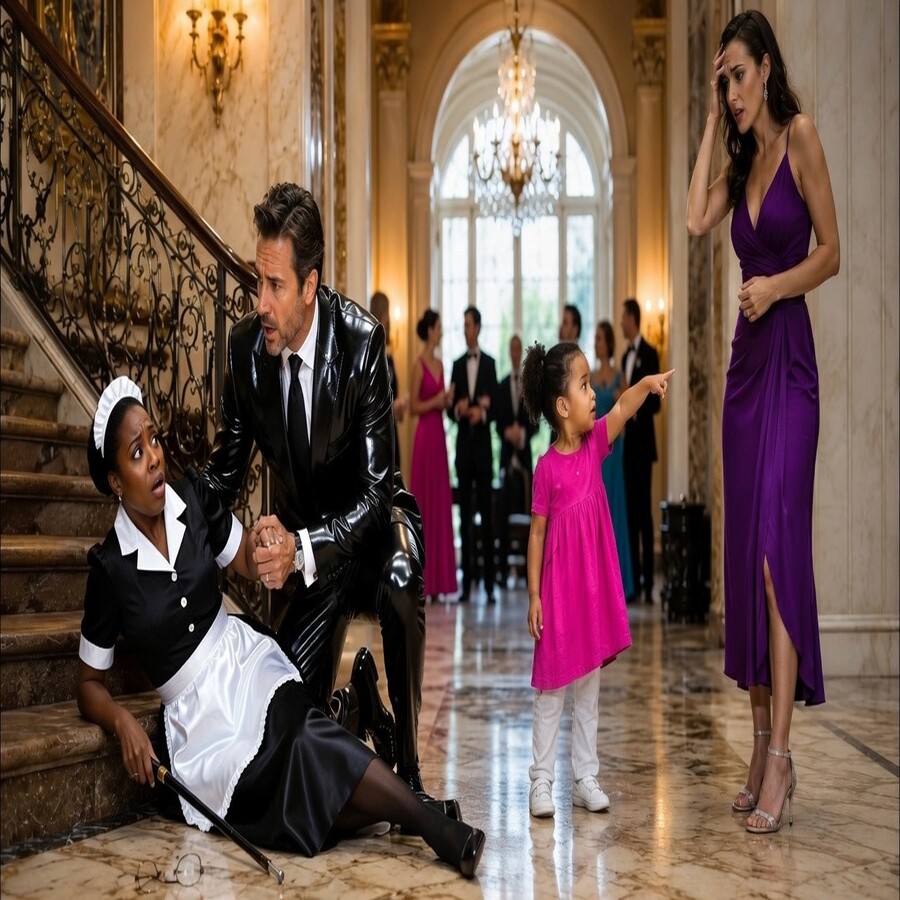
A three-year-old girl walked into a room full of the richest people in the city, pointed her tiny finger at the woman in the white dress, and said seven words that stopped the music, stopped the laughter, stopped everything.
“She pushed my mommy down the stairs.”
Nobody moved. Nobody breathed. The billionaire standing at the altar just stared at the little girl like she’d spoken a language only his heart understood. He turned slowly toward his fiancée. And in that one second before a single other word was said, his whole world quietly started to crack open.
Nobody in that house noticed her, and that was exactly how she liked it.
Maria Alvarez had been cleaning the Whitmore mansion for almost four years. In that time, she had learned the one skill that mattered most in a house like this: how to be invisible. She moved through the marble hallways like a shadow. Dusting. Folding. Wiping down counters that never seemed to get dirty. And she never once let anyone see her sweat.
Thirty-one years old, and most days she felt like she’d already lived three lifetimes.
She had good reason to move carefully. Maria’s eyesight had been failing for the last two years. A slow, creeping blur that made bright light sting and shadows swallow up the edges of things. She hadn’t told her employer. She couldn’t afford to. The glasses she wore were three prescriptions behind what she actually needed—bought secondhand from a flea market table in Queens.
And she’d learned to memorize the house instead of trusting her eyes. Twelve steps from the kitchen to the pantry. Eight from the laundry room to the back stairs. She knew the Whitmore mansion better with her feet than most people knew it with their eyes.
But none of that mattered when she looked at her daughter.
Lily was three years old, with a gap-toothed smile and a laugh that could turn Maria’s whole day around in half a second. She had her father’s dark curls—a father who had disappeared before Lily ever took her first steps—and Maria’s own stubborn chin.
Lily didn’t know they were poor. She didn’t know her mother worked six days a week for a family that barely looked at her. To Lily, the Whitmore mansion was a castle, and her mommy was the queen who kept it clean and sparkling.
She’d trail behind Maria some afternoons, when the nanny had errands and there was nowhere else for her to be. Humming little songs and touching the silk curtains like they were made of stardust.
Maria worked hard to keep it that way. She wanted her daughter’s world small and safe and full of wonder for as long as possible. Because Maria herself remembered exactly when that kind of innocence had ended for her—the day her own mother had gotten sick, the day the bills started arriving faster than the paychecks, the day she’d realized that being a good person and having a good life were not always the same thing.
She missed her mother every single day. She thought about her most in the quiet hour before dawn, when she rode two buses across the city to get to work on time, Lily asleep against her shoulder because daycare didn’t open until 7:00.
Some mornings she cried in that bus seat. Silent. Careful. So she wouldn’t wake her daughter. Other mornings, she just watched the sun come up over the rooftops and told herself:
“One more year.”
One more year, and she’d have enough saved for a better apartment. One more year, and maybe her eyes would hold out long enough to see her daughter start kindergarten.
The Whitmore house itself was its own kind of world.
Daniel Whitmore, thirty-five years old, had built a real estate empire from nothing but a business degree and a stubborn refusal to lose. And the house showed it. Floor-to-ceiling windows. A garden with roses flown in from Ecuador. A kitchen bigger than Maria’s entire apartment.
Daniel wasn’t cruel. That was the strange thing. He was distant, yes—always on calls, always somewhere else in his head. But he’d remembered Maria’s name from the very first week, which was more than she could say for most of the people she’d worked for.
Sometimes he’d nod at her in the hallway. Once, when Lily had wandered into his study and knocked over a stack of papers, he just laughed and helped her stack them back up before Maria could even apologize.
It was his fiancée who made the air in the house feel different.
Vanessa Cole had moved in eight months ago, right around the time the engagement was announced. And from the very first day, something about her unsettled Maria in a way she couldn’t quite name. Vanessa was beautiful in the polished, magazine-cover way. Thirty-three. Sharp cheekbones. A wardrobe that probably cost more than Maria would earn in ten years.
She smiled a lot. She was polite—even in front of Daniel. But when he wasn’t looking, her eyes would flick over Maria like she was a stain on the carpet that hadn’t been scrubbed out yet.
Maria told herself she was imagining it. She told herself that a woman about to marry one of the wealthiest men in the state had no reason to notice a half-blind housekeeper at all, let alone resent her. But some nights, lying awake with Lily curled against her side, she thought about the way Vanessa’s smile never quite reached her eyes when she looked at Maria’s daughter. Like Lily’s laughter in the hallways was an inconvenience. Like the mansion wasn’t big enough for a child who didn’t belong to the family.
The wedding was three weeks away. Invitations had gone out to half the city. Senators, CEOs, a few faces Maria recognized from magazine covers she used to flip through at the grocery store checkout line back when she still had money for magazines.
The house had turned into a hive of caterers, florists, and event planners speaking in hushed, urgent voices about seating charts and floral arches. Maria had been given extra hours, extra rooms to clean, extra silverware to polish until her fingers ached and her eyes burned from squinting at every smudge she couldn’t quite see clearly.
She didn’t mind the work. Work was work, and work meant a paycheck, and a paycheck meant Lily got new shoes for the fall instead of hand-me-downs with the toes worn through. But there was a tightness in her chest lately, a feeling she couldn’t shake. Like the house itself was holding its breath before something happened.
She just didn’t know yet that the something was already circling closer than she thought. And that her own daughter—small and fearless and too young to know what silence was for—was about to become the only person in that house brave enough to say what everyone else was too afraid to see.
It started with a bruise Maria couldn’t explain.
She noticed it on a Tuesday morning. A deep purple-blue mark along her left forearm, tender when she pressed it. She didn’t remember bumping into anything. With her eyesight the way it was, that wasn’t unusual. She walked into door frames more than she’d ever admit out loud. But this bruise felt different. Deeper. Like a grip.
She brushed it off. She had a wedding to help prepare for, and there was no room in her schedule for worrying about a mark on her arm.
Vanessa had started giving Maria more direct instructions lately, which was new. In the beginning, all of Maria’s assignments came through the house manager—a kind older man named Robert, who always said “please” and “thank you” like Maria was a person and not a piece of the furniture. But over the last month, Vanessa had taken to finding Maria herself, appearing suddenly in doorways with a list of tasks that always seemed designed to keep Maria as far from Daniel as possible. Cleaning the guest wing during the hours he usually worked from home. Restocking the wine cellar during his morning coffee. Anything that put walls and staircases between them.
Maria didn’t think much of it at first. Rich people were particular. She’d worked for enough of them to know that. But then came the day Vanessa asked her to carry a box of wedding china down to the cellar alone. Without Robert. Without anyone else in the house who might see.
The cellar stairs were steep, narrow, and poorly lit. Exactly the kind of place Maria’s failing eyes struggled with most. She’d told Vanessa once, gently, that stairs without a handrail made her nervous. Vanessa had just smiled and said, “You’ll be fine. You know this house better than anyone.”
Maria carried the box down those stairs three times that week. Each time, her heart pounded harder than it should have for a simple chore.
Meanwhile, Lily had started asking questions Maria didn’t know how to answer.
“Mommy, why does the pretty lady look at me like that?”
Maria had frozen over the stove that evening, spoon halfway to the pot. “Look at you like what, baby?”
Lily had shrugged—the universal three-year-old gesture for something too big for words. “Like she doesn’t like me being here.”
Maria had knelt down and pulled her daughter into a hug, told her she was imagining things, that everyone loved having her around. But that night, after Lily fell asleep, Maria lay awake staring at the water-stained ceiling of their apartment, turning the words over and over. Kids noticed things. Kids noticed things adults had trained themselves not to see.
The tension in the house kept climbing as the wedding drew closer. Daniel seemed to sense something was off too, though he couldn’t have said what. He’d taken to working even longer hours, coming home distracted, sometimes forgetting entirely that there were caterers and florists filling his home with noise and color.
Maria caught him once late at night, standing at the window of his study with a drink he wasn’t drinking, staring out at the dark garden like he was trying to solve a puzzle with no pieces.
She almost said something to him. She almost told him about the bruise, about the cellar stairs, about the strange chill that settled over her whenever Vanessa’s eyes landed on Lily. But who was she to say anything? A maid. Half blind. Barely holding her own life together. Accusing the woman about to become the lady of the house.
She’d lose her job in a heartbeat. And then what would happen to Lily? No new shoes. No apartment upgrade. No future at all if Maria let her fear speak louder than her paycheck.
So she stayed quiet. She kept her head down, did her work, and told herself that in three weeks, once the wedding was over and Vanessa had what she wanted, the tension would ease. Married women didn’t need to prove anything anymore. That’s what Maria told herself anyway. On the nights she needed something to believe.
But then came the day of the final dress fitting.
The house was packed with people. A photographer documenting the getting-ready moments for some bridal magazine. Two assistants steaming gowns. Robert directing traffic with his usual calm efficiency. Maria had been assigned to keep the hallway outside the fitting room clear and quiet. A simple task—except Lily had tagged along that day because daycare had closed early for a teacher’s meeting and there had been nowhere else to leave her.
Lily, curious and quick as ever, had wandered near the fitting room door, drawn by the shimmer of white fabric she could see through the gap. Maria had reached for her hand just a beat too late. The door swung open. Vanessa stood there in her wedding gown—unfinished, pins still glittering along the hem—and her face, for just one unguarded second before she composed herself, twisted into something Maria had never seen on her before. Not annoyance. Not impatience. Something colder. Something that made the hair on Maria’s arms stand up.
“Get her out of here,” Vanessa said, voice low and tight. “Now!”
Maria scooped Lily up immediately, apologizing, backing away down the hallway, heart hammering so hard she could feel it in her throat. Lily, confused, looked back over her mother’s shoulder at the woman in white.
“Mommy,” she whispered. “Why does she look so mad all the time?”
Maria didn’t have an answer. She just held her daughter tighter and carried her toward the stairs, toward the quiet safety of the laundry room where they could wait out the rest of the day unseen. She didn’t know, as she climbed those familiar steps with her half-blind daughter on her hip, that the coldest moment of her life was still three days away. And that when it came, it would happen in front of everyone.
The morning of the wedding rehearsal dinner, the house looked like something out of a dream. String lights wound through the garden trees. A string quartet tuned their instruments on the terrace. Long tables draped in ivory linen stretched across the lawn, set for two hundred guests.
Maria had been on her feet since 5:00 in the morning. Carrying trays. Arranging chairs. Trying to keep Lily close but occupied with a coloring book in a quiet corner of the kitchen.
She’d been sent again to the cellar, this time for extra crystal glasses Vanessa insisted weren’t in the pantry—though Maria had checked and knew they were. She didn’t argue. Arguing wasn’t a luxury she had.
The cellar stairs felt steeper than usual that evening. The single bulb overhead flickering weaker than she remembered. Maria gripped the wall with one hand, feeling her way down, step by step, the way she always did—trusting her memory more than her eyes.
She was halfway down when she heard footsteps behind her. Fast. Deliberate. And felt a hand press flat against her back.
The push wasn’t hard. It didn’t need to be. On stairs that steep, with a woman that unsteady on her feet, it took almost nothing at all. Maria’s body twisted as she fell. One arm slamming into the railing. Her head striking the edge of a step before she landed in a heap at the bottom. The world around her swimming into darker, blurrier shapes than her damaged eyes had ever shown her before.
Pain roared through her shoulder and skull. Somewhere above her, she heard the cellar door click shut. Soft and final. Like someone had simply closed it and walked away.
She didn’t know how long she lay there. Minutes. Maybe felt like hours. When Robert finally found her—drawn by a strange feeling that something wasn’t right—he found her barely conscious, blood matting her hair, whispering her daughter’s name.
Chaos erupted. Someone called an ambulance. Someone else ran to find Daniel. And in the middle of all of it, nobody thought to watch the little girl who had wandered away from her coloring book in the kitchen, drawn by the sudden noise. She slipped out toward the garden, where the rehearsal dinner guests had already begun to gather beneath the string lights, waiting for the bride and groom to make their entrance.
Lily found her mother’s phone abandoned on the kitchen counter and, in the particular logic of a frightened three-year-old, decided the only thing to do was go find someone important. She walked straight through the terrace doors in her little paint-stained overalls. Past caterers too busy to notice. Past guests murmuring about the ambulance sirens they could faintly hear in the distance. Until she reached the raised platform where Daniel stood in his rehearsal suit, phone pressed to his ear, panic written across his face as Robert relayed what had happened.
And that’s when Vanessa arrived on the terrace too. Gliding in from the side entrance in her ivory dress. Smoothing her hair. A little breathless. A little too composed for a woman who’d just heard the housekeeper had fallen down the stairs.
Lily saw her. And Lily—who had spent weeks watching the way this woman’s eyes turned to ice around her and her mother, who had felt something in her small chest that she didn’t have grown-up words for yet—finally found the only word she needed.
She pointed one small finger straight at Vanessa. Her voice ringing out clear and high across a terrace that had suddenly gone completely silent.
“She pushed my mommy down the stairs.”
Two hundred guests froze. The string quartet stopped mid-note. Somewhere near the back, a champagne glass slipped from someone’s hand and shattered against the stone. And even that sound seemed to echo forever in the silence that followed.
Daniel lowered his phone slowly, his face draining of color as he turned to look at his fiancée. Vanessa let out a short, sharp laugh, glancing around at the guests like she expected them to laugh with her.
“She’s three,” Vanessa said. “She doesn’t know what she’s talking about.”
But Lily didn’t waver. She stood her ground in her little paint-stained overalls, chin lifted, eyes locked on the woman in white.
“I saw you,” she said, quieter now, but somehow even more devastating for it. “You came out the door. Mommy was already on the floor.”
Daniel’s world, in that instant, cracked wide open. Every quiet unease he’d felt over the last few months. The strange tension whenever Maria was mentioned. The way Vanessa always seemed to know exactly where the housekeeper would be and when. The odd chill that had settled over his own home in the last several weeks without him ever being able to name why—all of it slammed into him at once, arranging itself into a shape he suddenly, horribly understood.
He didn’t say a word to Vanessa. He turned and ran for the house. Robert already ahead of him. Guests parting like water as he sprinted past the terrace doors, down the hallway toward the cellar where paramedics were already lifting Maria onto a stretcher. Her face pale. Her eyes barely open. One hand reaching weakly for a daughter who wasn’t even in the room.
Daniel reached her side just as they wheeled her toward the front door. He grabbed her hand, and for the first time in four years of walking past her in his own hallways, he actually looked at her. Really looked. And saw a woman in pain. A woman who had been carrying more than he’d ever bothered to notice.
“Stay with her,” he told the paramedics, voice cracking. “I’m riding with you.”
Behind him on the terrace, two hundred wedding guests stood in stunned silence around a little girl who refused to cry, refused to back down, standing alone in the wreckage of a celebration that would never happen the way anyone had planned.
While the bride—still in her white dress—stared at the empty space where her fiancé had been standing only seconds before. And understood for the first time that the ground beneath her had just disappeared completely.
The hospital hallway smelled like antiseptic and fear. Daniel Whitmore had never felt so useless in his entire life. He sat in a plastic chair outside Maria’s room, still in his rehearsal dinner suit, tie loosened, hands pressed together like a man praying—though he hadn’t prayed in years.
Lily sat beside him, curled into Robert’s side, clutching a stuffed rabbit one of the nurses had found for her. She hadn’t cried once. Not through the ambulance ride. Not through the waiting. And something about that steadiness unsettled Daniel more than tears would have. This little girl had spoken up in front of two hundred people without flinching. He was thirty-five years old, and he could barely find the courage to look at his own reflection right now.
The doctor came out an hour later with news that was both a relief and a warning. Maria had a concussion, a fractured wrist, and bruising along her ribs. But she would recover. The fall could have been so much worse.
Daniel felt the words land like a verdict on his own conscience. Could have been so much worse. And it almost was. In his house. Under his roof. Because of the woman he was supposed to marry in six days.
When he was finally allowed into her room, Maria was awake, propped against the pillows. Her face pale beneath a bandage at her hairline. She looked smaller than he’d ever noticed before. And it struck him with a fresh wave of shame that he’d walked past this woman for four years and never once really seen her.
“Mr. Whitmore,” she started, her voice already trying to apologize, already worried—he could see it plainly—about her job, about the cost of the ambulance, about anything except herself.
“Don’t,” he said quietly, pulling a chair to her bedside. “Please, just don’t apologize to me. Not after what happened to you in my house.”
Maria’s eyes filled. And for the first time since he’d known her, she let herself cry in front of him. Four years of exhaustion. Of invisible labor. Of buses before sunrise and bruises she’d learned to explain away. Of loving her daughter fiercely while quietly falling apart at the edges. It all came out in that hospital room, and Daniel sat and listened to every word without interrupting once.
“I felt the hand on my back,” Maria whispered. “I know I did. I’m not confused. I know what I felt.”
“I believe you,” Daniel said. And meant it completely.
The secondary blow came the next morning when Robert brought Daniel the mansion security footage from the cellar hallway. Grainy. Poorly angled. But unmistakable. Vanessa in her rehearsal dinner dress, stepping into frame behind Maria on the stairs. The brief press of her hand. The fall. The door closing softly behind her as she walked away without a backward glance.
Daniel watched it twice, then a third time. His jaw tight. His stomach twisting with a kind of grief he hadn’t expected. Not grief for the wedding that wouldn’t happen. But grief for the four years he’d spent building a life with someone who could do this and still smile at breakfast the next morning.
He thought about every gala, every quiet dinner, every moment he believed he was building something real with Vanessa. And felt the whole thing curdle in his memory like milk left too long in the sun.
He called his lawyer before he called the police. Then called the police right after. Because some decisions—once you saw clearly—didn’t need a second thought.
Vanessa didn’t deny it. Not really. Not once the footage was laid out in front of her. Instead, she raged about the housekeeper who didn’t know her place. About a marriage she’d planned down to the flowers being taken from her over an “accident.” About a three-year-old who had ruined the biggest night of her life with a lie that turned out, infuriatingly, not to be a lie at all.
Daniel watched the woman he’d almost married unravel in his living room and felt strangely calm. Like watching a storm pass over from somewhere safe and dry.
The wedding, of course, was cancelled. The two hundred guests who’d stood frozen on that terrace received a short, honest message the next day. And most of them, Daniel later learned, weren’t even surprised. Several admitted they’d noticed something cold in Vanessa long before Lily ever said a word.
But it was Maria—recovering in that hospital bed with a cast on her wrist and a bandage on her head—who faced the harder decision. Because even with Vanessa gone, even with the truth laid bare, Maria knew that speaking up—that letting her daughter’s words matter—might still cost her the only job that had kept a roof over their heads for four years. Rich men forgave rich women’s crimes more often than they protected the people who cleaned up after them. She’d seen it happen before. In other houses. To other women who looked like her.
So when Daniel sat beside her bed that second evening and said quietly, “I want to help you see again properly. With real doctors. Whatever it takes,” Maria almost laughed at the strangeness of it. The absurdity of hope showing up dressed as guilt.
“You don’t owe me anything,” she told him.
“I know,” Daniel said. “I’m not doing it because I owe you. I’m doing it because for four years, I didn’t see you at all. And I don’t want to be that man anymore.”
The morning of Maria’s first real eye surgery, Lily wouldn’t stop talking.
“Will you be able to see my drawings, Mommy? Will you see the sky? Will you see me?”
She bounced on the hospital waiting room chair, swinging her legs, oblivious to the fact that her mother’s hands were trembling. Not from fear of the surgery itself, but from the sheer disbelief that this was actually happening. That after two years of blurred edges and memorized footsteps, a real specialist—paid for in full—was finally going to fix what years of exhaustion and poverty had never let her afford to fix.
Daniel had kept his word. Not loudly. Not with cameras or announcements. But steadily. The way a person keeps a promise when they finally understood what it means to actually see someone else’s life. He’d covered the surgery. Found Maria and Lily a small, sunlit apartment closer to a good school. And quietly moved Robert into the role of estate manager with instructions that no one in that house would ever again be invisible on his watch.
He hadn’t done it out of guilt alone—though guilt had opened the door. He’d done it because in the wreckage of a cancelled wedding, he’d found something he hadn’t expected. A strange, growing respect for a woman who had carried an entire life on her shoulders without ever once asking anyone to notice.
The surgery went well. Three days later, when the bandages came off in a quiet clinic room, Maria blinked against the light. And the world arrived in a way it hadn’t in years. Sharp-edged. Clear. Almost too vivid to process all at once. The nurse’s name tag. The pattern on the curtain. And then when she turned—her daughter’s face fully in focus for what felt like the first time in Lily’s whole life.
Maria didn’t say anything at first. She just looked. Really looked. At the gap in Lily’s front teeth. At the flecks of gold in her brown eyes. At the little scar above her eyebrow from a tumble off a swing set two summers ago that Maria had felt more than seen. She’d loved this face with her whole heart for three years—through a haze of blur and guesswork. And now, finally, she got to actually see it.
“You’re so beautiful,” Maria whispered.
And Lily, delighted and a little confused by the tears streaming down her mother’s face, just climbed straight into her lap and declared, “I know, Mommy. I’ve been telling you.”
The moment that stayed with Daniel longest came a few weeks later, on an ordinary Tuesday afternoon. He stopped by the new apartment to drop off some paperwork and found Lily sitting cross-legged on the floor, carefully drawing a picture with a box of crayons that still had all its colors.
She held it up to him with the fierce pride only a three-year-old can manage. It was a picture of three people standing under a bright yellow sun. A woman with dark hair. A little girl with a gap-toothed smile. And off to the side—smaller, almost hesitant—a man in a suit.
“That’s you,” Lily informed him, pointing at the smallest figure. “You’re standing a little far away because you’re still learning how to be close to people. But you’re getting better.”
Daniel laughed. A real laugh. The kind that came from somewhere deep and surprised even him. And Maria, watching from the kitchen doorway with her newly clear eyes, thought that her daughter had a way of seeing the truth of things that most grown adults spent their whole lives avoiding.
Over the following months, something quiet and unhurried grew between Daniel and Maria. Not the whirlwind magazine-cover romance he’d once planned with Vanessa, but something steadier. Built on four years of him finally paying attention and a lifetime of her finally being seen. He didn’t rush it. Neither did she. But on the evenings he came by just to sit at their kitchen table and listen to Lily’s stories about kindergarten, Maria found herself thinking that this—this ordinary, unglamorous, deeply real kind of care—was worth more than any ballroom full of string lights ever could be.
The final twist came almost a year later at a small courthouse hearing where Vanessa’s case was finally settled. Maria sat in the gallery, Daniel beside her, and watched the woman who had once looked at her like a stain on the carpet finally face the consequences of a cruelty she’d never expected to be caught for. Not by security cameras, not by lawyers, but by the plain, fearless honesty of a three-year-old who simply couldn’t understand why grown-ups thought silence was something you owed to people who hurt you.
Walking out of that courthouse into the spring sunlight, Maria held her daughter’s hand and thought about everything that blurry, frightening year had taught her. That the people who see us most clearly aren’t always the ones with perfect eyesight. And that sometimes the smallest, most powerless-looking person in the room is carrying the truth everyone else is too afraid to speak.
To everyone watching this story tonight, if you’ve ever felt invisible, if you’ve ever carried more than anyone around you seem to notice, I hope you remember Maria’s story. Being unseen for a while doesn’t mean you’ll be unseen forever. Sometimes the truth just needs one brave, small voice willing to say it out loud.
THE END
Disclaimer : This content may be created by AI for entertainment purposes. Any resemblance to real persons, events, or places is coincidental.






