The Voice from the Inferno: When My Family’s Cruelty Collided with the Secret I’d Buried for Years
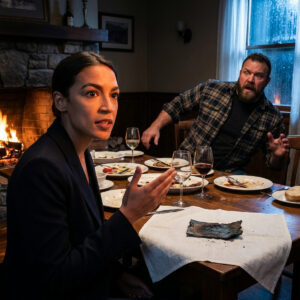
He looked me dead in the eye, the firelight from the hearth reflecting a mocking glint in his pupils, and said, “People like you don’t save anyone.” The room erupted in that familiar, synchronized laughter—the kind of laughter that has echoed through every family gathering since I was old enough to hold a fork. They saw me as the “safe” one, the girl drowning in spreadsheets and toner dust, the one who would freeze if a copy machine jammed. But as I sat there, feeling the cold condensation of my water glass against my palm, I realized their cruelty was finally on a collision course with a truth I had guarded like a state secret. My name is Katie, and for three years, I had been the ghost in the machine. That night, the ghost finally decided to speak.
Lake Windlow hadn’t changed, and in a way, that was the most exhausting thing about it. As I pulled into Uncle Jim’s driveway, the snow was piled high like silent white barricades, and the old pine trees leaned toward the house as if they were eavesdropping on the family drama within. The warm glow from the windows washed across the yard, casting a deceptive softness over everything. It looked like a postcard, but I knew the script that waited on the other side of that heavy oak door.
Inside, the air was thick with the scent of roasted rosemary and the frantic, buzzing energy of Laya’s wedding weekend. My sister, Laya, floated through the living room like a centerpiece come to life. Every hair was lacquered into place, every gesture timed for maximum charm. Beside her stood Mark, her fiancé, a man who functioned as a human spotlight. Mark was a firefighter, the town hero, a man who spoke with the easy bravado of someone who was used to being the most important person in any room he entered.
The moment I stepped inside, the familiar choreography began. “How was the flight? It must be cold in the city. Still doing that… desk job with the department?” Each question was delivered with a polite, rhythmic dismissiveness. I was the “analyst.” I was the one who handled the paperwork so the real heroes could do the real work. I nodded, I smiled, and I slipped into the last chair at the table—the one that never belonged to anyone, but somehow always belonged to me. I watched the orbit of attention swirl around Laya and Mark, feeling that old, quiet pressure against my ribs: the unspoken rule that I should remain small so the evening could keep its shine.
The shift happened halfway through the main course. Someone—perhaps it was Aunt Carol, always eager for a thrill—asked Mark to tell the story. The Redport explosion. The table went still, forks frozen in mid-air. Even Laya rested her chin on her hand, looking at him with an adoration she’d practiced in the mirror.
Mark sat up straighter, rolling his shoulders back as if bracing for a medal ceremony. He began to describe the shriek of metal collapsing, the ceiling trembling over their helmets, and the black, suffocating chemical smoke that had turned the corridors into a labyrinth of death. He painted it vividly, his voice dropping to a gravelly whisper as he described his team trapped in Shaft 3B, the heat blooming too fast in the corridor ahead.
I set my fork down slowly. My pulse began to drum a steady, rhythmic beat against my fingertips. I knew those details. I didn’t just know them; I owned them. Three years ago, while Mark had been sweating through his turnout gear, I had been locked in a soundproof concrete room, staring at three different monitors. I had been the one watching them through thermal imaging—tiny blotches of orange and red heat moving through a sea of digital grey. I had been the one watching the structural integrity markers flicker from yellow to a bleeding, terminal red.
“The voice on the radio,” Mark said, basking in the hushed awe of the room. “He was a seasoned man. You could tell by the tone. A man’s voice, steady and calm even while the roof was coming down. Because no woman,” he added with a wink to the table, “would sound that calm when the world is ending.”
The table chuckled. Everyone nodded. It made perfect sense to them. I felt a strange, cold realization click into place. Mark was giving me back fragments of my own life, but he was doing it with the absolute conviction that those fragments could never have belonged to someone like me.
“Katie’s probably drowning in paperwork,” Laya cut in, her voice slicing through the lingering tension of Mark’s story. “Those analyst types lose it if the stapler runs out.”
The laughter that followed was effortless. It was a comfortable joke. I took a sip of water, letting the ice-cold liquid steady my breath. I could have told them about the night I spent seventy-two hours straight in a command center, my eyes stinging from the glare of the screens, or the way my voice had remained a flat, unwavering line while I told a team of five men that the floor beneath them was about to become liquid. But no one was asking for that truth.
Aunt Carol chimed in again, trying to be helpful but failing as usual. “Laya once told me Katie wasn’t built for real danger. She’s the ‘safe’ one. The type who’d never last in a situation with actual consequences.”
Laya just shrugged, confirming the narrative. They didn’t just misunderstand my work; they needed me to be small so Laya could be the star and Mark could be the hero. The Redport secrets were a wound, but the way my own family had spent years shaping the container of my identity was a deeper cut—one that had been bleeding in silence for a very long time.
Mark wasn’t finished. He reached into his pocket and pulled out a small object wrapped in black cloth. The room went silent as he placed it on the white linen tablecloth. It was a charred piece of metal, warped at the edges and darkened by an intense, hellish fire.
“I carry it everywhere,” Mark said solemnly. “A reminder of the night I almost didn’t come home. We found it at the West Junction, right after the radio voice redirected us.”
My heart did a strange, stuttering dance. I recognized that piece of metal. I hadn’t touched it, but I had watched it fall. I had seen the thermal spike on the Northwest Scan. I had seen the ceiling fold exactly three seconds after I told them to “Move Left Now.”
Laya laughed, a high, condescending sound. She looked at me and asked if I’d ever seen anything that “intense” before. My fingers rested on my glass. Everything was aligning—every lie he’d told to inflate his own ego, every detail he’d stolen from my memory, and every dismissive comment my family had made about my “paperwork.”
Mark began to mock the “support staff” again, talking about how people in the back rooms panic when they see real smoke. He talked about “Real Action” versus “Spreadsheets.” He was walking toward a cliff edge, and he was too arrogant to see the drop.
The line Laya crossed next wasn’t just rude; it was the final breach. She leaned forward, her eyes gleaming with the pleasure of a final, crushing blow. “Katie, have you ever actually saved anyone?”
The question wasn’t an inquiry. It was an indictment. It was the closing argument in their case against my worth. My palm pressed against the cool wood of the table. My silence was no longer endurance; it was the gathering of a storm.
Mark leaned back, a smug smile on his face. “Like I said, the voice from Redport… that was a leader. A man’s man. A woman would have lost her composure the second the heat bloom hit.”
I inhaled—the deep, controlled breath I’d trained myself to take before making a tactical call. I set my glass down with a soft but decisive tap. The room stilled.
“Unit Six, hold position,” I said. My voice didn’t rise in volume, but its cadence changed. It became the flat, authoritative instrument of the command center. “Heat increase ahead. Debris imminent. Turn left… now.”
The words dropped into the room like live wires. Mark’s chair skidded backward with a violent screech as he recoiled, his face leaching of all color. A gasp escaped Laya, but I didn’t stop.
“Shaft 3B clear. Right side unstable. Ceiling collapse in three seconds. Keep moving. Team Two, maintain speed. West exit accessible. Thermal overload approaching… ninety seconds.”
Silence crashed over the room with the force of a closing vault. Every breath around that table froze. I let my voice return to its normal tone, though the weight remained.
“Do you remember now, Mark?” I asked.
His eyes were wide, filled with a dawning horror that carved straight through his pride. He whispered, his voice trembling, that only the person on the radio knew those details. The precise temperatures. The timing. The heat patterns that never made it into the official reports because the official reports were written by people who weren’t there.
The woman they had mocked all night had once held their lives in the palm of her hand.
Mark looked at me as if the walls of the house had vanished, leaving him back in the smoke, back in the heat, listening to the only thing that had stood between him and a shallow grave. I watched the realization hit him—slow at first, then sharp enough to crack his identity.
“You were the voice,” he choked out. “The one who got us out.”
Laya jumped up, her voice cracking as she accused me of ruining her night, of humiliating her on purpose. I looked her in the eye and reminded her that she was the one who asked if I had ever saved anyone. Now she had her answer.
Mark’s shoulders sagged. The bravado was gone, replaced by a raw, naked shame. “You saved my life,” he whispered, looking at the charred metal on the table. “And I spent all night mocking you for it.”
He reached out, his hand shaking, and pushed the piece of metal toward me. He said it had never belonged to him. It had always belonged to the person who guided them through the dark.
Laya’s face twisted in panic. She demanded to know what this meant for them, for their wedding. Mark exhaled—the long, weighted breath of a man who can no longer sustain a lie. He looked at Laya, and then at me. He said he couldn’t marry someone who built herself up by tearing others down—especially when the person she belittled was the reason he was still breathing.
Laya’s scream tore through the silence, followed by the sound of her running upstairs and the slam of a bedroom door. My parents lowered their gazes, unable to meet mine. They didn’t apologize. They couldn’t. Fear had filled the space where acceptance should have been.
I stepped onto the porch and pulled my coat close. The Minnesota air was biting, but it felt clean. Snow drifted down in slow, quiet flakes, landing on the railing without a sound. I was steady. I was self-contained. I didn’t need their audience to be real.
Behind me, the front door clicked shut. No footsteps followed. The house simply returned to its stillness, as if the evening’s eruption had never happened. But for once, that silence didn’t cut. It felt like a release.
I walked to my car, each crunch of snow under my boots grounding me more firmly in my own skin. As I slid into the driver’s seat, my phone lit up—an assignment for an early morning briefing. A small smile tugged at the corners of my mouth. That was the world where my decisions mattered.
I eased down the driveway, the headlights cutting paths through the fresh powder. At the curve above the lake, I looked back one last time. The house was still glowing, a stage set for a story that was finally finished. I didn’t look back again. My silence was never emptiness. It was depth. And not everyone is equipped to hear what lies beneath.
Katie’s journey is a powerful reminder that our worth is not defined by the roles others assign to us. Often, the people who do the most vital work are the ones who are never seen, operating in the “quiet rooms” of life while others bask in the spotlight. True strength doesn’t need to shout to be real, and true heroism often lies in the unwavering calm of a voice over a radio, guiding others through the fire.
When we allow others to make us feel small, we are participating in their lie. But when we stand in our truth—quietly, firmly, and without the need for revenge—the truth does the work for us. Katie didn’t seek to destroy Mark; she simply stopped protecting the fiction of his superiority.
Have you ever been underestimated by the people closest to you? Have you ever had to choose between staying small for someone else’s comfort or standing tall in your own truth? Share your story in the comments. Let’s celebrate the “quiet heroes” among us today.
Disclaimer : This content may be created by AI for entertainment purposes. Any resemblance to real persons, events, or places is coincidental.






