The River’s Reckoning: A Stranger’s Strangled Gasp and the Morning the Current Changed Forever
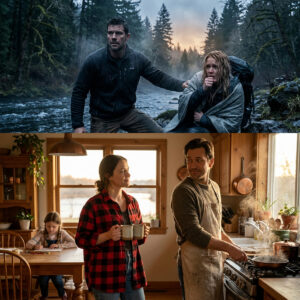
The river didn’t care about the fragile geometry of human lives. It rushed cold, dark, and heavy through the jagged edges of Mill Haven, Oregon, an indifferent titan of silver and foam that had carved its path through the valley long before men built fences beside it. It was powerful, deceptive, and completely unforgiving. Most locals knew the unspoken rules: you don’t test the current after a week of rain, and you never, ever underestimate the pull of the deep channels.
But tourists and drifters didn’t always get the memo.
Cole Harrington had lived in the shadow of that water for all of his thirty-eight years. He knew its moods—the way it whispered over smooth stones in July and the way it roared like a wounded animal in late October. He was a man built like the landscape: solid, weathered, and quiet. Three years ago, he had buried his wife, Sarah, and since then, he had lived in a sort of emotional stasis, raising his eight-year-old daughter, Maisie, and keeping his world small, predictable, and safe.
That Thursday evening, however, the safety of his routine was shattered by a sound that bypassed his ears and went straight to his marrow. It wasn’t a scream—screams were for people who still had air. It was a strangled, wet gasp, followed by a silence so heavy it felt like a physical blow. Cole didn’t think; he just ran, his boots thudding against the damp soil of the trail behind his property, heading toward the sound of a life being erased.
She was forty feet out, a frantic speck of blonde hair and thrashing limbs against the obsidian swirl of the river. A heavy hiking pack was acting like an anchor, dragging her into the freezing depths. Cole hit the water without pausing to shed his boots. The cold was a visceral punch to his lungs, a sudden, agonizing constriction that threatened to seize his heart.
He reached her in eight powerful strokes. She fought him—a blind, primal panic that nearly took them both under—but Cole was used to wrestling calves out of spring mud and holding together a world that wanted to fall apart. He grabbed the strap of her pack, hauled her chin above the waterline, and fought the current inch by agonizing inch until they reached the muddy bank.
He dragged her onto the grass, where she coughed up half the river, her body racking with violent, uncontrollable tremors. She looked up at him with wide, terrified blue eyes, her lips a bruising shade of purple.
“My pack,” she wheezed, her voice a ghost of a sound. “Lost it… everything was in…”
“It doesn’t matter,” Cole said, his voice a steady anchor in her chaos. He stripped off his heavy flannel shirt and wrapped it around her. She grabbed the fabric with both hands, pressing the warmth against her chest as if it were the only solid thing left in a liquid world. “You’re alive. That’s all that matters right now.”
He didn’t know then that the woman he was warming with his own clothes would, two days later, be standing in his kitchen at dawn, redefining the very meaning of the word “home.”
Lily Carson was a woman who had been running before she ever hit the water. She had left Chicago four months prior, following the quiet disintegration of an engagement that had burned out like a fire reaching ash. She was driving west in a used car, looking for a reset, trying to prove to herself that she could be capable, independent, and whole. The river had nearly turned that quest into a tragedy.
After the hospital discharged her, Lily found herself standing on a stranger’s porch at 7:00 a.m. with nowhere to go and a debt she couldn’t quantify. Cole opened the door, spatula in hand, a look of mild confusion crossing his face. She looked smaller in the daylight, wearing borrowed, oversized hospital scrubs, shadows under her eyes that spoke of more than just a near-death experience.
“I’m sorry to just show up,” she whispered. “I wanted to thank you… and I don’t have anywhere to go right now. I know it sounds insane.”
Cole looked at her for a long beat. He saw the bruise on her spirit that mirrored the one on her shoulder. He stepped back, widening the gap of the door. “There’s coffee,” he said.
What followed was a transition that happened in the “not making it a thing” moments. Lily stayed for breakfast, then for dinner. Then her car battery died—a small, mundane mercy that kept her anchored to Mill Haven for another night. She sat at the kitchen table, eggs and toast between them, while Maisie watched her with the unblinking, crystalline intensity of a child who hadn’t seen a woman in her father’s kitchen in years.
“You almost drowned?” Maisie asked, her chin resting on her hand.
“Yes,” Lily replied softly. “Your dad saved me.”
Maisie didn’t look surprised. She looked at Cole with a shrug. “He does that,” she said, before returning to her cereal. It was a simple statement, but it hung in the air like a title Cole hadn’t realized he was still wearing.
The guest room at the Harrington house had been a museum of sorts—a place for boxes and dust. But as Lily moved in, the room began to breathe. Cole would hear the floorboards creak as she moved, a sound that should have been intrusive but felt, strangely, like a resolution.
They lived in a delicate, unspoken tension. Cole was a man of few words, his grief having taught him that language is often insufficient. Lily was a woman of too many thoughts, her heart still reeling from the abandonment of her old life. They met in the kitchen at night, the hum of the refrigerator the only music between them.
On the second evening, he found her at the back window, her silhouette framed by the moon as she watched the river rush past in the dark.
“You scared of it now?” he asked, joining her.
“No,” Lily said, her reflection in the glass looking back at him. “But I respect it more.”
“Everything powerful can be a threat,” Cole noted, his voice low and gravelly. “Doesn’t mean you run. Means you learn to read it.”
Lily turned to him then, the lighting from the hallway catching the dampness in her eyes. “I think I’ve been running from things for a while.”
“I know,” Cole said. It wasn’t a judgment; it was an admission of his own history. He had been running by standing still, staying busy so the silence of Sarah’s absence wouldn’t catch up to him. In that moment, the distance between the savior and the saved vanished. They were just two people standing on a bank, watching the water go by.
By the third morning, Lily was wearing one of Cole’s flannel shirts—the one he had wrapped her in at the riverbank. It was too big, the sleeves rolled up past her wrists, smelling of cedar and woodsmoke. She leaned against the doorframe, watching Cole navigate the morning routine with the practiced efficiency of a man who had been doing it all alone for a thousand days.
“I should probably get back on the road today,” she said.
Cole didn’t look up from the pan. “Probably. Maisie has school. You have work. I’ve already overstayed.”
“You haven’t.”
He stopped then, turning to look at her directly. His eyes were unhurried, steady, and entirely too perceptive. “You haven’t overstayed, Lily. But I’m not going to ask you to stay. That’s your call.”
The weight of that choice settled in the kitchen. Lily stood there for a long time, the smell of bacon and the sound of the wind in the pines filling the silence. She eventually walked to the cabinet, took down two mugs, and poured the coffee herself. It was a small act, but it was a claim.
Cole didn’t smile, but the lines around his eyes softened. The door had finally found its frame.
Lily didn’t stay forever—not that day. She went to Portland, she called her sister, she closed the chapters of her life in Chicago that were still bleeding. She spent two weeks in a sterile hotel room, thinking clearly for the first time in years. She applied for a remote position she’d been avoiding, realizing that the “solo adventure” she’d been seeking wasn’t about a hike; it was about the strength to choose her own direction.
And then, on a Tuesday in November, as a light frost began to coat the Oregon pines, she found herself back on the highway.
On the passenger seat lay the flannel shirt. She had washed it, folded it with the precision of a letter, and wrapped it like something precious. But she knew, as the familiar sign for Mill Haven appeared, that the shirt was just an excuse.
When she pulled into the gravel driveway, Maisie was in the yard, a whirlwind of red hair and winter boots. The girl froze, her eyes widening as she recognized the car. Then, she sprinted. Lily was out of the car before the engine had fully died, her arms open to catch the girl who had become the heartbeat of her new life.
Cole appeared in the doorway. He was wearing a tank top despite the chill, his shoulders braced against the frame. He watched them for a long moment, those same unhurried eyes now holding a light that hadn’t been there in October.
“You forgot your jacket,” he called out, a ghost of a smile tugging at his lips.
Lily looked at him across the yard, her heart finally finding its rhythm. “I brought it back,” she said.
“I know,” Cole replied. He stepped back, a familiar gesture of invitation. “There’s coffee.”
The story of Cole and Lily is a testament to the fact that we often find our greatest purpose in the moments we least expect to be interrupted. Cole Harrington thought his life was a finished book, a story of grief and duty that would remain unchanged until Maisie grew up. He was standing still, a man frozen in his own history.
Lily Carson thought her life was a series of exits, a long road with no destination. She believed that independence meant never needing anyone to pull her from the current.
It took the violence of a river to break them both open. This narrative reminds us that kindness is not just an act of charity; it is a bridge. When Cole pulled Lily from the water, he wasn’t just saving a stranger; he was saving himself from the stagnation of his own silence. Sometimes, the universe has to knock us off our feet and throw us into the deep end just to remind us that we are still capable of swimming—and that no one was ever meant to swim alone.
How often do we walk past the “rivers” in our own lives, afraid of the cold? Have you ever had a stranger change your landscape in a single afternoon? Share your stories of unlikely connections and second chances in the comments below. Let’s talk about the moments that made us stop running.
Disclaimer : This content may be created by AI for entertainment purposes. Any resemblance to real persons, events, or places is coincidental.






