THE RIVER’S DREADFUL SECRET: A POST-MORTEM OF THE TRACY HARRIS CASE
The cold, muddy waters of the Choctawhatchee River do not offer up secrets willingly. In Ozark, Alabama, the river is a boundary, a place of baptism and recreation, but in March 1990, it became a tomb. When the body of 22-year-old Tracy Harris was discovered snagged against a rotting log, the water receding just enough to expose the horror beneath, the first fracture in the town’s collective consciousness occurred. She was a mother, a shy waitress, a woman who—according to every soul who knew her—was terrified of the water.
The first ten seconds of an investigation often dictate the next thirty years. As the District AttorneyKirk Adams would later reflect, the sight of Tracy’s lifeless form was not just a forensic puzzle; it was an emotional catastrophe. There were marks around her neck—dark, purplish reminders of a struggle that ended in the crushing of a windpipe. The autopsy confirmed the inevitable: strangulation followed by drowning. Tracy Harris had been murdered. And in the eyes of the law, and the vengeful whispers of a small town, there was only one man capable of such a deviation from humanity. Her ex-husband, Carl Harris.
To understand why Carl Harris became the protagonist of this thirty-year nightmare, one must dissect the anatomy of a toxic marriage. Psychologists often refer to the “cycle of violence,” a repetitive pattern of tension building, explosion, and a “honeymoon” phase that tethers the victim to the abuser. Tracy and Carl lived within this fortification of pain. They were recently divorced but remained under the same roof, sleeping in the same bed—a psychological entanglement that suggested a deep, dangerous inability to let go.
Carl Harris hid in plain sight by adopting the persona of the hardworking, albeit volatile, family man. In a town like Ozark, domestic violence was often viewed through a distorted lens of “private matters.” Witnesses like Dawn Beasley, who lived with the Harrises for a month, saw the mask slip. She recalled a moment at the dinner table where a simple request for water bill money transformed Carl into a predator. He flew into a rage, bending Tracy backward over the table, his hands white-knuckled around her throat.
“I’m going to kill you,” he had screamed. It was a premeditated threat delivered in front of an audience, a red flag so bright it should have halted time itself. Yet, the community’s reaction was a slow-motion failure. Psychopathy—or at least the traits of it—often manifests as an absolute need for control. Carl didn’t just want Tracy; he wanted to own the air she breathed. When she vanished on March 7th, 1990, the town didn’t ask what happened. They asked why it took so long.
Carl’s behavior after the disappearance was a masterclass in what forensic psychologists call “impression management.” He visited neighbors, feigning a “genuine concern” that bordered on the nauseating. He leaned into the narrative of the devoted father, stating, “I can see her leaving me, but she would never leave this baby.” By positioning himself as the abandoned lover, he sought to manipulate the initial police response. It worked, for a while. The mask was thick, reinforced by the lack of physical evidence at the home. No blood, no struggle, just a missing woman and a husband with a reputation for violence.
Ozark, Alabama, is the kind of place where the grocery store milk aisle serves as a local courthouse. Years after Tracy’s death, citizens would stand in those aisles, watching Carl Harris pass by, and whisper, “There’s the boy that finally killed that girl.” The environment was a suffocating blend of southern charm and dark suspicion. The crime didn’t happen in a vacuum; it happened in a house where the walls were accustomed to the sound of Tracy’s shyness being met with Carl’s roars.
The setting of the murder—the river—added a layer of psychological cruelty. Tracy’s phobia of water was legendary. Her childhood friend, Selena Dodson, remembered Tracy becoming hysterical during her own baptism, the simple act of being submerged triggering a primal terror. For the killer to choose the river as a disposal site was a final act of desecration, a way to ensure Tracy’s last moments were spent in the grip of her greatest fear.
The mundane details of that night—Carl picking Tracy up from the restaurant, dropping her at home, and then supposedly heading to his supermarket job—formed the basis of his alibi. But an alibi is only as strong as the silence of those who know better. The police narrative, fabricated or not, placed Carl in a jet-black timeline: leaving work at 9:00 PM, killing Tracy, driving seven miles to the bridge, dumping the body, and returning to pick up a friend by 9:30 PM. It was a physical impossibility, a forensic deviation that the Ozark Police Department chose to ignore in their haste to provide the town with a villain.
In 2016, the Ozark Police Department’s Cold Case Unit turned the page back to 1990. For twenty-seven years, Carl Harris had lived under a cloud of suspicion that followed him from Alabama to South Carolina. He had worked as a bouncer, in construction, and had started a new family, but the “rat bastard” label—as Dawn Beasley so bluntly put it—remained.
When investigators called Carl in 2016, his reaction was a fascinating study in cognitive dissonance. He claimed to think it was “good news,” hoping they had found the “real” killer. But the investigators weren’t looking for a ghost; they were looking to nail the man they had missed. The psychological pressure of a cold case interview is immense. Investigators use the “Reid Technique” or similar methods to break down a suspect’s defenses, looking for micro-expressions of guilt: the sudden dryness of the mouth, the shifting of weight, the inability to maintain eye contact.
However, Carl didn’t break. “I never put my hands on Tracy. Never,” he insisted. Herein lies the deviation: fourteen witnesses had seen him choke her, yet he denied the very existence of the abuse. This type of pathological lying is often a defense mechanism to preserve a fractured ego. To Carl, the truth was whatever he needed it to be to survive the room. The prosecution, led by Kirk Adams and Jordan Davis, built a case that was “circumstantially strong” but forensically thin. They relied on the cumulative weight of Carl’s violent history, his 17-year-old girlfriend, and the toxic atmosphere of his marriage. They were preparing to put a man on trial for a crime he didn’t commit, fueled by the very real crimes of domestic abuse he had committed.
The trial was set for January 13, 2020. The machinery of justice was grinding toward a conviction. Carolyn, Tracy’s daughter, who was only four when the river took her mother, was now a grown woman seeking the blood of the father she barely knew. She had been raised by her grandmother in Texas, her childhood peppered with the certainty that her father was a monster. She attended every hearing, her presence a silent, accusing phantom in the courtroom.
But justice has a way of being torpedoed by the unlikeliest of sources. Just days before the trial, prosecutor Jordan Davis decided to follow a single, overlooked lead from 1990: a woman named Dawn Halbert, now Dawn Beasley. Dawn had lived with the Harrises during the month of the murder. When Jordan finally reached her, she expected a witness who would provide the final nail in Carl’s coffin. Instead, she found a woman whose life was about to implode.
Dawn’s initial refusal to testify was more than just “job stress.” It was the heavy, suffocating weight of an “incredible secret” she had kept for three decades. When the subpoena arrived, the “dark curtain” she had pulled over her past was shredded. In a dramatic phone call, she told Jordan Davis the words that would nauseate the District Attorney’s office: “You have an innocent man on trial.”
Dawn revealed that on the night of March 7, 1990, her then-fiancé, Jeff Beasley, came home in the middle of the night. He was shaking, the smell of the river perhaps still clinging to his clothes. “I accidentally hurt her and now she’s dead,” he had confessed. The “she” was Tracy.
Jeff’s story was a classic example of a “displacement of guilt.” He claimed he went over to the Harris home to talk Tracy into leaving Carl. A fight ensued—a “tussle”—and he killed her. He took her to the river not out of malice, he claimed, but because he didn’t want the family to find her body in the house. Dawn, twenty years old and pregnant, made the “impossible choice” to stay silent. She wanted a “loving family,” and she was willing to bury Tracy Harris’s justice to get it.
This psychological surrender is common in co-dependent relationships involving domestic violence. Dawn was terrified that if she spoke, her life would be “thrown away.” For thirty years, she and Jeff lived a lie. They married, had four children, and never spoke of the murder again. “We just pretended it never happened,” Dawn said. This collective amnesia is a hallmark of trauma-bonded couples. Even after Jeff was sent to prison for other crimes, even after he became abusive toward Dawn, she kept the secret. She was sorry for herself, and only years later, sorry for Carolyn.
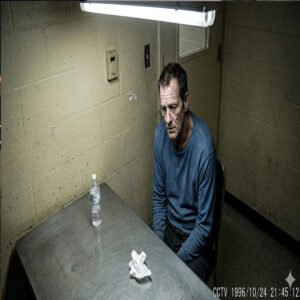
The Ozark Police Department moved swiftly. They tracked down Jeff Beasley, now a truck driver, and brought him into the interrogation room—the same room where Carl had sat years before. Jeff’s demeanor was the polar opposite of Carl’s. While Carl was defiant and aggressive, Jeff was hesitant, a man whose guilt was a physical weight he was tired of carrying.
He agreed to a polygraph—a “lie detector” test that measures autonomic responses. When the examiner told him he had failed, the psychological wall collapsed. Over four hours, Jeff Beasley spun a new, perhaps more sinister lie: he claimed he and Tracy were having an affair. He claimed they were wading in the river—a blatant lie given Tracy’s phobia—and they argued. “She went down and didn’t come back up,” he stated.
Prosecutors didn’t buy the “accident” narrative. The bruises on Tracy’s neck didn’t come from a “tussle” in the water; they came from the deliberate application of lethal force. Jeff eventually confessed to pushing her under. The confession matched the forensic truth that had been sitting in a file for thirty years: Tracy Harris had been strangled and drowned. The cat-and-mouse game was over. The mouse had finally walked into the trap of his own making.
On January 13, 2020, the day Carl Harris was supposed to stand trial for murder, the Dale County District Attorney held a press conference to dismiss the charges. Carl Harris was a free man, but he was not an unscarred man. He filed a $6 million lawsuit against the city of Ozark, alleging negligence and the fabrication of evidence. The “what ifs” that haunt the District Attorney are indeed nauseating. If Dawn Beasley hadn’t been called, an innocent man—guilty only of being a “rat bastard” husband—would likely be serving a life sentence.
The impact on the community was a quiet, stunned silence. The “Why” of the crime was rooted in Jeff Beasley’s own dark impulses—a man who had served time for burglary and escape, a man who saw Tracy’s vulnerability and decided to extinguish it. The societal reflection is one of collective failure. A town was so convinced of one man’s guilt that they allowed the real predator to drive a truck through their streets for thirty years.
Carolyn Harris remains the ultimate victim of this narrative. She learned that her father didn’t kill her mother, but she also learned that her father was an abuser who refused to apologize for the pain he did cause. “I can’t forgive him if he can’t be man enough to look at me and tell me what he did,” she said. The forensic truth solved the murder, but it could not heal the psychological fractures of a family built on violence. Tracy Harris, the “sweetest person” Ozark had ever met, remains a shy memory, her justice delayed by three decades of silence and a river that kept its secrets far too long.
Psychologists often observe that in cases of long-term secrecy, the truth doesn’t just “come out”; it erupts when the pressure of the lie exceeds the strength of the social mask. Dawn Beasley’s decision to speak was a desperate act of self-preservation against the looming perjury of a trial. Jeff Beasley’s confession was the inevitable end of a man whose psychopathy was tempered by a limited intellect.
The Tracy Harris case stands as a grim reminder of the “tunnel vision” that can plague law enforcement. By focusing solely on the “obvious” suspect, they ignored the red flags of the criminal living in the same house. The mundane environment of suburban Alabama provided the perfect camouflage for a nightmare. In the end, justice was served, but it was a cold, bitter meal, served thirty years too late to save a young mother or the childhood of the daughter she left behind.
Disclaimer : This content may be created by AI for entertainment purposes. Any resemblance to real persons, events, or places is coincidental.






