The Architect of Modern America or a Shadowy Mirror of Dictators? The Dark Legacy of FDR
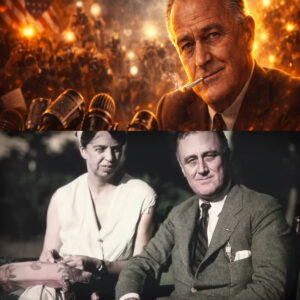
The year was 1933. The world was screaming. In the United States, twenty-five percent of the population stood in breadlines, their eyes hollowed by the Great Depression. Across the Atlantic, Germany was reeling from economic collapse. In that same year, two men rose to power promising a “New Order” and a “New Deal.” One was Franklin Delano Roosevelt; the other was Adolf Hitler. While history has painted them as polar opposites, a closer look into the forgotten archives reveals a chilling synchronicity in their tactics, their rhetoric, and their hunger for absolute control. This is not the FDR you learned about in high school. This is the story of a man who fought fear with fear, who revolutionized a nation while ignoring some of its darkest human rights atrocities, and whose decisions—made in the flickering light of his fireside—still haunt the globe today.
Franklin Delano Roosevelt did not enter the world with a whimper. Born on January 30, 1882, in the lush, rolling estates of Hyde Park, New York, he was a child of the American aristocracy. As the only child of James and Sarah Delano Roosevelt, he was cocooned in privilege, educated by private tutors until he was fourteen. He was a young man of easy smiles and smooth hands, a fifth cousin to the legendary Teddy Roosevelt. He moved through Groton and Harvard with the effortless grace of someone who knew the world was his for the taking.
Yet, behind the polished veneer of the Harvard graduate and Columbia law student lay a man who struggled to find his own spark. He was not a stellar student; he was a social butterfly in the halls of power. It wasn’t until he met his cousin Eleanor—an activist with a heart for the tenement-dwelling poor of New York—that Franklin began to see the cracks in the gilded age. They married in 1905, but the union was soon stained by a betrayal that would redefine their lives. Eleanor discovered Franklin’s affair with her social secretary, Lucy Mercer. A divorce was threatened, a promise was made to never see Mercer again, and a cold, political marriage of convenience was born.
Then, in August 1921, the world stopped turning for Franklin. While vacationing at Campobello Island, he was struck by poliomyelitis. The man who was built for the spotlight was suddenly paralyzed, his legs rendered useless. His mother urged him to retire to Hyde Park and fade into the shadows of a country gentleman. But Eleanor and his advisor, Louis Howe, saw something else. They saw a man whose physical weakness could be transformed into a symbol of national strength. They kept his image alive, teaching the public to see not a man in a wheelchair, but a titan standing tall against adversity.
By 1928, the “Roaring Twenties” were reaching a fever pitch of irresponsible speculation. Franklin had clawed his way back into politics, winning the New York governorship by a razor-thin margin. Then came October 28, 1929—Black Monday. The stock market didn’t just crash; it evaporated. Stocks fell thirteen percent in a single day, and the global economy took a nose dive from which it would not recover for a decade.
The Federal Reserve, a young and inexperienced entity, tried to put the brakes on the flowing cash, but they pressed too hard. Interest rates soared, businesses closed, and by the time Roosevelt set his sights on the White House in 1932, the American worker was desperate. FDR watched the events in Europe with a hawk’s eye. He saw the National Socialist German Workers Party in Germany promising jobs, military rebuilding, and massive public works. He saw a desperate people reaching out for a savior.
FDR stepped onto the stage and uttered the words that would ignite a movement: “I pledge you, I pledge myself, to a new deal for the American people.” He created a “Brain Trust” of advisors and admitted that his plan was an experiment. He would take control of the federal government in a way no president ever had. He was the savior the masses had been praying for, but the cost of salvation was a radical shift toward a pseudo-socialist agenda that would make the wealthy tremble and the Constitution groan.
As Roosevelt took the oath of office on March 4, 1933, he famously declared, “The only thing we have to fear is fear itself.” But there was something much more terrifying happening under his watch—something that historians often skip over in the rush to praise his economic reforms.
In 1932, the government began funding a project in Macon County, Alabama, known as the Tuskegee Syphilis Experiments. Six hundred African-American men, mostly poor and illiterate sharecroppers, were enrolled in a study to observe the natural progression of syphilis. They were told they were being treated for “bad blood.” In reality, the government doctors intentionally withheld treatment, even after penicillin was discovered to be a cure. They watched as these men went blind, went insane, and died, all so they could perform autopsies for “research.”
FDR, the man who spoke of a “New Deal” for all Americans, allowed this program to not only continue but to accelerate. At the same time, similar experiments were being conducted by Unit 731 in Japan and by doctors in Nazi Germany—men who would later be hanged at Nuremberg for the same crimes FDR permitted on American soil. The “champion of the common man” had a blind spot that was black, poor, and dying in Alabama, and his silence on the matter remains a dark stain on the fabric of his legacy.
To stop the hemorrhaging of the American economy, Roosevelt’s first act was a brutal show of power: he ordered all banks closed, regardless of their solvency. This “Bank Holiday” was designed to stop panicked depositors from withdrawing their life savings. Through his “Fireside Chats,” his voice radiating through millions of radio sets with the warmth of a trusted uncle, he restored public confidence. But behind the scenes, he was tightening the screws.
He signed the Agricultural Adjustment Act (AAA), a program that paid farmers not to grow crops in order to raise prices. In a world where Americans were literally starving, the government was ordering the destruction of newly planted fields and the slaughter of livestock. FDR wanted tax dollars and price stabilization; the hunger of the masses was a secondary concern.
He pushed the National Industrial Recovery Act (NIRA), attempting to dictate minimum wages and maximum hours across entire industries. The Supreme Court eventually struck these down as unconstitutional, but FDR was undeterred. He viewed the Constitution as a “paltry” obstacle. When the Court stood in his way, he attempted the first “court-packing” scheme in history, trying to appoint a new justice for every sitting member over the age of seventy. He was accused of being a dictator in a tuxedo, a man who would burn the law to save the economy.
The year 1936 brought the Berlin Olympics. The world watched as Jesse Owens, a black American, won four gold medals and shattered Hitler’s myth of Aryan supremacy. But back in Washington, FDR refused to even invite Owens to the White House. Roosevelt never hid his prejudices; he did nothing to stop segregation in the military or the government. He was a man of his class and his era, and for all his talk of “the forgotten man,” many were still left in the cold.
By 1939, the winds of war were howling in Europe. On May 13, the SS St. Louis sailed from Germany, carrying 937 Jewish refugees fleeing the impending Holocaust. They reached the coast of Florida, the lights of Miami visible from the deck. They begged for asylum. Roosevelt, under pressure from southern Democrats and isolationist quotas, personally denied the ship permission to dock. He sent them back. Two hundred and fifty-four of those passengers—doctors, lawyers, children—died in the gas chambers of the Holocaust because FDR would not risk a political skirmish over a boatload of refugees.
Franklin Delano Roosevelt was a man of immense contradictions. He saved the American economy from the brink of total collapse, yet he presided over some of the most horrific human rights violations in domestic history. He gave the American people a sense of hope during their darkest hour, yet he attempted to dismantle the very checks and balances that protected their freedom.
Was he a hero who did what was necessary, or was he a mirror of the very dictators he would eventually fight? His legacy is not a simple one of triumph. It is a cautionary tale of what happens when a nation trades its liberty for the promise of security, and when a leader decides that the end justifies any means.
We look back at FDR and see the New Deal, the Tennessee Valley Authority, and the Social Security Act. But if we listen closely to the echoes of history, we also hear the cough of a dying sharecropper in Alabama and the cries of refugees on a ship turned away from a land of the free. The world we live in today was built by his hands—hands that were as capable of great healing as they were of cold, calculated silence.
How do you view FDR’s legacy today? Can a leader truly be considered “great” if they permit atrocities like the Tuskegee experiments or the turning away of the SS St. Louis for political gain? Is the “New Deal” a blueprint for modern progress or a warning of government overreach? Share your thoughts and your family’s history with the Depression in the comments below. Let’s unearth the truth together.
Disclaimer : This content may be created by AI for entertainment purposes. Any resemblance to real persons, events, or places is coincidental.






