My Neighbor Said, “You Had A Girl Over Last Night” I Joked “Wish It Was You?”
I was in my driveway running a tape measure along a fresh cut of pine when I noticed it. A neon orange sticker, bright as a traffic cone, slapped right on the front door of the house next to mine. I set the tape measure down and stared at it for a second. In this neighborhood, a sticker like that meant one thing.
The HOA had paid a visit, and whoever was on the receiving end was not having a good day. I picked up my utility knife and went back to work. The pine was straight and clean, the kind of wood that does exactly what you expect it to do. I liked that. Predictable things, things that followed the rules. I lined up my next cut, pressed my thumb against the grain, and let the rhythm of the work pull my focus back in.
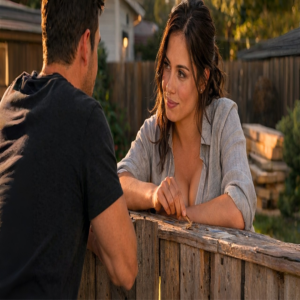
That lasted about 4 minutes. A heavy metallic crash came from the yard next door, loud enough to make me look up. I set the knife down, wiped my hands on the front of my jeans, and walked to the fence. I leaned my forearms on the top rail, and looked over. Serena was in her backyard fighting with a rusted metal trash can that clearly had no intention of cooperating.
She was wearing a light gray linen shirt with the sleeves rolled up to her elbows, and her dark hair was pulled back. She looked focused. Not the frustrated kind of focused where someone is about to give up. The kind where they have already decided they are not giving up no matter what. But underneath all of that, she looked tired.
Not the kind of tired a good night of sleep fixes. The kind that comes from carrying something heavy for too long and not telling anyone about it. She saw me watching. She abandoned the trash can and walked over to the fence, slow and easy, like she had not just been wrestling with a piece of rusted metal. She planted her elbows on the top rail directly across from me and rested her chin near her hands.
A small smile touched the corner of her mouth. It looked a little guarded, like she had put it there on purpose. “I saw you bring a girl home last night,” she said. Her voice was steady, “Casual, maybe a little too casual. I did not say anything right away. I just looked at her. The late afternoon light was cutting long shadows across the grass between us, and the air smelled like warm cedar and cut pine from my driveway.
I let the silence sit there for a moment, long enough to be noticeable. Then I let one corner of my mouth move up just slightly. “Are you jealous?” I asked. She blinked once. Then she let out a short, quiet breath that was not quite a laugh, but was trying to be. She looked down at the fence rail and her fingers found a loose splinter of wood and started picking at it absently.
You usually only bring lumber into that driveway. She said, “I was starting to think you were building a wooden roommate in that garage.” I watched her for a second. She was doing a good job of keeping things light, but something underneath her words had weight to it. “My sister Lily,” I said, keeping my voice level.
Her apartment flooded. burst pipe. She is staying in my guest room until the drywall gets replaced. Oh. Something shifted in Serena’s face. The small smile stayed, but the effort behind it dropped away. What was left looked closer to the truth. That is good of you to have space for her. She looked back down at the fence rail.
Her fingers kept working at the loose splinter. She was not picking at it because she was bored. She was picking at it because her hands needed something to do while her mind was somewhere else. I looked at the neon sticker on her front door. What is the orange sticker, Serena? I did not soften it. I just said it the way I would read a measurement off a tape.
Flat and direct. Her shoulders dropped about half an inch. She stopped picking at the wood. She told me the HOA board had done a driveby inspection earlier that week. Mrs. Callaway, the board president, had flagged two things. First, the front porch. The structure had a visible sag, and the columns at the base were showing signs of damage.
Callaway was calling it a safety hazard. Second, the wooden fence running between our two yards. According to the board, it no longer met the neighborhood aesthetic guidelines. Too weathered, too old, wrong look. Serena had 14 days to fix both. If she missed the deadline, the fines started at $200 a day. 14 days is not even enough time to find a contractor right now, she said.
And even if I could find one, I cannot afford to hire one. What are you planning to do? I asked. She looked at the porch. Then she looked at me. I am going to figure out how to fix it myself. I did not laugh. I did not tell her that was a bad idea. I just looked at the porch the way I look at a piece of wood before I decide what it needs.
The columns were water damaged at the base. The roof over the porch had a lean to it that told me the ledger board. The beam that connects the porch roof to the main house was likely in rough shape. One serious storm and the whole thing would pull away from the brick. “You are an architect,” I said. “You draw the plans. You do not frame the loads.” She looked back at me.
Her chin came up just slightly. I will learn. That one word told me everything. She was not asking for help. She had already closed that door and locked it. What she was doing was surviving the only way she knew how. Quietly and on her own terms. I looked at the porch one more time. Then I looked at her hands still resting on the top rail of the fence.
Knuckles a little pale from how hard she was gripping it. You do not have the tools for that kind of job. I said, “I will rent them.” She held my gaze when she said it. “No flinching, no backing down.” I straightened up and looked across at the porch again. The sag in the roof line, the soft columns, the way the whole front of the house was quietly losing a fight it did not even know it was in.
Then I looked at her and I made a decision. She said, “No before I even finished the sentence.” That should have been the end of it. It was not. I will do the labor, I said. You cover the cost of materials and draft the layout plans for my workshop expansion. Trade for trade. Serena stared at me. Not the kind of stare that means someone is considering an offer.
The kind that means they are looking for the angle, the catch. The part where someone is doing something nice but really just wants something back or wants to feel good about themselves or wants to hold it over you later. She was not going to find any of that. Gabriel, she said, “No, you run a custom furniture business.
What you charge per hour is more than I make in half a day. I cannot ask you to do that. You did not ask,” I said. I offered. I tapped my knuckles once on the top rail of the fence. “It is not charity. You are a trained architect. The plans you would draw for my expansion would save me weeks of guesswork. That has real value. This is a business arrangement.
She chewed on that for a moment. I could see her turning it over, looking at it from different sides, testing it for weak spots. It is not equal, she finally said. Close enough. I said it was not close at all. We both knew that. But the way I framed it gave her something solid to stand on. Not a handout, a deal.
And Serena was the kind of person who could accept a deal. What she could not accept was pity. The tension in her jaw eased by the smallest amount, just a fraction, but it was there. Trade for trade, she said quietly. Trade for trade, I confirmed. I pushed off the fence and walked back to my driveway.
I did not look back, but I listened. After a few seconds, I heard her let out a long, slow breath, the kind that has been held for hours without the person even realizing it. It was a small sound, but it landed heavier than any piece of lumber I had moved all week. I was up before 5 the next morning. I loaded the transit level, a pry bar, my flashlight, and a notepad into a canvas bag, and crossed the damp grass to her front porch at 5:45.
Serena was already outside. She had a mug of coffee in both hands and was wearing a heavy canvas jacket over her clothes. She handed me one of the mugs without saying anything and leaned against the porch post while I set up the tripod. We worked in silence for the first hour. Real silence, not the uncomfortable kind where two people are avoiding something.
On the fourth afternoon, the sky changed. I noticed it while I was cutting the last set of corbals for the porch posts. The light went flat and the air got heavy and still in the way it does right before a serious storm decides to introduce itself. I checked the cut, checked it again, and pushed the pace.
That was when a silver sedan pulled up to the curb and parked directly in front of the fire hydrant. Mrs. Callaway stepped out. She was carrying a clipboard and wearing the expression of someone who had been looking forward to this moment. She walked up the path, stepped around the stack of new lumber without acknowledging it, and stopped at the edge of the work area.
“Miss Bell,” she said. Her voice was sharp and clipped. The board has received noise complaints from three separate households. And what I am looking at here does not look like a simple repair. This looks like a structural alteration. Did you submit the architectural review forms before starting this work? Serena wiped her hands on her jeans and stepped off the unfinished porch. Mrs.
Callaway, we are well within the 14-day window you gave us. We are replacing damaged wood with identical materials at identical dimensions. That is a repair. A repair does not expose the framing of a loadbearing porch, Callaway said, tapping her pen against the clipboard. This requires a formal board review before work can continue.
I am issuing a stop work order effective immediately. The board convenes next month. Until then, nothing moves. Serena went completely still. I set down my speed square and walked over. I did not rush. I stopped between Callaway and Serena, close enough to hold the space far enough to keep it civil. “Mrs. Callaway,” I said.
My voice was flat and even. Section 4, paragraph B of the municipal building code covers emergency stabilization of a failing loadbearing structure. “When an active structural failure presents an immediate risk to the primary dwelling, work does not require prior architectural review.” Callaway blinked. She took half a step back without realizing she had done it.
The ledger board on this porch has failed. I continued. The rim joist is compromised. There is a storm arriving within the hour. If the porch roof loses its connection to the house tonight, it will pull the brick fascia off the front wall. That is not an aesthetic problem. That is an emergency.
I reached into my back pocket and held out my state contractor’s license card. I am a licensed contractor. The permit number is on file with the city as of Tuesday morning. If you issue a stop work order on an active emergency stabilization and this house sustains structural damage tonight, the HOA board assumes liability for the full cost of repairs.
Callaway looked at the card. She looked at the exposed framing. She looked up at the sky, which had gone the color of a bruise. Thunder rolled in low and close. She did not take the card. 14 days, Mr. Simmons, she said, her voice tight and flat. If this is not aesthetically complete by the deadline, the fines begin.
She turned, walked back to her car, and drove away. The silence that followed felt different from the working silence of the last 4 days. It was heavier, loaded. I turned around. Serena was standing at the edge of the unfinished porch. Her arms crossed loosely over her chest, staring at the spot where Callaway’s car had been. She was not shaking. She was not crying.
But something in the set of her shoulders told me she was working hard to keep it that way. That code citation, she said without looking at me. Was it real? Every word, I said. She finally looked at me. Something in her face shifted. Not relief exactly, more like the moment when you realize the ground beneath you is still there, even after you were sure it had moved.
I picked up my speed square off the saworse. We need to get the flashing taped before the rain hits. I said, “Hand me the utility knife.” She reached for it without hesitation, and we got back to work. She sorted my screws by size without me asking. I noticed. I told myself it didn’t mean anything. Over the next four days, my work continued in her driveway.
The miter saw sat at the center of the space. Saw horses on both sides. Fresh lumber stacked in the order I would need it. I had a system. I always had a system. Systems kept things clean. Systems kept things simple. The first morning after Callaway’s visit, Serena showed up with two mugs of coffee. She set one on the corner of my workbench without saying a word and went straight to stacking the cut off pieces into a neat pile near the trash.
I watched her for exactly 2 seconds longer than I should have. Then I picked up the coffee and got back to work. By the following morning, she already knew where everything went. She cleared the sawdust before it could pile up. She held the longboard steady at the far end when I needed both hands free on the saw. She never asked if I needed help.
She just watched, figured out where the gap was, and filled it quietly, efficiently, like someone who had spent years learning how to be useful in a space without taking it over. I told myself she was just practical, that it was just how she was wired. Architects were problem solvers. She was solving the problem of the work being slow. That was all.
But then I noticed the screws. I had a coffee can on the corner of the workbench where I tossed hardware at the end of each cut. 2-in screws mixed with 3-in screws mixed with lag bolts. A mess I always sorted later. One afternoon, I reached into the can and found everything already separated.
Two rows sorted by length, smallest to largest. No one asked her to do that. She just did it. I set the screws down and looked across the yard. She was sweeping sawdust off the porch steps. Her dark hair pulled back with a pencil she had grabbed off my workbench that morning. Not her pencil, me. And somehow that small thing, the pencil, the sorted screws, the two mugs of coffee each morning sat heavier in my chest than I expected.
I picked up the speed square and said nothing. The porch frame was taking real shape. The new posts were plum. The ledger board was flashed and solid. I could see the finished version in my head. the way I always could with a build. Clean lines, proper load paths, nothing wasted. I worked better when I could see the end clearly.
What I could not see clearly was why I kept track of where Serena was in the yard without meaning to. She was sanding the old railing caps one afternoon working through the grits in order, which told me she actually knew what she was doing. Most people skip straight to the fine paper. She did not. I almost said something about it. I stopped myself.
We worked side by side for 2 hours without a single word and it was not uncomfortable. That was the part that caught me off guard. The silence did not need to be filled. It just sat between us easy and clean like good joinery. At one point, she reached past me for the tape measure and her arm crossed close to mine.
I stepped back half a pace without thinking. She noticed. I saw the slight pause in her movement before she pulled the tape and walked to the far end of the board. She did not say anything. Neither did I. The days moved steadily. By the eighth morning of the project, the sky looked threatening again. Low, dark clouds pressed down on the neighborhood by midm morning.
I wanted to get the corbals fully installed before the weather turned. They were the last decorative pieces for the porch posts, and the timeline did not have room for a weather delay. I was focused on the blade, completely focused. The kind of focus where the rest of the world goes quiet and it is just you and the wood and the angle and the cut.
What I heard when I powered down the saw was Serena’s voice, calm and firm, coming from the front of the house. I set the corbal down and walked around. She was standing at the edge of the front yard facing Mrs. Callaway, who had parked at the curb and was already moving up the walk with her clipboard pressed to her chest. Callaway’s eyes moved across the lumber stacks and the porch framing like she was cataloging evidence.
Serena was telling her they were well within the 14-day window. Callaway was not interested in the window. She cited noise complaints again. She pointed at the remaining open framing near the upper fascia and called it a major structural alteration requiring a full board review. Her pen tapped the clipboard three times.
Then she said the words she had clearly come here to say. Stop work order effective immediately. Board convenes next month. I watched Serena’s hand drop to her side. Her fingers curled inward slowly like something folding under pressure. She did not argue. She did not raise her voice. She just stood very still while the weight of what Callaway had just done landed on her all at once.
An open frame on a porch with bad weather moving in. Another month of waiting. More water damage. more cost. I put down my speed square and walked to the front yard. I stepped between them before Callaway could write a single word on that clipboard. I did not raise my voice. I did not need to. I just stood there steady and let the silence do the first part of the work. Mrs.
Callaway, I said, calm. Even the kind of voice that does not invite argument. She blinked, took a half step back without realizing she had done it. I reminded her of section 4, paragraph B of the municipal building code, emergency stabilization of a failing loadbearing structure. I told her the ledger board had already failed.
I told her the water barrier was gone and the rot had reached the rim joist. I told her that if the storm hit tonight and this porch was not fully secured, the roof load would pull the brick fascia clean off the front of the house. I said all of it the same way I would read measurements off a tape. flat, precise, no room for negotiation.
Then I reached into my wallet and held out my state contractor’s license. I told her the permit number was already filed with the city as of earlier that week. And then I told her the part that made her pen stop moving entirely. If she issued a stop work order on an emergency stabilization and the house took structural damage because of it, the HOA board would carry the liability for every dollar of repair.
She stared at my license. She did not take it. Thunder rolled in from the west. Low and slow like a door being dragged across a concrete floor. 14 days, Mr. Simmons, she snapped. Then she turned on her heel and walked back to her car without another word. I slid the license back into my wallet. I turned around. Serena was standing at the edge of the porch, one hand resting on the new post I had set that morning.
She was not looking at Callaway’s car. She was looking at me. Her expression was hard to read and easy to read at the same time, like someone who had just watched something happen that they had not let themselves hope for. She sat down on the bottom step. I did not sit beside her. I stayed on my feet and gave her the space, but I did not move away either.
After a moment, she said quietly that Callaway was not going to stop. Even if the porch came out perfect. Even if the yard was clean and the paint was right and every single board was plum, she would find something else. She always did. I asked her why the house was worth fighting for. She did not answer right away.
She looked at the front door for a long moment. Then she told me her grandmother had handtiled the kitchen backsplash herself. Piece by piece. The summer Serena was 8 years old. She had stood on a step stool and been handed each tile, and she still remembered the weight of them. Her father had built the back deck the summer before he got sick.
She had held the boards while he drilled. She had painted the railing with him on a Saturday in October. When her architecture firm cut her position, and her relationship ended without a fight or a goodbye, just silence. This house did not move. It was the only thing left that still felt like herself. The only thing she had not lost yet.
If the fines stacked up, she would lose it. She could not carry the property taxes and the penalties at the same time. She had done the math more than once, hoping the numbers would change. They did not. I looked at the house, the slight dip in the roof line on the east end. The way the brick around the front window had been repointed once, maybe 30 years ago, with a slightly different mortar color, a flawed structure, an honest one.
You are not going to lose it, I said. She looked up at me. Her eyes were steady, but the edges were bright. You cannot promise that, Gabriel, she said. I do not make promises, I told her. I build. I picked up the utility knife from the saworse and held it out. grabbed the flashing tape.
We need to get the upper fascia sealed before the rain comes in. She stood up. She did not say anything else. She just went to the supply pile and found the tape without being told where it was. The storm hit 40 minutes later. It was not a soft rain. It came in sideways, heavy and cold, turning the yard to dark mud in under 10 minutes.
The kind of storm that finds every gap and every weakness in a structure. I welcomed it. There was no better test of the work than the actual pressure it was built to resist. We worked through all of it. I was on the ladder securing the heavy timber posts with Serena below me holding the level steady, calling out the reading every 30 seconds so I did not have to climb down to check.
Rain was running off her jacket in thin streams. Her dark hair was completely soaked and pressed flat against the back of her neck. She did not complain. She did not ask to stop. She just stood in the mud and held the level plum and kept calling the numbers. There is a particular kind of respect that only gets built in conditions like that.
You can know a person for years and never really see what they are made of, or you can stand with them in a storm for an hour and know everything you need to know. When the final bolt was torqued down, I stepped back under the cover of the new porch roof. Serena moved out of the rain and stood beside me.
We were both soaked through. The yard was a mess. The tools were going to need a full wipe down in the morning. The porch did not move, not even slightly. Serena reached out and pressed her hand flat against the cedar post. She held it there for a moment like she was checking for a pulse.
Then she turned and looked at me, a real smile. Not the careful guarded one from the fence line. This one reached all the way to her eyes and stayed there. She said, “Thank you.” Not for the porch specifically. I could hear the weight behind it. Thank you for not letting Callaway stop the work. Thank you for not walking away when it got complicated.
I do not like people who use clipboards as weapons, I said. She laughed a short, quiet, real laugh. The rain hammered on the new roof above us. I looked out at the dark yard, at the mud and the scattered tools and the stack of remaining lumber still covered under the tarp I had thrown on it just before the storm hit.
Everything I had planned for tomorrow was still on track. The structure was solid. The timeline was intact. I slid both hands into my pockets and kept my place beside her. The foundation was holding for now. That was enough. My phone buzzed on the workbench in my shop and I almost did not pick it up. Serena’s voice came through flat, not upset, not panicked, just empty, like something inside her had already given up before she even dialed. She said two words, “Come over.
” I sat down what I was holding and walked next door. When I came around to her driveway, she was standing at the front of the house holding a thick manila envelope pressed against her chest like she was trying to keep it from doing more damage. The porch behind her was finished.
every board level, every coat of paint clean and even. It looked exactly the way it was supposed to look, better even. I had spent days making sure of that, but Serena did not look like someone who had just saved her home. She looked like someone who had just lost it. He walked over slowly. I did not say anything right away. Sometimes silence gives a person room to breathe before the words come.
She held the envelope out to me without making eye contact. I took it and pulled out the papers inside. I read it once, then I read it again. The HOA had quietly hired a surveying company the previous month. Nobody had announced it. Nobody had warned any of the residents. They had just sent someone out with equipment and let the numbers do the work.
According to the new survey, the wooden fence sitting between Serena’s yard and mine had been placed 2 ft over her property line by the previous owner. that had happened over 40 years ago. Serena had nothing to do with it. She did not build it. She did not choose it. She had simply bought the house not knowing it was there.
None of that mattered to the HOA because the fence sat on her deed land. She was the one being held responsible. The notice gave her a clear choice. tear it down and replace it with rot iron fencing to match the updated neighborhood aesthetic guidelines or face a $500 fine starting immediately with daily penalties stacking on top of that until she complied. I looked up from the papers.
Serena had her arms crossed tight over her chest. Her eyes fixed on a spot somewhere past my left shoulder. She was not looking at the fence. She was not looking at the porch she had fought so hard to save. She was staring at nothing, which told me everything. I did the math quietly in my head. 100 linear feet of rot iron installed with the proper hardware and the HOA approved finish.
The number landed somewhere around $10,000, maybe more depending on the contractor. I folded the papers and held them out to her. She did not take them back right away. $10,000? She said quietly. It was not a question. She already knew. I did not sugarcoat it. I nodded once. She let out a breath that was barely a sound. Then she said the thing I had been half expecting to hear. They won. They have not, I said.
She looked at me then really looked at me and what was in her eyes was not anger. It was something much harder to sit with. It was the look of someone who had been fighting for so long that they had started to believe the fight was the only thing left. And now even that felt pointless. She told me to walk away.
She said it clearly and without any wobble in her voice. She said that Mrs. Callaway would go after my workshop permits if I kept inserting myself into this. She said my sister Lily had mentioned it. She said she had already cost me enough time and I had more than paid back whatever imaginary debt I thought I owed her.
I noticed the way she said imaginary, like she had been practicing how to make the whole thing smaller so it would be easier for me to leave. She pulled her arms tighter and shifted her eyes back to that same spot past my shoulder. She told me I was not her responsibility. She told me the trade was done.
She told me she would figure out the rest herself. I stood there and let every word land. Then I said it plainly. I will be here at 6:00 in the morning to start pulling the fence down. She opened her mouth like she had more to say. I did not wait to hear it. I turned around, walked back across the yard to my own house, and went straight into my shop.
I did not pick up a single tool. Instead, I sat down at my workbench with my laptop, a legal pad, and a full pot of black coffee. I pulled up the municipal zoning code for our county. Then I pulled up the HOA master deed and bylaws, the full document, not the summary version they handed out at welcome meetings.
I went through every section, every footnote, every amendment attached to the back pages that most people never bothered to read because the font was small and the language was dry and nothing about it seemed important until it was 2 hours passed, then 3. Somewhere around midnight, I got up, refilled my coffee, and kept reading.
At 7 minutes past 2 in the morning, I stopped. I read the same paragraph four times to make sure I was seeing it correctly. Then I sat back in my chair, looked up at the ceiling of my shop, and let out a slow breath. I had found it. I did not know yet exactly how I was going to use it, but I knew one thing with complete certainty. Mrs.
Callaway had made one serious mistake when she ordered that survey. She had aimed her weapon carefully at Serena’s property line. She had not thought to check her own. I walked into that meeting with two pieces of paper and absolutely no intention of losing. The community clubhouse was cold the way places get when the air conditioning is set by someone who does not have to sit in the room.
Metal folding chairs were arranged in uneven rows. About 20 residents had shown up, some out of habit, some because word had quietly spread that something was happening tonight. The overhead lights buzzed at a frequency that made the back of my neck tense. Mrs. Callaway sat at the front table like she owned the building, which as it turned out was exactly the problem.
She had two board members flanking her on either side. Both of them with the practiced look of people who had agreed to everything she had ever said and planned to keep doing so. A small wooden gavel sat near her right hand. An official HOA letterhead notepad sat near her left. She looked comfortable, settled, like someone who had already written the ending before the meeting even started.
I stood at the back of the room with my shoulder against the wall and waited. Serena came in 5 minutes after the meeting started. She had the Manila envelope under her arm and her chin up, which told me she had made a decision on the way over. She was not going to beg. Whatever happened tonight, she was going to stand straight through it.
She saw me at the back of the room and her steps slowed for just a half second before she straightened and took a seat in the second row. She did not look at me again after that. Callaway moved through the early agenda items quickly, barely pausing between them. Then she flipped to the next page on her notepad and her voice shifted, sharper, more deliberate.
She announced the property line violation at 318 Birwood. Serena stood up without being asked. She laid out the situation clearly. She acknowledged the survey. She acknowledged the fence placement. And then she said plainly that issuing a $10,000 demand with 3 days notice to a homeowner over a boundary error made by a previous owner four decades ago was not enforcement. It was a trap.
Callaway smiled with her mouth only. She said the rules applied to every property equally. She said the aesthetic guidelines had been voted on by the board. She said that if Serena found the standards of the neighborhood difficult to maintain, there were other options available to her.
She paused just long enough to let that settle. Then she mentioned, almost as an afterthought, that several buyers had already expressed interest in properties along that street. The room went quiet in a specific way, not because nothing was happening, because everyone understood exactly what had just been said. That was when I pushed off the wall and walked down the center aisle. I did not rush.
I did not raise my voice. I stopped at the front table and placed the first piece of paper flat in front of Callaway without saying a word. I gave her 3 seconds to look at it. Then I spoke. I told her the survey was accurate. I told her it clearly confirmed the fence at 318 Birwood sat 2 ft onto Serena’s property.
I said I had no argument with any of that. Then I placed the second piece of paper directly beside the first. I told her the same survey also confirmed something else. The community clubhouse, the building we were all sitting inside right now, had been constructed 4 ft over the municipal utility easement, not close to it, over it permanently with a foundation.
I heard someone in the third row shift in their seat. I told Callaway I had taken the time to fill out the city code violation report. I told her I had not filed it yet. I looked at her steadily and let that sentence stay in the air between us for a moment. Section 12 of the municipal code was not complicated. Any permanent structure built over an active utility easement could be ordered demolished at the owner’s expense if it was found to interfere with access.
The owner of this building was not a single person. It was the HOA board, which meant every person sitting at that front table shared the liability equally. One of the board members reached for the survey map. The other one leaned back in their chair and folded their hands in their lap and looked at the ceiling.
Callaway’s face had gone very still. She asked me what I wanted. I told her a written grandfather clause on official HOA letterhead signed and stamped tonight exempting 318 birchwood from the new aesthetic requirements for as long as the existing structures were safely maintained and a full stop to any further inspections targeting my workshop that had not been triggered by a legitimate complaint.
She stared at the two pieces of paper on the table in front of her. She looked at the 20 residents watching her from their folding chairs. She picked up her pen. She wrote it out on the letterhead in clear language, signed it, pressed the HOA stamp onto the bottom, and slid it across the table without a word.
I picked it up. I checked every line. Then I turned and walked back to where Serena was sitting and held it out to her. She took it with both hands. She read it slowly. Then she looked up at me, and for a moment, she did not say anything at all. There were no words that quite fit the size of what had just shifted.
I could see it moving through her, the relief landing somewhere deep, the kind that does not make noise. Callaway announced the meeting adjourned, and walked out the side door before anyone could ask her a single question. The room started to empty around us. We walked home together in the dark. The summer air was warm and thick, and the street lamps made small pools of gold on the pavement.
The clubhouse was only two blocks from Birwood, and neither of us spoke much on the way back. When we reached the stretch of sidewalk between our two driveways, I stopped and reached into my jacket pocket. I held out a small flat piece of wood. It was from the old fence, the section she had been quietly picking. At the very first afternoon, I had talked to her over the rail.
I had sanded it down until it was smooth, worked oil into the grain until it caught the light, and carved the number 318 into the surface by hand. She took it carefully. Her fingers crossed my palm and stayed there for just a second longer than necessary. She looked at the numbers in the wood. Then she looked up. “You keep fixing things I told you not to touch,” she said.
“I only work on things that are worth saving,” I told her. She closed the small distance between us slowly with no hesitation and no performance. She placed her open hand flat against the center of my chest and looked at me steadily. I covered her hand with mine and held it there. She tilted her face up and stayed exactly where she was, patient and certain.
I leaned down and kissed her. It was not rushed. It was not uncertain. It felt like every careful, deliberate thing I had done all week had been quietly leading to this exact point. The way good construction always makes sense when you step back and see the whole structure. When I pulled back, I rested my forehead against hers and breathd in the warm night air and the faint trace of sawdust that never quite left my clothes.
She stayed close. Her hand was still against my chest. Neither of us moved for a long moment. And for the first time in longer than I could honestly remember, I was not thinking about the next project or the next problem or the next thing that needed fixing. I was exactly where I was, right there on that sidewalk with her. That was more than enough.
Disclaimer : This content may be created by AI for entertainment purposes. Any resemblance to real persons, events, or places is coincidental.






