I Returned From War — Then My Neighbor Whispered, “Don’t Expect Much Sleep Tonight.”
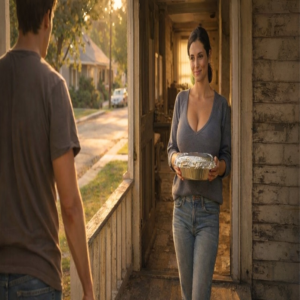
I came back from war on a Tuesday. No parave, no welcome home banner. Just me, a duffel bag, and a house that smelled like dust and old memories. The moving truck had barely stopped rolling when I saw her. She was standing on the porch across the street, one hand shading her eyes from the afternoon sun, watching me like she already knew something I didn’t.
Dark hair pulled back, worn jeans, a faded sweatshirt that looked like it had survived a few winters. She wasn’t staring in a rude way. It was more like she was waiting, like she’d been expecting me. I hadn’t seen Sarah Callaway since we were teenagers. I looked away first. My name is Jake Mercer. I spent 7 years in the army. Two tours overseas.
I watched good men come home different and bad situations get worse before they got better. I learned how to stay calm when everything around me was falling apart. I learned how to carry weight without showing it on my face. What nobody tells you about coming home is that the hardest part isn’t what happened over there.
The hardest part is standing in front of the house where you grew up, holding a key that sticks in the lock, wondering if you made a terrible mistake. The house belonged to my parents. My dad passed two years ago. My mom moved to live with my sister in Arizona not long after. The place had been sitting empty, waiting for someone to decide what to do with it.
I was that someone now. I jiggled the key twice before the door swung open. The smell hit me immediately. Dust, old wood, something faintly sweet I couldn’t quite place, like a memory I couldn’t fully grab. Sheets covered the furniture. Water stains marked the ceiling where the roof had leaked last winter. The kitchen cabinets held mismatched dishes and a few cans of soup that had probably expired years ago.
It was a mess, but it was mine. I set my duffel bag down in the hallway and stood there in the quiet. Real quiet. Not the kind of quiet where you’re waiting for something to go wrong. Just silence. Birds outside. A dog barking somewhere down the block. The distant hum of the interstate 3 mi away. I had forgotten what peaceful sounded like.
Clover Ridge hadn’t changed much. Population just under 9,000. One main street with a diner that still served breakfast all day. Two churches, a hardware store that had been run by the same family for 40 years. The kind of town where people waved at you from their driveways and knew your business before you did.
I had grown up here. Played little league at the park three blocks over. Got my first job washing dishes at that diner on Main Street. graduated from the high school that still looked exactly the same except for a fresh coat of paint on the front doors. I left at 18, desperate to see something bigger than these treeline streets.
Now I was back and I still wasn’t sure if that made me brave or just out of options. I had about $3,000 in savings and a military pension that covered the basics. No job lined up yet, though I had a few leads. The house needed a new roof, new bathroom tiles, a furnace that didn’t make threatening sounds, and about a dozen other things I was trying not to think about all at once.
I walked to the kitchen window and looked out at the backyard. Overgrown grass, a rusted fence along the back edge, and in the middle of it all, an old wooden bench my father had built by hand when I was about 7 years old. It was still standing. Something about that hit me harder than I expected. I heard the knock before I had time to get my thoughts straight.
I walked to the front door and opened it. Sarah Callaway was standing on my porch holding a casserole dish covered in foil. Her expression easy and open, like showing up at a near stranger’s door with food was the most natural thing in the world. For a second, neither of us said anything. She looked exactly like I remembered and also completely different.
same steady eyes, same slight smile that made it seem like she knew a joke nobody else had heard yet. But there was something calmer about her now, more settled, like she had figured out something about herself that most people spend their whole lives searching for. I probably looked like a man who hadn’t slept properly in 3 days, standing in a house full of dusty furniture, wearing the same clothes I’d driven 6 hours in.
“I thought you might be hungry,” she said. “It’s just lasagna. I made too much and figured you probably haven’t had time to get groceries yet. I stared at her for a moment longer than was probably polite. You didn’t have to do that. I know. She held out the dish. I wanted to. I took it.
The warmth came through the foil and spread into my hands. Thank you. Really? You’re welcome. She tucked a strand of hair behind her ear. A small nervous habit I somehow still recognized after all these years. How’s the house looking? Like it’s been sitting empty for 2 years. She laughed, not politely, actually laughed. And the sound of it did something strange to the tight feeling I’d been carrying in my chest since I pulled into the driveway.
Well, she said, “If you need help with anything, just let me know.” I watched her walk back across the street, and for the first time since I came home, the house didn’t feel quite so empty. I didn’t sleep well that first night. Not because anything was wrong exactly. The neighborhood was quiet. The old mattress in my parents’ room was still decent.
There were no sounds I needed to track or threats I needed to assess. My body just didn’t know how to believe that yet. I lay in the dark, staring at the ceiling, listening to the house settle around me. Old houses make a lot of noise, creeks and pops, and the occasional groan from somewhere in the walls.
When I was a kid, those sounds used to scare me. Now they felt almost like company. By 5:00 in the morning, I gave up on sleep and went downstairs to make coffee. I stood at the kitchen window while the coffee brewed and watched the street outside slowly get lighter. A man walked his dog past the house. A car pulled out of a driveway two doors down.
Somewhere nearby, a bird was announcing the morning like it was the most important news anyone had ever heard. I thought about what I was doing here. Not just in this kitchen, in this town, in this life. 7 years in the army teaches you a lot of things. How to stay focused under pressure. How to make fast decisions with incomplete information.
How to keep moving when every part of you wants to stop. What it does not teach you is how to come home, how to sit with silence that doesn’t mean danger, how to answer the question, “So, what are you going to do now?” without feeling like the floor just dropped out from under you. I was 31 years old, living in my childhood home with a list of repairs I couldn’t fully afford and no clear picture of what came next.
That was the honest truth of it. I poured my coffee and decided to start with what I could control. The kitchen cabinets came off the wall by 9. By noon, I had cleared out the living room enough to see the actual floor. By mid-afternoon, I was up on a ladder in the hallway, pressing my hand against the ceiling to figure out exactly where the roof was leaking.
That’s when I heard footsteps on the porch. I climbed down from the ladder and opened the front door before she could knock. Sarah was standing there holding two thermoses, wearing a flannel shirt with the sleeves rolled up and work boots that had clearly seen better days. Her hair was down this time, dark waves falling past her shoulders.
And she was looking at me with the calm, steady expression I was already starting to recognize as just how her face worked. “Coffee delivery,” she said, holding one out. “I took it. You’re going to spoil me. Somebody has to make sure you don’t collapse inside this house before you’ve had a chance to fix it.” I stepped back from the door.
“You want to come in? Fair warning, it looks worse than yesterday. I’ve seen worse. She walked past me into the hallway and looked around without any sign of being bothered by the chaos. She trailed her fingers along the banister as she moved toward the living room, taking everything in slowly, like she was reading a book she already knew, but still wanted to get right.
“Your parents kept this place really well,” she said quietly. “I remember coming over for things when we were kids. It always felt like a real home in here. I didn’t know what to say to that, so I just nodded. She turned to look at me. What are you starting with? Roof leak first, then the bathroom, then everything else.
That’s a lot for one person. I hendel. She gave me a look that said she wasn’t arguing with that, but she wasn’t entirely convinced either. Then she set down her thermos, walked over to the stack of tools I’d laid out near the staircase, and picked up a measuring tape like she owned the place. “Show me where the leak is,” she said.
I stared at her for a second. “You don’t have to do that.” “I know.” She looked over her shoulder at me. “You said that yesterday about the lasagna.” “My answer is the same.” That was the moment I stopped arguing. We spent the next 3 hours working through the hallway and into the upstairs bathroom.
Sarah knew what she was doing. She could hold a level steady, read a measurement without asking twice, and patch drywall with the kind of quiet focus that comes from actually knowing a skill rather than just thinking you do. Her father had taught her. She told me he believed everyone should know how to take care of their own space.
He said waiting for someone else to fix what was broken was how people ended up stuck. I liked that idea. We worked mostly in silence, but it wasn’t uncomfortable. It was the kind of quiet that happens between two people who don’t feel the need to fill every second with words. At some point, she asked without looking up from the wall she was patching.
“Why did you really come back?” I kept my eyes on the trim I was replacing. “The house was here. That’s not an answer.” I didn’t respond right away. Outside, a car passed slowly down the street. Somewhere in the distance, a lawn mower started up. I came back, I said finally, because everywhere else I felt like a ghost, like I was going through the motions without actually being in my own life.
I set down my hammer. I remembered what it felt like to be a kid here, to feel like I belonged somewhere. I wanted to find out if that feeling was still available. She was quiet for a moment. Is it? she asked. I looked at her across the room, paint smudge on her cheek, waiting for my answer without any pressure behind her eyes, starting to feel like it might be, I said.
She smiled small and real, and went back to work like she hadn’t just made something loosen in my chest that had been locked up for years. Over the following weeks, the work continued, and so did she. Sarah showed up most mornings with coffee, stayed through the afternoons, and left before dark. We fell into an easy rhythm.
She told me she worked as a therapist, mostly veterans and first responders, and kept her schedule flexible. I told her that explained a few things about how she listened. She said that was the nicest thing anyone had called a professional habit. One evening, after we’d spent the day replacing porch boards and arguing pleasantly about the best way to sand them flat, she suggested we walk down to the lake at the edge of town.
I hadn’t been there since I was a teenager. I said yes before I thought twice about it. We walked the six blocks together in the early evening. The air starting to cool, the neighborhood settling into the quiet end of the day. The lake wasn’t large, more of a wide pond really, but there was a wooden dock that jutted out over the water, and the view of the sky from its end was the kind of thing that made you stop talking. So, we did.
We just stood there for a while, watching the last of the light leave the water. That was the night things changed between us. Not dramatically, just a shift, quiet and certain, like a door opening that neither of us had to force. She didn’t let me off easy. Right there on that dock with the water black and still around us and the stars burning overhead, Sarah looked at me like she was deciding something important.
Not just about tonight, about everything. I need you to understand something before this goes any further, she said. Her voice was quiet but steady. I won’t be someone’s in between. I asked her what she meant. I mean, I’ve done this before. I’ve been the person someone leaned on while they were healing. I cooked the meals and showed up and cared too much.
And then one day they were better and I was just background. She pulled her knees to her chest. His name was Derek. We were together 3 years. He told me I was too much, too emotional, too intense, too everything. And the worst part, she paused. I believed him. I spent almost a year trying to need less, feel less, want less, just to keep him. I didn’t say anything.
I just listened. He didn’t leave because I was too much. She said he left because he wasn’t enough. But it took me a long time to figure that out. I told her she wasn’t too much, not even close. That every single time she showed up at my door with coffee or work gloves or just herself, I felt like I could breathe again.
Like the noise in my head went quiet. I told her that scared me more than anything I’d faced overseas. She turned to look at me then. Really? Look at me then? Why does it scare you? She asked. Because last time I let someone in, I held back. I kept one foot out the door and called it caution. My ex-wife needed someone present and I kept giving her someone prepared to leave.
I told Sarah that straight. No, just the truth laid out flat between us. The wind moved across the water. A fish broke the surface somewhere in the dark. I’m not asking you to be perfect, Sarah said finally. I’m asking you to be honest with me and with yourself. I reached across the space between us and took her hand. She didn’t pull away.
We kissed for the first time right there on that dock. Soft, careful, like something we both knew we couldn’t take back and didn’t want to. When we pulled apart, she rested her forehead against mine. “No promises,” she whispered. “No grand plans, just honest effort.” I told her that was something I could actually do.
We sat there for another hour talking about nothing important and everything that was. She told me about growing up in Clover Ridge, how she’d left for college and come back three years ago feeling like a stranger in her own hometown. I told her about the first deployment, about the noise and the dust and the way silence stops feeling safe when you’ve been in a war zone long enough. She didn’t flinch.
She didn’t look at me with pity. She just nodded and said, “That makes sense.” Nobody had ever just said that before. That was the night I understood what it felt like to be seen. We walked back to the street together slowly, not in any rush to end the evening. She stopped at the end of her driveway and turned to face me.
The porch light across the street. My porch light was still on, casting a yellow glow across the front steps. “Good night, Jake,” she said. “Good night, Sa.” I crossed the street and went inside. And I stood at the kitchen window for a long moment, watching her walk up her own porch steps and disappear through her door.
But here’s the part one didn’t expect. For days later, Derek showed up. I was in my front yard when a car I didn’t recognize parked in front of Sarah’s house across the street. A man got out tall and well-dressed in the way of someone who wanted you to notice. He walked up her porch steps like he owned them, like he’d done it a hundred times before.
I stayed where I was. It wasn’t my place, but I watched. Sarah opened the door and her whole body changed. shoulders up, arms crossed. She shook her head twice in the first 30 seconds. I went inside and tried to focus on the kitchen cabinet I’d been fixing. Couldn’t. Came back out 5 minutes later. They were still on the porch.
Derek standing too close. Sarah taking a step back every time he moved forward. I crossed the street. “Everything okay?” I asked. Derek looked at me like I was something he’d stepped over. We’re in the middle of a conversation. Doesn’t look like a conversation, I said. Sarah told me she was fine, but her jaw was tight and her eyes said something different.
I didn’t leave. Dererick smiled. The way people smile when they want you to know they think you’re beneath them. New boyfriend? He asked her. Interesting choice. Sarah didn’t answer him. She looked at me instead. Could you stay? She asked quietly. So, I did. Derek talked for another 10 minutes. He said things like, “I drove 2 hours and you’re not being fair.
” And, “You owe me a real conversation.” Every sentence designed to make her feel guilty for having the nerve to move on. Finally, Sarah stepped forward. “I don’t owe you anything,” she said. “Not a conversation, not my time, not an explanation. I spent 3 years being less than myself, so you’d stay and you left anyway.
” Her voice didn’t shake. So go and don’t come back. Something shifted in Dererick’s face. The charm dropped and underneath it was just a man who didn’t like being told no. He left, but he came back the next afternoon. This time I was on my porch when he pulled up across the street. I watched him walk to her door. I watched her open it and I watched his hand close around her arm when she tried to step away from him.
I was across the street before I even decided to move. Let her go, I said. He did immediately. Then he looked at me with something between anger and calculation. But Sarah didn’t need me to say another word. She stepped in front of me and pointed straight at him. If you come back here again, she said, “I’m calling the police.
We are done. There is nothing left to say. Leave.” He looked at her for a long moment. Then he got in his car and drove away. And this time, he didn’t come back. I thought that was the hardest part. I was wrong. 2 weeks after Derek disappeared from our lives, I got a phone call that sat in my stomach like cold coffee.
A construction firm based 2 hours north had tracked me down through a mutual contact at the Veterans Employment Office. Senior project manager, strong pay, real benefits. The kind of offer that would have made the version of me from 3 years ago say yes before they finished the sentence. I told them I’d think about it. I didn’t tell Sarah that night or the next morning.
I just worked on the bathroom tiles we’d been replacing and acted like nothing was different. She noticed anyway. You’ve been quiet all day, she said, setting down her grout tool. What’s going on? I told her about the call. She was still for a moment. Then she asked me the only question that mattered. Is this what you want? I looked around the half-finished bathroom, at the cracked tiles stacked in the corner, at the walls we prepped together, at this house that was slowly becoming something I was proud of.
No, I said, I don’t want the job. I want to be here. Then why are you still thinking about it? That was the question I didn’t have a clean answer for. So, I told her the messy one. I told her that growing up, I was always supposed to be going somewhere. The army was supposed to be a stepping stone.
The career was supposed to be impressive. The life was supposed to look a certain way from the outside. And even now, even after everything, part of me still heard that old voice telling me that choosing something small and quiet and real meant I had given up. Sarah put her grout tool down and turned to face me fully.
“Let me ask you something,” she said. “Who told you that a life you actually love is a small life?” I didn’t have an answer. You’ve been through two deployments, she said. You’ve watched things fall apart and put yourself back together more than once. You came back to a town that knew you before all of that, and you’re rebuilding something real.
That’s not giving up. That’s the hardest thing there is. I sat down on the bathroom floor right there among the tile pieces. I just don’t want to look back in 10 years and wonder if I took the easy road. I said, “The version of you that was afraid would have taken that job.” She said to prove something to people who aren’t even watching.
She sat down across from me. The man sitting on this bathroom floor right now. He already knows what he wants. He’s just scared to choose it out loud. I called the firm the next morning and turned down the offer. The recruiter sounded surprised. Most people don’t walk away from numbers like that, he said. I told him I understood and thanked him for the call and hung up feeling lighter than I had in weeks.
That same afternoon, I drove to the county medical center and picked up an application for their open facilities manager position. It wasn’t glamorous. It wasn’t the kind of thing you led with at dinner parties. But when I sat in the interview 3 days later across from a woman named Dr. Okafor, who had 20 years of hospital administration behind her and a framed service photo on her desk, I felt something I hadn’t felt in a long time, like I was in the right room.
She asked me why I wanted the job. I told her the truth. I said I was done chasing impressive and ready to build something that lasted. I said I was good at keeping complicated systems running under pressure and that I didn’t need recognition to do the work well. I said I wanted to come home at a reasonable hour and be present in my own life.
She studied me for a moment. You’re overqualified. She said I told her I was aware. But you’re not here because you couldn’t get something better. She said it wasn’t a question. No, ma’am. I’m here because this is what I actually want. She offered me the job before I reached the parking lot.
I started the following Monday. By the end of the first week, I knew the name of every person on the maintenance staff and had already fixed three problems that had apparently been on the work order list for months. My supervisor told me I was the first person to read the entire building manual before day three. I told her I’d been trained to know my environment.
Sarah was waiting on my porch when I got home Friday evening. She had two cups of coffee even though it was almost 6:00 at night. She handed me one without a word and we sat on the steps together watching the street lights come on one by one down the block. “How was the first week?” she asked. “Good,” I said.
“Really good, like something finally fit.” She leaned her head on my shoulder. “I told you,” she said. You did. The street was quiet. Somewhere down the block, a neighbor’s dog was barking at something in the dark. The air smelled like cut grass and the beginning of autumn. I thought about the version of me that had almost taken that other job.
That would have packed up and driven 2 hours away and spent weekdays in an empty apartment telling himself it was the responsible choice. That would have traded this exact moment, this porch, this woman, this quiet for something that looked better on paper. I didn’t feel like I had given anything up. I felt like I had finally chosen correctly.
Sarah lifted her head and looked at me with that expression I was still learning to read. The one that meant she was about to say something real. “I’m proud of you,” she said. “Not for taking the job or turning down the other one. Just for knowing what you wanted and not talking yourself out of it.” I looked at her in the fading evening light, dark hair loose around her face, coffee cup in both hands, completely herself in a way I was still learning to be.
And I thought, not for the first time, that I had no idea how I’d gotten this lucky. But I was done asking questions I didn’t need the answer to. She moved in on a Tuesday, which felt exactly right. Not a weekend with big plans and helping hands, just a Tuesday, quiet and ordinary. her boxes stacked in the hallway, her coat hanging on the hook by the door like it had always lived there.
I stood in the kitchen watching her arrange her coffee mugs on the shelf and thought, “This is what choosing someone looks like, not fireworks, just a Tuesday.” We settled into each other the way two people do when they’ve already spent months learning each other’s rhythms. I knew she needed silence before her first client call every morning.
She knew I needed 20 minutes on the porch after work before I was ready to talk. We cooked dinner together most nights, splitting the tasks without discussing them, moving around each other in the kitchen like we’d choreographed it years ago. But then something happened that I did not see coming. 3 weeks after she moved in, Sarah got a letter.
She read it at the kitchen table while I poured coffee, and I watched her face go through three different emotions before she said a single word. It was from a trauma recovery institute in Portland. They were offering her a consulting fellowship. 8 weeks working with veterans and first responders on a new recovery program, fully funded, exactly the kind of work she’d spent her entire career building toward.
She set the letter down and looked at me like she was already apologizing. I picked it up and read it. Then I set it down. Then I said the only thing I could honestly say, “You have to go.” She shook her head. I just moved in. We just started building something real here. I’m not going to leave because of a letter. I looked at her for a long moment.
Sarah, this is exactly the kind of work you told me you got into therapy for to help people who came back from places like the ones I came from. If you don’t go in 5 years, you’re going to wonder what would have happened. And I’m going to know I was the reason you didn’t find out.
She was quiet for a long time after that. She almost didn’t submit the acceptance. I found the email draft sitting unscent on her laptop one evening when she asked me to look up a restaurant. She hadn’t deleted it. She hadn’t sent it either, just left it sitting there waiting. I closed the laptop, walked to where she was reading on the couch and sat down beside her.
“Send the email,” I said. She looked at me. “What if the distance does something to us?” I took her hand. Then we deal with it. But I’m not going to be the reason you play small. Not after everything you told me about trying to be less for someone else. I refused to be that for you. She sent it that night. The first two weeks she was gone, I kept myself busy, painted the spare room, fixed the fence along the backyard, reorganized the garage, kept my hands moving so my head would stay quiet.
But the house had a sound without her in it that I hadn’t expected. Not exactly silence, more like an absence that had its own weight. She called every night at 9:00. Sometimes we talked for 2 hours. Sometimes we just sat on the phone saying nothing, the way you can only do with someone who doesn’t need you to fill the space.
She told me about the veterans she was working with, the progress that felt impossible one day and obvious. I told her about the hospital, about a burst pipe that flooded the east wing, and the 14-hour day that followed. One night she said, “I keep telling these veterans that going home is the hardest part of the mission.
” And they look at me like I don’t know what I’m talking about. Then I tell them about you coming back to Clover Ridge with nothing but a duffel bag and a house that needed everything. And they stopped looking at me like that. I didn’t know what to say to that. So I just said, “You’re good at what you do.” She laughed softly.
I learned from someone stubborn enough to fix a broken porch in the rain. We visited each other twice during those eight weeks. The first time I drove up to Portland on a Friday after my shift, arriving past midnight, she was awake, sitting on the steps of her rented apartment building in a flannel shirt, waiting.
She didn’t say anything when I got out of the truck. She just walked over and put her arms around me and held on. We stood in the parking lot like that for a long time. The second visit, she drove back to Clover Ridge for a long weekend. I had dinner waiting when she pulled in. Nothing complicated. Pasta, bread, the raspberry jam from the farmers market she liked on everything.
She walked through the door, dropped her bag, and stood in the kitchen just breathing the air. Smells like home, she said. Yeah, I said. It does. Those four days felt like a full season. We hiked the trail behind the county park. Sat on the porch until well past midnight three nights in a row.
had an argument on Sunday morning about nothing important that turned into a long conversation about something that was and then made each other laugh about it by noon. That was the part nobody tells you about loving someone. The way a small fight can actually pull you closer if both people are willing to stay in the room.
When she left again Sunday evening, I walked her to her car. She turned around at the door and looked at me with an expression I didn’t have a word for. Six more days, she said. I nodded. Six more days. I watched her tail lights disappear around the corner and went back inside to wait. She came home on a Thursday. I knew the approximate time, somewhere in the late afternoon, but I hadn’t planned anything.
No banner, no dinner reservation, no speech prepared. I just made sure I was there. I sat on the porch steps and waited. And when her car finally turned onto our street, something settled in my chest that had been restless for 8 weeks. She parked, got out, and stopped at the edge of the driveway. She looked at the house, then at me, then at the porch light that had been on every single night since she left. I had not turned it off once.
She noticed. I could tell by the way her expression shifted. She walked over slowly, dropped her bag on the bottom step, and sat down beside me. Not a dramatic reunion, not a movie moment, just Sarah in a blue flannel shirt and worn out boots sitting beside me on the steps like she’d never been gone. We sat there for a while without saying much.
Then she said quietly, “I spent 8 weeks helping people figure out how to let someone love them. And the whole time I kept thinking about how hard that was for me to learn, too.” I looked at her. She continued, “I used to think needing someone was a weakness. Derek made me feel that way, like needing anything from another person meant you were asking for too much. She paused.
But you have never once made me feel like I was too much. I didn’t say anything. Sometimes the right response isn’t words. She leaned her head on my shoulder. I reached into my pocket. I had been carrying the ring for 3 months. I had almost asked her before Portland. I had almost asked her the night she got the letter.
But something kept telling me to wait, not out of doubt, but out of patience. I wanted to ask when there was nothing urgent, nothing emotional pressing on the moment. I wanted it to be quiet like a Tuesday. A Thursday turned out to work just fine. Sarah, I said. She lifted her head. I didn’t get off one knee dramatically.
I just turned to face her and opened the box. The small diamond caught the last light of the evening and threw a thin arc of brightness across the porch. I’m not good at speeches, I told her. You know that, but I know that the bravest thing I have done since coming home from war was not fixing this house or starting over in this town.
It was letting you in. And I don’t want to spend a single day of my life where you are not completely sure that I choose you on purpose. Every day she stared at the ring for a long moment. Then she looked up at me. Her voice was barely above a whisper. You really did just propose to me on the porch steps in the dark. I did.
She laughed and it came out a little broken, the way laughing does when it’s tangled up with crying. Then she held out her hand, steady and certain. Yes, she said. Obviously, yes. I slid the ring onto her finger. She looked at it for a moment, turning her hand slightly. Then she closed her fingers around mine. We stayed on the porch steps for another hour, talking about nothing important and everything that mattered.
She told me more about Portland, about a young veteran she’d worked with who reminded her of me at the start, closed off and certain that opening up was the same thing as falling apart. She said she’d told him about the porch light, how I’d left it on every night. He’d written it down in his journal, she said like it was something he needed to remember.
I thought about that for a long time after she said it. We got married 6 months later. On a Saturday in late April, when the trees along our street had just started to bloom, it was small. The backyard, a handful of people who actually knew us. String lights Sarah had picked out herself and spent an entire evening helping me hang at precise intervals because, as she said, close enough is not the same as right.
Our neighbor from two doors down officiated. She had gotten ordained online 3 weeks before the wedding, specifically because Sarah had once stayed with her through a hard night when her husband was in the hospital, and she had been looking for a way to say thank you ever since. When I said my vows, I kept them short. I came back from war not knowing who I was anymore.
I said, “I came back to a house that needed everything and a life I had to build from the ground up. I did not expect any of this. I did not expect you. But here is what I know now. The hardest missions are not always the ones fought in foreign places. Sometimes the hardest mission is learning to come home. You taught me how to do that. Sarah’s vows were three sentences.
I choose you today, she said. I will choose you tomorrow. That is not a promise I make lightly, and it is not one I intend to break. After the ceremony, we danced in the backyard as the sun went down. At some point, the music stopped, but we kept moving anyway. Slow and quiet, her forehead against mine.
Later that night, sitting on the same porch steps where I had proposed, she looked up at the sky and said, “Do you ever think about how close you came to not coming back here, I thought about it.” Yeah. All the time. She laced her fingers through mine. I’m glad you came back. I looked at her at the ring on her finger at the house behind us with the lights on inside.
at the street I had grown up on and almost never returned to. Me too, I said.
Disclaimer : This content may be created by AI for entertainment purposes. Any resemblance to real persons, events, or places is coincidental.






