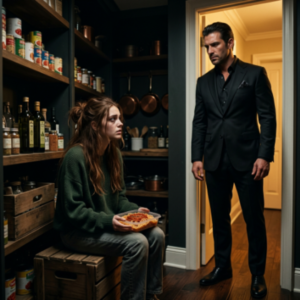
Chapter 1: The Storm Breaks
The city didn’t sleep at 3:00 a.m.
It held its breath.
Rain lashed the south side like a whip. A row of crumbling buildings. A flickering streetlight. And one lonely diner glowing in an ocean of dark.
The only place still keeping its lights on for people who had nowhere left to go.
Inside, Sloan Carver wiped down a table. Her hands were steady as a surgeon’s. But something in the way she stood—back to the door, yet knowing exactly how many people were in the room—told a different story.
A habit you didn’t pick up waiting tables.
You learned it somewhere else. Somewhere nobody wanted to talk about.
The bell over the door rang. Not the cheerful ring. The other one.
Three men walked in. Charcoal wool coats. The scent of cold rain, leather, and black pepper followed them like a warning.
Sloan didn’t look up. She kept wiping.
Her body knew before her eyes did. The little hairs on the back of her neck standing up. The pressure in the room shifting.
The old man at the counter stopped drinking his decaf. Jimmy, the line cook, stopped scraping the grill.
The two men on the outside were built like bank vault doors. Thick necks. Shoulders that didn’t quite fit the doorway. The kind of men who broke kneecaps for a living and ate sandwiches in the car between jobs.
But it was the man in the middle who made Sloan’s chest go tight.
Matteo Valente.
The name people whispered the way old folks whisper about cancer.
He scanned the diner like a property he was about to buy and demolish. Then he moved toward the back booth without waiting to be seated.
Sloan knew his face. Anyone on the south side longer than a month knew his face.
You didn’t say his name out loud. You didn’t make eye contact with the SUVs that rolled through your neighborhood. And you sure as hell didn’t want him sitting in your section.
Carla’s panicked hiss came from the wait station. “Sloan. Sloan. That’s Valente. My cousin owed one of his guys six hundred bucks. They broke his jaw in three places. I can’t go over there.”
Sloan breathed out slow through her nose.
Looked at Carla. The kid’s eyes were wet. Mascara starting to run. Nineteen years old. Nursing school. A future.
Looked at the booth. Three men. Two guns visible if you knew where to look. One man in the middle who didn’t need a gun.
Looked at her own hands. Steady. Because rent was due Tuesday. Because Frank Doyle had already drafted the eviction notice. Because the floor under her cheap mattress had a crack she could feel with her bare foot.
Because the world had never once given Sloan Carver the option to be afraid.
“Give me the pad,” Sloan said.
Carla didn’t move.
“Carla. The pad.”
She handed it over. The pen with it. Both still shaking.
Sloan didn’t bother with the apron. Didn’t bother with the smile. Men like Valente didn’t pay for smiles. Smiles made them suspicious.
She walked.
The diner air shifted as she got closer. Grease smell fading. Underneath it came something cleaner. Cold rain, leather, and cologne. Sharp cedar. A little black pepper.
Apex predator in the room.
She stopped at the edge of the booth. Up close, he looked tired. Not weak-tired. The other kind. Tense. Coiled. Like he hadn’t slept properly in years and had stopped expecting to.
He was tracing the rim of a water stain on the table with one finger. Didn’t look up.
“What can I get you?” Sloan said. Flat. Bored. The voice she used on truck drivers who tried to call her sweetheart.
The bodyguard on the left sneered. Scar through his eyebrow. “Show some respect.”
Sloan shifted her weight. The familiar twinge in her lower back. “Menu’s on the wall. Coffee’s fresh. I can call him whatever you want. But it doesn’t change the fact that we’re out of cherry pie.”
Scar eyebrow’s face darkened. His fingers twitched on the tabletop. He started to rise.
“You smart-mouthed little—”
Valente raised a hand. Two fingers an inch off the table.
Scar eyebrow froze. Snapped his jaw shut. Sank back into the booth.
The obedience wasn’t respect. It was fear. And it was complete.
Valente lifted his head. His eyes locked on hers and stayed there. He took her in. The chipped fingernails. The name tag pinned crooked. The dark crescents under her eyes.
A long, slow appraisal of nothing that mattered.
“Black coffee,” he said. His voice was a low rasp that lived somewhere below the floor. “Three of them. Bring a clean pot.”
Sloan turned. Walked back to the counter.
Her heart was doing the panic-bird thing inside her ribs. But her hands stayed steady. Grabbed the orange-rimmed pot. Regular. Brown was decaf. Three heavy mugs. Wiped the rims.
She could feel his stare burning into her spine the whole way back.
She set the mugs down. One, two, three. Didn’t spill a drop.
She reached across to put the last mug in front of Scar eyebrow. His hand shot out. Clamped around her wrist.
Steel vise.
Sloan went perfectly still. The coffee pot in her free hand tipped a hair. The black liquid inside swayed against the glass.
Scar eyebrow’s thumb pressed into the tendon. Hard. Looking for the flinch.
“I don’t like your attitude,” he murmured. “You need to learn how to talk to your betters, sweetheart.”
Pain bloomed up her forearm.
She didn’t gasp. She didn’t pull. Pulling gives them leverage. You learn that at twelve in a back hallway with the smell of beer on a foster father’s breath.
You learn it and you never forget.
“Let go of me,” Sloan said. Quiet. Calm. The wrong kind of calm.
The calm of a fuse that’s already lit.
Scar eyebrow chuckled. Looked at Valente for approval. “She’s giving orders now.”
Valente leaned back. Elbows on the backrest. Mildly amused. The way a man watches a stray cat hiss at a Rottweiler. He took a slow sip of his coffee. His eyes never left her face.
He was waiting for the tears. The apology. The begging.
He’d seen it a thousand times.
“You got a mouth on you, waitress,” Valente said. Condescension dripping off every syllable. “You think you’re tough, coming at my men in a place like this?”
He set the mug down. A soft click.
Then he laughed. A short, rough laugh that scraped against the silence.
“Prove it.”
Something inside Sloan went click.
Not a bang. A click. A safety being turned off.
Eighteen years of swallowing pride. Eighteen years of looking at the floor while men with heavy hands took what they wanted. Eighteen years of cheap copper pennies and cracked lips and pretending the ringing in her ears was nothing.
All of it. In one dismissive laugh.
She didn’t think. She didn’t pull away.
She stepped into him. Twisted her wrist sharp against his thumb joint—the weakest point of the human grip. His hold broke with a pop.
In the same motion, she slammed the heavy glass bottom of the hot coffee pot down on the back of his hand. Pinned it to the Formica.
He roared. Tried to yank back.
She had already pivoted. The second bodyguard lunged across the table. She caught a fistful of his leather jacket. Used his own momentum. Drove his face into the edge of the table.
Crunch. Cartilage. Wet.
Bright crimson sprayed the salt shaker. He slumped back, hands over his nose, groaning.
Three seconds. Maybe less.
Valente hadn’t moved. He hadn’t had time.
She kicked the heavy wooden chair beside the booth. Sent it skidding into his shins. He dropped his hands to block on instinct.
That was when she grabbed two fistfuls of expensive wool lapel. Dropped her center of gravity. Hooked her right leg behind his knee. Twisted her torso with everything she had.
Just physics.
Matteo Valente, untouchable boss of the Southside, went airborne.
He hit the linoleum with a sound that rattled the napkin dispenser at the next booth. All the air left his lungs in one violent huff. The back of his head bounced once against the tile.
The diner went silent.
A silence so loud it had its own weight. Jimmy had stopped scraping. The old man had dropped his fork. Even the dying fluorescent light picked that exact second to stop buzzing.
Sloan stood over him. Chest heaving. Apron twisted. A drop of the second bodyguard’s blood splattered on her white collar.
Her hands were shaking now. Not from fear. From the adrenaline. The toxic dump of it.
She looked down at the man on the floor.
Valente was staring up at her. Wide-eyed. Mouth open. Trying to drag oxygen back into his lungs.
The arrogant smirk was gone.
“I’m not tough,” Sloan rasped. She looked at the two bodyguards. One nursing a probably broken hand. One bleeding into a stack of napkins. Both reaching now, slow, for their coats.
“I’m just really, really tired of taking out the trash.”
Valente coughed. Held up a hand. His men froze.
He dragged a breath into his lungs. Then another. He looked at her. Just looked.
And then, very softly, he smiled.
Chapter 2: When The Wolves Walk In
Sloan didn’t run.
She wanted to. Every cell in her body was screaming at her to bolt out the back door and keep running until she hit the ocean.
But running was for people who didn’t know better. Running gave them your back.
She backed up instead. Three feet. Maybe four. Kept the booth in her sight. Kept the door in her peripheral vision. Bus tub on her left if she needed to throw something.
Valente didn’t rush.
He lay there a long, agonizing moment. Testing his shoulders. Rolling onto his side. Deliberate. A man choosing to take his time because he could.
He pushed himself up. Braced a hand on the table leg. Stood. Dusted off his knees with meticulous care—the kind a man uses on a suit that cost more than her car.
He didn’t look at his men. He looked at her.
That flat, dead look from earlier was gone. In its place was something worse.
Calculation.
He wasn’t seeing a waitress. He was seeing a puzzle. A piece that didn’t fit in any world he’d ever held.
He reached into his inner coat pocket. Sloan’s whole body locked.
But it wasn’t a gun. It was a silver money clip.
He peeled off three crisp hundred-dollar bills. Dropped them on the table next to the spilled coffee.
“For the mess,” Matteo said. His voice was even now. The breathlessness gone. He glanced at the broken chair. “And the entertainment.”
He turned. Walked toward the door. His men scrambled. The bleeding one left a trail of red dots on the linoleum that Jimmy would have to mop in the morning.
The bell chimed. The door closed.
Silence swallowed the diner whole. Heavier this time.
“Sloan,” Jimmy breathed. He walked out from behind the counter, greasy spatula still hanging from his hand. He looked at the empty booth. At the three hundred dollars sitting next to a puddle of coffee.
At her.
He looked like a man at a funeral.
“You’re dead. You know that, right? You just signed your own death certificate.”
“Shut up, Jimmy.”
But her voice didn’t have its usual bite.
She scrubbed a shaking hand over her face. Pressed the heels of her palms into her eyes until sparks danced in the dark.
“Just grab a mop. Please.”
The rest of the shift was a slow drowning.
Every car that drove past the rain-streaked windows made her heart slam against her ribs. Every rattle of the pipes in the wall—she heard a slide racking.
She wiped tables on autopilot. Refilled the old man’s coffee twice. He left without finishing it. Left exact change. Wouldn’t make eye contact.
At 6:00 a.m., the sun dragged itself over the skyline. Sickly pale gray bleeding through heavy clouds.
She clocked out. Changed in the cramped bathroom that always smelled faintly of mildew. Pulled on a faded oversized sweater and a denim jacket that did nothing against November.
She folded the three hundred dollars and pushed it deep into her jeans pocket. It felt radioactive against her thigh.
She stepped into the alley.
The cold hit her like a slap. Wet asphalt. Rotting cardboard. Exhaust fumes. She pulled her collar up, kept to the shadows.
A black sedan idled at Fourth and Elm.
Sloan stopped. Her breath plumed in the freezing air. She slid behind a rusted dumpster. Waited. Watched.
A woman got out of the sedan. Dragging a screaming toddler by the wrist.
Just a mother coming home from a night shift.
Sloan exhaled. Slow. Shaky.
She was losing it. Men like Valente didn’t send hit squads at sunrise. They worked in the dark. They took their time.
She kept walking.
She did not see the man across the street sitting in the driver’s seat of a parked sedan. Cigarette in one hand. Phone in the other. Watching her.
His name was Hollis. He had been waiting at this corner since 4:00 a.m.
He let her pass. Watched until she turned onto her block. Then he picked up his phone.
“Yeah,” he said. “It’s her. I’ll handle the introduction tomorrow.”
Her building was a crumbling brick heap with a broken buzzer and a front door that didn’t latch. Five flights of stairs. Sour smell of boiled cabbage on three. Cigarette smoke on four. Someone’s TV playing infomercials on five.
She unlocked her apartment. Three dead bolts. Click. Click. Click.
Closed the cheap wood door. So tired her teeth hurt.
But she didn’t go to bed.
She walked to the closet. Pulled out a battered tin box from the back—the kind that used to hold cookies a long time ago. The label was worn off.
She opened it.
Inside: a photograph. Two girls. One twelve. One eight. Standing in front of a sagging porch.
The twelve-year-old had her arms wrapped around the eight-year-old. Holding her up. Holding her in place. The kind of grip a sister uses when she’s the only thing standing between you and the world.
Daphne.
Sloan closed her eyes. She didn’t cry. She hadn’t cried in eighteen years.
She sat on the floor of her cramped apartment. Photograph in her lap. And waited for her hands to stop shaking.
They didn’t.
Chapter 3: The Photograph That Changed Everything
She woke at 2:00 in the afternoon.
Three hours of sleep. Maybe less. The kind that doesn’t count. The water stain on her ceiling looked like a crushed skull today. Some days it looked like a horse.
Today, a skull.
Her knuckles ached. Her lower back was a tight, burning knot of muscle. The three hundred dollars sat on her nightstand, weighing down a stack of past-due utility bills.
Exactly enough to cover what she owed Frank for rent.
Blood money. Dropped by a man who could erase her with a phone call.
She couldn’t stay in the apartment. The walls felt like they were inching closer. She needed normal. Something so boring her panic couldn’t survive it.
She gathered her dirty clothes. Shoved them in a cracked plastic basket. Grabbed her keys. The jar of quarters by the sink.
Normal. Just do normal things.
The laundromat was three blocks away. Sandwiched between a boarded-up liquor store and a pawn shop that nobody ever saw anybody enter or leave.
Inside, it smelled like artificial floral detergent and ozone. Washing machines churned a steady rhythm that dulled the ringing in her ears. An old woman was asleep in the corner over a crossword puzzle.
Sloan loaded a machine. Detergent. Quarters in the slot. Slammed the door.
Leaned her forehead against the cool glass as the water rushed in. Closed her eyes for one blessed minute.
“You favor your left leg when you walk.”
The voice wasn’t loud. It didn’t need to be. It cut through the hum like a straight razor.
Her eyes snapped open. Cedar and black pepper.
She turned slowly.
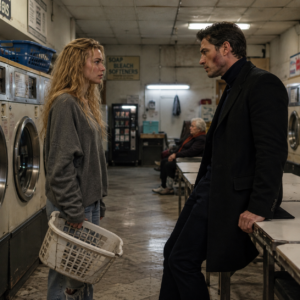
Matteo Valente was leaning against the row of folding tables across from her. Hands tucked casually in the pockets of a tailored black overcoat. Dark navy turtleneck. No tie.
He looked entirely out of place in the dingy laundromat. And entirely comfortable being out of place.
A faint purple bruise flowered along his jawline. Right where she had slammed him into the floor.
She looked at the front door. A massive man in a dark jacket was standing outside. Not one of the two from the diner. Pretending to look at his phone. Blocking the exit without seeming to.
She had no weapon. She had a basket of damp clothes and a roll of quarters.
“Old injury?” Matteo asked. “Or just tired?”
“What do you want?”
It came out rough. Scraped raw. But it didn’t tremble.
“That was the important part.” He looked around the laundromat. Cracked linoleum. Flickering overhead light. A faint expression of distaste crossed his face. “I was curious. It’s not every day a waitress in a dead-end diner drops a man twice her size with a textbook judo sweep. Takes years to learn how to manipulate a center of gravity like that.”
He took a slow step forward. She took an instinctive step back. Her spine hit the vibrating metal of the washing machine.
“So I made a phone call.”
He pulled out his phone. Tapped the screen. Turned it to face her.
A file. Her file.
“Sloan Carver. Grew up in the foster system. Group homes in the rust belt. Arrested twice at eighteen for assault. Both charges dropped because the men you put in the hospital refused to testify.”
She couldn’t breathe.
“Then you drop off the map. You show up here. Keeping your head down. Pouring coffee for minimum wage.”
He had unspooled her entire life in less than twelve hours. The violation was physical. A cold hand reaching into her chest and rearranging her organs.
“You don’t know anything about me.”
“I know you’re wasting your talents,” Matteo said. Soft. He stopped a few feet from her. Close enough she could see the faint stubble shadowing his bruised jaw.
“I don’t have talents. I have a temper. And your guy put his hands on me. That’s it. I’m not a hitman. I’m not a thug. I just want to be left alone.”
He let out a low, rough chuckle. Genuinely amused.
“Nobody who hits like you do just wants to be left alone. You’re hiding. And you’re doing a terrible job of it.”
He pulled one hand out of his pocket. Between his fingers, a sleek matte black card. He reached out—didn’t touch her—slid the card under the corner of her laundry basket.
“I have a problem. I have plenty of men who would pull triggers. Very few who can think under pressure. You embarrassed my security detail. Which means I need better security.”
“You’re out of your mind. I broke your guy’s nose. I dropped you on your head.”
“Exactly. You didn’t hesitate. You didn’t care who I was. I need someone who isn’t afraid of me.”
He looked at her bruised knuckles. Her bloodshot eyes.
“The diner pays you what? Four hundred a week? Work for me. Ten times that. You won’t ever worry about rent in this dump again.”
He stepped back. Turned toward the door.
“Think about it. There’s a number on the card. Or don’t. But if you stay here, Sloan, someone else from your past is going to find you eventually. And they won’t be as polite as I am.”
The door chimed. He was gone.
She stood there a long time. Staring at the card. Her clothes tumbled in the drum. Round and round. The whole world tumbling along with them.
She walked outside. Past the man in the dark jacket who was no longer there. Past the boarded-up liquor store. Into the gray afternoon.
Three blocks before she realized she was walking the wrong way.
She turned around. Walked back. The card was still there.
She picked it up. Slipped it into her pocket. Decided she would throw it away when she got home.
She did not.
Chapter 4: The Little Bird Returns
The next morning, she opened her eyes, and the world was wrong.
She knew it before she’d lifted her head from the pillow. Some small, animal part of her brain that had been on watch for eighteen years pinged a warning.
The apartment was too quiet.
She sat up slowly. The deadbolts—all three—still locked. The chain still in place. The fire escape window still cracked the same inch she always left for air.
Nothing was disturbed. Nothing was moved.
Except on the kitchenette counter.
A coffee cup. A clean white ceramic coffee cup. Steam still curling off the surface.
Sloan had not made coffee. Sloan did not own a clean white ceramic coffee cup.
She froze. She listened. Refrigerator hum. Radiator clank. A truck downshifting on the street outside. Her own pulse drumming behind her eardrums.
Nothing else.
She slid out of bed. Bare feet on cold floorboards. Picked up the heavy iron skillet from the drying rack.
Cleared the apartment. Bathroom—empty. Closet—empty. Behind the sagging armchair—empty. Under the bed—empty.
She came back to the kitchenette. There was something underneath the cup.
A folded piece of paper.
She lifted the cup with two fingers like it might bite. Set it on the counter. Unfolded the paper.
The handwriting was old-fashioned. Slanted. Deliberate. Done with a fountain pen by someone who had time to do things properly.
Three words. That was all.
Welcome home, little bird.
The skillet hit the floor. She didn’t hear it hit. Didn’t feel it leave her hand.
Her ears were ringing. A high, keening whine. Like the dying fluorescent at the diner.
Her knees gave out. She sat down hard on the linoleum.
She could not breathe.
Eighteen years. Eighteen years she had not heard that name.
Little bird.
Nobody called her that. Nobody had ever called her that except—
Silus Crow.
The man with the silver ring. The man whose face she had spent a decade trying to forget and never quite managed. The man who was supposed to be locked away for another four years.
He was out. He was here.
He had been inside her apartment while she slept. The coffee was still hot. That meant minutes. He had left minutes ago.
He had stood over her bed. Watched her sleep. Walked into her kitchen. Made himself a cup of coffee. Sat at her table. Drank some of it. Left her a note.
And left.
She crawled to the toilet. Was sick.
When she could stand again, she made herself walk to the bathroom mirror. She had to see her own face. She had to know it was still her face.
She turned on the cold water. Pressed her palms against the porcelain. Looked up.
On the mirror. Written in dark red lipstick. Her own lipstick—the cheap one kept in the drawer beside the sink. Uncapped now. Sitting next to the soap dish.
In the same slanted handwriting. A second message.
So much to talk about.
Sloan gripped the edges of the sink. Her reflection looked back with eyes she had not seen in a long time.
The eyes of an eight-year-old girl hiding under a kitchen table. Listening to a man with a silver ring walk slowly down a hallway.
She did not call the police. Police were for people who could afford to be saved.
She walked back into the main room. Took off her sweatpants. Pulled on her jeans—the good ones with no holes. Pulled on a black sweater—the one without the unraveling cuff. Brushed her hair. Tied it back tight.
She did not pack a bag. A bag was something you could lose. A bag was something a man like Silus could find and rifle through and learn things from.
She took the photograph. Daphne and her on the porch. Folded it once. Slid it into the back pocket of her jeans.
Then she walked to the dresser. Opened the top drawer. Pushed aside the pile of cheap cotton until her fingers closed on the matte black card.
She held it for a long time.
A leash. A very expensive velvet-lined leash held by a very expensive man with very expensive eyes.
But a leash held by Matteo Valente was a leash with teeth on the other end.
And right now, somewhere in the city, Silus Crow was sitting in a chair. Drinking the rest of his coffee. Waiting for her to come find him.
She picked up her phone. Walked into the alley behind her building. Bricks slick with old rain. A grocery cart with three wheels rusting against the dumpster.
She dialed the number.
Two rings. A voice picked up. Smooth. Neutral. The voice of a man whose job was to never be remembered.
“Yes.”
“This is Sloan Carver.” She did not recognize her own voice. It was older. “I need an address.”
A pause. The faintest sound of a pen scratching on paper somewhere on the other end.
“A car will be at your building in twenty-two minutes.”
The line went dead.
She stood in the alley. The cold wind cut through her sweater. She watched her breath plume in the air and disappear.
Eighteen years she had spent building a small, careful life out of nothing. A diner job. A leaky apartment. A photograph in a tin box.
Eighteen years of staying small.
And in eighteen seconds, with a phone call to a number on a black card, she had ended it.
She walked back inside. Sat on the edge of her bed. Waited.
The radiator clanked. The pipes shuddered. Someone two floors down was yelling at someone else about a TV remote.
Twenty-two minutes later, exactly, a black town car pulled up outside her building.
She did not look back at the apartment as she closed the door. She did not turn the dead bolts.
There was nothing left inside worth locking up.
Chapter 5: The Devil’s Offer
The driver said nothing.
Merged into morning traffic. The city slid past the tinted glass in a gray wet blur. Brake lights bloomed and faded.
In her pocket, the photograph of Daphne pressed against her thigh. In her other pocket, the matte black card.
The car pulled into the underground garage of a glass-and-steel high-rise downtown. The smell of hot brake pads. Expensive wax.
A man was waiting by the elevator banks. Tailored gray suit. Thick neck. Squared shoulders of a fighter. Wire-rimmed glasses that didn’t belong on his face.
“Miss Carver. I’m Knox. Mr. Valente is expecting you. Forty-second floor.”
“Do I get searched?”
His lips twitched. The smallest smile. “Mr. Valente said not to bother. He assumes if you wanted to kill him, you would have done it with the coffee pot.”
He swiped a key card. The steel doors slid open.
The elevator was silent. Mirrored. Her ears popped as it climbed. She looked at her reflection. Faded jeans. Scuffed combat boots. Gray sweater starting to fray at the cuff.
A stray dog being dragged into a show ring.
The doors opened with a soft chime. The forty-second floor wasn’t an office. It was a penthouse.
Floor-to-ceiling windows. The city’s skyline stretching out under low gray clouds. Dark polished hardwood. The smell of fresh espresso and rain and cedar and black pepper.
Knox led her past a minimalist kitchen into a sunken living area. Matteo Valente was sitting at a slab of a concrete dining table. Two laptops. Stacks of folders. Two men beside him speaking in low, rapid Italian.
He looked up. White dress shirt. Sleeves rolled to the forearms. Faded ink of tattoos winding under the fabric. The bruise on his jaw was darker today. Deeper purple.
He held up a hand. The two men stopped instantly. Gathered their folders. Walked past her without a glance. Disappeared into the elevator.
Knox set down a duffel bag. She didn’t remember handing him anything. He retreated. Vanished.
She was alone with Matteo.
“You didn’t sleep,” he said. Leaned back. Picked up a sleek black pen. Tapped it against a folder.
“Someone was in my apartment.”
She didn’t soften it. Didn’t have the energy.
His eyes sharpened. That was all. A scope adjusting focus.
“Who?”
She didn’t answer. She wasn’t ready. She wasn’t going to tell him until she knew what she was selling and what he was buying.
“You offered me a job. I’m here. I want to know what the catch is.”
He set the pen down. Stood. Walked around the table. His footsteps were silent on the hardwood. He moved with a terrifying grace. The way men move when violence is a language they’ve been speaking since childhood.
He stopped a few feet from her. Close enough that she could smell the faint trace of bourbon under the cologne.
“No catch. My current security detail is heavy on intimidation. Big, loud, thuggish. The people I deal with now don’t get scared by broken noses. They sit in boardrooms. I need someone who doesn’t look like a threat until it’s far too late.”
“So I’m a prop. You want a guard dog that fits in a purse.”
He let out a low laugh. “If I wanted a lap dog, I’d buy one.”
He pulled a thick stack of bills from his pocket. Banded in white paper. Ten thousand dollars.
“Signing bonus. Buy clothes that don’t look like they came out of a donation bin. Knox will show you to your room down the hall.”
She stared at the money. More cash than she had ever seen in her life. Enough to buy a bus ticket to anywhere. Enough to disappear.
But disappearing required a place to disappear to. And Silus Crow had already found her in the one place she had spent eight years carefully not being found.
There was no disappearing now. There was only this.
She reached out and took the money. Didn’t say thank you. Looked him dead in the eye.
“If one of your guys touches me again, I won’t use a coffee pot next time.”
His smile was slow. Sharp. Entirely dangerous.
“I’m counting on it.”
Chapter 6: The Weight of Ghosts
Knox showed her to a room down a long hallway lined with abstract paintings she didn’t understand.
The room had a bed bigger than her entire apartment. A walk-in closet. A bathroom with a tub she could have drowned in. A window with a view of the river.
She set the duffel bag on the bench at the foot of the bed. The duvet was so soft her hand sank into it up to the wrist.
She did not lie down.
She walked to the window. Looked out at the city. Somewhere out there, sitting in a chair, drinking a cup of coffee, was a man with a silver ring shaped like an owl.
Waiting for her.
She pressed her forehead against the cold glass.
That night, she could not sleep.
She lay on the soft bed in the soft duvet in the soft quiet of a building that had probably never heard a domestic disturbance in its entire existence. And her body wouldn’t let her go under.
At 1:00 a.m., she gave up. Pulled on the t-shirt and sweatpants Knox had left folded on the bench. Opened her bedroom door.
The penthouse was dark. A single low lamp burning in the living area. The skyline glowing through the windows. A bruised purple light spilling across the hardwood.
She walked toward the kitchen. She wanted water. Something cold and clean. To pretend she was a person who lived in a place like this.
She stopped in the hallway.
Matteo’s voice. Low. From the office at the far end of the hall. The door was cracked an inch.
She did not mean to listen.
She did mean to listen.
She held very still.
“I told you not to call this line.” A pause. “I know what he wants. He wants me to know he’s back.” Another pause. “No, not yet. He’ll come to me when he’s ready. He always did like a slow burn.”
A longer pause.
“Silus Crow was a dead man eight years ago. And he’ll be a dead man eight days from now. I’m not in the mood to play with him a second time.”
The world tilted.
Sloan took a step backward. Bare feet on cold hardwood. Silent.
She made it to her room. Closed the door without a sound. Pressed her back against the wood. Slid down to the floor.
Silus Crow. Matteo Valente. Eight years ago.
Her cheap drugstore lipstick on a mirror. Welcome home, little bird. A coffee cup still hot on the counter.
Her chest squeezed. Air wouldn’t come.
Two men. Two men who had reasons to want each other dead. Two men whose paths crossed eight years ago in a way she didn’t know about.
And she was standing between them. Wearing a sweater Matteo Valente had bought her. Living in a room Matteo Valente had given her. Carrying his money in her pocket.
She did not know whose side Matteo was on. She did not know if there were sides.
She did not know anything except that the eight-year-old girl under the kitchen table—the girl Daphne had thrown her own body in front of so many times, the girl who had taught herself to fight the way she had to—that girl was not going to stay small anymore.
She got up off the floor. Walked to the bathroom. Cold water on her face. Cold water on the back of her neck.
She looked at her hands. Steady.
She walked back to the bedroom. Opened the duffel bag. Pulled out the cheap holster Knox had given her that afternoon. And the heavy compact pistol that had come with it.
She did not put it on. She placed it on the nightstand. Right next to the photograph of her sister.
She turned off the lamp. Sat on the edge of the bed in the dark.
Outside the window, the city pulsed. A million lives going about their business. Drunks stumbling home. Bakers starting their first rises. Children turning over in their beds.
And somewhere out there, a man with a silver ring shaped like an owl. Drinking a cup of coffee. Waiting.
And somewhere closer—down the hall—a man with a bruised jaw. Talking on a phone in the dark. Planning something she couldn’t see the edges of yet.
Sloan Carver sat on the edge of a bed that wasn’t hers. In a building that wasn’t hers. In clothes that weren’t hers.
And in the dark, she said very quietly to no one:
“All right.”
Then she lay down on top of the covers. One hand on the grip of the pistol on the nightstand.
And waited for morning.
Chapter 7: The Training
Morning came gray. It always came gray in November.
She was already awake when the soft knock came at her door. Exactly 6:00 a.m.
“Miss Carver. Training in twenty minutes.”
She didn’t say thank you. She got up. Pulled on the workout clothes that had appeared in the closet overnight. Black leggings. Black shirt. Cross-trainers that fit better than any shoe she had ever owned.
She did not ask how they knew her shoe size. She did not want to know the answer.
The gym was four floors below the penthouse. A private elevator with a key card she had not yet been given. Knox swiped her down.
The doors opened onto a space that was not a gym. It was a temple. Polished concrete floors. Mirrored walls. A heavy bag that had never been used. A mat that smelled of new rubber. Free weights racked in perfect descending order.
Nobody else was there. Nobody else was ever going to be there.
“How do you want to do this?” Knox said.
“You hit me. I hit back. Whoever stops first loses.”
He smiled. It was not a friendly smile. It was the smile of a man who had just realized this was going to be more interesting than he’d planned.
He hit her in the ribs. Sloan went down.
She got back up. Hit him in the throat. He went down.
He came back up.
They did this for forty minutes. By the end of it, her left side was bruising in a long purple stripe. Knox was bleeding from his lip. Neither of them had said another word.
He held up a hand. She stopped.
He spat blood onto the mat. Wiped his mouth on his forearm.
“Who taught you?”
“Nobody.”
She didn’t answer.
“You’ve got fundamentals. The footwork. The angles. The way you cover your liver on the inside. That doesn’t come from getting jumped in alleys.”
She picked up the water bottle. Drank.
“Maybe I got jumped in a lot of alleys.”
He looked at her a long moment. “Whoever taught you was a professional.”
She handed him the bottle back. “Then he should have done a better job.”
Three weeks. Three weeks of this. 6:00 a.m. wake-ups. Forty minutes of contact work. An hour of tactical drills. Another hour of weapons. Then breakfast. Then briefings. Then the city.
Knox didn’t try to make her hit harder. She already hit hard. He tried to make her hit cleaner.
Don’t bite. Don’t gouge. Don’t grab the nearest object and turn it into a weapon. Those things work in alleys. They don’t work in rooms with cameras.
He taught her to look like a wall. To read a room in three seconds. The exits. The cameras. The angles. The hands.
Always the hands. The most dangerous man in any room is the man whose hands you can’t see.
She had known that one since she was eight.
She did not see Matteo for nine days.
He was in the city. He was somewhere. The signs of him were everywhere. Folders moving around the concrete dining table. Phones ringing in rooms with closed doors. The smell of his cologne still lingering in the elevator at 6:00 in the morning—hours after he must have used it.
But she did not see him.
She told herself she didn’t care.
Until day ten. When he was sitting at the breakfast bar. Reading something on a tablet. Black coffee in front of him. Wearing a charcoal sweater. No tie. No suit.
The bruise on his jaw was gone now. It had taken the bruise to remember he could heal. He looked that morning like something carved out of stone that had remembered it was a man.
She froze in the hallway.
He didn’t look up.
“You’re walking lighter. Knox is working on my weight distribution.”
“He’s good at it.”
“He should be. I paid for him to be.”
She walked into the kitchen. Poured herself coffee. The carafe was heavy ceramic. The mug was heavier. The whole apartment was furnished by a man who didn’t trust anything that could break easily.
“There’s a sit-down tonight.” She stilled. “An associate of mine named Carmine. He runs the shipping yards on the east side. He’s been skimming for six months. He thinks I don’t know.”
She turned to face him. “And you’ve decided I’m going.”
“I’ve decided you’re going.”
She leaned against the counter. The coffee was very good. It was one of the things about the penthouse that made her angrier than she could explain.
“What’s the job?”
“You stand at my right shoulder. You don’t speak. You watch the hands. You watch the mirrors. You watch the doors. If anybody reaches, you drop them the way you dropped me. And if everybody behaves themselves, then we have dinner.”
“Civilized men break bread before they break bones.”
“Is that supposed to be a joke?”
He finally looked up. His eyes were tired. She had not noticed it before. She noticed it now.
“No. It’s not a joke.”
Chapter 8: The Sit-Down
The town car smelled like new leather and cold rain.
She sat beside him in the back. He was in midnight blue. Silver tie clip. The kind of suit that made other men aware of their own suits.
She wore black. Tailored. The kind of black that suggested funeral or operating theater. Take your pick.
The shoulder holster sat under her left arm. The weight of it had stopped feeling strange three days ago. That bothered her.
“What do you want to know?” Matteo said. He was looking out the window. The city sliding past in red and yellow streaks.
“I want to know what Carmine thinks I am.”
He turned his head. “He thinks you’re a woman in a suit. He thinks I brought you because I’m sleeping with you. He thinks the real bodyguards are the two men in the lobby downstairs. He thinks you’re decoration.”
“Good. That’s exactly what I want him to think.”
She looked out her own window. A bus pulled up next to them at a light. Inside it, a woman was crying. Just sitting in a window seat. Tears running down her face. Looking at nothing.
Sloan watched her until the light turned and the bus pulled away.
She did not know that woman. She felt for that woman more than she had felt for anyone in a long time.
“Matteo.”
She had not used his name before. The cabin of the car went very quiet.
“Yeah.”
“Who’s Silus Crow?”
He did not move. He did not flinch. He did not look at her. But the air in the car did something. A small change. A pressure shift. The way the diner had changed when he’d walked through the door three weeks ago.
“Where did you hear that name?”
“I overheard it. The first night. You were on the phone.”
A pause.
“Silus Crow is a man who used to do business with my father a long time ago. He’s been in prison for the last eight years. He’s not your problem.”
“He sounded like your problem.”
“He’s not my problem either. He’s a problem I’m going to handle.”
The car pulled up at the steakhouse. He did not say anything else. She did not ask. But somewhere in her ribs, something heavy and cold settled into place.
The steakhouse had a private back room. Cigar smoke hung in the air like a gray curtain. Roasted meat. Aged bourbon. Old money. The kind of room that smelled the same way it had in 1962 and was going to smell the same way in 2062. It considered that consistency a moral virtue.
Carmine sat at one end of a mahogany table. A heavy man. Heavy face. Heavy hands. A nervous tick that made him keep dabbing his upper lip with a linen napkin.
Two bodyguards stood behind him. Big. Thick-necked. Aggressively incompetent.
Sloan cataloged two exits. One in. One service door behind the bar in the corner. Three cameras. The big one over the bar was real. The smaller ones in the corners were decoys. The mirror behind the sideboard was angled wrong.
She could see the reflection of the back of Carmine’s bodyguards from where she stood. Both of them had holsters under their left arms. Both favored their right hands.
The one closer to the wall had a wedding ring. The one farther from the wall did not. He had a tan line where one used to be. Recent divorce.
A man going through a recent divorce will reach for his weapon faster than a man who isn’t. He has fewer reasons not to.
She filed it.
Carmine was already talking. “It’s a misunderstanding, Matteo. I swear to God, the manifest was shorted at the port of origin. Three million dollars of electronics doesn’t just evaporate.”
“It doesn’t evaporate, Carmine.” Matteo’s voice was smooth. He took a slow sip of his scotch. “And yet, my accountant found a very interesting sudden influx of cash in your brother-in-law’s shell company. Exactly three million. Minus laundering fees.”
Carmine flushed deeper red. Recent divorce shifted his weight.
That was it. The bodyguard whose right arm she would have to break.
“You’re accusing me. After ten years—”
Carmine slammed his fist on the table. The silverware jumped. The bodyguard’s hands moved a millimeter toward their holsters.
Sloan was already moving.
She crossed the carpet in three long, silent strides. Recent divorce was telegraphing—shoulder dipping, right hand sweeping back. He was fast. But he was panicking.
And panic is just speed in the wrong direction.
She didn’t draw her gun. A gunshot in a soundproofed room is deafening. A gunshot in a soundproofed room is also a thing that has to be cleaned up. Bullets leave evidence. Hands don’t.
She slammed the heel of her palm into the nerve cluster where his neck met his collarbone. Brachial stun. Textbook.
His eyes rolled back. His entire right arm went numb. Dropped uselessly to his side.
She used his stumbling weight against him. Caught his tie. Swept his leg. He hit the carpet with a muffled thud. Knee in his sternum. Left hand pinning his wrist. Right hand with the ceramic folding knife already open, pressed gently against the femoral artery through his trousers.
The whole thing took two and a half seconds.
The second bodyguard hadn’t even moved.
Dead silence.
Carmine froze mid-rant. He looked down at his best enforcer pinned under a hundred-thirty-pound woman in a tailored suit.
Sloan did not look at the man under her knee. She looked at Carmine.
“Sit back down.”
Carmine swallowed hard. His Adam’s apple bobbed. He lowered himself back into his leather chair. Raised his hands. Palms out.
Matteo hadn’t flinched. He hadn’t spilled a drop of his scotch.
“As I was saying,” Matteo said. “You will wire the three million plus twenty percent for the inconvenience into my account by morning. Then you will step down from the shipping yards entirely. If I see your face on the east side again, Miss Carver will be less accommodating.”
He stood up. Buttoned his suit jacket.
“Enjoy the steak, Carmine.”
Sloan held her position for another two seconds. Pressed the ceramic blade just enough that Recent Divorce’s eyes watered.
Then she stood up. Collapsed the knife. Slipped it away. Turned. Followed Matteo out of the room.
Knox fell in behind her. She did not look back.
Until she was almost at the door.
Carmine spoke behind her. Low and quick.
“I know that face.”
She stopped. Foot mid-step.
“I know that face. Sweet Jesus. I know who that is.”
She turned her head slowly. Carmine was staring at her. The bluster had gone out of him entirely. His skin was the color of skim milk.
“Crow’s girl,” he whispered. “You’re Crow’s girl.”
Sloan felt her own face go blank. The way it had gone blank at eight. At ten. At fourteen. The face she put on when there was nothing safe to do with her actual face.
She did not answer. She turned. She walked out.
Matteo was waiting in the hallway. The door had swung shut behind her. He had not heard.
She walked past him without slowing.
In the elevator down, she stood very still and watched the floor numbers descend. Her pulse was loud in her ears.
Matteo glanced at her. “What did Carmine say to you?”
“Nothing.”
“Sloan.”
“Nothing.”
He did not push. But he did not stop watching her either. She felt his eyes on the side of her face the whole way down. Forty-two floors.
The lie sat between them in the back of the town car all the way home. In the hallway outside her bedroom.
She closed her door before he could find a way to make her tell the truth.
She did not sleep.
Chapter 9: The Bourbon and The Truth
The bourbon came two nights later.
She walked out of her room at midnight because the walls had stopped being walls and had become the inside of her own skull. She could not stay in there anymore.
The penthouse was dark except for the city. The skyline a bruised purple bleeding through the windows.
Matteo was standing by the glass. Coat off. Top two buttons of his collar undone. Two heavy crystal tumblers on the concrete table. Two fingers of dark amber in each. A single ice cube in each glass.
The cubes were perfect spheres.
He’d been waiting for her.
She walked over. Stopped at the edge of the table. He slid one of the glasses toward her without turning around.
“I didn’t peg you for a bourbon drinker.”
“I drink whatever takes the edge off. That’s the only kind of person who drinks bourbon.”
She picked up the glass. The first sip burned. The kind of burn that went all the way down and reminded you that you had a body.
“You’re shaking.”
She looked at her hand. So she was. She set the glass down before she dropped it.
“You almost killed Carmine’s man.”
“Almost isn’t killed.”
“Almost is enough that I’m having to make phone calls about it.”
“Then make the phone calls.”
He laughed. Quiet. Surprised. “You don’t apologize.”
“I haven’t found an apology worth the breath in twenty years.”
He looked at her for a long moment. Something in his face had changed. The calculation was still there—the calculation never left. But underneath it, something softer had crept in.
Not soft. Sad. The way a stone is sad. The way a wall is sad when it remembers it was once a quarry.
“Why are you up?”
“I can’t sleep.”
“Why?”
“You know why.”
He set his glass down. Walked toward her. She did not move. She watched him—dark, expensive, probably hand-stitched Italian leather.
He stopped a foot from her. His hand came up.
She flinched.
The smallest flinch. A microscopic flinch. The kind of person who has spent eighteen years training herself not to flinch produces when training fails.
He saw it.
His hand did not stop. It did not speed up. It came up slow. His knuckles brushed against the side of her neck. His thumb grazed the edge of a dark, ugly bruise peeking out from the collar of her t-shirt.
His touch was rough. Calloused. Shockingly warm.
“Who did this to you?”
“Knox. Yesterday. Sparring.”
“I’m not asking about Knox.”
She closed her eyes. She did not mean to close her eyes.
His thumb slid up along the side of her neck. Stopped behind her ear. He turned her head a fraction. Looked at the small scar there.
“I’ve seen this scar before.”
Her eyes opened. “What?”
“This scar. The one behind your ear.” His thumb traced it. A long crescent. White. So old it didn’t look like a scar to her anymore. Just a part of her ear. Just a part of her.
“I’ve seen this exact scar before. On a different girl. A long time ago.”
The world went very narrow. Sloan’s breath had stopped doing what breath does.
“What did you say?”
Matteo lowered his hand. Took a step back. Reached into the inside pocket of his shirt. The pocket she should have noticed. He pulled out a photograph.
An old photograph. Edges soft from being held. Colors faded. A Polaroid that had spent a long time in the wrong kind of light.
Two people in the photograph. A girl. Eighteen years old. Long dark hair. Thin. Pale. Wearing a hooded sweatshirt three sizes too big. Sitting on the front steps of a brick building.
Sloan did not recognize the building.
Next to her, a young man. Twenty years old. He had not yet grown into his jaw. He had not yet learned to hold his shoulders the way he held them now. He had not yet become Matteo Valente.
He was just a kid in a leather jacket. Sitting next to a runaway. Looking at her like he didn’t know what to do with her.
The girl was Daphne.
Sloan’s knees gave out. She caught the edge of the table.
“Where did you get this?”
“It was in her things.”
“In whose things?”
“In hers.” He took a long breath. “Her name was Daphne Carver. She was eighteen. She came to my father’s house twelve years ago. She told him there was a man named Silus Crow. She told him this man had a little sister he wasn’t going to let go. She asked my father to take her in. To take both of them in. Said she would do anything. Anything at all.”
Sloan could not stand. She could not sit. She held on to the table.
“What did your father do?”
A pause.
“My father said no.” Matteo’s voice was very even. The kind of even that costs a man. “My father told her our family did not get involved in domestic matters. He told her to leave through the back gate so the neighbors wouldn’t see her.”
He stopped.
“I was twenty years old. I drove her home. I dropped her off two blocks from the house. I told her to call me if anything happened. I gave her my number on a napkin from a coffee shop.”
He stopped again.
“She did not call.”
He stopped again.
“She was dead by the end of the week.”
The penthouse was very quiet. The skyline kept doing the skyline thing outside. The city kept doing the city thing.
Sloan felt the wood of the concrete table under her hand. Felt the carpet under her feet. Felt the small scar behind her ear that her sister had given her with a kitchen knife by accident when she was four years old and Daphne was eight. Daphne had been trying to cut Sloan’s hair. Daphne had cried for an hour afterward and held Sloan in her lap and rocked her and rocked her.
She felt all of these things.
She did not feel her own face.
“Sloan. Look at me.”
She looked at him. His eyes were not the eyes that had looked at her in the diner. They were a different man’s eyes. A man she did not know.
“I found her three days later. In a lot behind a gas station off the interstate. I buried her myself.”
A long silence.
“I have been looking for her sister for twelve years.”
She took a step back. “You hired me.”
“I didn’t hire you because I dropped your guy in a diner.”
“I hired you because you dropped my guy in a diner. And you proved you could do it.”
“Both things are true.”
“You hired me because I’m her sister.”
“Yes.”
She took another step back. “You used me.”
“I gave you a job. I gave you ten thousand dollars. I gave you a place to sleep where a man with a silver ring couldn’t get to you.”
“You used me.”
“I am using you, Sloan.” His voice was still even. It was awful that it was still even. “I have been waiting for eight years for Silus Crow to be paroled. I have been waiting for the day he made the mistake of coming back to this city. I swore on her grave I would put him in the ground if he ever did. And the universe handed me her sister. Walking out of a diner. Throwing my own bodyguards across a booth.”
He looked at her.
“I would have been a fool not to use you.”
She backed up. Her shoulders hit the cold glass of the window. She felt the entire city pressing against her back. Forty-two stories of nothing underneath.
“I am not a tool.”
“I know.”
“I am not a tool.”
“I know. Sloan.”
He had not moved. He had not closed the distance between them. He was giving her room. Letting her decide. Letting her hate him or not.
That was worse. Somehow, if he had pushed, she could have hit him. She could not hit a man who was waiting.
“My sister came to your family for help.”
“Yes.”
“And your family said no.”
“Yes.”
“And she died.”
“Yes.”
“And you let her.”
“I drove her home, Sloan. I was twenty years old. I was not the man I am now. If she came to my door tonight, I would burn down every building between here and the next state to keep her alive.”
He paused.
“But she did not come to my door tonight. She came to my father’s door twelve years ago. And he turned her away. And I drove her home. And I have lived with that every single day.”
She closed her eyes. She did not want to look at him. She did not want him to be true.
If he was true, she had a problem she did not know how to solve. If he was true, she had spent eighteen years hating a family she had never met. If he was true, the man standing in front of her had loved her sister—in whatever way a twenty-year-old kid loves a runaway he drives home in a borrowed car—and had been carrying her photograph for twelve years.
If he was true, she was not alone in this.
She had been alone in this her entire life. She did not know how to not be alone in this.
“Get out.”
He stayed where he was.
“Get out, Matteo.”
“This is my apartment.”
“Then I’ll get out.”
She walked past him. She did not look at him. She did not look at the photograph still sitting on the table next to two glasses of bourbon.
She walked down the hallway into her room. Closed the door very softly. Because if she had slammed it, she would have shattered.
She sat on the edge of the bed. Put her hands over her face.
She did not weep.
The walls did. The whole room held its breath and waited for her.
She sat there a long time.
A man down the hall in a different room did not knock on her door. Did not call her name through the wood. Did not come after her.
He let her have it.
That was the worst part.
Chapter 10: The Kidnapping
She slept for three hours.
She did not remember falling asleep. She woke when her phone buzzed on the nightstand. Sun coming through the window now. Pale and gray.
She picked up the phone. A text from an unknown number.
A photograph.
She opened it.
Carla. Nineteen-year-old Carla from the diner. The kid in nursing school. The kid with a future. Sitting in a metal folding chair. Hands zip-tied behind her back. A piece of gray duct tape across her mouth.
Mascara ran down her face in long black streaks. Old streaks. Hours old. She wasn’t crying in the photograph. She had stopped crying.
She had gone to that empty place. Sloan had been to that empty place. She knew the look.
A piece of paper on Carla’s lap. Handwriting on the paper. Slanted. Old-fashioned. Done with a fountain pen.
Come alone. No Valente, no police. You have four hours.
An address underneath.
A second text buzzed. One line.
Little birds don’t bring their hawks. If I see them, she disappears.
Sloan sat on the edge of the bed in a sweatshirt she did not own and stared at her phone.
It was a trap. Of course it was a trap. Silus had not survived eight years in a federal facility by being stupid. He had not gotten paroled by being impatient.
He had been waiting for her since the day he was processed in. He did not want to kill her. If he wanted to kill her, he would have done it in her apartment three weeks ago.
He wanted something from her. She did not know what.
She knew Carla did not deserve to die finding out.
She got up. She showered. She put on the black tactical pants and the black long-sleeve shirt. The holster. Loaded the pistol. The jacket—tactical, hidden pockets. The ceramic knife in the left wrist. A second knife in the right ankle.
Three times she started to write a note. Ripped it up each time.
The final version was four words. She left it on the kitchen counter.
Went to save Carla.
No address. No who. Nothing that would help Matteo find her before he had to find her.
She walked down the back stairwell. Forty-two stories. By the time she hit the parking garage, her thighs were on fire.
She did not take a car from the building. She walked out the service entrance into a cold gray morning that smelled like wet pavement and bus exhaust. Walked six blocks. Caught a cab. Gave the cabbie an intersection eight blocks from the address.
Paid in cash. Walked the last eight blocks.
The address was a warehouse. She had known it would be a warehouse. It was always a warehouse with men like Silus. They never grew. They never changed.
The building sat at the end of a dead-end industrial road. Two stories. Cinder block. Roll-up bay doors. Windows blacked out with sheets of plywood. A single rusted side door cracked open an inch.
She did not see a guard. She did not see a car. That meant they were all somewhere she could not see.
She walked toward the side door anyway.
Halfway across the cracked asphalt, she stopped. Closed her eyes for one second.
She thought of an eight-year-old girl under a kitchen table. She thought of a twelve-year-old girl wrapping her arms around that eight-year-old girl on a sagging porch. She thought of a twenty-year-old boy driving a runaway home in a borrowed car. Giving her a phone number on a napkin. Burying her in a lot behind a gas station three days later.
She thought of Matteo Valente standing in his penthouse alone. Twelve years’ worth of grief in his pocket. Waiting for her to walk back into the room.
She opened her eyes. Walked through the door.
Chapter 11: The Warehouse
The inside of the warehouse was darker than the outside. The plywood over the windows did its job. The only light was a single yellow bulb hanging from a wire over a metal folding chair in the center of the floor.
The chair was empty.
The zip ties were on the floor next to it. A roll of gray duct tape lay beside them.
Sloan felt her stomach drop.
“Carla.” She said it quiet.
The room said nothing back.
Footsteps. Slow. Coming from the dark on her left. She did not draw. If he had wanted her dead, she would already be dead.
A figure stepped into the edge of the light.
He was older than she remembered. Of course he was older. Thinner. Prison had done something to his face. Hollowed it out. The skin sat closer to the bone than it used to.
But he was the same. The same the way a building is the same after a fire.
Silus Crow.
He smiled at her. The smile she remembered. The smile from under the kitchen table.
“Little bird.”
His voice was soft. It had always been soft. That was the trick.
“Where is she?”
“Where is who?”
“You know who.”
“Oh, the girl.” He waved a hand. “She’s fine. She’s drinking a soda in the back room with a friend of mine. We’ll bring her out in a minute. I wanted to talk to you first. Just you and me. Like the old days.”
He took another step into the light. The silver ring on his right hand caught the yellow bulb. The owl on the ring still had its little ruby eyes. He had not been allowed to wear it in prison. He had clearly been very happy to put it back on.
“I missed you, Sloan.”
“You broke my arm when I was nine.”
“You made me angry when you were nine. You broke my collarbone when I was eleven.”
“You spilled the soup.”
“You killed my sister.”
The smile changed. It did not disappear. It just changed. A smile she had not seen since she was a small girl.
“That wasn’t me, little bird. You’re a liar.”
“I have never lied to you.”
He took another step. Ten feet away now. Behind him in the dark, Sloan could feel other shapes. Other men. Two. Maybe three.
And in the deeper dark behind those—sitting in a chair—a shape she could see only an outline. A long, thin shape. A man in a coat.
Her phone buzzed in her pocket. She did not look at it.
Silus saw her not look at it. His smile widened. “You should answer that. It’s probably your boyfriend.”
She kept her eyes on him. “Where is Carla?”
“In a minute. First, there’s somebody I want you to meet.”
He turned his head toward the dark behind him. “Come on out. She’s wondering.”
The shape in the chair stood up. Walked forward into the light. A tall man. Late fifties. Gray at the temples. A coat that fit too well. The kind of face that looked honest.
The kind of face you would trust to find your daughter if your daughter had gone missing.
He smiled at Sloan. A warm smile.
“Miss Carver. I don’t think we’ve been properly introduced. My name is Hollis. I’m a detective. I gave you my card outside the diner.”
The world stopped.
A voice that had told her on a sidewalk three weeks ago that he had been hunting Valente for twenty years. A voice that had offered to keep her safe.
A voice she had been right not to trust.
Silus put his hand on Hollis’s shoulder. “Hollis has been a great help for a very, very long time. Twenty years.”
“Twenty-two,” Hollis said.
Sloan took one slow step back toward the door.
“Don’t, little bird. You’ll only embarrass yourself.”
Behind her, in the dark, she heard the click of a hammer being cocked. Then another. Then another.
Three men. Three guns.
She had walked into exactly the trap she had known was a trap. She had done it for the right reason. It was still a trap.
Silus spread his arms wide. The owl on his ring winked at her under the yellow bulb.
“Welcome home, little bird. We have so much to talk about.”
Chapter 12: The Reckoning
Three hammers cocked behind her.
Three. She had counted two from the dark and assumed a third. She had been right. She was always right about the number of guns in a room. The one talent the world had given her without asking.
She kept her hands away from her body. Open. Visible.
The yellow bulb hummed. Silus stepped closer. Five feet. Four.
“Hands behind your back, little bird.”
Sloan did not move.
“Sloan.”
She did not move.
Silus sighed. The sigh from her childhood. The sigh that came right before things got bad.
He nodded once at the dark behind her. A boot scraped concrete. A barrel touched the base of her skull. Cold. Steady. The man behind her had held a gun in this position before. Many times. He was not nervous.
She put her hands behind her back. A zip tie went on. Tight. Tighter than it needed to be. Tighter than it needed to be on purpose.
She did not flinch.
The man behind her patted her down. Took the pistol from the holster. Took the ceramic knife from her wrist. Took the second knife from her ankle. Took her phone. Took the small folding lock pick from the seam of her jacket. Took the wire saw she had hidden in the lining.
He missed the third knife. The one Knox had told her about that morning. She had taped it to the back of her belt inside the waistband. Where a male hand would not look unless that hand was looking for it.
The handle of it pressed against her spine like a small, steady promise.
“Sit her down,” Silus said.
A pair of hands pushed her shoulders. She sat in the metal folding chair. Her wrists already swelling against the plastic.
Hollis walked into the light. Looking at her with the same warm face he had used on the sidewalk three weeks ago. A father’s face. A grandfather’s face. The face you would let into your house if your child was lost.
“I’m sorry it had to be this way, Miss Carver. If you’d taken my card—if you’d come to the precinct—we could have done this somewhere more comfortable.”
“You’re not a cop.”
“I am a cop.”
“You’re not.”
He smiled. “I am exactly a cop, Miss Carver. That’s the trick. I have a badge. I have a desk. I have a pension I’ll never collect. I have a wife I haven’t slept in the same room with in fourteen years. Everything about me checks out.”
He tilted his head. “That’s how you do twenty-two years in a city like this. You don’t pretend to be anything. You just answer to a different boss than the one on the door.”
“How long have you been Silus’s?”
He glanced at Silus. Silus waved a hand. Permission to talk.
“Twenty-two years. Since before you were born, I imagine. Mr. Crow and I have a long working relationship. He helped me with a problem I had when I was a young man. I have been helping him with his ever since.”
“You got him out of prison.”
“I made some calls.”
“You hurt people.”
“I keep a city moving.” He spread his hands. “This is a very large city. It has a great deal of moving parts. Many of those parts do not move on their own. Somebody has to move them.”
She stared at him. She had spent her whole life being afraid of the wrong men. The men she had been afraid of had been the obvious ones. The men with heavy hands. The men in the alleys. The Silus Crows.
The men she should have been afraid of had worn ties. The men she should have been afraid of had given her business cards. The men she should have been afraid of had asked her if she wanted to be safe.
Silus pulled up a second chair. Sat down across from her. Knees almost touching her knees. Close enough she could smell him. Cheap aftershave. Prison soap that had not quite faded.
And something underneath. The same thing she had smelled at eight. Cold metal. Old blood. Something she could not name and would have known anywhere.
He leaned forward. Took her chin in his fingers.
She did not let her face change. She had spent eighteen years training her face not to change in the presence of this hand.
“You grew up pretty, little bird.”
“Take your hand off me.”
“In a minute.”
His thumb traced her jaw. She thought about the knife at the small of her back. About the angle she would need. About the three men behind her. About how long it would take her to free her wrists.
Three minutes if she was careful. Eight seconds if she was willing to dislocate her thumb.
She had dislocated her thumb before. She could do it again.
“Where’s Carla?”
“In a minute. In a minute. We’re talking, you and me. We haven’t talked in such a long time.”
He let go of her chin. Leaned back.
“I want to tell you a story, Sloan.”
She said nothing. He took that as permission.
“When I was a younger man, I worked with a gentleman named Don Valente. Don and I did business together for many years. The kind of business a man can build a life on.”
He paused.
“I shorted a great deal of money one summer. Two and a half million in the currency of the day.”
“You stole from him.”
“I rebalanced our partnership.” She breathed out through her nose. “Don did not see it as rebalancing. Don sent men. I sent men back. By the end of that summer, Don was in a coffin and I was on a beach. It was the best summer of my life.”
“You killed Matteo’s father.”
“I had Matteo’s father killed. Different verb. Important verb.”
“It’s the same verb.”
“It is not. But I won’t argue with you. You were always a stubborn child.”
He leaned forward again.
“I came back to this city the next year because a man cannot live on a beach forever. A man needs work. A man needs purpose.”
He smiled.
“I had a project. A small project. A long project. A project that would take many years.”
He looked at her.
“You had been with me for a long time already. You and your sister both. From the time you were little. I had been raising you. I had been training you. Daphne was twelve. You were eight.”
He spread his hands.
“You were already mine. I just hadn’t decided what I was going to do with you yet.”
She said nothing.
“I want you to understand something, Sloan. I did not pick you and your sister at random. I went looking for two little girls. Two specific kinds of little girls. Strong. Smart. Already a little broken. I looked for a long time. I found you. I built you, little bird. From the bone up. You are mine in a way nothing else in my life has ever been mine.”
She stared at him. She did not feel the chair under her anymore. She did not feel the zip tie cutting her wrists. She felt only the small, steady pressure of the knife handle against her spine.
“You wanted soldiers.”
“I wanted daughters.”
“You wanted weapons.”
“A good father raises both.”
“Daphne ran.”
His face changed. The smile thinned out at the edges.
“Daphne ran. Daphne went to the Valentis.”
“Yes.”
“Daphne went to the family of the man you killed and asked them for help.”
“Yes.”
“Did you know?”
“I knew within an hour.” He smiled again. “I had a friend in the household, Sloan. Don Valente had a cousin who owed me a favor. The cousin called me from a pay phone the same afternoon Daphne walked through Don’s front door. I knew where she was. I knew what she said. I knew Don turned her away. I knew Matteo drove her home.”
His voice was very soft now.
“I waited a week. I gave her the chance to come back. To say she was sorry. To tell me she had made a mistake.”
He shook his head.
“She didn’t.”
He looked at his hands.
“I dealt with her on a Thursday.”
The warehouse was quiet for a long time. The yellow bulb hummed.
Sloan was breathing. That was the important thing. She had been breathing for eighteen years for exactly this moment. And she was not going to stop now.
The man with the gun behind her had relaxed his stance. She had felt it three minutes ago. He had been on the balls of his feet. Now he was on his heels. He had decided this conversation was the show. He had decided the danger was not in this room.
He was wrong.
She rolled her wrists. A small motion. Slow. The zip tie bit. She felt the swell of her own blood pressing against the plastic.
She thought about the angle of her shoulder. About the moment Silus would lean in. About Hollis standing six feet to her right—within stab range if her hands were free. About the dark behind her. Three men. Three weapons.
About Carla. Wherever Carla was.
She could not see Carla. She had to assume Carla was alive until she had proof otherwise. That was what Knox had taught her. The hostage is alive until you see the body.
“Now,” Silus said. He leaned back in his chair. Clapped his hands together once. The sound was sharp in the warehouse.
“Now we come to the reason for our little family reunion.”
He looked at Hollis. Hollis nodded.
“Hollis and I have a problem. The problem is named Matteo Valente. Twelve years ago, this man’s father died because of me. Twelve years ago, this man was a boy. Twelve years ago, this man swore to bury me. Every year since, he has gotten older and stronger and richer and angrier. Every year since, I have gotten older. I am no longer in a position to fight a long war.”
He smiled.
“But I am in a position to end one quickly.”
He held out his hand. Hollis put a pistol in it. A small thing. Black. A subcompact. The kind a woman might carry in a purse.
Silus turned it in his fingers.
“You are going to kill Matteo Valente for me, Sloan.”
She said nothing.
“You are going to walk back into his penthouse tonight. You are going to apologize for storming out. You are going to let him pour you a drink. And when his back is turned, you are going to shoot him in the back of the head.”
He smiled.
“Twice. Just to be sure.”
“And if I don’t?”
“Then your nineteen-year-old friend dies in a back room of this building. In about thirty seconds.”
She nodded. The way a person nods when she has been told the time.
She did not argue. She did not bargain. She did not pretend.
“Bring her out. Let me see her. Then I’ll do it.”
“That was quicker than I expected.”
“You raised me. You know how I think.”
“Do I? You think you do?”
He laughed softly. “Please bring the girl.”
A door scraped open behind him. A man Sloan had not seen before walked Carla into the light.
Carla’s eyes were swollen. Mascara dried in tracks. A bruise on the side of her face that hadn’t been in the photograph. They had hit her after the photograph.
Carla looked at Sloan. She did not say anything. She had stopped saying anything a long time ago.
Sloan held Carla’s eyes. She tried to put a thing in her face. She did not know what thing. Something like stay alive. Just stay alive. I am about to do something. Stay alive through it.
Carla blinked once. The smallest blink. A nineteen-year-old girl from a nursing program who had spent the last twelve hours in a chair with duct tape on her mouth still understood what a blink meant.
Good.
Sloan turned her head back to Silus.
“All right. Cut me loose. I’ll do it.”
“Of course you will.”
He held out his hand. The man behind her stepped forward. A knife flashed. The zip tie fell off her wrists.
She brought her hands forward slowly. The way a person who has been tied a long time would bring her hands forward. She rubbed her wrists. She rolled her shoulders.
She did not look at the back of her belt. She did not look at Hollis.
She looked at Silus with the eyes of an eight-year-old girl under a kitchen table.
He smiled. He was so pleased. He had spent eighteen years building this. He had spent eight years in a federal facility imagining this. He had spent the last six months on the outside arranging this.
And now it was happening.
He stood up. Held out the small black pistol.
“Take it.”
She took it. The grip was warm from his hand. She did not feel anything about it. She was empty. She was open. She was ready.
“There’s no firing pin. Just so you know. I’m not a fool. The gun is for show—to get you in the door. You’ll use his own. He keeps a Glock in the desk drawer of his study. Top right. I had a friend in the building tell me.”
She nodded. Tucked it into the empty holster under her arm.
Silus spread his hands.
“That’s my girl.”
He turned to walk back into the dark.
He turned his back on her.
Sloan moved.
She moved faster than she had ever moved. She did not reach for the dead pistol. The dead pistol was the wrong move. The dead pistol was the move he was expecting her to try.
She reached behind her back. The third knife came free.
She did not throw it. She had two seconds.
She had Hollis to her right at six feet. She had three armed men in the dark behind her. She had a man with a gun on Carla.
Two seconds.
She used them.
She crossed the floor. Drove the knife up under Hollis’s chin. Up. Straight up. A thing Knox had practiced with her on a leather dummy for three weeks until her shoulders ached.
The knife went in to the hilt.
Hollis’s eyes opened very wide. He had spent twenty-two years putting other people in this position. He had not perhaps ever imagined being in it himself.
She wrenched it sideways. The light went out behind his eyes before his knees gave.
She caught his service pistol off his hip on the way down. Already chambered. Cops chamber their pistols. That was the small lucky thing.
She turned and shot the man behind her holding Carla.
He went down with a hole where his left eye had been.
Carla screamed. It was the first sound Carla had made. Good screams meant Carla was alive.
Two left.
The dark in the warehouse came alive. Muzzle flashes. She dove for the floor. Came up firing. She did not aim. She fired into the dark where she had heard the boots scrape ten minutes ago.
The first man fell.
The second man fired back. Something hot tore through the outside of her left thigh. She did not feel it yet. She would feel it later.
She fired three more times. The second man fell silent.
The yellow bulb still hummed. It hummed and it hummed.
She was on the floor on her stomach. Breathing in dust. Breathing in blood. Behind her, Carla was on her knees. Hands still zip-tied. Sobbing in a way that did not sound human.
In front of her, Silus Crow was standing exactly where he had been standing. He had not moved. He had not drawn a weapon.
He had stood and watched her kill four men in fifteen seconds.
He was smiling. The same smile. The one from under the kitchen table.
“Little bird. That was magnificent.”
She got to her knees. Got to her feet. Her left thigh started to feel the bullet now. A graze. A clean line through muscle and out the other side. It would not stop her.
She kept Hollis’s service pistol pointed at the center of Silus’s chest.
“Get on the ground.”
“You’re not going to shoot me, Sloan.”
“Get on the ground.”
“You can’t. You and I both know you can’t. You can shoot the others. They’re nothing. But you cannot shoot me. I am the only family you have left in this world. I am the only person who knows you.”
“Get on the ground.”
“I built you, Sloan. I am in your blood.”
She breathed out. Breathed in. Lowered the pistol an inch.
Silus smiled. Took a step toward her.
“That’s right. Come back. Come back to me, little bird. Come home.”
He took another step.
Sloan raised the pistol.
She shot him in the kneecap.
The sound was enormous. Silus screamed. Went down on his back. Hands at his ruined knee. Face white. Mouth open. The owl ring on his right hand glinting against the warehouse floor.
She walked over to him slowly. Favoring her left leg now. Stopped at his feet. Looked down.
He was looking up at her. The smile was gone.
For the first time in eighteen years, she was looking at his face without the smile.
She had not known until that exact moment that without the smile, he was just an old man on a warehouse floor with a hole in his knee. That was all he was. That was all he had ever been.
She had spent eighteen years afraid of an old man.
The doors of the warehouse exploded inward. Both of them. Front and back.
Black tactical figures poured in like water. Lasers cut the dark. A voice shouted. “Valente! On the ground! Get down! Get down!”
She did not get down. She did not turn. She kept the pistol pointed at Silus.
She heard boots crossing the warehouse. Heard the voice she had been listening for without admitting it.
“Matteo. Sloan.”
She did not turn.
“Sloan, look at me.”
She did not turn.
“Stay back. Sloan. Stay back.”
She heard him stop. Three feet behind her. She felt him. She had not realized she could feel him until that exact moment. Like the air pressure changing. The same way the diner had changed when he walked in.
He had been there inside her ribs ever since. She had not noticed. She noticed now.
“He killed Daphne.”
“Yes,” Matteo said.
“He killed your father.”
“Yes.”
“He had Hollis. I see that. Hollis offered me his card three weeks ago outside the diner. He told me you were the bad one. He told me he would protect me.”
“I know.”
“How do you know?”
“Because I’ve known about Hollis for nine years. I just didn’t have the body to prove it.”
She closed her eyes for one second. Opened them again. Silus was looking up at her from the floor. Mouth moving. Saying something. She did not hear it. She did not want to hear it.
“He says I can’t kill him. He says he made me. He says he’s in my blood. He says I can’t kill him because of that.”
Matteo did not answer. Did not move closer. Did not take the gun from her. Did not tell her what to do.
He waited.
He let her have it. The way he had let her have it the night with the photographs.
Sloan looked down at the man on the floor. His mouth was still moving. She could hear him now. He was saying her name. He was saying little bird. Little bird. Little bird.
“You’re not in my blood,” Sloan said. “You’re just a man with a ring.”
She pulled the trigger once.
A single shot.
The owl on his right hand stopped catching the light.
The yellow bulb kept humming.
Carla was still sobbing. A tactical officer was cutting her wrists free. A medic was pulling Sloan down to the floor and ripping open the leg of her tactical pants and saying things she could not hear.
Matteo crouched in front of her. He did not touch her. He waited until she looked at him.
She looked at him. His face was the face of the boy in the photograph. It was also the face of the man who had let her storm out of his penthouse and not follow.
It was both faces at the same time. She had not understood until that moment that a man could be both faces at the same time.
“You came.”
“I came.”
“I didn’t tell you where.”
“You left a note. It didn’t say where. Knox put a tracker in your jacket.”
“When?”
“The first day. Knox does what I tell him.”
She laughed. It came out as a cough. “Of course he does.”
The medic kept working. The pain was coming now. Slow. Rolling in. She let it come. She had been holding too much for twenty-six years. The pain was real. The pain was the realest thing in the room.
The pain was easier than the other thing.
“Matteo.”
“Yeah.”
“Where’s Hollis?”
He turned his head. Looked at the body of the detective on the floor. The knife was still in Hollis’s throat. The handle of it caught the yellow bulb. The pistol on Hollis’s hip was now in Sloan’s other hand.
Matteo looked back at her.
“Hollis is going home with us.”
“He’s dead.”
“Yes.”
“You can’t take a dead body home.”
“You can if you have the right friends.”
He looked over his shoulder. A man in tactical gear with no patch on his sleeve nodded once.
“Federal authorities have been waiting for Hollis for nine years. They didn’t know who they were waiting for. They knew there was someone. I’m going to give him to them. With evidence. With a paper trail. With every name he ever protected.”
He looked at her.
” Including Silus. Including you. Including me.”
She looked at him. “That’s stupid.”
“It’s a trade.”
“You’ll go to prison.”
“I might.”
“I won’t.”
“The cake is bigger than the slice they want from me. They’ll take Hollis and the network. They’ll let me walk.”
He looked at her.
“And if they don’t, I’ll have known I gave them the man who took your sister. And the man who took my father. And the kid in nursing school over there who’s going to live to graduate.”
The medic put pressure on her thigh. It hurt. She let it hurt.
“Why?”
“What?”
“Why are you doing this?”
He breathed out through his nose. For a long moment, he did not answer.
Then he said, “Because I drove a girl home twelve years ago. And I never drove a girl home again.”
Her eyes burned. She did not cry. She did not cry now.
But her eyes burned.
It was something.
Chapter 13: The Morning After
The morning came gray. It always came gray in November.
She was on the balcony of the penthouse. Her left leg was in a long compression brace from hip to ankle. The bullet had gone through clean. The medic had put twenty-two stitches on the way out and seventeen on the way in.
She would walk with a limp for a month. Maybe two.
She did not care.
She was leaning on the railing. The city was forty-two stories below her. The river was past the city. The gray clouds were past the river. And somewhere past the gray clouds was a sun.
She had not seen the sun in three days. She did not mind.
Matteo came out onto the balcony. Dark sweater. No tie. The bruise on his jaw was gone. There was a new bruise on his temple from the warehouse. That one would also go away.
He held a coffee in each hand. Gave her one. Did not stand too close. He never stood too close. It was one of the things about him she had decided she would keep.
“They took Hollis this morning. And the network.”
“And the network?”
“Forty-one names. Including two judges. Including a deputy mayor.”
“You’re not on the list.”
“I’m not on the list.”
“Lucky.”
“Not luck.”
She nodded. The wind off the river was cold. The coffee was hot. She did not say anything for a long time.
Then she said, “Carla.”
“Carla is at her mother’s. She’ll testify if she’s needed.”
“She won’t be needed.”
“She wants to go back to school.”
“I’m paying.”
“You’re paying.”
“I am paying. She doesn’t know it’s me.”
“The scholarship has a different name on it.”
“What name?”
He looked out at the river.
“Daphne Carver Memorial.”
She closed her eyes. The wind kept doing the wind thing. The river kept doing the river thing. A long time passed.
She opened her eyes. Turned to look at him. His face was the face of the boy in the photograph. The boy in the borrowed leather jacket. The boy who had driven a runaway home and lost her forever.
He had been carrying that boy around inside the man for twelve years. She could see it now. She did not know how she had missed it before.
She thought about it.
“What do you want now?”
She did not answer right away. She thought about it carefully. She thought about an eight-year-old girl under a kitchen table. About a twelve-year-old girl on a sagging porch holding her arms around the eight-year-old girl. About a runaway in a hooded sweatshirt three sizes too big sitting on the front steps of a brick building she did not recognize.
She thought about a man with a silver ring. About that man on the floor of a warehouse with a hole where the smile used to be.
She thought about Carla in a chair with duct tape on her mouth. About Carla in her mother’s kitchen drinking soup.
She thought about Hollis going home in a bag.
She thought about a kitchen table with two coffee cups and a photograph on it. And a man who let her storm out and did not follow.
She thought about the small, steady promise of a knife taped to the back of a belt. And how the promise had paid out.
She thought about all the things she had ever wanted in twenty-six years of not being allowed to want anything.
She did not have an answer. She had spent her entire life with an enemy. With a name to hunt. With a man with a silver ring at the edges of every room.
She did not have him anymore. She did not have anything to hunt. She did not know what a person was supposed to want when there was no one left to fight.
She set the coffee on the railing. She reached over. She took his hand.
That was all. She just took his hand.
His hand was warm. His hand was rough. His hand had a callus on the second knuckle from a thing she did not yet know about. A thing she would learn about in the years to come.
His hand closed around hers.
He did not say anything. He did not have to.
A small, lucky thing.
The sun came through the gray clouds for maybe four seconds. Just long enough to catch the railing and the river and the side of his face.
Then it went back behind the clouds. The gray came back. The city went on being the city.
Sloan stood on the balcony of a penthouse that was not hers. Holding the hand of a man who was not hers. Looking at a river that was not hers.
In a body that, for the first time in twenty-six years, was hers.
Just hers. Nothing else inside it anymore. No little bird. No silver ring. No kitchen table. No man waiting at the edge of every dark room.
Just her. Just the breath going in. Just the breath going out. Just the warmth of another hand around her own.
“Sloan.”
“Yeah.”
“You don’t have to know yet.”
“I know.”
“You can stand here as long as you want.”
“I know.”
A pause.
“I’m not going anywhere,” Matteo said.
She did not look at him. She did not have to. She felt him there. The same way she had felt him through the door of the warehouse. Through the wall of the bedroom. Through the dark of the penthouse.
She had felt him for weeks. She had not known it was him. She knew it now.
“I’m not going anywhere either,” she said.
The words came out very quiet. She had not meant to say them. She did not take them back.
A flock of birds rose off the bridge somewhere downtown. Turned together against the gray. Disappeared into the buildings on the far side.
She watched them go. Watched until she could not see them anymore.
She kept holding his hand.
Chapter 14: The Things She Kept
Six months later, spring came to the city.
Not the kind of spring that existed in movies. The kind that existed in November cities after a long gray winter. The kind that meant the gray lifted for an afternoon and the sun stayed out for a whole hour and people stood on street corners with their faces turned up like flowers.
Sloan stood at the window of the penthouse. The river was brown and fast and full of melted snow. The sky was a color she did not have a name for.
Matteo was in the kitchen. She could hear him moving. Coffee cup on the counter. The soft sound of a cabinet closing. The hiss of the espresso machine.
She had learned all his sounds. The way he walked—silent except for the faint creak of his left shoe. The way he breathed when he was reading something that made him angry. The way he set down his phone when he was about to say something he did not want to say.
He had learned hers too. The way she left one cabinet door open. The way she always checked the dead bolts twice before bed. The way she said nothing when she was thinking about something that hurt.
They had not talked about what they were.
There was no name for it. She did not want a name for it. Names were cages. She had spent her whole life in cages. She was not going to build a new one out of words.
But he was there. Every morning. Every night. In the chair across from her at the concrete table. In the passenger seat of the town car. In the doorway of her room at 2:00 a.m. when she woke up screaming and he did not ask.
He just stood there. Letting her decide.
She always let him in.
She had started going back to the diner once a week. Jimmy pretended not to notice the black SUV that idled outside. The old man with the decaf pretended not to notice the two men in dark jackets who sat in the corner booth and didn’t order anything.
Sloan poured coffee. Wiped tables. Listened to the hum of the dying fluorescent light.
It was still dying. Still buzzing. Still refusing to go quietly.
She understood.
Carla graduated from nursing school. Sloan sat in the back row of the auditorium. Matteo sat next to her. He wore a suit that cost more than most people’s cars. He clapped when Carla walked across the stage.
Carla did not see them. That was the point.
The scholarship had a different name on it. Daphne Carver Memorial. Carla had cried when she read the letter. She had written a thank-you note to the anonymous donor. Sloan kept it in the tin box with the photograph.
Matteo did not ask to see it. He did not have to.
The federal investigation into Hollis’s network widened. Forty-one names became sixty-three. Two judges resigned. The deputy mayor went to prison. A detective no one had ever heard of became a cautionary tale at every precinct in the city.
Matteo’s name stayed out of the papers. Sloan’s name was never mentioned.
Knox had done his job.
Silus Crow’s body was never found. The warehouse had burned to the ground two nights after the shooting. An electrical fire, the investigators said. Faulty wiring.
Sloan did not ask. Matteo did not offer.
Some things did not need to be said.
She stood at the window. The river kept moving. The city kept breathing. Somewhere in the building, a door opened and closed. Footsteps in the hallway.
Matteo came up behind her. Did not touch her. Stopped a foot away. Gave her the space she still needed.
“Coffee,” he said.
She took it. The mug was warm. Heavy ceramic. The kind that did not break easily.
“The river is high,” she said.
“Snowmelt.”
“I know.”
He stood beside her. Not touching. Close enough that she could feel the heat coming off his body. Close enough that she could smell cedar and black pepper.
She had stopped flinching three months ago. He had not said anything about it. He had just stopped reaching for her so fast.
She turned her head. Looked at him. His jaw was clean-shaven. The bruise on his temple was long gone. There was a new scar on his hand from something she did not ask about.
Some things she did not need to know.
“I’ve been thinking,” she said.
“That’s dangerous.”
“About Daphne.”
He went very still.
“I used to think about her every day. Every hour. Every minute. And then I came here. And I stopped.”
She looked back at the river.
“I didn’t stop missing her. I stopped… hurting. The sharp part. The part that felt like a knife in my ribs every time I breathed.”
She took a sip of coffee. It was very good. It was always very good.
“I thought that meant I was forgetting her. But I’m not. I’m just… putting her somewhere else. Somewhere that doesn’t hurt as much.”
Matteo did not say anything. He never said anything when she talked about Daphne. He just stood there. Letting her have it.
“I think she would have liked you,” Sloan said. “The you now. Not the kid who drove her home. The you now.”
His jaw tightened. She saw it. A small muscle jumping.
“I think she would have liked that you kept her photograph. I think she would have liked that you named a scholarship after her. I think she would have liked that you didn’t let her sister disappear.”
“Sloan—”
“I’m not saying thank you.” She turned to face him. “I’m saying I see you. The way you saw me in the diner. The way you saw me in the laundromat. The way you saw me on the floor of that warehouse.”
She stepped closer. One step. Two. Close enough to touch.
She reached up. Put her hand on his chest. Right over his heart. It was beating fast. She had not expected that. He always seemed so still. So controlled.
But his heart was beating fast.
“I see you, Matteo Valente. The boy in the photograph. The man in the penthouse. The one who drove her home. The one who buried her. The one who waited twelve years.”
She pressed her palm flat against his chest.
“I’m not going anywhere either.”
He looked at her for a long moment. His face was the face of the boy in the photograph and the face of the man who had let her storm out and not follow.
Both faces. At the same time.
He raised his hand. Slow. The way he had raised it in the hallway that first night. The way he had raised it when she flinched.
She did not flinch.
His hand cupped the back of her neck. His thumb found the scar behind her ear. Traced it. The same scar. The one Daphne had given her with a kitchen knife when she was four years old.
He touched it like it was holy.
“I know,” he said.
He kissed her forehead. Just her forehead. Soft. Brief. A promise he did not put into words.
Then he let her go. Stepped back. Picked up his coffee.
The river kept moving. The city kept breathing. The sun came through the clouds for maybe two minutes. Long enough to warm the side of her face.
She stood at the window. Holding her coffee. Watching the water.
She did not know what came next. She did not know what they were. She did not know if there was a word for the thing between them.
But she knew his heart beat fast when she touched him. She knew he had carried her sister’s photograph for twelve years. She knew he had come for her in a warehouse when he could have stayed safe.
She knew he let her decide.
That was enough.
For now, that was more than enough.
She set her coffee on the railing. Reached over. Took his hand.
He did not say anything. He did not have to.
His hand closed around hers.
The sun went back behind the clouds. The gray came back. The city went on being the city.
Sloan Carver stood on a balcony in a penthouse that was becoming hers. Holding the hand of a man who was becoming hers. Looking at a river that was becoming hers.
In a body that had been hers all along.
She had just needed someone to show her.
She breathed in. She breathed out.
The world kept turning.
She did not let go.