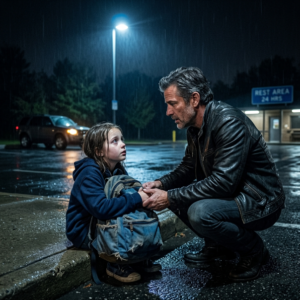
3 days later, I was served with papers. Derek Hodge was petitioning the court for custody of Charlie. I am not too proud to tell you that I sat down on my front porch with those papers in my hand, and I shook. Because here was the nightmare, the exact nightmare. This man, this stranger who shared half of Charlie’s blood and nothing else, was going to stand up in a courtroom and claim my grandson.
And I was a 56-year-old bus driver on a fixed income. And what if the law just handed that little boy over? What if all my love and all my care counted for nothing against a piece of paper that said, “Father”? And underneath all of it was the thing I could see as plain as day and could not yet prove, that Derek didn’t want Charlie at all.
He wanted Charlie’s money. He wanted to become the boy’s guardian so he could get his hands on that trust. And if he won, he’d take a grieving 8-year-old away from the only safe home he had left, not out of love, but out of greed, and bleed that child’s future dry. I did not know what to do, and that is when Faye Dunbar showed me what she was made of.
I told her about Derek over the phone, my voice coming apart, and the next evening she showed up at my door with a casserole and a yellow legal pad and a look on her face I hadn’t seen before, a kind of flint. “All right,” she said, setting the casserole on my counter like she’d done it a hundred times. “Now you listen to me, Hank Bishop.
I have spent 20 years watching kids come through my lunch line, and I know the difference between a child who’s safe and a child who isn’t, and that boy upstairs is safe with you, and I’m not going to sit here and watch some deadbeat take him for a payday. So, we are not going to fall apart. We are going to fight this. Sit down.
Let’s make a list.” And we did. I want you to understand what this woman did, this woman who 3 weeks earlier had apologized for existing across a diner table. She organized me. She helped me find a lawyer, a sharp woman named Ruiz over in the county seat who took the case when she heard the shape of it. She helped me write down everything every year Derek had been gone, every birthday he’d missed, every dollar he’d never paid.
And most of all, she did the thing that mattered most because Faye Dunbar was not just anybody in this fight. She was the lunch lady at Charlie’s school, a woman with 20 years of standing in that community, a woman who had personally watched over my grandson 5 days a week, and she said, “I will testify. I will stand up in that courtroom and tell them what kind of home that boy comes from.
I see these kids, Hank. I see which ones are cared for. Let me tell them about Charlie.” Charlie knew something was wrong. Children always do. He couldn’t have told you what it was, but he could feel the change in the house, the hushed phone calls, the way I’d go quiet and and at nothing. And one night during the worst of it, during the good thing and the hard thing at the edge of his bed, his hard thing was “Something’s making you sad, and you won’t tell me what.
” And then, in a voice gone small and scared in a way I hadn’t heard since right after his mama died, “Is somebody going to take me away from you, Grandpa?” It about killed me that he’d sensed it. I sat down on his bed, and I made a decision, which was to not lie to that boy because he’d had enough people be less than honest with him.
“There’s a man,” I told him careful, “who says he wants you to come live with him. But Charlie, listen to me. I am fighting that with everything I’ve got, and a whole lot of people are helping me. And I made you a promise, didn’t I? At this exact bed, I told you I wasn’t going anywhere, and I meant it.
So, I need you to trust your grandpa. I am going to keep you. Do you hear me? I am going to keep you.” And that boy threw his arms around my neck and held on like he was drowning, and I held him just as hard, and I made myself a promise of my own that night that I would burn down the whole world before I let anybody take him. And here’s the thing that still gets me.
The very next evening, Faye came over, and Charlie was still shaken, still clingy and quiet, and Faye Dunbar took one look at that boy, and she didn’t say a word about any of it. She just rolled up her sleeves and said, “Charlie Bishop, I happen to know you’ve been eating my cooking for 2 years, and you’ve never once seen me make anything from scratch.
How would you like to learn to make my grandmother’s biscuits? They’re famous. People have wept.” And she pulled that boy into the kitchen, and for 2 hours I listened to my grandson laugh, really laugh, covered in flour, while the lunch lady who’d been feeding him for 2 years taught him to cut biscuits with a juice glass.
She knew exactly what that child needed, which wasn’t talk and wasn’t pity. It was somebody acting like the world was still a normal place where a boy could learn to make biscuits on a Tuesday. I stood in that doorway and watched her, and that was the night I knew I was falling in love with Faye Dunbar, watching her flower up my grieving grandson and give him back 2 hours of being an ordinary kid.
The lawyer, Ruiz, told us the truth about where we stood, the way a good lawyer does. “A biological parent has strong rights,” she said. “I won’t lie to you. If this were a fit father who’d simply been absent and wanted to reconnect, you’d be facing an uphill climb, but that’s not what this is. We have 6 years of total abandonment, no support, no contact.
And if we can show the court what’s really driving this, that he surfaced only after learning about the trust, that his interest is the money and not the child, then the picture changes completely. Courts care about one thing above all in these cases, the best interest of the child. Our job is to show them clearly that his interest and Charlie’s interest are opposites.
Disclaimer: This story is a work of fiction created for entertainment purposes. Any resemblance to real persons, events, or places is coincidental.