I made my peace with it. She looked at me. Or I thought I had until your friend Earl wouldn’t quit calling. We talked until the Bluebird started stacking chairs and when I walked her to her car in the cold, neither of us did anything dramatic. I just said, Faye, I’d like to do this again.
I haven’t got much to offer, but I’d like to see you again if you’d let me. And she looked at me for a long moment and said, “You know what, Hank Bishop? I believe you would. And yes, I’d like that, too.” I drove home that night feeling something I hadn’t felt in years, which was the small dangerous flicker of hope. And for 3 weeks, life was good in a way it hadn’t been in a long time.
Faye and I saw each other twice more, slow and easy. A movie one night and a long walk another. And at home, Charlie and I had our life, the one we’d built out of the wreckage. And I want you to see a piece of it, so you understand what was about to be threatened. Every morning, I’d get up before light and make Charlie his breakfast, and then he’d ride my bus to school, sitting up front in the seat right behind me, which the other kids thought was the best thing in the world, getting to be the bus driver’s kid.
He’d talk to me the whole route about everything and nothing, dinosaurs and what he was going to be when he grew up, which changed weekly. And every afternoon, I’d drive that same bus and he’d be on it again, and we’d go home together, and I’d help him with his homework at the kitchen table, the same table where I’d helped his mother with hers 30 years before.
And every single night, at the edge of his bed, we’d do the good thing and the hard thing. One night, not long after the diner, Charlie’s hard thing was, “I can’t remember what Mom’s voice sounded like anymore.” And he said it so quiet, looking at the ceiling, trying to be brave about it the way he tried to be brave about everything, and it about took the legs out from under me.
I sat down on the edge of his bed, and I told him that was okay, that the sound of a voice is one of the first things that fades, and it doesn’t mean he loved her any less, and that I’d tell him stories about her every single day, so he’d never forget who she was, even if the exact sound of her got far away.
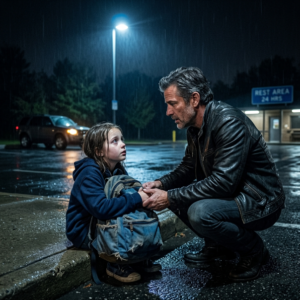
And then, I asked him for his good thing, and he thought about it, and he said, “My good thing is that you’re not going anywhere.” And he said it like a fact, like the one solid thing he could stand on. “You’re not going anywhere, right, Grandpa?” “No, buddy,” I told him, “I’m not going anywhere, not ever.” I want you to hold on to that promise I made an 8-year-old at the edge of his bed because 3 days after I made it, a man came back to town who was going to test whether I could keep it.
I told you the rest of it wasn’t easy. It wasn’t. Because 3 weeks after that first night at the Bluebird on a Tuesday, Derek Hodge came back to Marlow. I found out the way you find out everything in a town this size, which is sideways. Earl heard it from a man at the Anchor, the bar out on the highway, and Earl came and found me in the bus barn looking like he’d swallowed something sharp.
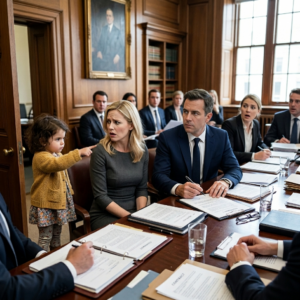
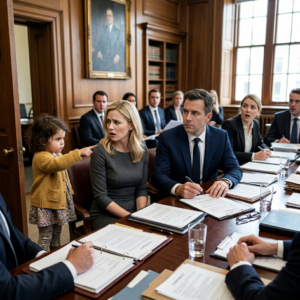
“Hank,” he said, “Derek’s back. Laney’s Derek. He’s been at the Anchor 2 nights running.” And then Earl told me the part that turned my blood to ice water. “And Hank, he’s not asking about Charlie. He’s asking about the settlement.” You need to understand about the settlement. After Laney was killed, there was a lawsuit because the man who hit her had been drinking and there was insurance and liability.
And it was handled by lawyers and a judge and the long and short of it was that a sum of money was set aside, a real sum, held in a court-supervised trust for Charlie, for his future, his education, his care. I never touched it and never would except for Charlie’s needs and even then only with the court’s say-so because that’s how those things work when the money belongs to a child.
It was the one thing Laney’s death had left her son, the closest thing to security that little boy had in this world. And Derek Hodge had come back to town and before he’d asked a single soul how his own son was doing, before he’d so much as driven past the boy’s school, he’d been sitting at the Anchor asking how much money the kid was sitting on.
I drove out to the Anchor that very night. I shouldn’t have, maybe, but I did. And I found Derek Hodge on a barstool and he was older and harder than I remembered, but it was him, the man who’d left my daughter alone with a baby. He gave me a big false smile when he saw me, like we were old friends. “Hank Bishop,” he said, “been a long time.
” “You’ve been back 2 days,” I said, “and you haven’t been to see your son.” The smile flickered. “I’ve been meaning to. Wanted to get settled first, get my footing. A man wants to come back right, you know. I’ve changed, Hank. I’ve been thinking a lot about Charlie, about being his dad.” “That’s funny,” I said, “because the way I hear it, the only thing you’ve been thinking about is the money my daughter died to leave him.
” And there it was. Just for a second before he could cover it, I saw the real thing move behind his eyes, the calculation, the greed. And I knew. Whatever he said next, I knew. He started in about how that wasn’t true, how a man had a right to be in his son’s life, how he’d heard there was some money, but that wasn’t why, how I had no right to keep a father from his child.
And I stood there in that bar and understood with a cold and sinking certainty what was coming, because he was right about one terrible thing. He was Charlie’s father. And in the eyes of the law, a father has rights, even a father who walked out 6 years ago, and a man who wants to get at a child’s money has one obvious door to walk through to get to it.
Disclaimer: This story is a work of fiction created for entertainment purposes. Any resemblance to real persons, events, or places is coincidental.