Why True Love Is Smarter Than Any Logic
In a world that constantly measures us by our grades, our titles, and our quick-wittedness, we often forget a profound truth: a brilliant mind is nothing without a compassionate heart. We have been taught to chase “cleverness,” but what happens when that cleverness is fueled by greed and arrogance? This is the story of two households, two marriages, and a daring gamble that almost tore a family apart. It is a narrative that reminds us that the most sophisticated person in the room isn’t always the one with the answers—sometimes, it’s the one who knows exactly when to play the fool to save what they love.
CHAPTER 1: THE NEIGHBORS AND THE SHADOW OF JEALOUSY
In a peaceful village where the hills rolled like green waves, there lived two families whose lives were mirror images of irony. In the first house lived a man known for his simple nature. He was not a man of books or complex theories; he was what many would call “clueless.” Yet, his life was illuminated by his wife—a woman of extraordinary intelligence, grace, and wit. Their home was not filled with high-minded debates, but it was overflowing with a rare, quiet happiness. They loved each other with a devotion that required no explanation.
Directly next door, the atmosphere was starkly different. There lived a man who prided himself on his “cleverness.” He was educated, sharp-tongued, and deeply arrogant. His wife, however, was simple and unlearned. Instead of cherishing her, the clever man looked upon her with disdain. He was miserable, and he made sure everyone knew it.
Every day, the clever man would watch his neighbor’s wife. He watched how she managed their affairs, how she spoke with wisdom, and how she looked at her “foolish” husband with eyes full of tenderness. A poisonous seed of jealousy began to sprout in his heart. “How did that man, who can barely count his own fingers, end up with such a treasure?” he wondered. “It is a cosmic injustice. She deserves a man who matches her intellect. She deserves me.”
CHAPTER 2: THE CRUEL PROPOSAL
The clever man’s jealousy eventually boiled over into action. One afternoon, he walked over to his neighbor’s fence, his face twisted into a smug grin. He didn’t come to offer tea or talk of the weather; he came to dismantle a life.
“Listen, neighbor,” he began, his voice dripping with condescension. “I will be honest with you. You are not a smart man. In fact, you are entirely clueless. My wife, too, is not clever. On the other hand, your wife is brilliant, and I am the most educated man in this village. It is only logical that we switch.”
The simple man frowned, the air around him suddenly feeling heavy. “Switch? You want to take my wife?”
The clever man laughed, a harsh sound that startled the birds in the trees. “Don’t pretend you don’t understand. Why waste such a mind on a man who doesn’t know the first thing about the world? I will take your wife, and you can take mine. We will all be better suited. We will all be happier.”
When the simple man tried to protest, asserting that he was just as clever as anyone else, the neighbor’s eyes narrowed. “Do you really believe that? Fine. Let the law decide. Let us go to the Judge. He will see the truth, and we will find out who is worthy of a clever woman’s hand.”
CHAPTER 3: THE IMPOSSIBLE RIDDLES OF THE JUDGE
The walk to the Judge’s chambers felt like a funeral march for the simple man. His heart pounded against his ribs like a trapped bird. He loved his wife more than the air he breathed, but the fear of his own ignorance was a heavy weight.
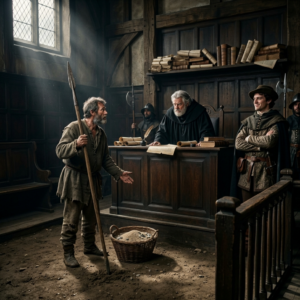
In the courtroom, the clever man laid out his “logical” argument. The Judge, a man of grey hair and piercing eyes, listened carefully. He looked at the simple man and decided to test the claim of ignorance.
“I will ask you two questions,” the Judge declared. “If you answer them, you keep your life as it is. If you fail, it proves you are unfit for a wife of such intelligence.”
The Judge leaned forward. “First: How many stars are in the sky?” The simple man’s mouth hung open. He looked out the window at the vast, infinite blue. The number was beyond his comprehension. He shook his head in silence.
“Second: Where is the center of the earth?” Again, the man felt the cold sting of failure. He thought of the deep soil, the mountains, and the endless horizon. He had no map for such a question. He looked at the Judge with eyes full of sorrow, thinking, “My poor wife. I am losing her because I am not smart enough to keep her.”
The Judge sighed. “Go home. Think about these questions. Come back tomorrow with your answers, or the exchange will be finalized.”
CHAPTER 4: THE WISDOM UNDER THE STARLIGHT
As the sun dipped below the horizon, painting the sky in bruises of purple and gold, the simple man stood in his yard. He was staring upward, pointing his finger at the twinkling lights of the firmament, trying desperately to count.
“One… two… three…” he whispered, his voice cracking.
His wife came out of the house, the scent of a warm supper following her. She saw the distress in his slumped shoulders. “What are you doing, my dear husband? Come in and eat.”
“I can’t,” he cried, his voice breaking. “I have to count the stars. If I don’t give the Judge a number, he will take you away from me and give you to our neighbor.”
He poured out the whole story—the neighbor’s arrogance, the Judge’s impossible questions, and the impending loss of their happiness. His wife didn’t panic. She didn’t cry. Instead, she let out a gentle, melodic laugh that seemed to clear the fog in his mind.
“Don’t worry, my love,” she said, taking his hand. “The answers are easier than you think. Now, come inside, eat, and rest. Tomorrow, I will give you everything you need.”
CHAPTER 5: SAND, SPEARS, AND A REVEALING TRUTH
The next morning, the clever neighbor arrived early, practically vibrating with the anticipation of his “prize.” The simple man emerged from his house, but he wasn’t alone. His wife had handed him a basket filled with fine sand and a long, sturdy spear.
Back in the courtroom, the Judge repeated his first question. “How many stars are in the sky?”
The simple man didn’t hesitate. He took a handful of sand from the basket and let it trickle through his fingers onto the floor. “The number of stars in the sky,” he said firmly, “is exactly the same as the number of grains of sand in this basket. If you do not believe me, Your Honor, you are welcome to count them yourself.”
The Judge’s eyes twinkled. “A fair point. No one can prove you wrong.”
“And the second question,” the Judge continued. “Where is the center of the earth?”
The man stepped forward and thrust his spear deep into the dirt floor of the courtroom. “The center of the earth is right here, where my spear stands. If you do not believe me, you are welcome to dig a hole and measure it yourself.”
The Judge burst into laughter. “This man is not ignorant! These are the answers of a philosopher!”
But the clever neighbor was fuming. “He is a fraud! He is stupid! Someone gave him those answers!”
The Judge looked at the simple man. “Is this true? Did you find these answers yourself?”
In his honesty and joy, the man forgot the stakes. “Oh, yes!” he said happily. “My dear, clever wife told me exactly what to say!”
The courtroom went silent. The clever neighbor’s face lit up with a predatory triumph. “Aha! You see? He admits it. He is a puppet. A smart woman needs a smart husband. Swap them now!”
The Judge nodded gravely. “The law is the law. A man who cannot think for himself cannot hold a woman of such brilliance. Go home and prepare for the exchange.”
CHAPTER 6: THE FINAL DINNER
The simple man returned home with tears streaming down his face. “I am a fool,” he sobbed to his wife. “I have lost you because I couldn’t keep my mouth shut.”
But his wife remained remarkably calm. She wiped his tears and whispered a new plan. “Go to the neighbor and the Judge. Tell them you accept the decision. Invite them both to our home for a final dinner to celebrate the exchange. Trust me one more time.”
The following evening, the clever neighbor and the Judge arrived, their appetites whetted by the promise of a feast prepared by the “cleverest woman in the village.”
“Wife!” the simple man shouted. “Our guests are here! Bring the food!”
The woman emerged, carrying a beautifully woven basket and a golden pot. The Judge rubbed his hands together. “I have heard of your brilliance,” he said. “I expect your cooking is as sharp as your mind.”
She handed the Judge a piece of bread. It was black, hard as stone, and smelled of acrid smoke. “What is this?” the Judge coughed, nearly breaking a tooth.
“It’s my bread,” the woman replied innocently. “I am so smart that I have discovered that the more you burn it, the more… interesting it becomes. I always make it like this.”
Next, she ladled a bowl of chicken stew for the clever neighbor. He looked down and recoiled in horror. Floating in the grey, watery broth was a whole chicken—skin, beak, and every single feather still attached.
“There are feathers in this stew!” the clever man shrieked.
“Of course,” the woman said with a blank stare. “Taking the feathers off is such a tedious task for a mind as grand as mine. I prefer the ‘natural’ texture. Don’t you like it? I thought a clever man like you would appreciate my unique methods.”
CHAPTER 7: THE REJECTION OF THE “PRIZE”
The Judge pushed his bowl away, his stomach churning. The clever neighbor looked from the burnt bread to the feathered chicken, and then at the woman who stood there looking perfectly satisfied with her disastrous meal.
“It is time,” the Judge said, though he looked like he wanted to be anywhere else. “Exchange the wives.”
But the clever neighbor stood up abruptly. “Wait!” he shouted. “I think… perhaps I made a mistake.”
The Judge raised an eyebrow. “Don’t you want this ‘smart’ woman?”
“Smart?” the neighbor spat. “She is a lunatic! She can’t even bake bread or clean a chicken! Let her stay with her foolish husband. They deserve each other. My own wife may not be a philosopher, but at least her bread is edible and her stew doesn’t have feathers in it!”
Without another word, the clever man and the Judge fled the house, leaving the simple man and his wife alone in the quiet of their dining room.
DEEP REFLECTION: THE BEAUTY OF THE HEART
As the gate clicked shut, the woman’s “clueless” expression vanished, replaced by a brilliant, triumphant smile. She threw the burnt bread and the feathered stew into the waste bin and brought out a second, hidden feast—golden loaves of fresh bread and a stew that smelled of herbs and perfection.
“Oh, my dear wife,” the husband said, looking at her with absolute awe. “You are so clever. You deserve a better man than a simpleton like me.”
She sat beside him and took his hand. “You are wrong,” she said softly. “You are the best man in the world. You are kind, you are honest, and you love me enough to fight for me. Cleverness can be learned from books, but the goodness in your heart? That is a gift from the heavens. I will never leave you.”
This story teaches us a viral truth for our modern age: Being “smart” is not about winning every argument or knowing every fact. True wisdom is knowing how to protect the people you love. It’s about realizing that a life filled with “clueless” kindness is infinitely more valuable than a life filled with “clever” cruelty.
CALL TO ACTION: In your life, have you ever met someone who was “book smart” but “heart poor”? Or someone who seemed simple but had the wisdom of the ages? We want to hear your stories about the power of love over logic. Share your thoughts in the comments below, and don’t forget to tag someone who makes your life “cleverer” just by being in it!
Disclaimer : This content may be created by AI for entertainment purposes. Any resemblance to real persons, events, or places is coincidental.






