He Inherited Only A Box Of Old Recipes — But The Next Day He Was Summoned To A Private Island
In the humid, neon-soaked streets of Miami, Kaelen Reed was a man who lived by the rhythm of a kitchen timer. At nineteen, he was a line cook at a failing bistro, his hands scarred from grease burns and his spirit worn thin by a city that only respects the shiny. He had spent his childhood in a series of cramped apartments, his only connection to the past being a collection of postcards from a grandfather he’d never met. When he was called to a high-rise in Brickell for the reading of a will, he expected a life-changing windfall. Instead, he was handed a wooden cigar box filled with hand-written recipes for stews and sauces. While the rest of the room erupted in laughter at his “inheritance,” Kaelen felt a different kind of weight. He didn’t realize that the recipes weren’t for food—they were the encrypted keys to a global logistics empire. This is the story of how a boy with a wooden box proved that the most powerful secrets are the ones you can’t see until you turn up the heat.
The air in the office of Mendoza & Sons was thick with the scent of leather and ego. Garrick Mendoza, a man whose tan was as artificial as his smile, sat at the head of the mahogany table. He had just inherited the fleet of cargo ships and the skyscraper we were currently standing in.
Beside him sat Sienna, his sister, who was busy photographing her new diamond heirloom for her followers.
The lawyer, a man named Huxley Pike, looked at Kaelen with pity. “And to Kaelen Reed, the son of my youngest daughter… I leave the ‘Cedar Box’ and the contents therein.”
Garrick snorted, adjusting his gold watch. “Grandfather always did love a joke. He gives me the ships that move the world’s oil, and he gives the fry-cook a book of soup recipes. Don’t burn yourself, Kaelen.”
Sienna laughed, a sharp, cold sound. “Maybe you can open a food truck, Kaelen. I’ll tag you in a post. It’ll be charity.”
Kaelen didn’t say a word. He tucked the small, fragrant box under his arm and walked out. He had $40 in his pocket and a box of paper.
That night, in his tiny studio apartment, Kaelen opened the box. The recipes were written in a sprawling, elegant script. But as a cook, Kaelen noticed something odd.
“The Midnight Bouillabaisse: Requires 4.5 kilos of saffron, 1.2 liters of salt, and exactly 88 degrees of heat.”
“That’s not a recipe,” Kaelen muttered. “That would be inedible. That’s a chemical disaster.”
He looked closer. The “ingredients” were coordinates. The “heat” was a frequency.
Suddenly, a knock thundered against his door. It wasn’t the landlord. It was Huxley Pike, the lawyer, looking frantic.
“Kaelen, get your things. Garrick has already sent men to your grandfather’s estate to burn the archives. He thinks he’s cleared the path, but he doesn’t know about the box. He doesn’t know you’re the only one who can unlock the ‘Deep Water’ accounts.”
“What are you talking about, Huxley?”
“Your grandfather didn’t trust his own sons. He saw the rot in them. He moved the company’s true value—the proprietary software that tracks every ship on the ocean—into a private trust. The password isn’t a string of numbers. It’s a sensory sequence hidden in those recipes. We need to get to the Island.”
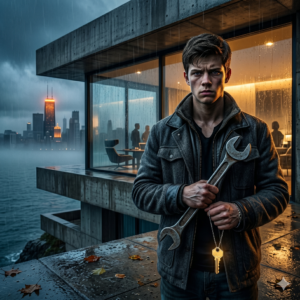
The private island wasn’t a tropical paradise. It was a jagged rock off the coast of the Keys, topped with a brutalist concrete fortress.
Inside, Kaelen stood before a massive server terminal. Garrick and his security team arrived twenty minutes later, their faces twisted with rage.
“Give me the box, Kaelen!” Garrick roared, leveling a finger at him. “That software belongs to the company. I’m the CEO!”
“You’re the CEO of a bunch of empty hulls, Garrick,” Kaelen said, his voice cold and steady. “Without the ‘Midnight Bouillabaisse’ protocol, your ships can’t clear customs in a single port. They’re just floating scrap metal.”
Kaelen began to type. He didn’t enter numbers. He entered the proportions of the spices.
Saffron. Salt. 88.
The screens flickered from red to a brilliant, cool blue.
The real twist came when the final line of the recipe was entered. The monitors didn’t just show bank accounts; they showed a live video feed from ten years ago.
It was Kaelen’s grandfather, sitting in this very chair.
“If you’re seeing this, Kaelen, it means you actually read the book. Garrick would have burned it for the cedar wood. Sienna would have used the paper to blot her lipstick. But you… you know that a good meal, like a good life, requires patience and the right ingredients.”
The video shifted to a digital ledger. It revealed that Garrick had been stealing from the company’s pension fund for years to cover his gambling debts in Macau.
“I’m not just the heir, Garrick,” Kaelen said, turning to his uncle. “According to the ‘Mendoza Protocol’ my grandfather installed, the moment the software is unlocked by someone other than you, an automatic audit is triggered. The SEC has been pinged. Your ‘inheritance’ just became a federal indictment.”
One year later, the Reed-Mendoza Foundation is the most successful logistics firm in the South.
Kaelen Reed doesn’t wear a suit. He still wears his chef’s coat, and he’s converted the ground floor of the headquarters into a world-class kitchen that feeds the city’s homeless every morning.
Garrick and Sienna are gone, their names erased from the building.
Kaelen realized then that his grandfather didn’t leave him a business. He left him a sieve—a way to filter out the greedy and keep what was pure.
I realized then that the best way to change the world isn’t to buy it, but to know exactly what makes it run.
Disclaimer : This content may be created by AI for entertainment purposes. Any resemblance to real persons, events, or places is coincidental.






