The Key to the Kingdom: Why I Stripped My Father’s Girlfriend of Her Power Before She Destroyed My Family
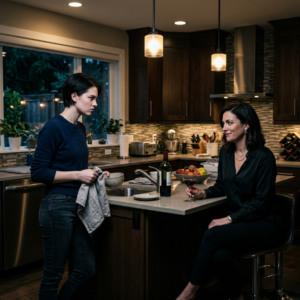
The air in the kitchen was thick with the scent of a dinner that should have been a celebration of reconciliation. Instead, it felt like a battlefield. Across the granite island, a woman who had been in my father’s life for barely six months looked at me—a 21-year-old college student who had raised four siblings in the vacuum of our mother’s death and our father’s alcoholism—and uttered four words that would ignite a year-long psychological war:
“You too, hun. Bedtime.”
At that moment, the suburban quiet of our home was shattered by the realization that an intruder wasn’t someone who broke in through a window, but someone who walked in through the front door with a smile and a stolen sense of authority. This is not just a story about a “crazy” girlfriend; it is a chronicle of a family’s survival against a master gaslighter, a fake pregnancy, and a twisted obsession with a life that wasn’t hers to claim.
To understand the weight of the key in my pocket, you have to understand the ghosts in our hallways. When our mother passed, the light in our house didn’t just dim; it went out. Our father, Anatol, chose the bottle over his children, leaving my oldest brother, Henry, and me to become the parents we never had. By the age of twelve, I wasn’t playing with dolls; I was packing school lunches, monitoring fevers, and navigating the complex sensory needs of my autistic younger brother.
Our uncle eventually became our legal guardian, providing the stability our father couldn’t. But recently, Anatol had been sober. He wanted back in. And with him came Sorell.
Sorell was in her thirties, significantly younger than my father, and she possessed a terrifying, performative hunger for “motherhood.” She didn’t just want to date our father; she wanted to skin our family history and wear it as a coat. She began showing up uninvited, using a key my uncle had foolishly given her for “emergencies” to let herself in when the house was empty. She would be standing in our kitchen, unannounced, humming a tune that didn’t belong in our house, her eyes scanning our photos with a predatory kind of “love.”
The first crack in the facade happened at a “reconciliation dinner.” Amidst the clinking of silverware, Anatol made an insensitive joke about our past. Sorell didn’t just laugh; she added an ugly, sharp insinuation about our late mother. The table went cold. The silence was a physical weight. We saw them out, but the poison had been spilled.
The following afternoon, I returned from the school run to find Sorell in my kitchen again. She claimed she was there to apologize for Anatol, but her eyes were dancing with a strange amusement. When I told her—calmly, as I do everything—that her comments about my mother were intolerable, she laughed.
“It’s so cute that you’re trying to be the adult here,” she cooed.
I am twenty-one. I work forty hours a week. I am a university student. I have been the emotional pillar of this house for a decade. Her patronization wasn’t just an insult; it was a denial of my existence.
That night, she stayed for dinner. She didn’t ask; she simply occupied space. Around 10:00 PM, she turned to my younger siblings and performed the “Step-Mom Routine,” ushering them to bed with a saccharine sweetness that made my skin crawl. They looked at me, I shrugged, and they went—not because of her, but because they are disciplined kids.
Then, she turned her gaze on me. The kitchen light caught the triumph in her eyes.
“You too, hun. It’s getting late. Time for bed.”
I froze, a dishcloth halfway to a plate. “What?”
“Time for bed,” she repeated, actually tutting at me like I was a rebellious toddler.
In that micro-moment, I saw the madness. She wasn’t joking. She truly believed that by saying the words, she could command my reality. I felt a cold, sharp clarity. I told her it was time for her to go home. She refused, escalating into a “hissy fit” narrative, calling me a “rebellious teenager.”
When she retreated to the bathroom to compose her next act, I saw her handbag on the couch. Her keyring was a bloated mess of metal. I didn’t hesitate. I slid the house key off the ring and tucked it into my pocket.
Twenty minutes later, she left, unaware that she had just been evicted from the sanctuary she tried to hijack.
The war of the keys was only the prologue. Over the next few weeks, Sorell’s behavior shifted from patronizing to predatory.
Henry, my eldest brother, was a rising star in his field. When his girlfriend had to undergo knee surgery, I became his “plus-one” for a prestigious gala at the local opera house. It was a standard family arrangement. But to Sorell, it was “weird.” She began texting Henry, her messages oscillating between networking requests and something far more sinister.
“I wouldn’t want my baby boy to go hungry,” she texted him, offering to bring lunch to his office.
The “baby boy” comment sent a shiver through our entire family group chat. Was it a misguided attempt at being a “mother figure”? Or was it a sexual innuendo aimed at the eldest son of the man she was dating? The ambiguity was the point; it kept us off balance.
At the gala, she was a whirlwind of interference. She lectured us on “babying” my autistic brother when he couldn’t eat food that was touching on his plate—ignoring the fact that for him, sensory issues are a physical barrier. She tried to “correct” my sister’s medication, nearly giving her the wrong pills because she wanted to play doctor.
But the final straw came during the family photos. As we stood on the red carpet, Sorell began arranging us like props. She pushed me to the far edge, literally standing in front of me to block me from the camera’s lens. She then jumped into the arms of my father and Henry, screaming, “Carry me!” like a child demanding center stage.
As we walked to the cars, I used a French term for the dessert we’d eaten. Sorell mocked my accent with a cruel, exaggerated trill.
I turned to my father, my voice a low, vibrating blade. “Anatol, take your girlfriend and get in the car right now, because I am about to kick this woman in the head.”
A month later, the news hit like a physical blow: Sorell was pregnant.
Anatol vouched for her, claiming she had changed. We were trapped. If she was carrying our future sibling, we couldn’t simply cut her out. We began a “paper trail” phase, documenting every interaction, waiting for the other shoe to drop.
Then came my little sister’s birthday. Anatol brought a gift from Sorell. Inside were two jars of Masamora Marada—a Peruvian purple corn pudding.
To a stranger, it was a sweet gesture. To me, it was a violation. Masamora was the tradition of my late mother. It was the one thing I did every summer to keep her memory alive for the younger kids who never knew her. By making it, Sorell was trying to overwrite my mother’s signature with her own.
I stood in the kitchen, staring at the jars, feeling a sense of grief so fresh it burned. She had stolen our keys, she had tried to steal our brothers, and now she was trying to steal our ghosts.
The climax of this long-form nightmare didn’t happen at a gala or a dinner. It happened in my backyard during Easter break.
I was watering the garden, the sun warm on my neck, when my sister ran out, pale-faced. “Sorell is here. She said she had to leave something in your room.”
I didn’t think. I ran. By the time I reached the driveway, Sorell was scurrying to her car, clutching a giant, bulging designer purse.
I didn’t wait for the police I was already dialing. I hauled her out of the car. We struggled. In a moment of pure, unadulterated protective instinct, I swung the heavy metal watering can. It connected with a hollow thwack against her head.
She slumped to the pavement, wailing about a “forgotten hoodie.” But when the police arrived and upended her purse, the “hoodie” wasn’t there. Instead, out spilled my clothes. My jewelry—over $5,000 worth of heirlooms. My intimate apparel.
Disclaimer : This content may be created by AI for entertainment purposes. Any resemblance to real persons, events, or places is coincidental.






