How a Simple Choice Defied a Death Sentence
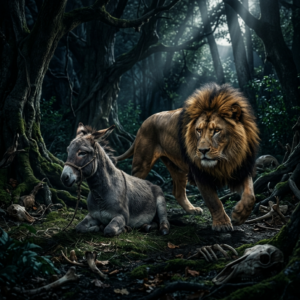
In the theater of the wild, there is a script that has been written in blood for millennia. It is a script where the strong consume the weak, where the hunter strikes the terrified, and where fear acts as the final confirmation of a victim’s fate. We have all felt that primal urge to flee when faced with a “lion” in our own lives—whether that lion is a looming financial crisis, a devastating personal betrayal, or a crushing failure. We feel our hearts hammer against our ribs, our breath grow shallow, and every fiber of our being screams at us to run. But what if the secret to survival isn’t found in the speed of our legs, but in the stillness of our souls?
This is the incredible, true narrative of a small, unpretentious donkey who wandered into the jaws of death and walked out not through strength, but through a psychological mastery that left the king of the jungle paralyzed by confusion.
CHAPTER 1: THE WRONG TURN INTO DARKNESS
It was an afternoon that began like a thousand others. The donkey, a creature of habit and heavy burdens, was navigating the winding trails that connected the merchant villages. On his back, he carried the weight of several bags of grain—coarse, heavy burlap sacks that smelled of earth and harvest. The sun was warm, the rhythmic clip-clop of his hooves on the dirt was a familiar song, and the route was one he could have walked with his eyes closed.
But as the path reached a fork, shrouded by the lengthening shadows of the trees, something shifted. The donkey chose the left path—the one he believed to be his familiar home stretch. However, as the canopy thickened and the light began to take on a sickly, greenish hue, the “familiar” began to rot into the “unknown.” The trees here were different; their bark was gnarled like old fingers, and the air grew heavy, thick with the scent of damp earth and something metallic.
After an hour of walking, the realization hit him like a physical blow: he was lost. Deeply, dangerously lost. He stopped in his tracks, his ears swiveling frantically, trying to catch the distant, comforting sounds of human activity. He looked for the smoke of a village fire, listened for the bark of a dog or the chime of a market bell. There was nothing. The only sound was the hollow whistle of the wind through the leaves and the frantic thudding of his own heart.
CHAPTER 2: THE VALLEY OF BONES
The silence of the forest was not the silence of peace; it was the silence of a graveyard. As the donkey stepped forward, his hoof crunched against something brittle. He looked down and saw them—bones. Ribcages of deer, femurs of cattle, all picked clean and bleached white by the elements. This was not a forest; it was a dining room for the world’s most efficient killers.
His legs, usually so sturdy and reliable, began to tremble. A cold sweat broke out along his neck. It was in this moment of peak vulnerability that he heard it: a low, guttural rumble that seemed to vibrate the very ground beneath his hooves. It wasn’t a growl; it was a sound of absolute authority.
He turned his head slowly, his neck stiff with terror. There, standing less than twenty paces away, was the lion. The great cat was magnificent and horrifying all at once. His golden eyes were locked onto the donkey’s with a predatory focus that seemed to drain the air from the glade. The lion’s tail flicked from side to side—a rhythmic, hypnotic motion that signaled the beginning of the end. The donkey felt his entire body freeze. He was a statue of flesh and fear, staring into the abyss of his own mortality.
CHAPTER 3: THE ANCIENT WISDOM OF THE MASTER
As the lion began to circle—slow, patient, and terrifyingly calm—the donkey’s mind raced through every possible exit. Run? He would be caught in seconds. Kick? A futile gesture against such power. Cry out? No one was listening. This was the moment of the “crack,” the moment when the prey usually panics and triggers the final lethal pounce.
But then, from the dusty corners of his memory, a voice emerged. It was the voice of his old master from many years ago, a man who had handled thousands of animals with a quiet, unshakable confidence. The master had once whispered to him during a terrifying thunderstorm: “The one who shows no fear confuses every bully.”
The words acted like an anchor in a storm. A shaky, shallow breath left the donkey’s lungs, replaced by a deep, intentional one. He realized that if he acted like prey, he would become a meal. To survive, he had to change the script. In an act that defied every instinct of a thousand generations of his kind, the donkey didn’t run. He didn’t even stand his ground. He sat down.
Quietly, deliberately, he lowered his heavy body onto the grass right in front of the king of the forest. And then, he began to eat. He reached down, plucked a clump of green grass, and began to chew. Slowly. Methodically.
CHAPTER 4: THE KING’S CONFUSION
The lion stopped. For the first time in his life, the predator was the one who was startled. In the lion’s world, there are only two responses to his presence: fight or flight. No creature—no gazelle, no buffalo, no man—sits down to have a snack when the king is at the table.
The lion growled again, deeper this time, a sound that shook the very leaves on the trees. He was trying to re-establish the hierarchy of fear. The donkey, however, merely glanced up. He met the lion’s gaze with a bored, almost annoyed expression, chewed a few more times, and then looked away toward the trees as if he were contemplating the weather.
Inside, the donkey’s heart was hammering so hard he thought it might shatter his ribs. But externally, he was a pool of still water. He even forced a yawn—a grand, wide-mouthed display of utter indifference.
The lion took a step back. It was only one step, but in the language of the wild, that step was a tectonic shift. The predator was now questioning himself. Is this donkey sick? Is he a trap? Does he possess a power I don’t understand? The lion began to circle again, closer this time, his whiskers twitching, waiting for the donkey to crack, to show just one flicker of panic. But the donkey just kept chewing, the slow, rhythmic sound of grinding grass the only noise in the clearing.
CHAPTER 5: THE HYENA’S GAMBIT
After what felt like an eternity, the lion retreated. He didn’t leave, but he backed away into the shadows of the brush, still watching, still trying to solve the puzzle of the sitting donkey.
It was then that a hyena slinked out from the undergrowth. With his oily fur and a permanent, jagged grin, the hyena was the forest’s ultimate opportunist. He had seen the standoff and smelled a chance for a free meal. He walked right up to the donkey, his yellow teeth bared and his voice a high-pitched, mocking cackle.
“You think you’re clever, don’t you?” the hyena whispered, his eyes darting toward the hidden lion. “Sitting here like you own the woods. The big guy might be confused, but I’m not as nice as he is. I’ll start with your throat.”
The donkey looked at the hyena. For a second, his mind went blank. The bluff was being pushed to its limit. But then, a flash of brilliant, desperate wit struck him. He looked the hyena in the eye and said, “The lion already looked at me and decided I wasn’t worth his time. Are you trying to say the King is wrong? Are you saying you have better judgment than him?”
The hyena froze. He looked toward the bushes where the lion’s golden eyes were still glowing in the dark. If the hyena attacked, he would be insulting the lion’s “decision.” The hyena’s grin faded into a look of genuine worry. “I… I was just asking,” he muttered, before scurrying back into the darkness.
CHAPTER 6: THE WALK OF FREEDOM
The donkey stayed sitting for a few moments longer, ensuring the silence was absolute. Then, with a slow, dignified grace, he pushed himself up onto his four hooves. He didn’t bolt. He didn’t gallop. He turned his back to the lion and walked—one steady, measured step at a time—out of the forest.
He didn’t look back. He knew that looking back was a sign of doubt, and doubt is the sibling of fear. He walked until the air grew lighter, until the smell of the forest faded, and the familiar scent of woodsmoke and hay returned. The lion never moved. He watched the donkey leave, forever haunted by the creature who refused to play the role of the victim.
The lesson for us is profound. Our “lions”—our greatest fears—are looking for one thing: our panic. They feed on our anxiety and grow powerful on our desire to run. But when you refuse to give them the fear they expect, they lose their power over you. They don’t know what to do with a soul that remains calm in the face of destruction.
DEEP REFLECTION: WINNING THE INNER WAR
The donkey didn’t survive because he was stronger than the lion; he survived because he was stronger than his own fear. The real battle wasn’t fought in the forest glade; it was fought in the donkey’s mind during those first few seconds of freezing terror.
When your world feels like it’s closing in, when the “bones” of previous failures are scattered at your feet, remember the donkey. You don’t always need a sword to fight a lion. Sometimes, you just need to sit down, take a breath, and refuse to be afraid. The world may roar at you, but it cannot consume you if you remain the master of your own spirit.
CALL TO ACTION
How do you handle your “lions”? Have you ever faced a moment where staying calm was your only way out? We want to hear your stories of courage and quiet strength. Drop a comment below and tell us about a time you refused to run when everything was screaming at you to go. Let’s inspire this global community to stay calm, stay still, and conquer the kings of their own forests.
Disclaimer : This content may be created by AI for entertainment purposes. Any resemblance to real persons, events, or places is coincidental.






