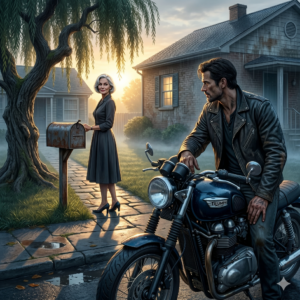
She Checked The Empty Mailbox Every Day At Dawn — The Biker Realized The Gears Had Stopped Turning
In the quiet, suburban veins of a town that prided itself on its predictability, Adeline Vance was the heartbeat. For exactly six years, she had been the only constant in a world of shifting seasons and fleeting neighbors. To the casual observer, Adeline was merely a relic of a bygone era, a silver-haired widow whose only purpose was a slow, rhythmic walk to a rusted mailbox at the edge of a overgrown driveway. But to those who look deeper, habits are rarely just habits; they are anchors. For Adeline, the mailbox wasn’t about the mail—it was a signal fire. She had spent two thousand days perfecting a routine so rigid that it became invisible, a camouflage of normalcy designed to hide a truth far more volatile than the neighborhood could ever suspect. This is the story of the day that anchor was cut, and the man with grease under his fingernails who realized that when a clockwork life stops ticking, it isn’t just silence that follows—it’s a countdown.
Caleb Thorne lived his life in the rhythm of high-performance engines and the metallic scent of a garage. Every morning at 8:45 AM, he roared down the stretch of Blackwood Road on a custom-built, midnight-blue Triumph. He wasn’t a man of many words; he was a man of observation. He understood the language of machines—if a gasket was leaking, the sound changed; if a timing belt was frayed, the vibration shifted.
He applied that same logic to the world around him.
For six years, Caleb had seen the same image in his peripheral vision: Adeline Vance, dressed in a faded floral housecoat, stepping onto her porch at exactly 8:50 AM. She would pause for exactly three seconds to look at the sky, walk ten paces down the cracked stone path, and peer into an empty mailbox. She never pulled anything out. She never left anything in.
Caleb never stopped to talk. He was a ghost on two wheels, and she was a ghost in the garden. He would lift a gloved hand in a two-finger salute, and she would offer a small, dignified nod. It was a silent contract—a mutual recognition of two souls who preferred their own company.
But on Tuesday morning, the engine felt wrong. Not his Triumph—the neighborhood.
Caleb rode past Adeline’s house, his eyes scanning for the floral housecoat. The porch was empty. The door was shut. The weeds in the garden seemed to lean a little closer to the house.
He checked his watch: 8:52 AM.
“Maybe she’s just late,” Caleb muttered under his breath, shifting gears. “People get late.”
But on Wednesday morning, the house was still holding its breath. The mailbox door was slightly ajar, swinging in the breeze like a broken jaw.
Caleb felt a cold prickle at the base of his neck. In his world, a machine that stops running doesn’t fix itself.
By Thursday, the silence of the Vance house had become deafening. Caleb didn’t even make it to the garage. He pulled his bike to the curb, the low growl of the exhaust the only thing breaking the eerie stillness of the street.
Neighbors were mowing lawns. A mail truck—the actual one—drove past without stopping at Adeline’s. Nobody noticed. Adeline Vance had become part of the scenery, and people don’t notice when a specific tree in a forest stops growing.
Caleb walked up the stone path. His heavy boots felt like an intrusion on the silence. He reached the mailbox first. Inside, there was nothing but a single, dried oak leaf.
He moved toward the house. The windows were dark, the heavy velvet curtains drawn tight. He knocked once. The sound echoed through the hollow structure of the home.
“Mrs. Vance?” Caleb called. “It’s Caleb. From the bike.”
No answer.
He tried the handle. It didn’t budge. He walked around to the back, his eyes catching a detail that sent his heart into a frantic rhythm: a single, broken pane of glass in the mudroom door, covered perfectly by a piece of cardboard taped from the inside.
This wasn’t an old woman who had fallen. This was a house that had been breached.
Caleb didn’t call the police immediately. He knew the local sheriff—a man who thought “welfare checks” were a waste of time unless there was a smell. Caleb reached into his boot, pulled out a small tension wrench, and made short work of the mudroom lock.
The air inside smelled of stale tea and something metallic—gun oil.
Caleb moved through the house like a predator. He found the kitchen first. A teacup was shattered on the floor, the porcelain ground into the tile as if by a heavy heel. A chair was overturned.
But it was the living room that stopped him.
The walls weren’t covered in photos of grandchildren. They were covered in maps. Topographical maps of Eastern Europe, maritime routes through the Black Sea, and a complex web of photographs pinned to a corkboard. In the center of the web was a man Caleb recognized from the news—a high-level financier who had “disappeared” three years ago following a massive money-laundering scandal.
Adeline Vance wasn’t a lonely widow. She was a tracker.
He found her cell phone hidden in a hollowed-out book on the coffee table. The last outgoing message was from four days ago: “The package is moving. I’m going in. If I don’t signal at dawn, initiate the protocol.”
Caleb realized then that Adeline’s daily walk to the mailbox hadn’t been a ritual of hope. It had been a “Dead Man’s Switch.” Every day she walked to that box, she was telling her handlers she was safe.
And for three days, the signal had been dark.
As Caleb searched the house, a shadow darkened the doorway. He spun around, hand reaching for a heavy wrench on the counter.
“Who the hell are you?” a voice barked.
A man stood there, mid-thirties, wearing a tactical jacket and carrying a government-issue sidearm. He looked like Adeline, but with a face hardened by war.
“I’m the guy who noticed she didn’t come out for her mail,” Caleb said, not backing down. “Who are you?”
“I’m her son,” the man said, his eyes scanning the room with the same precision Caleb used for engines. “And you shouldn’t be here.”
The man was Julian Vance, an operative with a “consultancy” group that didn’t exist on paper.
“She’s been taken, Julian,” Caleb said. “I saw a white utility van parked two blocks away for the last week. It’s gone now. They took her Sunday night.”
Julian looked at Caleb, really looking at him for the first time. “You’re the biker. She mentioned you in her logs. ‘The Blue Triumph.’ She said you were the only person in this town who actually looked at people’s faces.”
Julian moved to the map on the wall. “She wasn’t just tracking the financier. She was the one who hid the encrypted drive he stole. She’s been the vault for six years, living in plain sight because nobody suspects an old woman in a floral housecoat.”
The rescue wasn’t a police raid. It was a surgical strike. Julian had the tech, but Caleb knew the terrain. Caleb knew every abandoned warehouse and rusted shipyard in the county where a van could be hidden without being seen from the air.
“There’s an old canning factory by the docks,” Caleb said, tracing a finger over Julian’s digital map. “The power was turned back on there two weeks ago, but no business license was filed. It’s the only place with enough lead in the walls to block a cellular signal.”
They arrived at midnight. Caleb stayed on the perimeter, his bike acting as a scout, while Julian moved in with the silence of a shadow.
The fight was short, brutal, and professional. Three men—mercenaries hired to find the drive—were neutralized before they could even draw.
Caleb found Adeline in the basement. She was tied to a chair, her face bruised, her silver hair matted with blood. But when she saw Caleb, she didn’t cry. She didn’t scream.
She looked at his hands—stained with grease and carbon.
“You’re late, Caleb,” she whispered, her voice a dry rasp. “The mail was supposed to be checked at dawn.”
Caleb cut the zip-ties with a pocketknife. “I had to stop for gas, Mrs. Vance.”
One week later, the Vance house was quiet again. The weeds had been trimmed, and the cardboard on the mudroom door had been replaced with reinforced plexiglass.
The financier had been captured. The drive was back in government hands. The “Ghost of Maple Street” was officially retired.
At 8:50 AM, Caleb Thorne roared down Blackwood Road. He slowed the Triumph as he approached the driveway.
Adeline Vance stepped onto her porch. She was wearing a new housecoat—this one a deep, vibrant blue. She didn’t look at the sky today. She looked directly at the road.
She walked down the path, opened the mailbox, and pulled out a single envelope. It was a thank-you note from the son she had protected for six years.
As Caleb rode past, he didn’t just lift two fingers. He pulled the bike to a stop for the first time in six years. He killed the engine.
Adeline walked to the curb.
“Is there mail for me today, Caleb?” she asked, a spark of humor in her eyes.
“No mail, Adeline,” Caleb said, removing his helmet. “Just checking the timing. You’re exactly on schedule.”
Adeline smiled—a real, radiant smile that made the six years of hiding feel like a distant dream.
“It’s good to be seen, Caleb,” she said.
“It’s good to have you back, Mrs. Vance.”
Caleb kicked the bike into gear and pulled away, the roar of the engine a triumphant anthem in the morning air. The routine was back, but the camouflage was gone. In a world that rarely slows down, one man had stopped long enough to realize that the most extraordinary stories are often hidden in the most ordinary habits.
Disclaimer : This content may be created by AI for entertainment purposes. Any resemblance to real persons, events, or places is coincidental.






