He Tried To Buy The Jury — So The Librarian Of Records Buried Him In The Truth
In a city where the skyscrapers are built on foundations of paper and promises, the most powerful person isn’t the one with the loudest voice, but the one who holds the keys to the archive. I have spent my life as a writer observing the “Kings of the Concrete,” men who believe that if they pay enough people, the truth becomes a variable they can edit. Judge Octavia Sterling was not a woman who believed in variables. To her, the law was an absolute constant, like gravity or the speed of light. She was a woman who had risen from the tenements of the East Side, armed only with a scholarship and a refusal to be intimidated. When Caspian Drake, the billionaire “King of Crypto-Real Estate,” walked into her courtroom, he thought he was playing a game he had already rigged. He didn’t realize that Octavia had spent her life learning how to dismantle men who think they are architects of reality. This is a story of a single bribe that backfired so spectacularly it didn’t just end a trial—it erased a dynasty.
The air in the courtroom was stagnant, smelling of old wood and the expensive cologne of men who didn’t plan on staying long. Caspian Drake, 39, sat at the defense table. He didn’t look like a man accused of a $1.2 billion “Ghost Title” fraud—a scheme where he sold virtual ownership of properties that were actually owned by the city’s poorest residents.
He wore a suit made of “smart-fabric” that shimmered slightly as he moved, and he kept a pair of dark sunglasses perched on the bridge of his nose, even indoors. He was surrounded by a phalanx of twelve lawyers, led by the infamous Barnaby Finch.
“Relax, Caspian,” Finch whispered, checking his gold watch. “The ‘incentive’ has been delivered to the jury foreman. We just need to sit through the opening statements.”
Caspian smirked, leaning back so far his chair creaked. He looked at the gallery, filled with people like Beatrix O’Shea, an eighty-year-old grandmother who had been evicted from her home of fifty years because of Drake’s digital “re-zoning.” He didn’t see a human being; he saw a bug on the windshield of his progress.
“All rise for the Honorable Judge Octavia Sterling,” the bailiff intoned.
The room snapped to attention. The victims, the press, and even the bored court reporters stood.
Caspian Drake stayed down. He didn’t even look up from his phone. He began humming a low, tuneless melody, his fingers tapping a rhythm on the table. It was a calculated insult, a way of telling everyone in the room that he was the only one who didn’t have to obey the rules of the physical world.
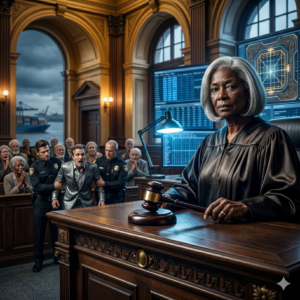
Judge Sterling entered. She was a woman of seventy, her skin the color of polished teak, her hair a striking silver bob. She didn’t look at the crowd. She walked to the bench, her movements as precise as a clockwork mechanism. She stood there, silent, her eyes fixed on Caspian.
The hum of the courtroom died. The silence became heavy, a physical weight pressing down on Drake’s shimmering shoulders.
“Mr. Drake,” Octavia said, her voice like velvet wrapped around a steel rod. “In this room, we acknowledge the authority of the people. If you find your seat more compelling than the dignity of this court, I will be happy to have the bailiffs weld you to it for the duration of the trial.”
Caspian slowly stood, a mocking grin on his face. “My apologies, Octavia. I was just checking the markets. I’m sure you understand—time is money.”
“In this room, Mr. Drake,” she replied, sitting down, “time is measured in years. And I have plenty of them to give you.”
The trial was a masterclass in obfuscation. Barnaby Finch argued that the “Ghost Titles” were a “technological misunderstanding” and that the victims were simply “late adopters” who didn’t understand the new economy.
Caspian spent his time making a show of his wealth. He had lunch delivered by a Michelin-star chef to the courthouse steps. He invited the press to a “Victory Yacht Party” scheduled for the day after the expected verdict. He even tried to wink at the jury foreman, Quincy Miller, during a particularly dense piece of financial testimony.
But Judge Sterling was watching. She noticed the way Miller’s hand shook when he looked at Drake. She noticed the way Finch and Drake shared a secret, triumphant look when a key witness for the prosecution, Silas Moon, “forgot” a crucial detail on the stand.
On the day of the closing arguments, the courtroom felt like a crime scene waiting to happen. Caspian was already celebrating. Finch had assured him the “fix” was in.
But before the jury could be sent to deliberate, Judge Sterling called a “Procedural Auditor” to the stand—a quiet, middle-aged woman named Muriel Glass.
“Ms. Glass is the Chief Archivist for the City’s Digital Records,” Octavia announced. “And she has found something that was… overlooked during discovery.”
The plot twist hit the defense like a tidal wave.
Muriel Glass hadn’t just found more fraud. She had found the “Alchemist’s Ledger”—a hidden encrypted file where Caspian Drake had recorded every bribe he had ever paid, including the one he had just sent to the jury foreman, Quincy Miller.
Caspian’s face went from bronzed to ghost-white. “That’s a private server! You didn’t have a warrant for that!”
“I didn’t need one,” Muriel Glass said, her voice small but firm. “You stored it on a ‘Ghost Title’ server, Mr. Drake. And according to your own legal argument, those servers are ‘public digital commons.’ You legalized my access yourself.”
The irony was a poison. Caspian had been hoisted by his own digital petard.
The jury was dismissed. A new, emergency jury was sequestered, but it didn’t matter. The evidence in the “Alchemist’s Ledger” was absolute.
When the verdict came—Guilty on every single count—Caspian Drake finally lost his cool. He stood up, screaming at Judge Sterling, his “smart-fabric” suit flickering erratically like a dying lightbulb.
“You can’t do this! I have assets in ten countries! I’ll buy this whole district and turn it into a parking lot!”
“Mr. Drake,” Octavia said, her voice calm and terrifying. “You have mistaken a bank account for a soul. Because you tried to corrupt the very heart of this court, and because you treated the homes of these citizens as pixels on a screen, I am applying the ‘Total Restitution’ statute.”
“I sentence you to 40 years in a maximum-security facility. Furthermore, I am ordering the immediate ‘De-rez’ of your empire. Every digital asset, every physical skyscraper, and every cent in your offshore accounts is hereby seized. It will be converted into the ‘Glass-O’Shea Housing Fund.’ Beatrix O’Shea will not only have her home back; she will be your new landlord, as the fund is purchasing the land your prison sits on.”
Caspian Drake collapsed into his chair. He didn’t look like a king anymore. He looked like a glitch in the system.
One year later, the Drake Tower has been converted into a vertical park and low-income housing complex. Beatrix O’Shea has a garden on the 40th floor.
Judge Octavia Sterling still sits on the bench. She doesn’t have a shimmering suit, and she doesn’t make “market-moving” tweets. But every morning when she enters the courtroom, everyone stands.
Not because they have to, but because they know that in her room, the truth isn’t a variable—it’s the floor they walk on.
I realized then that the most dangerous person in the world isn’t the one who can change the numbers. It’s the one who remembers where the original ones were hidden.
Disclaimer : This content may be created by AI for entertainment purposes. Any resemblance to real persons, events, or places is coincidental.






