The Rookie Nurse Whose Command Silenced The Gilded Halls
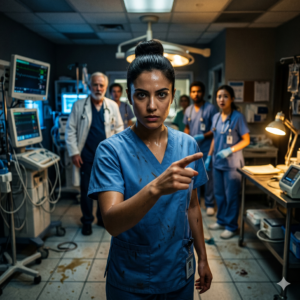
In the high-stakes world of metropolitan medicine, the hierarchy is as rigid as the steel beams of the skyscrapers that house it. Doctors are the architects, senior staff are the foremen, and rookie nurses are the invisible mortar, expected to hold everything together without ever making a sound. For twenty-four-year-old Maya Vance, being invisible was a survival strategy she had mastered long before she stepped into the sterile white corridors of St. Jude’s International. She moved with a silence that most mistook for inexperience, her dark hair pinned in a severe bun that mirrored the discipline of a life shaped by trauma and duty. But St. Jude’s—and its profit-obsessed CEO, Alistair Thorne—didn’t realize that their newest “recruit” was a sleeping giant. Within Maya lived a past forged in fire, a ghost sentinel waiting for the exact moment when a hospital’s polished order would collapse into a battlefield’s chaos.
St. Jude’s International was not just a hospital; it was a cathedral of high-tier capitalism. Here, the floor polish cost more than a nurse’s monthly rent, and the patient suites resembled five-star hotels more than medical wards. Director Alistair Thorne, a man whose soul seemed to have been replaced by a spreadsheet, viewed patients as “units” and staff as “overhead.”
Maya Vance was the ultimate overhead. In her first month, she had already been flagged for “excessive patient interaction”—otherwise known as showing compassion to a frightened elderly man who was dying alone.
“Vance, this is a hospital, not a counseling center,” her supervisor, a weary woman named Linda, had told her. “Efficiency is the only currency Thorne accepts. Don’t let him see you holding hands when you should be logging vitals.”
Maya had nodded, her eyes fixed on the floor, projecting the image of a submissive rookie. But beneath that exterior, her mind was a tactical map. She saw the structural flaws in the department: the bottleneck at the triage desk, the lag in the pharmacy delivery system, the way the senior residents buckled when three sirens sounded at once. She saw it all because she had seen worse.
Her father had been a legendary field medic in the 10th Mountain Division, and after his death in a remote valley in Kunar, Maya had spent three years as a civilian volunteer in disaster zones across South Asia. She had performed emergency tracheotomies in the mud and organized triage centers in the wake of tsunamis. But she had kept her “Valkyrie” past off her resume, fearing that a hospital like St. Jude’s wouldn’t want a “rogue” medic. They wanted a drone.
The storm hit on a Tuesday night. A massive multi-vehicle pileup on the I-95 had sent waves of casualties toward St. Jude’s. The ER was already at 90% capacity.
Dr. Adrien Carter, the head of Trauma, was a brilliant man, but he was drowning. He had been on shift for sixteen hours. His hands were steady, but his eyes were beginning to glaze. The “order” of the ER was unravelling. A dozen patients arrived in twenty minutes; the shouting of residents was clashing with the wailing of family members.
“I need surgical backup in Bay 4! Where are those blood units?” Carter roared, but his voice was lost in the cacophony.
A nurse panicked, dropping a tray of instruments. A resident was arguing with a paramedic about a heart monitor reading. It was a symphony of failure.
Alistair Thorne was watching from the glass observation deck, his phone to his ear, worrying about the liability of a “bottleneck” event. He prepared to descend to bark at the staff for their lack of “procedural flow.”
Then, a voice cut through the room. It wasn’t loud, but it had the frequency of a sonic boom.
“STOP.”
The room didn’t just go quiet; it froze. Maya Vance was standing in the center of the trauma bay. Her posture had shifted. The submissive rookie was gone. In her place stood a woman whose spine was made of cold-rolled steel.
Maya didn’t wait for permission. She didn’t look at Dr. Carter for approval. She stepped into the vacuum of leadership.
“Carter, Bay 1. Now. The patient has a tension pneumothorax—don’t wait for the X-ray, needle chest decompress immediately,” she barked, her voice a precise instrument of war.
“Linda! Get the rapid infuser to Bay 3. We’re losing the pedal pulse on the pediatric case. resident Miller, stop arguing and get me two units of O-negative. GO!”
The staff stared at her. For a second, the hierarchy threatened to reassert itself. Who was this girl to speak to the Head of Trauma like a cadet?
Dr. Carter looked at Maya. He saw the fire in her eyes, the lack of doubt, and the unmistakable “Combat Command” stance. He recognized the signal. He didn’t argue. He moved.
Within sixty seconds, the chaos had been forged into a machine. Maya moved between the beds with an efficiency that was terrifying to behold. She wasn’t just a nurse; she was a conductor. She predicted every crash, every drop in blood pressure, every need for a specific suture.
Thorne, standing on the observation deck, felt his jaw go slack. He watched the “overhead” rookie stabilize three critical patients before the surgical team even arrived. He saw her guide a senior resident through a complex airway stabilization with two words and a look that could pierce armor.
The morning after the storm, the hospital was a graveyard of adrenaline. Dr. Carter found Maya in the breakroom, her hands finally shaking as she sipped a lukewarm coffee.
“Where?” Carter asked, sitting across from her.
“The Hindu Kush,” Maya whispered. “And the rubble of Port-au-Prince.”
“You’re a Ghost Sentinel,” Carter said, using the slang for elite combat medics who disappear into civilian life. “Why are you here emptying bedpans for a man like Thorne?”
“I wanted a life where people didn’t die because of bullets,” she replied.
But the drama was just beginning. Thorne called Maya to his office. He had her personnel file open.
“You violated six hospital bylaws last night, Ms. Vance,” Thorne said, though his voice lacked its usual bite. “You gave orders to senior physicians. You skipped diagnostic protocols.”
“I saved seven people who would have been ‘loss units’ on your spreadsheet, Alistair,” Maya said, refusing to use his title.
Thorne looked at her, then he did something no one at St. Jude’s had ever seen. He turned his computer screen around. It was a video feed from the ER the night before.
“I received a call this morning,” Thorne said. “From the Governor. His daughter was the patient in Bay 2. The one you diagnosed with internal hemorrhaging before the CT scan was even warm.”
He paused, his eyes narrowing. “But that’s not why I’m shaking, Maya. I looked into your father’s records. Sergeant Elias Vance.”
Maya stiffened. “What does my father have to do with this?”
Thorne stood up and walked to the window. “Twenty-five years ago, I was a young, arrogant intern with a medical team in a war zone. I made a mistake. A massive one. I miscalculated a dosage during a mass casualty event. I would have been court-martialed, my career over before it began. A field medic took the blame for me. He told the board it was his error because he knew the world needed surgeons more than it needed medics.”
Maya felt the air leave her lungs. “My father.”
“I spent twenty-five years building this hospital to bury that debt,” Thorne whispered. “I thought money and efficiency could replace the soul I lost that day. And then last night, I saw his daughter stand in my ER and lead it better than I ever could. You didn’t just save those patients, Maya. You saved this hospital from me.”
The transformation of St. Jude’s became the lead story in every medical journal in the country. Alistair Thorne didn’t resign, but he changed. He stepped down as CEO to become the Chairman of the new “Vance Foundation for Crisis Medicine.”
Maya Vance was appointed the Director of Emergency Operations. She didn’t want a corner office; she wanted the floor.
The hierarchy was gone. In its place was a culture where the “rookie” was listened to, and where leadership was defined by courage, not by the quality of a suit.
Months later, Dr. Carter watched Maya training a new group of nurses. She wasn’t teaching them how to fill out forms; she was teaching them how to find their voice in the middle of a scream.
He realized then that the world is full of hidden heroes, ghosts of past wars and private tragedies, waiting for the shadows to grow long enough for them to step out and shine. Maya Vance was no longer a shadow. She was the light.
Disclaimer : This content may be created by AI for entertainment purposes. Any resemblance to real persons, events, or places is coincidental.






