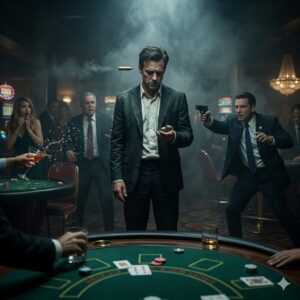
The Architecture of Anticipation: The Prisoner of Two Minutes
What is the precise weight of two minutes? Is it the time it takes for a cigarette to burn down to the filter, the duration of a pop song, the boiling point of a kettle? Or is it a glass cage, a temporal prison where a man watches the world die, over and over, just before it happens? Imagine a man sitting in a smoke-filled Las Vegas casino, watching the roulette wheel. He does not guess; he knows. But his knowledge is a curse. He lives in a perpetual state of almost, a ghost haunting the razor-thin margin between the present and the immediate future. Chris Johnson is a man who can see exactly two minutes ahead. He is a god of the immediate, yet a slave to the inevitable. Why does a man who can predict the fall of a necklace, the path of a bullet, and the turn of a card choose to perform cheap magic tricks under the pseudonym “Frank Cadillac”? Why does the architect of the future hide in the neon-drenched mediocrity of the present?
The Paradox of the Prophet
There is a staggering, almost offensive gap between the absolute power of Chris Johnson’s mind and the pathetic reality of his existence. To the outside world, he is a “two-bit magic act,” a sleight-of-hand artist performing in the dusty back rooms of Vegas. He makes a living predicting when an audience member will drop a necklace, soaking in the applause of drunk tourists who believe they are witnessing a clever parlor trick. In his off-hours, he haunts the casino floors, carefully extracting small, unnoticeable sums of money from the tables. He enforces a strict rule upon himself: no big wins, no jackpots. He is terrified of the spotlight.
Yet, within the confines of his own temporal reality, Chris is omnipotent. He possesses the power to rewrite history before it is written. When an armed robber storms the casino cashier, Chris does not freeze; he walks calmly into the line of fire, snatching the weapon with the bored precision of a man who has already rehearsed the choreography a dozen times in his head.
This is the tension that defines him. He is a titan masquerading as a mouse. He dodges casino security guards by weaving through their future trajectories, slipping through their ranks like smoke. He evades police cruisers by accelerating his stolen car to beat an oncoming train by fractions of a second, having already experienced the fatal crash and chosen the alternate path. He is the most powerful weapon on the planet, yet he uses his gift solely to maintain his own anonymity. He is drowning in a shallow pool of mediocrity, terrified that if he steps into the deep end, the world will drown him.
The Roots of the Glass Cage
To understand the architecture of Chris’s isolation, one must look at the psychological trap of total foresight. Vulnerability is a product of uncertainty. We connect with others because we do not know what will happen next; we share the risk of the unknown. But Chris knows. He is trapped in a biological feedback loop of his own survival.
His childhood and early years, though unstated, are written in his defensive posture. He learned early that to reveal his gift is to invite exploitation. He is a man who has been studied, hunted, and desired not for who he is, but for what he can see. This has bred a profound, calcified cynicism. He views people not as companions, but as predictable algorithms. He retreats to his old friend, Irv, a man who offers him the simple comfort of billiards and scolding, perhaps because Irv is the only person who sees Chris the man, not Frank Cadillac the oracle. The two-minute window is not a superpower; it is a neurological quarantine. He is isolated from the human experience because he is always experiencing it before anyone else.
The Descent into the State Apparatus
The corruption of Chris’s quiet life does not happen through malice; it happens through the cold, utilitarian logic of the state. The FBI, represented by the relentless Agent Callie Ferris, views Chris not as a citizen, but as a tactical asset. Terrorists have stolen a nuclear device. Millions of lives hang in the balance. In the face of such apocalyptic math, individual liberty is an irrelevance.
The descent is a process of agonizing, systemic control. Callie initiates a campaign of psychological and physical entrapment. When she corners him in Irv’s billiard hall, appealing to his patriotism, Chris refuses. He understands that once he becomes a tool of the government, he will never be free again. When Callie resorts to threats, surrounding the building with armed tactical teams, Chris simply rewinds the clock, escaping out the back door before the trap springs.
But the state is relentless. The gaslighting reaches its zenith when Callie intercepts Liz, the woman Chris believes is his destiny. Callie weaponizes Liz’s trust, showing her out-of-context casino footage to paint Chris as a violent psychopath. She instructs Liz to drug him, turning his only genuine human connection into a biological weapon. When that fails, the FBI finally captures him, and the true horror of his subjugation is revealed.
Chris is strapped to a chair in a subterranean interrogation room. His eyelids are clamped open, an image of visceral, clockwork-orange cruelty. He is forced to watch live news feeds, compelled by his captors to project his mind into the future until he finds the nuclear blast. He is no longer a man; he is a biological radar dish, forced to experience the agonizing death of the woman he loves, over and over, as a method of data extraction. The state has turned his gift into an instrument of torture.
The Collateral Damage
The true cost of Chris’s power is paid by those who walk blindly into his blast radius. The terrorists, seeking to eliminate the prophet, brutally murder Roy Ball, the casino security chief, shooting him in the knees and slitting his throat simply for knowing Chris’s name.
But the most profound collateral damage is Liz. She is a civilian, a teacher from an Indian reservation, pulled into a geopolitical nightmare simply because she crossed paths with a man who could see her future. She is manipulated by the FBI, kidnapped by terrorists, and strapped with high explosives, paraded on a rooftop as a human shield. The pain inflicted upon her is heavy with emotional weight because she is entirely innocent. She believed she was embarking on a strange, romantic road trip with a charming magician; instead, she is weaponized by both the American government and a terrorist cell. She is the collateral damage of a war fought in the margins of time.
The Climax and the Decay of Certainty
The climax of the temporal war is a masterpiece of bifurcated reality. Chris agrees to lead the FBI assault on the terrorist stronghold at the port. It is a sequence of absolute, terrifying mastery. He clones his consciousness, projecting multiple versions of himself through the ship’s corridors, triggering traps and absorbing bullets in hypothetical futures so that his physical body can walk the safe path.
He confronts the terrorist leader, Smith, who is using Liz as a human shield. In a sequence of balletic, precognitive violence, Chris runs through dozens of scenarios. He dodges bullets with the liquid grace of a man who knows exactly where they will be. Agent Callie fires the fatal shot, killing Smith. Liz is saved.
But then, the catastrophic decay. The victory is a phantom. Callie brings Chris to a seismograph, hoping to pinpoint the nuclear device. Chris looks at the readouts. The color drains from his face. The terrorists did not hide the bomb at the port; the port was a decoy to stall the prophet.
In downtown Los Angeles, the sky tears open. A nuclear mushroom cloud erupts, incinerating the city. Millions die in a blinding white flash. The shockwave consumes Chris and Liz. The absolute power of the prophet has failed. The world ends.
The Silent Aftermath of the Awakening
And then, the flash fades, and Chris Johnson opens his eyes.
He is lying in a cheap bed at the Cliffhanger Motel. Liz is sleeping peacefully on his chest. It is morning. The entire assault, the kidnapping, the nuclear holocaust—none of it has happened yet. It was all a vision, a projection of a future that he followed to its apocalyptic conclusion.
The aftermath is defined by a chilling, profound solitude. Chris has experienced the death of millions. He has felt the heat of the nuclear fire. He is the only man on earth who knows that the world is about to end. He carefully slips out from under the sleeping woman he loves.
He does not run. He does not steal a car. He picks up the phone and calls Agent Callie Ferris.
Final Reflection
We are obsessed with the concept of destiny. We believe that the future is a river, carrying us toward an inevitable ocean. But the story of the Vegas magician reveals the terrifying philosophy of agency.
Chris Johnson spent his life using his power to avoid consequence. He played small bets to avoid the pit boss; he ran from the FBI to avoid responsibility. But when he finally looked past the two-minute horizon, he saw that avoiding responsibility is the surest way to guarantee destruction.
True power is not the ability to dodge a bullet or predict the turn of a card. True power is the agonizing realization that you are the author of the timeline. Chris leaves the motel room, leaving Liz safely behind, and steps into the black SUV with the FBI. He has learned the heaviest lesson of human existence: with total vision comes total culpability. He can no longer hide in the two minutes of the present. He must step into the fire of the future, because he is the only one who can put it out.
Disclaimer : This content may be created by AI for entertainment purposes. Any resemblance to real persons, events, or places is coincidental.






