The Architecture of the Ghost
What is the precise sound of a soul fracturing? Is it the deafening, percussive roar of a Black Hawk helicopter plummeting into the Afghan desert, tearing through the thin fabric of the sky? Or is it something infinitely quieter, infinitely more devastating? Is it the soft, rubbery squeak of a child’s balloon at a suburban birthday party? Is it the dull, wet thud of an iron pipe striking the skull of a twenty-one-year-old boy in a subterranean prison? We build our lives on the illusion of permanence. We lock our doors, we paint our kitchens, we kiss our spouses in the warm glow of hallway lights, pretending that the monsters of the world are kept at bay by the borders of our nation. But what happens when the monster does not break through the front door? What happens when the monster is the man holding the key? In the quiet, suffocating warmth of a remodeled suburban kitchen, a farewell letter sits unread in a drawer, carrying the scent of desert dust and impending doom. It is a letter written by a ghost, waiting to be read by a widow who does not yet know her husband is already dead, even as he breathes in her bed.
The Paradox of the Hollow Hero
There is a staggering, almost offensive gap between the public mythology of the American soldier and the private, rotting reality of the man who survives the unsurvivable. To the world, Captain Sam Cahill is a monument cast in bronze. He is the golden boy of the United States Marine Corps, a man whose chest is heavy with ribbons and whose posture radiates the rigid, unyielding certainty of moral righteousness. When he walks through the airport terminal upon his miraculous return from the dead, he is greeted by tears, by applause, by the desperate, clinging embraces of a nation—and a family—that needs him to be a hero. They see the uniform. They see the survivor. They see the triumph of the American will over the savagery of the Afghan mountains.
Yet, beneath the crisp fabric of his dress uniform, Sam Cahill is a decaying corpse walking among the living. The private hell of his existence is defined by the absolute absence of his former self. He is a hollow vessel, scraped clean of his humanity by the things he was forced to do to return to this very airport. When he lies in his marital bed, his wife Grace’s skin—smelling of vanilla and familiar soap—feels like an alien landscape. When she kisses the jagged scars on his back, offering the desperate, unconditional love of a grieving widow whose prayers were answered, Sam offers only the freezing cold of a morgue.
This is the tension that threatens to tear the fabric of their reality apart. To Hank, his father, Sam is the ultimate triumph of discipline and patriotism, the living rebuke to his ex-convict brother, Tommy. But inside the glass cage of Sam’s mind, he is the ultimate coward, a murderer masquerading as a martyr. He walks through his house like an intruder, staring at his family with eyes that no longer recognize love, only threat. He suspects his wife of infidelity not because there is evidence, but because his own soul is so thoroughly corrupted that he can no longer conceive of purity. He is drowning in a shallow pool of suburban domesticity, terrified that if anyone looks too closely, they will see the blood of Private Joe Willis dripping from his hands.
The Roots of the Fragile Pedestal
To understand why the architecture of Sam Cahill’s psyche collapsed so catastrophically, one must look to the architect. The vulnerability of the golden child is forged in the fires of conditional love. Hank Cahill, a Vietnam veteran whose own trauma was never treated but instead weaponized, built his family on a foundation of brutal, binary comparisons. In Hank’s house, love was not a birthright; it was a medal to be earned on the battlefield of his approval.
Sam was the receptacle of Hank’s vicarious glory. From his early years, Sam was conditioned to believe that his worth was inextricably tied to his stoicism, his physical prowess, and his adherence to the military code. He was placed on a pedestal so high and so narrow that any deviation, any failure, would guarantee a fatal fall. Tommy, the younger brother, was designated the scapegoat, the mirror in which Sam’s perfection could be constantly reflected and admired. This was the psychological trap. Sam was never allowed to be weak. He was never allowed to fail. He was never allowed to be anything less than the hero Hank demanded. Therefore, when Sam found himself in a situation where heroism was impossible—where the only options were death or moral annihilation—he had no psychological scaffolding to support the weight of his own failure. When the perfect soldier broke, there was no human being left underneath to catch the pieces.
The Descent into the Sinking Ship
The corruption of Sam Cahill does not happen in a sweeping cinematic battle; it happens in the damp, claustrophobic dark of an Afghan Zindan. It is a slow, agonizing asphyxiation of the soul. For months, Sam is starved, beaten, and buried alive in a subterranean grave. But the physical torture is merely the prelude to the true descent. The Taliban captors do not just want his life; they want to break his morality. They initiate a process of psychological gaslighting and extreme control, shrinking Sam’s universe until nothing exists but the freezing mud, the hot iron, and the terrified cries of Private Joe Willis.
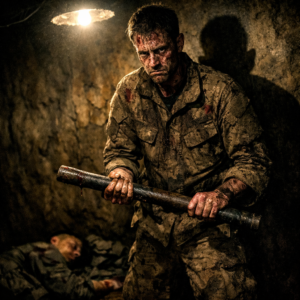
Sam tries to be the captain. He orders Joe to give them nothing. He tries to uphold the Marine code, to maintain the structure of his glass cage. But the cage cracks when Joe, screaming under the searing agony of a hot iron, breaks. Joe reveals everything—Sam’s rank, his family, the existence of his two little girls. And in that moment, the Taliban find the lever to Sam’s soul. They place a cold, heavy iron pipe in Sam’s trembling hands. The choice is delivered with terrifying, apocalyptic simplicity: kill the private, or we will kill you and hunt down your family.
This is the sinking ship. Sam is pulled beneath the black water of his own desperation. He swings the pipe. He swings it again. With every wet, sickening crunch of metal against bone, Sam Cahill murders the captain, the father, and the husband he used to be. He is completely corrupted, stripped of his humanity, forced to record his own damnation on video while the captors cheer. He is no longer a man; he is a weapon that has been successfully turned against its own kind.
The Collateral Damage
The tragedy of a shattered man is that his jagged edges inevitably slice through the flesh of those who try to hold him. The collateral damage of Sam’s resurrection is borne by the innocent bystanders of his suburban life. Focus on Isabelle, the older daughter. Before the deployment, she looked at her father as a mountain of safety. Now, she looks at him with the wide, terrified eyes of prey trapped in a room with a predator. She shrinks away from his touch. She feels the freezing cold radiating from his chest. She watches her mother, Grace, trying desperately to pour love into a sieve, walking on eggshells in a house that suddenly feels like a minefield.
And then there is Tommy. Tommy, who crawled out of his own history of failure, who fought his way through the shame of prison to step up when his brother was presumed dead. Tommy installed the cabinets; Tommy painted the walls; Tommy became the surrogate smile in a household drowning in grief. The pain inflicted upon them is heavy with emotional weight because they are being punished for their survival. They are being punished for finding a way to laugh while Sam was in the dark. Sam gazes upon the remodeled kitchen—a physical manifestation of their resilience—and sees only betrayal. The children are traumatized not by the loss of their father, but by the terrifying stranger who returned wearing his face.
The Climax and the Decay of Reason
The moment of total collapse arrives on a day meant to celebrate life: Maggie’s birthday. The house is filled with forced cheer, the air thick with the suffocating tension of a family pretending the bomb in the center of the room is not ticking. Isabelle, desperate for attention, desperate to express the localized terror of living with a ghost, squeaks a rubber balloon. Squeak. Squeak. A tiny, high-pitched assault on the silence.
Sam snaps. He pops the balloon, a gunshot of sound that shatters the fragile veneer of the afternoon. In the aftermath, the truth—twisted by a child’s anger—spills out. Isabelle screams the words that echo Sam’s deepest, darkest paranoia: “Why didn’t you stay dead? You’re mad because mom wants to sleep with Uncle Tommy… They’re always making love.” It is the final, catastrophic decay of Sam’s reality. That night, the Marine returns to his training. He becomes the insurgent in his own home. He takes a steel crowbar to the newly remodeled kitchen, swinging it with the same violent, rhythmic fury he used on Private Joe. He is smashing the domesticity he can no longer access. He is destroying the life that moved on without him. When Tommy rushes in to stop him, Sam pulls a pistol, holding it to his own brother’s head before turning it on himself in the freezing, snow-covered yard. Surrounded by police sirens, bathed in the flashing red and blue lights of his own destruction, Sam screams the agonizing truth of his existence: “What kind of hero am I? You don’t know what I did! I’m drowning, Tommy!” He has lost everything. He has lost his mind, his family, and his right to live.
The Silent Aftermath
The aftermath of an explosion is defined by its ringing silence. Sam does not return to the warm kitchen; he is locked away in the sterile, white-walled solitude of a psychiatric clinic for war veterans. The uniform is gone, replaced by the drab, shapeless clothing of the institutionalized. He sits in an empty shell of a room, a man who survived the physical war only to become a prisoner of war within his own mind.
Grace, embodying a terrifying, unconditional strength, visits him in this purgatory. She does not come to coddle the hero; she comes to confront the ghost. She demands the truth, threatening to sever the final thread connecting him to the world of the living if he does not speak it. In the suffocating quiet of the visitation room, the dam finally breaks. A single tear tracks down the scarred landscape of Sam’s cheek. “I killed him,” he whispers. “I killed Joe Willis.” He is no longer a Marine. He is just a broken man, shivering in the cold light of his own confession, wondering if the blood will ever wash off.
Final Reflection
We demand that our soldiers perform the acts of gods and monsters in the dark, and then we demand they return to the light and pretend they are still men. The story of Sam Cahill is a brutal, philosophical indictment of the myth of the untouched hero. It forces us to confront the terrifying elasticity of human nature—the realization that, under the right pressure, the line between a loving father and a brutal murderer is astonishingly, horrifyingly thin.
But there is also a desperate, beautiful lesson about the nature of love embedded in the rubble of this tragedy. Power, military might, and rigid discipline can destroy a man, but they cannot put him back together. Grace’s embrace in the psychiatric ward, after hearing the most unforgivable sin a human can commit, suggests that love is not about maintaining the illusion of perfection. True love—the kind that survives the Zindan, the kind that survives the crowbar—is found in the willingness to look at the monster, to see the blood on its hands, and to pull it back into the light anyway. We are all capable of terrible darkness, but perhaps we are also capable of a grace that is stronger than our deepest sins.
Disclaimer : This content may be created by AI for entertainment purposes. Any resemblance to real persons, events, or places is coincidental.






