The Architecture of Anticipatory Grief: When the Body Becomes a Ticking Clock
What is the precise temperature of a shattered illusion? Is it the biting, crystalline wind sweeping across a pristine alpine ski resort, or is it the sterile, recycled chill of a hospital examination room? Imagine the scene: a celebration suspended in amber. One year free from the shadow of breast cancer. Five years free from the creeping stain of melanoma. The champagne has been poured, the lift tickets purchased, the heavy coats zipped against the winter chill. And then, a shadow. A bruise that does not fade. A hematoma beneath the skin, throbbing with a silent, biological malice. The doctor speaks of a long needle, of draining the site, his voice carrying the practiced, smooth cadence of a professional breaking bad news in slow motion. Why do we believe in the concept of safety? Why do we build fortresses of milestones—one year clear, five years clear—when the enemy is not at the gates, but already living in the marrow, hiding in the genetic code? The needle is uncapped. The skin is pierced. And the long, agonizing winter of the soul begins all over again.
The Paradox of the Glass Empire
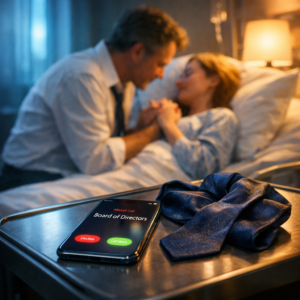
There is a devastating chasm between the mastery of the external world and the utter helplessness of the internal one. To observe the husband in the pristine corridors of the oncology ward is to witness a masterclass in this terrible paradox. He is a man of commerce, a man of action, a man who dictates the flow of capital and the structure of corporate mergers. When his phone vibrates in the middle of a medical consultation, he does not hesitate to excuse himself. “Sorry, I have to intervene before this deal goes south. You don’t mind if I step out?” he asks, the words slick with the lubricant of high-stakes business. He steps into the hallway, a titan of industry, a man who can bend the will of boards and shareholders to his exact specifications.
Yet, this public glory is nothing but a glittering, fragile veneer stretched tightly over a private hell. Inside the examination room, his wife’s blood is being drawn. Inside the examination room, her cells are mutating, multiplying, ignoring every law of human decency and medical expectation. He possesses the power to liquidate assets across continents, but he cannot negotiate with a single malignant cell in his wife’s thyroid. He can stop a multi-million-dollar deal from going south, but he cannot stop the carcinoma from invading her local vasculature.
This is the glass cage of the modern titan. He walks through his life wearing a bespoke suit of armor, commanding respect, projecting an aura of total, unyielding control. But the glass cage is completely transparent. He is forced to watch, in high definition, the slow, systematic destruction of the woman he loves. He retreats into his phone, into his spreadsheets, into the adrenaline of the boardroom, because the boardroom is a theater where he knows the script.
The hospital, however, is an arena of absolute impotence. Every beep of the telemetry monitor, every crinkle of the sterile paper on the examination table, every hushed whisper of the attending physicians is a reminder of his profound irrelevance. He is a king locked outside the castle walls, watching the empire of his marriage burn down from the inside out. He uses his wealth and his work not as a tool for living, but as an anesthetic against the terror of dying.
The Roots of the Hurricane
To understand the husband’s flight into the sanctuary of his work, one must understand the psychological trap of the human desperate for certainty. We are a species terrified of the ambush. In the years before 1873, before the Army Signal Corps first hoisted flags to warn coastal towns that a hurricane was churning off the horizon, the storms simply arrived. The sky darkened, the wind shrieked, and houses were flattened into splinters without a moment’s notice. Lives were annihilated by the invisible, unpredictable violence of the atmosphere.
For the husband, the cancer is the 19th-century hurricane. It does not announce itself with sirens; it announces itself with a bruise on a ski trip. The trauma of the initial diagnoses—the melanoma, the breast cancer—has fundamentally rewired his psychological architecture. He has learned that the world is an inherently unsafe place, a landscape where disasters drop from a clear blue sky.
His reaction to this unbearable unpredictability is to manufacture control. “My release is my job,” he confesses, his voice tight with the strain of a man holding up a collapsing roof. “My work requires total focus. And every minute I’m working is a minute I’m not thinking about losing her.” Work is his Army Signal Corps flag. It is the one environment where inputs lead directly to logical outputs. He throws himself into the machinery of his career because the machinery does not bleed. The machinery does not require long needles. The machinery does not die. His workaholic nature is not born of ambition; it is born of profound, paralyzing terror. He is running as fast as he can on a treadmill, hoping that if he just moves fast enough, the specter of death will not be able to catch his shadow.
The Descent into the Sinking Ship
The descent into chronic, genetic illness is not a sudden drop; it is a slow, agonizing asphyxiation. The diagnosis of thyroid carcinoma is bad enough, a brutal recurrence just as the champagne of remission was being uncorked. But the true horror, the ultimate corruption of the body, is revealed in the genetic sequencing. Li-Fraumeni syndrome. LFS. It is an inherited predisposition to developing a wide, terrifying range of cancers. The doctor’s words fall like lead weights upon the linoleum floor. “Your body is super sensitive and will respond with tumors for the rest of your life.”
This is the gaslighting of the human genome. Hannah’s body is a sinking ship, but the holes are not being torn by external reefs; they are being drilled by the vessel’s own crew. Every cell is a potential traitor. Every ache, every cough, every faint shadow on an X-ray is a harbinger of doom. The doctors attempt to frame this as a victory of knowledge—“We know the most common associated with LFS and we can do surveillance. Nip anything in the bud.”—but it is the victory of a warden handing a prisoner the schedule of their torture.
The husband watches this descent in a state of hyper-vigilant agony. He describes the chemotherapy with the visceral, raw revulsion of a witness to a slow execution. “You see them put those gloves on before they hook up the chemo. You know why they do that? It’s because it’s poison.” The rhythmic drip of the IV bag. The sterile smell of the alcohol wipes. The slow, methodical poisoning of the woman he loves, all justified by the horrific caveat: Because she might die. He is watching her drown, and the only life raft the doctors can offer is a medication that burns her veins and strips her of her vitality. The illness controls everything. It dictates their vacations, their finances, their future, their very ability to breathe without fear.
The Collateral Damage
And what of the victims left shivering in the wake of this medical hurricane? The collateral damage of chronic illness is measured in the silent, suffocating spaces between a husband and a wife. Hannah sits in her hospital bed, the sterile white sheets pulled to her chest, and she reads. She does not read literature that challenges the soul; she reads cozy mysteries set in little English villages. She reads them because in those villages, nothing bad happens to anyone the reader likes. It is a desperate, heartbreaking grab for a world where justice is absolute, where violence is neat and tidy, and where the innocent are always spared.
But outside the pages of her book, she is acutely, painfully aware of the ghost in the room. She feels the heavy, oppressive weight of her husband’s anticipatory grief. Statistically, the strain of chronic illness is a relationship killer. Statistically, it is the healthy partner, more often the man, who buckles under the unending pressure of caretaking. The doctor notes it with ruthless clarity: “You look at her, you imagine she’s gone, and that is hard… She thinks the same thing when she looks at you.”
Every time Hannah receives a new diagnosis, every time a new tumor blossoms in her hypersensitive biology, she is forced to carry a dual burden. She must fight the rogue cells in her body, and she must fiercely guard the fragile perimeter of her marriage. Is this the straw that will break him? she wonders. Is this the hematoma that will finally drive him to the door? The illness has stolen her health, but worse, it is actively eroding her security in being loved. She is reduced to a burden, a patient, a tragedy in motion, while her husband stands beside her, physically present but emotionally evacuated, already grieving a ghost while the woman still breathes.
The Climax and Decay of Cowardice
The moment of total collapse arrives not with a crashing monitor or a code blue, but in the harsh, fluorescent glare of a hospital hallway confrontation. A doctor, weary of the statistical inevitabilities of human frailty, corners the husband. The doctor does not offer platitudes. He does not offer a shoulder to cry on. He offers a brutal, surgical strike to the husband’s fragile ego.
“I am telling you to consider how best to time your divorce.”
The words are a physical blow. They are a scalpel cutting straight through the husband’s self-deception. The doctor lays bare the agonizing reality of their future: Hannah will be this way forever. There will be no final victory bell to ring. There will only be a relentless cycle of surveillance, fear, poison, and temporary relief. The doctor looks at the husband, sees a man running on the fumes of his own terror, and predicts the decay. “Just don’t break when she needs you most. Get out before that happens.”
This is the climax of the husband’s internal war. He is faced with the ultimate mirror. Will he be the statistic? Will he be the man who runs back to his spreadsheets and his corporate acquisitions because the sight of his wife’s suffering is too heavy a cross to bear? The decay of his cowardice is absolute. The doctor’s harsh intervention strips away the illusion that his work is a noble sacrifice. It is exposed for what it truly is: a well-compensated form of abandonment.
The Silent Aftermath
The aftermath of this revelation is shockingly quiet. There are no soaring strings, no grand cinematic speeches. There is only the cold air outside the hospital entrance, where a taxi cab is waiting to take Hannah home to a life defined by Li-Fraumeni syndrome.
But the husband is there. The tailored suit remains, but the armor has been discarded.
“I sent your cab away,” he says, his voice devoid of the slick confidence of the boardroom, replaced by something rougher, something infinitely more profound.
He stands before her, a man who has just incinerated his own escape route. He had stepped away to present a proposal to his partners—not a merger, not an acquisition, but a surrender. “I’m selling them my share of the business.” He is liquidating the very empire he used as a shield. He is tearing down the glass cage. He is choosing to stand in the direct path of the hurricane without the warning flags, without the distractions, without the frantic, desperate need to be anywhere but beside her bed.
He survives now in the solitude of absolute devotion. The empty shell of his corporate identity has been left behind on the trading floor. He looks at his chronically ill, genetically besieged wife, and he makes the only declaration that matters: “I realized I was so afraid of losing you in the future, I was losing you now. I want to be your husband.”
Final Reflection
We are creatures bound by the arrow of time, forever looking over our shoulders at the past or squinting into the blinding terror of the future. We believe that power lies in anticipation, that if we can just predict the storm, we can outrun it. We hoard our wealth, our titles, and our distractions, building monuments to our own control, only to find that biology is the ultimate anarchist.
The story of the husband and the hospital bed offers a profound, terrifying philosophical lesson about the nature of human love. True love is not the absence of the storm. It is not the ability to cure the illness or negotiate with the genetics. True love is the agonizing, beautiful decision to stop running. It is the realization that to grieve a loss before it happens is to rob oneself of the only thing we actually possess: the present moment. Power is not found in the ability to step out of the room when the deal goes south; power is found in the courage to stay in the room when the poison is administered, to hold the hand of the one you love, and to say to the hurricane, Let it come. We are here.
Disclaimer : This content may be created by AI for entertainment purposes. Any resemblance to real persons, events, or places is coincidental.






