The Architecture of Erasure: The Man Who Bought the Winter
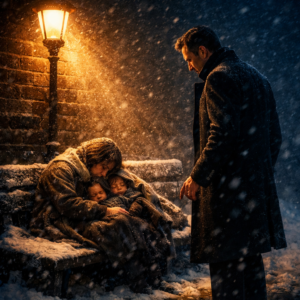
The cold in Boston does not arrive; it weaponizes. It sweeps down Tremont Street with a serrated edge, a sharpness that turns the moisture in the lungs to ground glass and strips the dignity from anyone caught outside its grace. In the deepest, darkest hollow of this winter, a woman sat on a forgotten metal bench pressed against a brutalist brick wall. She did not shiver. Shivering burns calories, and Clara Evans had none to spare. She was curled protectively around two small, sleeping children, her body a frail human shield against the freezing apathy of the city. The breath of the twins plumed in the amber glow of a streetlamp, rhythmic and slow, terrifyingly fragile. A bus rumbled past, tires hissing against the salted slush, but its doors remained closed. A man in a heavy cashmere coat walked by, his eyes sliding over them with the practiced blindness of the urban elite. How does a mother measure the end of her endurance? Is it the numbness in her fingers, or the dry, rattling cough of her son? When pride finally surrendered to biology, Clara pulled a dying phone from her pocket. The battery icon bled red. She aimed for the number of a friend, her stiff, frostbitten thumb shaking against the glass. One digit slipped. One millimeter of misaligned flesh. She pressed send, unaware that this microscopic accident was about to tear open a six-year-old grave.
The Paradox of the Glass Cage
Four blocks away, suspended three hundred feet above the freezing streets, the air was perfectly, chemically still. The climate control inside the executive suites of Cole Infrastructure was calibrated to an eternal, sterile spring. Ethan Cole stepped out of a mahogany-paneled conference room into a cavernous, empty hallway. The silence here was expensive. It was the kind of quiet that only millions of dollars could buy, a vacuum sealed against the grit and noise of the human world below. To the public, Ethan Cole was a titan. He was the golden heir, a man whose signature could alter the skyline, whose passing moods dictated the rise and fall of municipal bonds. He moved through the world draped in the bespoke armor of a conqueror.
Yet, to observe Ethan Cole in the quiet moments between conquests was to look at a man slowly suffocating in a vacuum. He was the master of a glass cage. He possessed limitless capital, but he possessed no warmth. He possessed absolute authority, but he possessed no autonomy. He possessed the city, but he had lost the only thing that ever made him feel alive within it. His private hell was not one of fire, but of frost. It was a creeping, agonizing numbness that had begun six years prior and had slowly calcified his spirit. He worked until midnight not out of ambition, but out of a desperate need to outrun the silence of his own penthouse.
This was the grand paradox of the modern oligarch. He was a king who ruled over a kingdom of spreadsheets, entirely isolated from the consequences of his own empire. The building’s artificial heat settled heavily on his broad shoulders, a suffocating embrace that offered temperature without comfort. He was a man who had traded his soul for an inheritance he never truly wanted, living in a museum of his own success.
When his phone vibrated in the stillness of the corridor, he expected a market fluctuation. He expected a quarterly projection. Instead, he looked down and saw a ghost. Can we stay with you tonight? Just until morning. The kids are freezing. Below the text, a blue autogenerated location tag pulsed like a dying heartbeat. Above it, a name he had forbidden himself to speak: Clara. The six years of carefully constructed apathy collapsed in a single, visceral jolt. The titan vanished; the man remained.
The Roots of the Sinking Ship
To understand how a man of such immense power could be stripped of the woman he loved, one must understand the soil from which the Cole dynasty grew. Ethan was not raised; he was cultivated. The Cole family did not view children as kin; they viewed them as assets, vulnerabilities to be managed, or investments to be protected. His early years were a masterclass in emotional suppression. Love, his uncle Richard Cole had subtly taught him, was a transactional error. It was a flaw in the system, a vulnerability that competitors could exploit.
Ethan’s psychological trap was the belief that duty to the legacy superseded the right to a personal identity. He was groomed to believe that the company was the family, and the family was the state. When he met Clara six years ago, she was an anomaly—an unscripted variable in a tightly coded life. But because he had never been taught how to protect his own heart, he was entirely unprepared for the ruthlessness with which his family would attack it. He was a sinking ship, taking on water for years, completely unaware that his own captain had drilled the holes in the hull.
The Descent into the Void
The corruption of Ethan’s life did not happen in a single night of explosive conflict. It was a slow, agonizing process of administrative execution orchestrated by his uncle, Richard Cole. Richard did not use violence; he used leverage. He used the terrifying, invisible machinery of institutional wealth.
The manipulation was a masterpiece of corporate gaslighting. While Ethan was distracted by orchestrated crises abroad, Richard moved on Clara. It was a campaign of systemic erasure. Richard deployed private investigators, aggressive legal threats, and financial blockades to sever Clara’s ties to the city. He presented her with an impossible calculus: disappear quietly, or watch as the Cole family machinery ground both her and Ethan to dust. And then, the true sickness of the corruption took hold. Richard managed the aftermath, filtering Ethan’s mail, intercepting communications, and planting subtle, poisonous seeds of doubt. She moved on, Ethan. She took the buyout. She was never meant for this world. Ethan was fed a diet of meticulously curated lies until he believed them. He was trapped in a glass cage, watching a distorted version of reality play out, convinced that Clara had abandoned him. He became a willing participant in his own manipulation, burying his grief under a mountain of corporate acquisitions. The corruption was total, an agonizing descent into a life where trust was a liability and isolation was the only safety.
The Collateral Damage
But the true cost of Richard Cole’s ambition was not paid in boardrooms. It was paid in the pediatric wing of a public clinic. It was paid on a freezing bench on Tremont Street. The collateral damage of this corporate preservation was Clara Evans and the twin children Ethan never knew he had.
They speak of the resilience of mothers. They speak of the invisible strength it takes to carry a secret for six years. But they rarely speak of the sheer, grinding agony of it. Clara bore the weight of Richard’s threats in absolute solitude. She hid them from the wealth that was their birthright. She hid them from the legacy that would have consumed them. She hid them from the danger of the Cole name.
The pain of the victims carried a high, desperate frequency. It was the sound of her son’s dry, rasping cough echoing against the sterile walls of a free clinic. It was the humiliating, metallic taste of fear when she had to measure out baby formula to make it last the week. It was the profound psychological weight of watching her daughter stare longingly at a toy in a window, knowing that their father owned the building that housed the store. The children were the ghosts of a stolen future, breathing, walking evidence of a love that had been violently censored by power.
The Climax and the Decay
The moment of total collapse began not with a shout, but with the quiet hum of a coffee shop. When Ethan finally uncovered the manila folders—the rental histories, the forwarded addresses, the legal intimidation tactics—the glass cage shattered. The titan woke up.
Richard Cole believed he was untouchable. He believed that money insulated him from consequence. When he called Clara at the penthouse, his voice dripping with the smooth, polished malice of a man accustomed to total obedience, he assumed the old terrors would still hold. “Leave before this becomes ugly. I have resources you can’t imagine.”
But Richard had miscalculated the physics of a cornered parent. The climax was a synchronized, dual-front annihilation of the Cole legacy of silence.
In the lobby downstairs, surrounded by a forest of microphones and the blinding flash of cameras, Clara stood alone. She did not whisper. She did not hide. “Six years ago, I was in love with Ethan Cole… I left thinking I was protecting him and our unborn children. I’m here now because I won’t run again.” Her voice was a scalpel, cutting through six years of manufactured darkness, laying the rotting core of the Cole family bare for the world to see.
Simultaneously, three hundred feet above her, Ethan executed the final decay of his uncle’s empire. The boardroom was tense, the air thick with the smell of expensive cologne and impending doom. Richard sat at the far end, his smile a brittle, dying thing. Ethan did not just defend his family; he dismantled his uncle’s reality. He slid the folder across the mahogany table. Financial irregularities. Unauthorized transfers. Theft. It was the moment of greatest loss for Richard—the instantaneous, total evaporation of his authority, his reputation, and his freedom. The suspension was unanimous. The empire did not just fall; it dissolved into ash.
The Silent Aftermath
The news cycles churned, feasted on the scandal, and eventually moved on to fresh blood. But what remains when the war is won and the cameras stop flashing?
They live now in a state of deliberate, protected quiet. The penthouse, once a sterile mausoleum of Ethan’s isolation, is now chaotic with the domestic hum of a real life. There are picture books left on the expensive rugs. There is the smell of oatmeal and burnt toast in the mornings.
But Ethan did not simply retreat into his newfound warmth. The survivor of the glass cage looked back at the cold. The empty shell of the Cole organization’s ruthless past was repurposed. In his study, the financial projections were replaced by architectural blueprints. He began quietly building community housing projects in South Boston—safe, warm, indestructible spaces for families who were trapped in the freezing dark, just as Clara had been. They do not cut ribbons. They do not invite the press. They survive in the quiet satisfaction of balancing the scales, one warm room at a time.
Final Reflection
We are taught to worship power. We are conditioned to believe that wealth is a fortress, that influence is a shield, and that those who control the high-rises are the ones who truly own the world. But the story of Tremont Street reveals the brittle, hollow nature of manufactured power.
Richard Cole had all the resources of a modern empire, yet he was entirely undone by the simple, undeniable gravity of a mother’s refusal to freeze. Ethan Cole had everything money could buy, but he was a beggar in his own life until he learned to surrender his pride for the sake of two children he had just met.
The philosophical truth buried in the Boston snow is this: Power can rewrite history, it can forge documents, and it can force a woman into the biting cold. But power cannot erase the fundamental human instinct to protect what is loved. True strength is not found in the boardroom, nor is it measured in stock valuations. It is found on a freezing metal bench, in the willingness to take a desperate risk, and in the quiet, terrifying courage to finally let the warmth in.
Disclaimer : This content may be created by AI for entertainment purposes. Any resemblance to real persons, events, or places is coincidental.






