She’s Still Breathing!’—The Single Dad’s Bold Choice Shook the Entire Police Department!
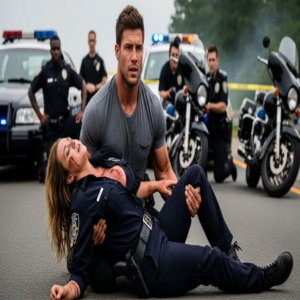
Jackson Mercer grabbed the woman by the collar, yanked her out of that wrecked car with his bare hands, and pressed two fingers against her throat. Still breathing. Barely. Three bullet holes. No skid marks. A desert road with nobody for 50 miles. And the woman wasn’t a stranger off the highway. She was Elena Cruz, CEO of Cruz Industries, the most powerful woman in Harlan County.
And somebody had just tried to make sure she never spoke another word again. What Jackson did next didn’t just save her life. It blew the lid off a conspiracy that went all the way to the top of the Harlan County Sheriff’s Department.
The first thing Jackson Mercer heard was silence. Not the comfortable kind. Not the kind a man finds when he’s been riding for 6 hours straight and the engine finally settles into its rhythm and the wind stops fighting him. This was the wrong kind of silence. The kind that lands in your chest like a stone dropped into still water and doesn’t come back up.
He’d been running the I-17 bypass for years. He knew every crack in that asphalt, every dip where the road bent away from the ridge and dropped into the open desert like the edge of the world. He knew where the coyotes crossed at dusk. He knew which mile markers were shot through with bullet holes from bored teenagers on summer nights.
He did not know that stretch of road to produce wrecked vehicles. Not like this. The black SUV, a Cadillac Escalade high-end government plates, was sitting nose first in the shallow ravine at the edge of the shoulder. Not rolled, not flipped, just driven almost deliberately into that ditch driver side caved in like something enormous had struck it at speed.
No smoke. No fire. The engine had already stopped. The headlights were still on, flooding the desert floor with two pale yellow columns of light pointing at nothing. Jackson slowed the Harley. He didn’t stop, not at first. He coasted standing on the pegs scanning. He’d been in enough situations in his life to know that what looked like an accident wasn’t always one.
He’d been in enough situations to know that a man who stopped at the wrong place at the wrong time could end up part of whatever had already happened there. He rode past it by about 40 yards. Then he stopped. He sat there with the engine idling staring straight ahead at the dark highway, his jaw tight.
His hands were still on the bars. His boots were flat on the asphalt. Ride on, something told him. Not your problem. Not your world. He thought about his daughter Maya, 11 years old back in Ridgecrest with his sister Connie sleeping by now. He’d promised her he’d be back before she woke up. She’d made him promise twice because she didn’t always believe him the first time and he didn’t blame her for that.
He hadn’t always given her reason to. Not your problem. But there hadn’t been any skid marks. He’d noticed that. You couldn’t not notice it if you were paying attention. A vehicle that size moving at speed striking a ravine embankment, you’d see the marks. The panic. The brake. The swerve. There was nothing.
Just tire tracks leaving the pavement in a smooth, almost measured arc like somebody had simply turned the wheel and let go. Or like somebody else had done the turning for them. Jackson killed the engine. He swung off the bike and walked back toward the SUV gravel crunching under his boots. The desert night was cold and cloudless and the stars above Harlan County were the kind that made a man feel small if he let himself look at them too long.
He didn’t look up. He kept his eyes on the vehicle. “Hello.” He called out. His voice felt strange in all that open quiet. Too loud. Too human. Nothing from the car. He reached the driver’s door. The handle was crumpled. The whole panel had buckled inward and it took him two hard pulls before it gave way with a sound like a gunshot that made him flinch and step back.
Then he saw her. She was still in the seat. Her seatbelt had locked across her chest and probably saved her life. He didn’t know it yet, but that was true. Her head was tilted to the left, hair across her face, one hand still loosely resting on the steering wheel like she might have just drifted off. She was wearing a charcoal blazer over a white blouse, expensive watch on her left wrist, and there was blood.
A lot of blood. It had soaked through the front of that white blouse in three distinct places and pooled in the crease of her lap and dripped down onto the tan leather seat. Three holes. Tight grouping. High chest right side. Jackson Mercer had seen gunshot wounds before. He knew what deliberate looked like.
He knew what execution style looked like. This was execution style. He reached in, immediately pressed two fingers against the side of her throat, and held his breath. Pulse. Faint. Irregular. But there. She’s still breathing. He didn’t think about it after that. He just moved. “Hey.” He got his hand under her jaw, gently tilted her face toward him.
“Hey. Can you hear me?” Her eyelids fluttered. Her lips parted. Nothing came out. “I’m going to get you out of here.” He said. “I need you to stay with me. Can you do that?” Her eyes opened, dark brown, glassy with pain and shock, but focused. Focused on him. He watched her fight through whatever was pulling her under and bring herself back to the surface of consciousness through sheer will.
He saw it happen. It was one of the most determined things he’d ever seen a human being do. “Don’t.” She whispered. Her voice was barely a threat. “Don’t what?” “Don’t call it in.” A pause. She swallowed. Each word was costing her. “They’ll finish the job.” Jackson felt something shift in his gut. A cold, heavy settling.
“Who did this to you?” She turned her head away. A cough rattled through her chest and she bit down on it hard, suppressing it like she was afraid of how much it would hurt. It hurt anyway. “Who are you?” She whispered instead. “Nobody.” He said. “Just a guy on a bike.” She almost smiled at that. Almost. “I’m Elena Cruz.
” She said. He knew the name. Everybody in Harlan County knew the name. Cruz Industries had been the biggest private employer in the county for 30 years. Her father’s company before it was hers. She was on billboards. She was in the paper. She’d testified before the county commissioners six months ago about water rights legislation that had half the ranchers furious and the other half lining up to shake her hand.
She was not someone who ended up shot three times in a ditch on the I-17 bypass. Except she had. “Okay, Miss Cruz.” Jackson said, and his voice came out steadier than he felt. “I’m going to get you onto my bike. I know that’s going to hurt. I need you to hold on to me as long as you can.” “You can’t take me to a hospital.
” She said, urgent now. Her hand found his forearm and gripped it with surprising strength. “Not Harlan General. Not County. Nowhere. Nowhere local. They have people. Do you understand? They have people everywhere.” “Who does?” She held his gaze. “Harrow.” “Sheriff Dale Harrow.” Jackson’s jaw tightened.
He’d had his own history with Harrow. Most of the Red Ridge MC had. Harrow had been running Harlan County for 11 years and he ran it the way a landlord runs a building like everything in it was his property and everyone in it owed him something. He’d pulled members of the club over on pretense for as long as Jackson could remember. He’d frozen their business permits.
He’d pressured their suppliers. He’d made it very clear in very quiet ways that operating within the county limits required a kind of informal understanding that Jackson and his brothers had never been willing to reach. And now a woman with three bullets in her chest was telling him Harrow had tried to kill her. He believed it.
He didn’t know why he believed it so completely and so immediately, but he did. Maybe it was the way she said it. Maybe it was the no skid marks, government plates, deliberate arc off the road reality of what he was looking at. Maybe it was 11 years of watching Dale Harrow operate and knowing in his bones that a man like that had a ceiling, a point beyond which he would do anything to protect what he’d built.
“Can you move your legs?” Jackson asked. “Yes.” “Arms?” “My right side.” She winced. “Right arm’s weak. The shoulder.” “Okay.” He reached across her and clicked the seatbelt release. She sagged forward and he caught her. She made a sound tight involuntary that told him everything he needed to know about her pain tolerance.
She was managing it. She was fighting it. She was not going to let it win. He got her arms around his neck. He got one arm under her knees and one behind her back and he lifted. She gasped. Her fingers dug into his jacket. “I’ve got you.” He said. “I’ve got you. Breathe.” “I’m breathing.” She said through her teeth. “I’ve been breathing this whole time.
Don’t make it a bigger deal than it is.” He almost laughed. Almost. And he carried her to the Harley and getting her onto it was an exercise in patience and improvisation and a fair amount of quiet profanity. He managed it. She got her arms around his torso and locked her hands at his sternum and he could feel her trembling, the deep bone level tremble of someone in traumatic shock whose body is doing everything it can just to stay functional.
“There’s a man.” Jackson said as he started the engine. “Name’s Hale, Doc Hale. He’s not He’s not exactly licensed anymore, but he’s good. He was an Army surgeon for 12 years. He knows what he’s doing.” “Where?” “22 miles east, off the grid. Nobody’s going to look for you there.” She was quiet for a moment.
Then, “Why are you doing this?” Jackson thought about it. He could have said something about conscience. He could have said something about not being the kind of man who leaves a woman bleeding in a ditch. Both of those things were true, but they weren’t quite the whole truth. The whole truth was something he hadn’t examined yet.
Something about the no skid marks and the execution grouping and the name Harrow spoken with that specific mix of certainty and fear. The fear of someone who wasn’t afraid of much, but was afraid of this. Something about all of that had activated something in Jackson Mercer that hadn’t been fully awake in a long time.
“Because it’s the right thing.” He said finally. He felt her lean her forehead against his back. “That’s a dangerous reason.” She said quietly. “Yeah.” He said. “Usually is.” He rolled out onto the highway and he pushed the Harley hard. Her name had been on the news for a week before this night, though not in the way it usually was.
Three weeks ago a story had broken about Cruz Industries, not about the company itself, but about the land, about water, about a network of shell companies that had been quietly purchasing mineral rights throughout the basin for the last four years. The reporter who broke it, a kid from the Harlan County Courier named Devon Marsh, had framed it as a Cruz Industries story.
He’d gotten it wrong, or rather he’d gotten it half right, which is the most dangerous kind of wrong. Elena Cruz had known for 6 months what was actually happening with that land. She’d known because one of her senior partners at Cruz Industries, a man named Gerald Whitmore, 10 years her father’s friend, 8 years her own, had come to her in February with a USB drive and shaking hands and the look of a man who understood he might not survive what he was about to say.
“Harrow’s been running a land scheme through a cartel front.” Whitmore had told her, sitting across her desk with that drive between them on the polished wood like a grenade. “They’ve been using the Cruz name. Someone forged documents, partnership agreements, proxy authorizations. Your company signature is on four of these land contracts.
You didn’t sign them, but your name is on them.” “To frame us.” She’d said. “To have leverage over us or to have someone to hand to the feds if it ever gets that far.” He’d pushed the drive toward her. “This is everything. Financial records, correspondence. There are names on here, Elena.
Judges, county commissioners, two state senators.” He’d paused. “And the sheriff.” She’d taken the drive. She’d been careful. She’d been building a case methodically, quietly doing everything right. She’d retained a federal attorney in Phoenix. She’d been in contact with the FBI field office. She’d been two weeks, maybe three, from having everything in order.
Then someone had run her off the road. Gerald Whitmore had died of a heart attack 4 days ago. He’d been 51 and ran a half marathon every spring. She told Jackson most of this on the ride. She spoke into the back of his jacket because that was the only way she could make herself heard over the engine and she kept her voice low and steady even though the vibration of the road was doing terrible things to her wounds and she told him because she understood instinctively that the man carrying her through the dark deserved to know what
he was carrying her toward. “There’s a bus depot in Ridgecrest.” She said. “Locker number 417. I have a spare drive there. A copy of everything Whitmore gave me plus what I added to it over 6 months. That drive is the only reason I’m still It’s the reason they need me dead before the FBI meeting.” “When’s the meeting?” “48 hours.
” Jackson said nothing for a moment. She could feel him thinking, could feel the quality of his attention shift the way a man gets very still when he’s making a calculation that matters. “How’d they know you had a copy?” He asked. “I don’t know.” She said. “Someone in my office maybe or someone in the Phoenix attorney’s office or” She stopped.
“Or someone in the FBI office. I’ve been running through the possibilities for the last” She checked the time on her watch. The crystal was cracked, but it was still running. “For the last 4 hours since I woke up in that ditch with a gun in my ribs and Harrow’s deputy telling me to say my prayers.” Jackson’s hands tightened on the bars.
“They left you alive.” He said. “The crash was supposed to finish it.” She said. “The deputy was back up. He was still there when I came around. He panicked when he heard a bike coming. Ran.” A pause. “That was you.” “You saved my life just by being on that road.” “I almost didn’t stop.” He said. “But you did.” He didn’t say anything to that.
They rode in silence for a stretch. The desert opened up around them black and silver under that enormous sky and the wind was cold and clean and Elena Cruz pressed her face against the leather of his jacket and kept her hands locked and kept breathing, just breathing one breath at a time because that was the only job she had right now.
Doc Hale answered the door holding a paperback western and looking deeply annoyed at the interruption. He was 71, thin as wire with white hair cropped close and the kind of steady blue eyes that had seen enough human damage to stop being surprised by it. He looked at Jackson. He looked at the woman Jackson was carrying.
He looked at the blood. “Get her inside.” He said and turned back into the house. Jackson had known Hale for 9 years. They’d met under circumstances neither of them discussed in polite company. What mattered was that Hale had patched up two of Jackson’s club brothers after a situation that would have ended very differently if they’d shown up anywhere with cameras and paperwork and he had never once asked for anything in return except to be left alone and occasionally brought a case of decent bourbon at Christmas.
The inside of the house was immaculate. That was the first thing anyone noticed who came here, how clean it was, how precise. Hale spread a plastic sheeting over his kitchen table without being asked and pointed at it and Jackson laid Elena down and stepped back. Hale’s hands moved immediately cutting away the blouse, pressing, checking, tilting her head back to check her airway.
“Three through and throughs.” He said not really asking. “Two through and throughs.” Elena said. “One still in.” Hale looked at her. “You counted?” “I counted.” “What’s your pain level 1 to 10?” “Manageable.” “That’s not a number.” “Six.” She said. “Occasionally seven when I breathe deep.” “Okay.” He turned to Jackson.
“I’ve got plasma expanders, but no blood. She needs blood if the internal bleeding’s worse than it looks. If it’s worse than it looks, she goes to a real hospital. I don’t care who’s after her.” “Understood.” Jackson said. “And I need you out of my kitchen. You’re contaminating my workspace.” Jackson went to the front room.
He sat down on a wooden chair by the window and put his elbows on his knees and stared at the floor. His hands were shaking slightly, the delayed reaction, the one that always came after you’d done something and your body finally got the chance to catch up with your brain. He pressed his palms flat on his thighs and breathed through it.
His phone had four missed calls. Two from Hammer, one from his sister Connie, one from a number he didn’t recognize. He called Connie first. She picked up on the second ring. Jackson. Maya had a bad dream. She’s okay. She went back to sleep, but you told her you’d be back by I know, he said quietly. Something came up.
I’ll call her in the morning. You okay? I’m fine. What kind of something? The kind I can’t talk about right now. A pause. Connie had known him for 44 years. She knew exactly what that meant. You be careful, she said. You hear me? You be careful. Always am. You are absolutely never careful, Jackson. That’s not even a little bit true. Goodnight, Connie.
He called Hammer next. Roark Hammer Ellis had been president of the Red Ridge MC for 6 years and he’d earned the name through several incidents that the statute of limitations had not entirely expired on. He was loud, opinionated, deeply loyal, and one of the smartest strategic thinkers Jackson had ever known, which was not something most people would have guessed to look at him.
Where are you? Hammer said before Jackson could speak. East of Ridgecrest, in deep trouble. By a Doc Hales. Silence. Then carefully, You bringing trouble to that old man? It was already trouble when I found it. Talk. Jackson talked. He kept it brief what he’d found, who she was, what she told him. When he finished, Hammer was quiet for a full 10 seconds, which was not a thing Hammer did naturally.
Sheriff Harrow. Hammer said finally. She named him directly. She could be wrong. She’s not wrong. Another pause. You seen the grouping? Yeah. Professionals. Yeah. Hammer exhaled. It was a long, tired sound. Jackson, man, you understand what you just walked into? I do. The whole county’s going to light up. He’s got the department.
He’s got the commissioners. He’s got I know who he’s got. And you’re at Doc Hales. I’m at Doc Hales. Okay, Hammer said. Just that. Okay. The word of a man who had just made a decision and was committing to it fully. I’m going to make some calls. Don’t go anywhere. And Jackson, a pause. The bus depot in Ridgecrest, 417. Don’t tell me over the phone, but if you need someone to move on that quietly fast, you call me.
How’d you know about I didn’t, Hammer said. You just told me by how you reacted. A beat. Get some sleep if you can. Tomorrow’s going to be long. The call ended. Jackson sat in the dark of Doc Hales’ front room and listened to the muffled sounds of the old man working in the kitchen, the clink of instruments, the quiet efficient movements of someone who understood exactly what they were doing.
And he thought about his daughter asleep in his sister’s house across town. And he thought about a woman who’d been shot three times and still managed to hold on to him for 22 miles through the desert. And he thought about a bus depot locker with a flash drive inside it. And he thought about 48 hours. It wasn’t enough time, but it was what they had.
Around 2:00 in the morning, Doc Hale came through the doorway drying his hands on a towel. She’s stable, he said. Third bullet was in the intercostal muscle above the bottom rib. I got it out. She lost significant blood, but her pressure’s holding. She’s got a constitution like you wouldn’t believe. He looked at Jackson. She’s asking for you.
Jackson stood up. She told me not to call the sheriff, Hale said. He said it plainly without judgment, the way he said most things. Good instinct, Jackson said. I don’t get involved in politics, Hale said. I just cut and stitch. But I’ll tell you this. He paused. 12 years I was army surgeon. I did two tours. I saw exit wounds.
I saw entry wounds. I know the difference between a man who got caught in crossfire and a man who got shot standing still. He held Jackson’s gaze. She was standing still or sitting, not moving. And whoever pulled the trigger had done it before. I know, Jackson said. Hale nodded once. She’s in the back room.
Don’t tire her out. Jackson walked down the narrow hallway past the shelves of medical texts and the framed commendations that Hale never took down even though he’d lost his license, and he pushed open the door at the end. Elena Cruz was lying on a narrow bed, a clean white sheet pulled to her waist, an IV line running into her left arm.
The room smelled of antiseptic and something faintly like cedar. She looked diminished in a way she probably hated. Small in that bed, but her eyes were open and they were sharp. You’re still here, she said. I’m still here, he said. He pulled a chair up beside the bed and sat down. Gerald Whitmore trusted me with everything he knew, she said without preamble, and they killed him for it.
Made it look like his heart. Her voice was steady, but something moved behind her eyes. He had a daughter. She’s 14. She thinks her father died of natural causes. Jackson said nothing. He let her have that. The drive in the locker, she said. It’s the only copy I can get to in time. My attorney in Phoenix has partial files, but not the full record.
What’s in that locker is it’s the whole picture. Financial trails, recorded conversations, signed documents, enough to take down Harrow and everything he’s built. She looked at him. But if Harrow’s people find it first, They won’t, Jackson said. She looked at him for a long time. You don’t know me, she said. I don’t know you.
You have no reason to trust anything I’ve told you, and you have every reason to walk out that door and put 500 miles between yourself and this county. I know. Why won’t you? Jackson leaned back in the chair. He thought about the right answer. He thought about the true one. I’ve got a daughter, he said finally.
11 years old, smart as hell. Asks me questions I can’t always answer. A pause. One time she asked me, she was maybe eight, nine, she asked me what I would want somebody to do if I was in trouble and I couldn’t help myself. What I’d want a stranger to do. He was quiet for a moment. I told her I’d want them to stop.
She said, well then, that’s what we should do, too. Stop. Elena Cruz was very still. She sounds remarkable, she said quietly. She is, Jackson said. She’s the best thing I’ve ever done. He stood up from the chair. Get some sleep. Tomorrow we get that drive. He turned toward the door. Mr. Mercer, she said. He stopped.
Thank you, she said. It wasn’t a small thing. He could hear the weight behind it. Everything she wasn’t saying, everything she’d been carrying alone for 6 months, everything she’d nearly died for tonight. He nodded once. Get some rest. He walked back out into the dark hallway and pulled the door almost shut behind him.
And he stood there for a moment with his hand still on the doorframe and he could hear her breathing in the room behind him. Slow, careful, deliberate. Still breathing. Outside somewhere far across the desert, something moved in the dark. And in the Harlan County Sheriff’s Department, a radio crackled. A deputy pressed his hand to his earpiece and listened.
And then he reached for his phone. Jackson didn’t sleep. He sat in Doc Hales’ front room with his back against the wall and his boots flat on the floor. And he watched the window go from black to gray to the pale washed-out blue that comes before actual dawn in the desert. And he thought. He turned the whole thing over in his mind, the way you’d turn a stone looking for the edge that would tell you what you were dealing with.
Elena Cruz, Gerald Whitmore, shell companies, forged signatures, a locker in a bus depot 40 minutes away, and Dale Harrow somewhere out there in the dark, running a county and a cartel and a cover-up all at once, and now looking for a woman he thought he’d already killed. The problem with Ridgecrest wasn’t getting to the bus depot.
Jackson knew that town like he knew his own reflection. The problem was that Harro knew it, too. Harro had deputies at every fuel station on the main strip. He had informants in places you wouldn’t expect, in diners and tire shops, in the small claims courthouse where half the county came to argue over fence lines. He’d built 11 years of that kind of infrastructure slow and quiet, the way you build anything that’s meant to last.
And now he’d be running scared, which was worse than running confident. Scared men make bigger moves. Jackson called Hammer at 5:15 in the morning. Hammer answered like he hadn’t slept, either. Talk. I need someone at the depot before it opens. 7:00 a.m. Locker 417. The key. Jackson thought about it. The key’s going to be on her, probably in her jacket. I’ll find it.
Who’s going in? Not me. My face is too known in that part of town. Harro’s people will be watching for me specifically now. Denny. Hammer said. Dennis Pryor. Denny was 26, looked 19, and had a face so unremarkable that Jackson had genuinely failed to recognize him twice at club gatherings. He was quiet and fast and completely uninterested in drama, which made him very useful in situations that were full of it.
Denny works. Jackson said. I’ll have him there at 6:45. He’ll wait. A pause. You going to get that key? Working on it. He found Elena’s jacket folded on the table beside the bed where Doc Hale had set it after cutting away her blouse. She was asleep, real sleep deep and exhausted, and he moved carefully going through the pockets without disturbing her.
Inside pocket, left side, a folded card with a Phoenix attorney’s number. Right side, a phone with a cracked screen that had locked itself. And then, in the small interior zip pocket that most people didn’t even know those jackets had, a single key on a plain ring, the number 417 stamped into the metal head. He held it in his palm for a moment.
Small thing. Everything riding on it. He texted Hammer the locker number again, confirmed Denny was moving, then pocketed the key. When he turned around, Elena was watching him. I was going to ask you. She said. Her voice was rough with sleep and pain. I figured we didn’t have time for a conversation about it. He said.
He held up the key. Depot opens at 7:00. I’ve got someone going in. She pushed herself up onto her elbows, slowly wincing. Someone you trust? Someone I’d trust with my life. Which is what this is, more or less. She held out her hand. He hesitated. Then he crossed to the bed and placed the key in her palm.
She looked at it, then looked back at him. I’m not keeping it from you. He said. I just want you to know it’s your call. She looked at the key for another long moment. Then she handed it back. Make the call. He texted Denny directly, 417. In and out. Nobody sees you touch that locker. Drive goes to me directly, nobody else. Denny’s reply came back in under a minute, understood.
Doc Hale appeared in the doorway with two cups of coffee. He handed one to Jackson without comment, looked at Elena and said, You moved. You shouldn’t have. I was already awake. She said. That’s not what I said. He set the second cup on the table beside the bed. You want the pain level, honest or polite? Honest.
You’re going to feel significantly worse this morning than you did last night. That’s normal. Your body’s catching up. Fever’s a concern, I’ve got antibiotics running in the IV, but infection’s still a real possibility with the third wound. You need to stay horizontal as much as possible. He paused. And you need to eat something.
I’m not hungry. I didn’t ask if you were hungry. She looked at him. He looked back. It was the look of a man who had dealt with more stubborn patients than she would ever be, and he won it without effort. Fine. She said. Doc Hale left. Jackson drank his coffee standing up, leaning against the doorframe. What happens? Elena said.
If Harro’s people get to the depot first? They won’t. But if they do? He thought about it. Then we go to Phoenix. You call your attorney, we get whatever partial files he has, we go directly to the FBI field office, and we walk in the front door, and we don’t stop walking until someone with federal credentials is between us and Harro.
The attorney is Frank DeLuca. She said. He’s good, but what he has isn’t enough to prosecute. It’s enough to investigate. That’s different. Investigation starts something. Harro can survive an investigation. He survived two. Her voice was flat. She wasn’t being pessimistic, she was being precise. This was how she thought.
He was starting to recognize it. What’s on that drive ends it. Without it, we’re people making claims. With it, we’re people with evidence. That’s the difference between Harro losing an election cycle and Harro going to federal prison. Then Denny gets the drive. Jackson said. And we go from there. She nodded, looked at her coffee cup, then looked back at him.
Tell me about your daughter. He hadn’t expected that. Maya. He said. How long have you been doing it alone? Since she was four. Her mother He stopped, started again. Cara left. She wasn’t built for it. The life, the uncertainty. I don’t blame her for it. She sends cards on Maya’s birthday.
That’s the relationship they have. He was quiet for a moment. Maya doesn’t talk about it much. She processes things internally, stores them somewhere, brings them out later when she’s ready. She’s smarter than me that way. What does she want to be? Elena asked. When she grows up? He almost smiled. Last month it was a marine biologist, month before that a judge.
A pause. She changes her mind a lot. But the things she picks, they’re always about something. She doesn’t want to just have a job. She wants to do something that matters. She gets that from somewhere. Elena said. Jackson looked at her. She held his gaze steadily. No agenda behind it, just a simple observation stated simply.
He looked away. She gets it from herself. He said. His phone buzzed. Hammer. Law enforcement’s running plates on the bypass. Hammer said the second Jackson picked up. Three cruisers, county plates. They found the SUV. How long ago? 20 minutes, maybe more. I’ve got eyes near the site Pryor was passing through. They’re working the scene, but they’re not treating it like an accident.
They know what they’ve got. Jackson turned slightly away from Elena. Lowered his voice. Are they running it through the system? Missing person on Elena Cruz is already active. Going out countywide in the next hour, maybe less. They’re going to ping her phone if she’s got it on her. He turned back to Elena. Your phone.
Is it on? She reached for it instinctively on the table beside her. It was dead when I She looked at it. The screen was dark. Dead. Battery. It died sometime last night. Keep it that way. Jackson said. Back to Hammer. We’ve got a window. It’s closing. I know. Hammer said. Denny’s 10 minutes from the depot.
He’s going to get in, get out. Then what? Then he brings it to me and we figure out the next step. You can’t stay at Doc Hale’s. If they’re working the scene on the bypass and they’re taking it seriously, they’re going to start running through possibilities. People who live off the grid, people Harro’s department has flagged before.
A pause that meant something. You’ve been flagged before, Jackson. I know. They come out here and find you with her. I know, Hammer. Silence. Then Hammer said quietly, Tell me what you need. Jackson thought about it. He thought about Maya sleeping at Connie’s. He thought about the 48-hour window Elena had named. He thought about Frank DeLuca in Phoenix and an FBI field office and a flash drive that was either in Danny Pryor’s hands in the next 90 minutes or it wasn’t.
“I need a car,” he said. “Something clean, not connected to the club, not to me. And I need someone to move my bike.” “Done and done. Anything else?” “Yeah, I need you to keep your phone on.” “My phone is always on,” Hammer said, and the line went dead. Doc Hale came back with a plate of scrambled eggs and toast and set it on the bed beside Elena with the particular efficiency of a man who was not going to argue about it.
He looked at Jackson. “You should eat something, too.” “I’m fine.” “You’ve been up all night after a significant physical and psychological event,” Hale said. “You are not fine. You are running on adrenaline and stubbornness, and when those run out, you will be useless to this woman and to whatever it is you’re trying to do.
” He pointed at the chair beside the bed. “Sit down. I’ll bring you a plate.” Jackson sat down. Elena was eating slowly, mechanically, the way you eat when you understand it’s fuel and not pleasure. But she was eating. “You called someone,” she said. “Couple of people.” “Your club.” He nodded. She was quiet for a moment.
“I’ve had Cruise Industries legal team, a federal attorney, and contact with the FBI for 6 months,” she said, “and none of them kept me alive last night.” “People and institutions are different things,” Jackson said. “Your people, are they” She paused, choosing the word carefully. “Trustworthy?” “They’re not saints,” he said.
“None of us are, but they’re loyal. There’s a difference between legal and trustworthy, and most people confuse them.” He looked at her. “Harrow has a badge and an institution and 11 years of legal authority. How trustworthy is he?” She acknowledged that with a small nod and went back to eating. His phone buzzed at 6:58.
“Denny.” “I’m in.” “Give me five.” Jackson stood up from the chair. He walked to the window and watched the early road outside the early morning light laying flat and pale across the desert, and he counted his own heartbeats. Elena had gone still on the bed. She was watching him. At 7:04, his phone buzzed again.
“Got it. Moving now.” He exhaled. He hadn’t realized he’d been holding it. “He’s got it,” he said. Elena closed her eyes, just for a second. When she opened them again, they were bright and clear and steady. “Okay,” she said. “Okay. Now we need to move it. We can’t just hold it. It needs to get to the FBI before” “Before Harrow finds out the depot’s been accessed,” Jackson said.
“Yeah, I know.” He was already texting Denny. “Don’t go to Hammer. Come to me directly. Doc Hale’s. You know the place.” Denny’s reply, “20 minutes.” “There’s something else,” Elena said. She said it in the tone of someone who had been waiting to say it and had decided this was the time. Jackson looked at her.
“Harrow isn’t working alone,” she said. “I mean, I’ve told you about the cartel connections, the shell companies, but what I mean is inside the department. He has someone specifically, a lieutenant, Marcus Vell. He’s the one who actually runs the operational side of what Harrow does. Harrow sets the strategy, Vell executes it.
” She paused. “Vell is the one who was with the deputy at the crash site last night. I saw him before I passed out. I didn’t say it before because I wasn’t sure you needed to know yet.” “Why does it matter now?” “Because Vell knows I saw him. He knows I can identify him specifically, not just Harrow him.” She held Jackson’s gaze.
“Which means he has more to lose than Harrow does in some ways. And that makes him more dangerous, not as leverage, as a threat.” Jackson processed this. “Vell,” he said. “Marcus Vell, 12 years on the force, Harrow’s man completely, three commendations and a chest full of medals that have nothing to do with who he actually is.
” “Does he know who pulled you out of that car?” “No,” she said. “Not yet. But if they found the crash site and they’re working it, and if the deputy who was there panicked and talked” She didn’t finish it. She didn’t need to. Jackson had been unknown to this situation 6 hours ago, an accident of geography, a man who almost didn’t stop.
The longer this went on, the less anonymous he became. Every hour the circle closed tighter. Harrow’s machine would work the problem the way it worked everything methodically from the outside in, eliminating possibilities until what was left was the truth. He had a flash drive coming his way in 20 minutes.
He had a woman with three gunshot wounds who was the only living witness to what Harrow’s people had done. He had 44 hours until an FBI meeting that would either bring down a corrupt sheriff or disappear into the bureaucratic void while that sheriff quietly finished the job. And now he had a name, Marcus Vell. He sat back down in the chair and leaned forward, elbows on knees, and looked at Elena Cruz directly.
“What do you need from me?” he said. “Not what needs to happen. I know what needs to happen. What do you need specifically?” She thought about it. She was someone who thought carefully before she spoke. He’d noticed that. Even in the middle of everything, she measured. “I need to get a message to Frank DeLuca in Phoenix without using my phone or any traceable line,” she said.
“I need him to contact the FBI field office directly, not through official channels, but through the agent I’ve been working with, Agent Sandra Reyes. She needs to know I’m alive and that the full evidence package is incoming.” She paused. “And I need to be moved, not far, but somewhere that isn’t this address.
” “I’ve got a car coming,” Jackson said. “And I can get a message to DeLuca through a clean line. It won’t come from anyone connected to this, and it won’t say more than it has to.” “Can your club do that?” “My club can do a lot of things that don’t show up anywhere official.” She almost smiled. There it was again, that almost.
“I’m going to pretend I don’t find that comforting,” she said. “You do what you need to do,” he said. Doc Hale appeared in the doorway again. He was holding Jackson’s plate of scrambled eggs, and he looked mildly offended that Jackson had moved away from the chair without eating them. He set the plate on the side table and crossed his arms.
“The woman needs to rest,” he said. “Whatever you two are planning, plan it in 30-minute intervals with rest in between. She’s stable, but she’s not strong. That difference matters.” “Understood,” Elena said. “I’m not talking to you,” Hale said. “I’m talking to him. You’ll push yourself regardless of what I say.
He’s the variable I can actually influence.” Jackson picked up the plate of eggs. He ate them standing up, looking out the window at that flat desert road, waiting for Denny’s headlights. Hale watched him for a moment, seemed satisfied, and left. The room was quiet. Outside, somewhere far off, a hawk called sharp and clean and indifferent to everything happening inside that small house.
“Jackson,” Elena said. He turned. She was looking at the ceiling, not at him. If this goes wrong, if Vell finds us before the drive gets to Reyes” “It’s not going to go wrong.” “But if it does” She turned her head on the pillow to look at him directly. “You have a daughter who needs you to come home. You remember that.
” He held her gaze. “I remember,” he said. “Good.” She looked back at the ceiling. “Then don’t let it go wrong.” 14 minutes later, headlights swept across the window. Denny Pryor parked a battered Nissan pickup 30 yards from the front door, got out, looked both directions down the road with the casual deliberateness of someone who’d been taught to do it without looking like he was doing it, and walked toward the house.
He was holding a small black USB drive between his thumb and forefinger like it was a live coal. Jackson met him at the door. Denny held out the drive. “Nobody saw me,” he said. “Depot clerk was half asleep. Locker was exactly where she said.” He paused. “There was something else in the locker, an envelope.” He reached into his jacket and produced it.
Plain white envelope, sealed, Elena Cruz written on the front in handwriting that wasn’t hers. Jackson took both. He looked at the envelope. “Who else knew about that locker?” Danny asked. “That’s the question.” Jackson said quietly. He walked back to the bedroom and held up the envelope. Elena’s eyes went to it immediately and he saw something shift in her face.
Not surprise. Something more complex than surprise. “That’s Gerald Whitmore’s handwriting.” She said. Jackson brought it to her. She took it with steady hands, broke the seal, unfolded the single sheet inside, and read. He watched her face. He watched the stillness come over it. The specific stillness of someone receiving news they were not prepared for.
When she lowered the paper, her eyes were bright. Not with tears, with something harder. Something that looked a lot like resolve. “He knew.” She said. “He knew they were going to kill him. He put this here weeks ago.” She looked at Jackson. “He named Val by name.” With a date and a location of a meeting between Val and the cartel contact.
She held up the paper. “This is a sworn affidavit, notarized.” A pause. “Gerald Whitmore gave us everything we needed even after they took him.” Jackson stood very still. Outside Danny was moving the Nissan around the back of the house out of sight from the road because Danny understood without being told that visibility was a problem right now.
Doc Hale was in the kitchen running water. The Hawk had stopped calling. And somewhere in Harlan County, Marcus Val was waking up and starting to work the problem. Starting to pull the thread. Starting to close the circle. But the drive was in Jackson’s hand. The affidavit was in Elena Cruz’s. And 47 hours and change still remained on the clock.
It wasn’t enough. But it was something. Hammer sent the car at 9:15. A 10-year-old Ford Taurus gray, no club markings, registered to a woman named Patricia Elaine Stokes, who had been deceased for 3 years, and whose plates had never been reported stolen because nobody had ever noticed they were gone. It was exactly the kind of car that disappeared in traffic.
Exactly the kind of car that nobody remembered seeing. Jackson had Elena on her feet and moving by 9:40. It wasn’t easy. She didn’t complain about it once, which told him more about her than anything she’d said in the last 12 hours. She moved carefully, one hand on the wall, jaw set, breathing in measured counts, four and four out the way someone breathes when pain is a management problem rather than a stopping point.
Doc Hale had changed her dressing, given her a sealed bag of supplies, antibiotics, painkillers, she almost certainly wouldn’t take in the doses he’d prescribed, and a list of symptoms that meant she needed to be in a real hospital regardless of who was looking for her. “You come back if the fever spikes above 102.” Hale told her at the door.
“I know.” She said. “I’m not asking if you know. I’m telling you to do it.” “I understand.” He looked at her for a moment with those steady blue eyes. Then he looked at Jackson. “You’re going to get her killed running her around like this.” “I’m going to get her killed if I don’t.” Jackson said. Hale held his gaze for exactly as long as it took him to decide Jackson was right, then stepped back from the door and let them go.
That was the thing about Hale. He didn’t perform concern. He calculated it and when the calculation came out the other way, he accepted it without drama. Jackson got Elena into the backseat of the Taurus with a folded blanket from Hale’s linen closet and the bag of medical supplies and her ruined jacket, which she still wanted despite the dried blood on it.
And he got in the front seat and Danny got behind the wheel without being asked because they’d already talked about the logic. Jackson’s face was the problem, not Danny’s, and two people moving in a car were less notable if one of them looked like he was just giving a ride. “Where are we going?” Elena asked.
“Ridgecrest.” “Different part of it.” Jackson turned halfway in his seat to look at her. “Hammer has a place.” “It’s not glamorous.” “I’m currently wearing a dead man’s blanket in a stolen car.” She said. “My standards have adjusted.” Danny almost smiled. Almost. He had that in common with her, Jackson thought.
They moved through the back roads avoiding the main routes and Danny drove the way he did everything, quietly and without wasted motion. Jackson watched the side mirrors. Nothing behind them. Nothing that stayed behind them longer than a mile, which was the real test. He had the flash drive in his inside pocket.
He had Whitmore’s affidavit folded inside his jacket against his chest. He had his phone, which had been ringing in intervals, two more calls from a number he didn’t recognize, which he hadn’t answered, and a text from his sister Connie that said, “Maya made pancakes this morning. She wants to know when you’re coming home.
” He typed back. “Soon.” “Tell her I love her.” Connie’s reply came 30 seconds later. “You tell her yourself when you get here.” He put the phone away. The place Hammer had referenced was a storage unit facility on the east edge of Ridgecrest that the club used for various purposes that did not require explanation.
Behind the main row of units was a converted office space, two rooms, a bathroom, a coffee maker that worked intermittently, and a space heater that worked reliably. It was not comfortable. It was private. It was off any record that connected to Jackson’s name or the club’s formal business and the owner of the facility had been friends with Hammer’s father for 40 years and asked no questions about the back room as long as the envelope showed up on the first of the month.
Hammer was already there when they arrived. He was standing outside the unit with his arms crossed and a coffee cup in one hand and he looked at the Taurus pulling in with the expression of a man who is managing approximately 17 different concerns simultaneously and adding more by the second. He was 6’3″ broad through the chest with a gray-streaked beard he’d had since Jackson met him and eyes that moved constantly cataloging, assessing, filing.
He looked at Elena as Jackson helped her out of the backseat. He didn’t say anything for a moment. Then he said, “You’re Elena Cruz.” “I am.” She said. “Hammer Ellis.” He didn’t offer a hand. Both of his were occupied and she was in no position for handshakes anyway. “You’re in rougher shape than I expected.” “I’m in better shape than I was 12 hours ago.
” He considered that. “Fair.” He looked at Jackson. “We need to talk, both of you. Inside.” The back room had three folding chairs and a card table and not much else. Danny leaned in the doorway. Elena sat in one of the chairs and didn’t fight it. She’d been on her feet as long as she could manage for now. Jackson stood.
Hammer set his coffee cup on the card table and put both hands flat on it and looked at them. “Here’s where we are.” Hammer said. “Harrow’s department put out a county-wide alert on Elena Cruz at 8:50 this morning. Missing person, possible medical emergency. They’re calling it a car accident.” He paused. “Which means they don’t want anyone knowing what actually happened.
They’re containing it. They’ve also got two units running the I-17 corridor and the roads around Doc Hale’s area, which tells me somebody thought of Hale independently.” “They didn’t find us there.” Jackson said. “No, but they’re narrowing. And here’s the part that matters.” Hammer looked at Elena. “Marcus Val has been at the county commissioner’s office since 7:00 this morning.
Behind closed doors. Nobody outside knows what’s being discussed, but two of the commissioners who came out of that meeting got in their personal vehicles and drove to the airport.” He let that land. “Not the county airport.” “The regional one in Pima.” Elena’s expression didn’t change, but something in her eyes sharpened.
“He’s moving assets.” She said. “That’s what it looks like.” “Which means he knows the timeline.” She said. “He knows about the FBI meeting. If he’s moving people out of the county before the meeting happens, he’s trying to create distance before the structure collapses.” She looked at Jackson. “He doesn’t know about the drive yet.
If he did, he wouldn’t be managing the fallout, he’d be eliminating the source.” “He’ll know soon enough.” Hammer said. “Bus depot security footage.” “If they pull it.” “Danny was on camera?” Jackson asked. Hammer looked at Danny. Danny shrugged. “I had a hat and glasses. I wasn’t looking up.” “They’ll still run it.” Hammer said.
“And when they do, they’ll start working the connections.” “It’s a matter of time. The room was quiet for a moment. Jackson could hear the faint sound of traffic on the road outside the facility. Ordinary and indifferent, the sound of a town going about its Tuesday morning without knowing what was happening in a converted storage room behind a row of metal units.
“I need to reach Sandra Reyes,” Elena said. “The FBI agent I’ve been working with. I need to reach her directly, not through the field office switchboard, not through DeLuca, directly. Her personal cell.” “Do you have the number?” Jackson asked. “I have it memorized.” She looked at Hammer. “I need a phone that’s never been connected to my name, my company, or anyone in this room.
” Hammer reached into his jacket and put a prepaid on the table without a word. She picked it up and dialed. Jackson watched her. She held the phone with her left hand, the right arm still had limited strength, and she sat up slightly in the chair, squaring her shoulders. And in that moment, he could see exactly who she was when she wasn’t bleeding in a ditch.
He could see the CEO, the woman who’d testified before county commissioners and held a corporation together after her father died, and built a case against a corrupt sheriff for 6 months without breaking cover. There was something almost painful about watching that person reassemble herself in real time in a folding chair in a storage facility running a fever and held together by Doc Hale’s stitching.
The call connected. He could hear a woman’s voice on the other end, cautious professional, the single word yes. “Sandra,” Elena said. “It’s me. Don’t say my name. I need you to listen.” A pause, then the voice lower and tighter. “I’ve been trying to reach you for 14 hours. I know. I was unavailable.
I’m going to need you to move the meeting forward.” “How far forward?” “As far as you can, 24 hours if possible. I have the full package.” She paused. “Everything, including a notarized affidavit from a primary witness naming a specific operative.” The silence on the other end was brief, but full. “Are you safe?” “Functional,” Elena said.
It was a telling choice of word, and Jackson noted it. “Where?” “Don’t. Not on this line.” Elena looked at the drive sitting on the card table in front of Jackson. “I need you to receive a data package through a secure channel, not through DeLuca, directly. Can you give me a drop address?” Another pause, the sound of movement, a door closing.
Then Reyes read out an encrypted email address slowly letter by letter. Elena repeated it back without writing it down. She had it. “24 hours,” Reyes said. “I’ll do what I can. Elena.” A breath. “Be careful about who knows where you are.” “I know,” Elena said. And something in the way she said it made Reyes go quiet like the implication had landed and was settling.
“There’s someone inside,” Reyes said finally. Quiet. Almost a whisper. “I know,” Elena said again. The call ended. The room absorbed that for a moment. Hammer looked at Jackson. Jackson looked at Elena. “Someone inside the FBI office,” Hammer said. It wasn’t quite a question. “Someone who’s been feeding information to Harrow’s operation,” Elena said.
“I’ve suspected it for 2 months. It explains how they knew about the meeting timeline. It explains how they knew about the locker, or at least how they knew I had a contingency.” She set the prepaid on the table. “Reyes knows. She’s been working around it, but it means the information about the drive, about this location, it can’t go anywhere near official channels.
So we transmit the drive to Reyes directly,” Jackson said. “Encrypted. And we sit on the affidavit until the meeting.” “We can’t sit,” Elena said. “Vel is moving. If he gets to Reyes before the meeting He’s not going to get to a federal agent,” Jackson said. “2 months ago, I would have agreed with you,” she said.
The flatness in her voice wasn’t defeat. It was the specific gravity of someone who has had their certainties revised by reality one by one until what’s left is clear-eyed and undeceive. Gerald Whitmore was careful. He was meticulous. They still found him. Jackson looked at Hammer. Hammer was already thinking, he could see it the way Hammer’s jaw worked slightly when he was running scenarios.
“We need to get that drive transmitted,” Hammer said. “And we need to do it from somewhere that isn’t here on equipment that isn’t connected to anything in this room.” He looked at Denny. The kid with the laptops, Fontaine. Denny nodded. “He’s in Tucson.” “Can he be here in 2 hours?” “For the right ask, yeah.
” “Make the ask,” Hammer said. Denny stepped outside. Jackson could hear the murmur of the call starting. “Fontaine?” Elena asked. “Thinks like a machine,” Jackson said. “Does things with networks and encryption that I’ve never fully understood and stopped trying to. He’s helped the club with security before. Legitimate help.
” Jackson looked at her. “The kind that works. That’s all I can tell you.” She accepted that with a small nod, which was what she did when she’d heard what she needed and was moving on. He’d noticed she didn’t waste time arguing about things that had already been decided by circumstances. Then Jackson’s phone rang.
Not a number he recognized, not the repeated unknown number from earlier, a different one. He looked at it, looked at Hammer. Hammer tilted his head slightly. “Answer it.” Jackson answered. He said nothing. A man’s voice came through low and controlled, the voice of someone who had decided how this conversation was going to go before he placed the call.
“Mr. Mercer, my name is Marcus Vel. I’m a lieutenant with the Harlan County Sheriff’s Department. I think you and I should talk.” Jackson’s blood went cold and stayed there. He didn’t let it reach his voice. “You’ve got the wrong number,” he said. “I don’t think so.” Vel’s voice didn’t change. No aggression, no threat, not yet.
The calm of a man who knows he has more information than the person he’s talking to and is patient about it. “I think you stopped on the I-17 bypass last night. I think you found something that wasn’t yours to find, and I think you’ve been making some decisions since then that you didn’t fully think through.
A pause. I’m not calling to threaten you, Mr. Mercer. I’m calling because there’s still a version of this where you walk away clean, you and your daughter.” Jackson heard the word daughter and felt something go absolutely still inside him. Not fear, something more precise than fear, something that focused. “I don’t know what you’re talking about,” Jackson said.
“The woman you’re with is in a great deal of said. “Not from me, from the people who are looking for what she’s carrying. These aren’t county people, Mr. Mercer. These are people that a county sheriff has very limited control over, people who do not make distinctions between the target and the people around the target.
” Another pause. “I’m trying to help you.” “You shot her three times,” Jackson said. The silence that followed was exactly one beat too long. “I don’t know what she’s told you,” Vel said. His voice had shifted barely just a fraction the way a man’s voice shifts when he’s been caught in something and is recalculating.
But she’s not who she’s presented herself as. The evidence she says she has “I’m going to stop you there,” Jackson said. His voice was quiet and even and utterly flat. “I know what Gerald Whitmore left in that locker. I know your name. I know the date and the location of your meeting with the cartel contact.
I know what you’ve built with Harrow and how long you’ve been building it. And in about 20 hours, so will the FBI.” He paused. Let that land. “So I’m going to ask you to not call this number again.” He ended the call. The room was completely silent. Hammer was staring at him. Elena was staring at him. “He found your number,” Hammer said slowly.
“Yeah.” Jackson set the phone on the table. He was thinking very fast. “Which means he found a connection, me to this situation. He went looking for it and he found it. He’s further along than we thought.” “He mentioned Maya,” Elena said quietly, not a question. “Not directly. He mentioned my daughter. Jackson looked at Hammer.
I need Connie and Maya moved right now. Not their house, somewhere Val can’t connect to me. Hammer was already on his own phone. I’ve got a place, my cousin’s ranch, an hour north, completely off the county grid. Into the phone. Rosie, it’s Hammer. I need a favor for Jackson. Yeah, now. His sister and his kid.
>> Yeah. I’ll explain later. He stepped outside. Jackson stood there with his hands flat on the card table and his eyes on the drive and his mind on a conversation that had just told him three things simultaneously. Val was scared enough to call, connected enough to find him, and dangerous enough to have made it personal.
And a scared, connected, dangerous man with a timeline collapsing around him was the worst possible combination. He knows you have the drive. Elena said. He suspects, he doesn’t know. If he knew he wouldn’t be calling to negotiate, he’d be moving. He will be moving. She said. As of right now. That call was his last soft option.
I know. Jackson. She waited until he looked at her. Her voice was steady and direct and carried the full weight of someone who understood consequences. If Val gets here before Fontaine transmits that drive, everything Whitmore died for disappears. Not just this case. Not just Harrow. All of it. The cartel connections, the land scheme, the commissioners, the judges, every thread leads back to what’s on that drive.
If it doesn’t reach Reyes, it’s going to reach her. Jackson said. How can you be sure? He picked the drive up from the table and turned it once in his fingers. Small thing. Heavy in its own way. The weight of a dead man’s last act and a live woman’s 6 months and a case that had been bled for. Because the alternative isn’t acceptable. He said.
Hammer came back in. Connie’s moving in 20 minutes. She thinks it’s a club thing. She’s not asking. He looked at Jackson. Denny reached Fontaine. He’s 2 hours out, maybe less. 2 hours might be tight. Elena said. Then we make it work. Hammer said. He pulled the third chair out from the table and sat down in it for the first time, which meant he’d stopped managing the perimeter and was committing to being in the room.
It was a subtle thing. Jackson noticed it. Tell me everything Val knows and everything we know about what he’ll do next. Elena looked at Hammer. He looked back. Two people who had never met sitting across a card table in a storage room with everything at stake taking the measure of each other. He’ll try to contain. She said.
He can’t escalate to open force, not against a civilian like Jackson, not this visibly. He’s still wearing a badge and he’s still needs the badge to function. So his first move is surveillance. Find this location, confirm I’m here, confirm the drive is here. She paused. His second move is pressure. Legal, if he can make it work fast enough.
He finds a judge who owes him and he has several and he gets something signed. Warrant, injunction, anything that gets county deputies to this door. And if he can’t do it fast enough? Hammer asked. She was quiet for a moment. Then he goes to the other option. The people I mentioned. The ones with cartel connections.
And those people don’t care about badges or warrants or visible force. The three of them sat with that. Outside a car passed on the road. Ordinary. Moving on. The space heater in the corner clicked and whirred. 2 hours. Jackson said finally. We hold this location for 2 hours. Fontaine gets here, he transmits the drive, the affidavit gets photographed and sent to Reyes through a second channel.
Once Reyes has everything, Val’s leverage disappears. He can come through that door and it won’t matter because the information is already beyond his reach. And if he comes before the 2 hours are up? Denny said from the doorway. He asked it simply without drama, the way you ask a logistical question. Jackson looked at him. Then at Hammer.
Then at Elena. Then we deal with it. Jackson said. Together. Hammer nodded once. He reached under his jacket and checked something Jackson didn’t look at directly. Then he stood up and walked to the door of the back room and took up a position beside it, leaning against the wall, facing the entrance to the facility.
Elena looked at Jackson. He looked back. You should have ridden on. She said. Not for the first time. Yeah. He said. Not for the first time, either. Somewhere across town, his daughter was being moved to a ranch an hour north, eating the last of the pancakes she’d made that morning, probably asking Connie questions that Connie didn’t know how to answer.
And in a county commissioner’s office somewhere, Marcus Val was getting off a call that hadn’t gone the way he’d planned. And he was making his next decision. And somewhere on a highway between Tucson and Ridgecrest, a man named Fontaine was driving as fast as the road would let him. The clock was running. Fontaine arrived in 91 minutes.
He was 24 years old, slight with wire-rimmed glasses and the distracted energy of someone whose mind was always running three conversations ahead of his mouth. He came through the door of the back room carrying a backpack that looked like it weighed more than he did, took one look at Elena Cruz sitting in the folding chair with a medical IV bag hanging from a hook on the wall, said, “Okay.
” quietly to himself, the way people do when they’re adjusting their expectations of a situation, and set the bag down on the card table. You’re Fontaine. Elena said. Yeah. He was already pulling equipment out of the bag. A laptop, a portable router, two devices Jackson didn’t recognize. And you’re the reason I’m not in Tucson right now. I am. I’m sorry.
He looked up at that. People didn’t usually apologize to him. He seemed to recalibrate slightly. It’s fine. He said. This is honestly, this is more interesting than what I was doing. He looked at Jackson. You have the drive. Jackson set it on the table. Fontaine picked it up, turned it over, looked at it the way a doctor looks at a patient, searching, assessing, running through possibilities.
Standard USB-A. Okay. He plugged it into the laptop. Let me see what we’ve got before we talk about where it goes. We know what’s on it. Elena said. You know what’s supposed to be on it? Fontaine said, not unkindly. I need to know if it’s intact, if it’s been duplicated, if there’s any tracking software embedded in the file structure.
If Harrow’s people touched this drive at any point, they could have tagged it. He typed without looking at the keyboard. 2 minutes. Hammer came in from the doorway. He’d been outside for the last 20 minutes walking the perimeter of the facility in a pattern that looked casual to anyone driving past and wasn’t.
He looked at Fontaine’s equipment. We good? Checking. Fontaine said. How long for the transmission once we’re good? Depends on the file size and the encryption level. 15 minutes on the low end, 40 on the high. He paused, eyes on the screen. This is a lot of data. How much? Elena asked. Gigabytes, multiple.
Whoever built this archive was thorough. He glanced at her. You? My source originally. I added to it. Your source knew what they were doing. The file structure is organized by date, by participant, by transaction type. His eyes moved. Bank records, recorded audio, scanned documents. A pause. Emails between a Sheriff Dale Harrow and someone listed only as MV.
Marcus Val. Elena said. Fontaine said nothing for a moment. His expression had become very focused. There’s a folder here labeled judicial. I’m not going to open it, but whoever sees this, it’s going to be significant. Judges who were paid. Elena said. Four of them. Two still sitting. Fontaine sat back from the keyboard for a second. He was quiet.
Then he leaned forward again. Okay. Drive’s clean. No embedded tracking, no duplication flag. Whoever put this together kept it isolated. He looked up. Who am I transmitting to and how secure does the channel need to be? Federal level. Elena said. FBI field agent. The recipient knows to expect it.
She gave me an encrypted drop address. Read it to me. Elena recited the address letter by letter from memory. Fontaine typed it in and confirmed it back to her. She nodded. I’m going to run this through three relay points before it hits the destination. Fontaine said, “That adds maybe 10 minutes, but it means the origin location is untraceable.
If anyone’s monitoring the recipient’s incoming traffic, they’ll get a dead end.” He looked at Jackson. You want me to include anything else in the package? The affidavit, Jackson said. He unfolded it from his jacket. Handed it to Fontaine. Photograph each page and embed the images in a separate file. Same transmission.
Fontaine photographed each page of Whitmore’s affidavit with precise practiced efficiency using the laptop camera with a small clip-on lens he’d pulled from his bag. He embedded them, labeled them, attached them to the package. His fingers moved the way a musician’s move without hesitation, without second-guessing.
“40 minutes,” he said. “Maybe 35. I’m starting now.” A progress bar appeared on the screen. Thin and slow the way all critical things move when you’re watching them. Jackson looked at it for a moment, then looked away because watching it wasn’t going to make it move faster, and he had other things to pay attention to.
He stepped outside the back room and stood in the larger storage corridor where the air was cooler and the light came in through a high window at a low angle, and he called his sister. Connie picked up on the first ring. “We’re here,” she said, “at Hammer’s cousin’s. It’s a nice place, actually. Maya loves the horses.
” A pause. “Jackson, what is going on? Hammer’s cousin Rose uh barely speaks, and when she does, she just says, ‘It’s fine. It’s fine.’ And I don’t know what’s fine.” “Everything’s fine,” he said. “Don’t you dare.” He closed his eyes. “I’m in the middle of something. I can’t give you the full picture right now, but I need you and Maya to stay there until I call you.
Don’t go back to the house. Don’t contact anyone who knows where you live. Can you do that for me?” “For how long?” “24 hours, maybe less.” “Jackson.” Her voice had changed. The irritation was still there, but under it now was the other thing, the older thing. The thing that went all the way back to being children in the same house with a father who’d made the same kind of phone calls.
She knew this register. She’d heard it before, and she’d hated it before. “You come back to this girl. You hear me? Whatever this is, you come back.” “I’m coming back,” he said. “Tell her I called.” “Tell her yourself. She’s right here.” Before he could say anything, the phone shuffled, and then Maya’s voice. “Dad.
” He leaned his shoulder against the wall. “Hey, bug.” “Are you okay?” “I’m good. You have fun with Rose’s horses.” “There’s one named Biscuit. He’s enormous. He let me feed him an apple.” A pause, the hesitant kind. “Dad, is something wrong? Like actually wrong?” He thought about lying. He thought about it seriously the way a parent does when they’re running the math on what a child can handle, and then he thought about what Elena had said, “She sounds remarkable,” and what he knew to be true about his daughter,
which was that she handled the truth better than she handled being managed. “I’m dealing with something,” he said. “It’s complicated, but I’m handling it.” “Are you safe?” “Working on it.” Another pause. “Okay,” she said. And she meant it. She wasn’t reassured, but she was choosing to trust him, which was a different thing and meant more.
“Biscuit is better company than you, anyway.” “That’s fair,” he said. “Come home, Dad.” “I will,” he said. “I promise.” He went back inside. The progress bar was at 11%. Elena was watching it. She was doing the thing she did when she was managing pain, the four-count breathing barely visible, just the slight expansion of her rib cage on the inhale and the controlled release on the exhale.
She’d been doing it for hours. He doubted she knew she was doing it anymore. “Tell me about your company,” he said. He said it deliberately, not because he was particularly curious about Cruz Industries in that moment, but because she needed something to do with her mind other than watch a progress bar and feel her wounds.
She looked at him. She understood what he was doing. She answered anyway. “My father built it out of a land survey company he inherited from his father. Water rights, primarily. This region is almost entirely about water, who owns it, who controls it, who can sell it. He spent 30 years turning a small survey operation into an infrastructure company.
” She paused. “He died when I was 37. He left me the whole thing without asking if I wanted it.” “Did you?” “No,” she said. And then yes. The way things become yours when you fought for them. She shifted in the chair just slightly adjusting. “The land scheme Harrow built it was using Cruz Industries’ reputation as cover specifically because my father spent 30 years making that name mean something.
His signature opened doors. Forging it was It was a particular kind of violence.” “He chose your company specifically.” “He chose it because it was credible and because he thought” She stopped. Something crossed her face. “He thought I was too corporate to look past the surface, too focused on quarterly returns to notice what was happening in the subsidiary structures.
” A pause. “He underestimated me.” “Most people probably do,” Jackson said. She looked at him sideways. “You didn’t.” “I picked you up out of a ditch,” he said. “That’s not the same as not underestimating you.” “You listen to me,” she said. “When I said don’t call it in, you didn’t argue. You didn’t rationalize.
You didn’t tell me I was in shock and didn’t know what I was saying. You just listened.” She held his gaze. “Do you know how rare that is?” He didn’t say anything for a moment. “I had a reason to believe you,” he said finally. “The no skid marks.” “The no skid marks.” She almost smiled. The almost was becoming familiar to him, that specific edge of expression that got close and then pulled back like she’d learned somewhere along the way to hold things in reserve.
The progress bar was at 28%. Then Hammer’s voice came from outside, sharp and immediate. “Jackson.” Jackson was through the door in two steps. Hammer was standing at the entrance to the corridor, not moving toward the facility exit, which meant it wasn’t imminent, but his posture had changed. The easy lean was gone.
He was squared up. “Blue Expedition,” Hammer said. “Passed the facility twice in the last 12 minutes. Slowed down both times.” “County plates?” “No plates.” A pause that meant something. “Nobody runs no plates in this county except people who want to.” Jackson processed this. Velle had made his next move faster than expected.
Not with a warrant too slow, and not with cartel assets, not yet. With surveillance confirming the location first. Which meant they had a window, but it was closing at a different rate than the transmission. He went back to Fontaine. “How long?” Fontaine looked at the progress bar. “41%.” “18-20 minutes at current speed.
” “Can you push it?” “I can take out one of the relay points. Faster, but slightly more traceable.” “How slightly?” “The difference between completely untraceable and very difficult to trace. In practical terms, if someone’s actively monitoring the recipient’s traffic right now in real time, there’s maybe a 15% chance they catch the general origin region.
” Jackson looked at Elena. She looked back. “Do it,” she said. Fontaine pulled out one relay point. The progress bar jumped to 44% and started moving visibly faster. “Mom uh yeah.” “12 minutes,” Fontaine said. “Maybe 10.” Jackson went back to Hammer. “The Expedition comes back, I need to know immediately.
Not when it stops, when it slows.” Hammer nodded and went outside. Danny appeared from the far end of the corridor. He’d been sitting in the Taurus with the engine off and a sight line to the facility entrance. I can move the car around back if you want to clear the front. Do it. Jackson said. And stay with the car.
If this goes sideways, Elena goes in that car and you drive north. You take her to Rosa’s ranch. You don’t stop, you don’t make calls, you don’t come back. Danny looked at him steadily. And you? I’ll manage, Jackson said. Danny went. Jackson went back inside. 8 minutes on the transmission. He stood beside the card table and watched the bar move and thought about the blue Expedition circling and Val on a phone somewhere making the calculation that Jackson had known he’d make eventually, the math of a man whose soft options had
run out. Elena spoke without looking away from the screen. He’s going to try to take the drive before it transmits. I know. He can’t let it reach Reyes. Even with the affidavit, the drive is the body of evidence. The affidavit is a limb. He needs the whole thing dead. He’s not getting in this room. Jackson said.
Jackson. She looked at him now. If it comes to it, the transmission matters more than anything else in this room, including me. If you have to make a choice between I’m not making that choice, he said. So don’t finish that sentence. You need to be realistic about 6% Fontaine said. 6% [snorts] left. The alert from Hammer came not through the phone, but through the sound of the man himself, his boots on the concrete outside the room, fast and deliberate, the specific rhythm of controlled urgency.
It stopped. Hammer said coming through the door. Expedition, 50 yards east of the entrance. Three men got out, not in uniform. He looked at Jackson. Moving on foot toward the facility. Three men. Jackson said. Armed. Jacket concealed but armed. How long do we have? 2 minutes, maybe three. Jackson looked at Fontaine.
The progress bar said 4%. Fontaine, he said. Whatever you need to do to finish this in the next 2 minutes, do it. I can’t make the internet faster. I don’t need the internet faster. I need you to keep transmitting regardless of what happens in this room. Whatever you hear, whatever comes through that door, you keep your eyes on that screen and you keep this going.
Can you do that? Fontaine looked at him. Behind the glasses, his eyes were serious and clear. He was scared, Jackson could see it, but he was the kind of scared that focuses rather than freezes. Yeah. Fontaine said. Yeah, I can do that. Good. Jackson looked at Elena. You stay in this room. You stay behind the table. I’m not going to I know you’re not, he said.
I just need you behind the table. He went to Hammer. They moved to the entrance of the corridor without speaking because they’d known each other long enough that the plan communicated itself in the positioning of their bodies in the way Hammer went left and Jackson went right in the specific stillness of two men who understood that what was coming was beyond the range of negotiation.
The first man came through the facility entrance fast and low, the way trained men move when they’re expecting resistance. He got three steps inside before he understood the geometry of the situation had already been decided against him. Hammer was on him from the left. Big, fast, precise, the way a man is when 6 feet 3 inches of him has been doing this for 30 years.
The collision was brief and the outcome was not uncertain. The second man pulled a weapon. Jackson closed the distance before he could use it inside the range where a handgun becomes a problem of leverage rather than ballistics and the struggle was ugly and fast and ended with the weapon skittering across the concrete floor and the man going down hard with his arm at an angle that would require attention.
The third man stopped in the entrance. He had his own weapon up. He was calculating which meant he wasn’t fully committed, which meant he was operating on instructions rather than instinct. Instructions could be reasoned with. Tell Val the transmission is already done. Jackson said. His voice was even.
He was breathing hard, but his voice was even. Tell him it’s finished. Tell him he’s already too late. It was a gamble. He didn’t know if it was true yet. The man in the entrance looked at him for a long moment. 2 seconds, three. Then his eyes went to Hammer, who was standing very still with the patience of someone who has already done the math on the situation.
Then back to Jackson. He lowered the weapon. He reached into his jacket with his other hand and produced a phone. He made a call, said three words, “It’s too late.” Then he walked backward out of the entrance. Jackson didn’t follow. He turned and walked back down the corridor to the back room. Fontaine was staring at the screen.
His hands were shaking very slightly. But his eyes were fixed on it and he had not moved from that position. The progress bar said transmission complete. What it The time stamp read 6 minutes and 41 seconds ago. Fontaine had finished it early and said nothing because he’d understood the instruction. Whatever you hear, whatever comes through that door, eyes on the screen.
Fontaine, Jackson said. The young man exhaled. One long, complete exhale like he’d been holding it the whole time. Done, he said. It’s done. It’s with her. Jackson put his hand briefly on the kid’s shoulder. Just briefly. Then he turned to Elena. She was standing. She’d gotten herself up from the chair and she was standing with one hand on the table and her chin level and she was looking at him with an expression he couldn’t fully read, too many things in it at once, relief and grief and the particular exhaustion of
someone who has been carrying an enormous weight and has just at last been able to set it down. It went through. She said. It went through. She nodded once. She sat back down. Her phone, the prepaid, buzzed on the table. She picked it up. A text from a number that wasn’t saved, just a string of digits received.
Package confirmed. Meeting moved to 800 tomorrow. Get somewhere safe. SR, Sandra Reyes. Elena read it twice. Set the phone down. Pressed her palm flat on the table and stared at it for a moment. Whitmore’s going to get his justice, she said quietly. More to herself than to anyone in the room. His daughter’s going to know what her father actually did.
She paused. What he died for. The room was very quiet. Hammer came in and leaned against the door frame and looked at the progress bar on the laptop that now just said complete in plain text and he said nothing because some things don’t need commentary. Outside, they heard the sound of the blue Expedition’s engine starting.
Moving away. But Jackson was under no illusions about what that meant. Val pulling those men back didn’t mean Val was done. It meant Val had changed his calculation. A man like that with everything closing in from one direction doesn’t retreat. He pivots. He finds the pressure point that still hasn’t been addressed and he presses it.
And the pressure point that still hadn’t been addressed was the one Val had named on the phone that morning in a voice that had been carefully, deliberately calm. You and your daughter. Jackson looked at his phone. No new messages from Connie. No missed calls from Rosa’s ranch. Everything quiet on that end, which was good.
Which was how it needed to stay. But Val knew about Maya. He’d named her not precisely, not by name. But he’d named the existence of her, which meant he’d researched enough to know she was there. And a man who’d done that much research didn’t stop halfway. We need to move again, Jackson said. I know, Elena said.
She was already looking at the door. Fontaine, pack your equipment. You’re done here. You go back to Tucson. You don’t talk about today to anyone. You don’t access anything related to this through any of your regular channels. Fontaine was already packing. I was never here. He said simply. Good man. Hammer pushed off the door frame.
I’ve got one more option for location. A place Val absolutely cannot connect to you. No club ties, no property records, nothing. It’s not comfortable. None of this has been comfortable. Elena said, standing again, one hand on the table. You shouldn’t be standing, Jackson said. I know,” she said.
“I’m doing it anyway.” He looked at her. She looked back. There it was, that particular quality of determination that wasn’t stubbornness so much as a deeply settled refusal to be less than what the moment required. He’d seen it when she’d fought her way back to consciousness in that wrecked SUV.
He’d seen it when she’d managed her pain through 22 miles of desert highway. He’d seen it in every conversation since the way she stayed precise and forward-facing even when the ground kept shifting under her. “Can you walk to the car?” he asked. “Yes,” she said. He didn’t offer his arm. He understood by now that she’d ask for help when she needed it and not a moment before.
She walked to the car. Danny had it running in the back of the facility and as they came through the side exit, the late afternoon light hit them gold and low. The particular light of a desert day burning itself out and Jackson put his hand briefly at Elena’s back to guide her over the uneven ground and she let him just for those few steps.
And then she was in the back seat and he was in the front and Hammer was pulling out in his own truck ahead of them. Somewhere across the county, Marcus Vell was making his next call. And in a federal building in Phoenix, Sandra Reyes was sitting in front of a monitor watching a data package arrive in an encrypted inbox and she was opening it and she was beginning to understand the full scope of what Gerald Whitmore had built with the last months of his life.
The drive had made it. But the night wasn’t over. And Vell still had one move that none of them had fully blocked. Jackson knew what it was. He’d known it since the phone call that morning, since the word daughter had been placed in a conversation like a coin dropped on a table casually carefully with exact intent. He hadn’t told Elena.
He hadn’t told Hammer. He was going to have to deal with it himself. He told Hammer to take Elena to the safe location without him. He said it simply while they were stopped at a light two blocks from the storage facility, the gold desert light going orange now as the afternoon burned down.
He said it the way he said most things that mattered without preamble, without decoration. Just the plain fact of it laid out for whoever needed to hear it. Hammer looked at him in the rearview mirror. A long look. The kind between two men who have known each other long enough that the argument happens entirely in the silence before anyone speaks.
“No,” Hammer said. “It’s not a discussion.” “Then stop talking like it is and tell me what you actually know.” Hammer pulled the truck to the shoulder and put it in park. Danny following in the Taurus with Elena pulled up behind them. “Talk.” “Now.” Jackson exhaled. “Vell named my daughter this morning.” “Not by name, but he named her.
” “He’s done enough research to know she exists, to know she’s a pressure point.” “The drive’s transmitted.” “The affidavit is with Reyes.” “The evidence is beyond his reach now.” He looked at Hammer. “Which means the only leverage he has left is personal and the only personal thing he knows about me is Maya.
” Hammer was very still. “You think he’s going to move on her?” “I think a man whose entire operation is collapsing in real time, who has 48 hours before federal agents start making arrests, who has already tried to kill one person tonight, I think that man does not stop because his surveillance team got turned around at a storage facility.
” “I think he pivots to what’s left.” Jackson looked straight ahead. “And what’s left is my kid.” “Then we go to the ranch together.” “If Vell’s tracking me leading him to the ranch defeats the purpose of moving them there.” He turned in the seat to look at Hammer fully. “I need you to take Elena. She can’t be in a vehicle with me right now.
I’m the one Vell is running toward and she’s the one who needs to make it to 8:00 a.m. tomorrow.” He paused. “I’ll handle my family. You handle her.” The silence lasted a long moment. Then Hammer said, “You call me every 30 minutes.” “Every 30 minutes,” Jackson agreed. Elena’s voice came from the rolled-down window of the Taurus beside them.
She’d heard enough of it. “Jackson.” He got out and walked back to the Taurus. She was looking at him through the window with that steady dark gaze that missed nothing and softened nothing and still somehow managed to carry more warmth than he’d expected from her at the start of all this. “Go,” she said. “Your daughter needs you.
” “You’ve got Hammer and Danny,” he said. “You make it to 8:00 a.m. You walk into that meeting. You let it finish.” “I know what I have to do.” “I know you do.” He paused. There was more he could have said. He chose the thing that was actually true. “You’re one of the toughest people I’ve met and I’ve met some people.
” She looked at him for a moment. “Go be her father,” she said. “That’s the most important thing you do.” “Not this. Not tonight. That.” He held her gaze, nodded once. He stepped back. Hammer pulled the truck forward. Danny followed and Jackson stood on the shoulder of that road and watched the two vehicles move away into the low orange light of the dying afternoon.
And then he turned and walked to the nearest intersection and called the one person he hadn’t called yet. Connie answered before the first ring finished. “Jackson, there’s a car.” His blood stopped. “What kind of car?” “Black. No plates.” “It’s been on the road at the end of Rosa’s drive for 20 minutes. Just sitting.
” “Rosa says she doesn’t recognize it. Maya doesn’t know I kept her inside. I told her we were looking at the horses from the window. But Jackson.” “Listen to me,” he said. His voice was completely controlled. Every resource he had went into keeping it that way because the moment Connie heard fear in it, the situation changed in ways he couldn’t manage from 40 miles away.
“Do not go outside. Do not approach the road. Get Maya away from the windows and keep her in the interior of the house.” “Is that Are they here for us?” “They’re not going to do anything,” he said. “Not yet.” “This is a pressure move. They want me to know they can find her. They’re waiting for me to respond.
” He was already moving, walking fast, looking for options. “How many exits does the ranch have?” “Rosa, Rosa, how many ways out of the property?” A muffled exchange. Then Connie. “She says the main drive and a fire road on the north side that goes out to the county highway.” “It’s rough.” “Does Rosa have a vehicle that can handle it?” Another exchange.
“Her truck, four-wheel drive. She says it’s full on gas.” “Okay.” He was at a gas station on the corner. He went straight to the lot scanning. Two vehicles. A beat-up Jeep Wrangler with a construction company sticker on the back, keys probably inside because this was a small town and small town habits die hard.
He was not proud of the decision he made in the next 30 seconds. He made it anyway. He got in the Jeep. Keys were there. He started it and pulled out of the lot heading north and the owner of that Jeep would find it returned to the same spot six hours later with a full tank of gas and an envelope of cash in the glove box. This was the compromise he made with himself in real time, the accounting he did as he drove.
“Connie.” “You’re going to take Rosa’s truck.” “The fire road north.” “You go slow. You go dark. No headlights until you’re on the county highway.” “And you don’t call me while you’re moving because I need you focused on the road.” “Where do I go once I’m on the highway?” “West on 912 until you hit the junction.
There’s a diner called Pearson’s. You know it.” “I know it.” “You park in the back lot. You stay in the truck. I’ll be there.” “Jackson.” “Connie.” A breath. “Okay.” “How’s Maya?” A pause. He heard faintly in the background of the call his daughter’s voice asking Connie something and Connie saying something light and easy in response, the voice of a woman performing calm for an 11-year-old with complete commitment.
“She’s good,” Connie said. “She’s good.” “She’s asking Rosa about the fire road because she saw us looking at the truck and she wants to know if we’re going on an adventure.” Jackson pressed his eyes closed for exactly 1 second. Then opened them because he was driving. “Tell her yes,” he said. “Tell her absolutely yes.
” He pushed the Jeep north on the back roads, running the route in his head, calculating the time against the distance, against the unknown of what was happening at the end of Rosa’s drive. Vell’s people were watching, waiting for him to show up because that was the play. Draw Jackson to the location, deal with Jackson and the people around him at once.
Clean up everything in a single movement. And which meant he couldn’t show up at the ranch. He had to intercept his family on the far side of it at Pearson’s. And he had to do it before Vel’s people realized the truck had gone out the north fire road and repositioned. He had about 20 minutes. Maybe 25. He called Hammer while he drove.
Talk. Hammer said. Vel’s got a car on Rosa’s ranch. Connie and Maya are moving out the fire road north. I’m heading to intercept them at Pearson’s on 912. A pause. How’s Elena? Stable. Quiet. She keeps checking the prepaid for messages from Reyes. A beat. She asked about you first thing after you left. Tell her I’m handling it.
She’ll want specifics. She always does. Tell her I’ll give them to her tomorrow. He drove. The road north was straight and flat through the darkening desert and the stars were starting to appear at the edges of the sky the way they did out here. Slowly at first, then all at once, the way big things reveal themselves.
He kept his speed high and his headlights on and his eyes on the mirrors. 35 minutes later, he turned into the back lot of Pearson’s diner and saw Rosa’s truck already there, dark parked close to the building. He pulled up beside it and got out and Connie was out of the driver’s side in the same motion and she grabbed his arm with both hands and didn’t say anything for a moment, just held on.
She’s okay. Connie said finally. She’s fine. We’re fine. I know. I know. The passenger door opened and Maya came out. Benny C. She was wearing a jacket too big for her, one of Rosa’s probably, and her dark hair was loose and she crossed the distance between them in three steps and put her arms around his waist and held on with the focused ferocity of an 11-year-old who had been told everything was an adventure and had believed it and had also completely not believed it.
He put his arms around her and held her tight. His chin was on top of her head and he stood there in the back lot of a roadside diner in the Harlan County dark. And he just breathed. You’re shaking. Maya said into his jacket. Little bit. He said. Dads aren’t supposed to shake. Dads are human. He said. We shake.
She was quiet for a moment, still holding on. Then Is it over? He thought about it. He thought about the honest answer and the comfortable answer and the space between them where the true answer usually lived. Almost. He said. She pulled back enough to look up at him. Her face in the diner light from the window was serious and clear.
His face in a way the same bones, the same quality of directness. But her mother’s eyes. He’d always thought that. Whatever else Cara had left or hadn’t left, she’d given Maya those eyes. The woman you helped. Maya said. He went still. How do you know about that? I don’t. Not really. But Aunt Connie was on the phone with you this morning and I could tell by the way she talked that it was someone specific.
She held his gaze steadily. Was it a woman? Yeah. Yeah. Is she okay? He thought about Elena Cruz in the back of a truck heading to a safe location running a fever, keeping her breathing controlled, waiting for 8:00 a.m. and a meeting that was going to bring down a sheriff and two state senators and a cartel operation and a network of corrupt judges.
Waiting to finish what Gerald Whitmore had started and died for. She’s going to be. He said. Maya nodded slowly like she was filing this information in whatever internal system she used to understand the world. You did the right thing. She said. I hope so. No. She shook her head. You did. That’s not an I hope so thing.
That’s a fact. She said it with the complete confidence of someone who has not yet learned to second-guess her moral clarity and he was profoundly grateful for that. He looked at Connie over Maya’s head. Connie looked back at him with the particular expression of a woman who has been worried sick and furious and relieved all in the same hour and hasn’t decided yet which one to lead with.
Buy me a piece of pie. She said. I’ve earned it. He almost laughed. He got their actual laughter quiet surprised out of him. Yeah. He said. You have. They went inside. He sat in a corner booth with Maya on one side and Connie on the other and he drank bad coffee and ate pie he didn’t taste and kept his phone on the table and every 30 minutes he called Hammer.
And every 30 minutes Hammer said the same thing. All clear. She’s resting. Nothing moving on our end. And Jackson said same and put the phone down and took another sip of bad coffee. At 11:47 that night, Connie fell asleep against the window. Maya was drawing something on a paper napkin with a pen she’d borrowed from the waitress.
Some kind of horse he thought Biscuit probably reproduced from memory in the careful lines of a kid who takes everything she sees seriously. Some. He watched her draw and he thought about Vel who was somewhere in Harlan County right now having discovered that his pressure move hadn’t moved anything, that the fire road had been used and the family was gone, that the drive had transmitted and the affidavit was in federal hands and the 8:00 a.m.
meeting was happening regardless of anything he did from this point forward. He thought about a man in that position. What he does. Where he goes. At 12:16 a.m. his phone rang. Elena. Reyes called. Elena said. The moment he picked up, no preamble, no greeting. Vel tried to cross into Mexico 40 minutes ago. Nogales crossing.
He was stopped. Jackson set down his coffee cup. Stopped by who? Customs and Border Protection had a flag on his passport. Reyes put it there this afternoon after the package arrived. A pause. He’s in federal custody. They’re processing him now. Haro? Her voice shifted slightly. Haro’s attorney called Reyes’s office an hour ago. He’s cooperating.
He’s been cooperating since 9:00 p.m. He gave up Vel. He gave up everything. The cartel contacts, the shell companies, the judges, the commissioners who were at the airport this morning. Everything. She paused. He’s trying to trade. He’s probably going to spend the rest of his life in a federal facility regardless. But he’s trying to trade.
Another pause. The kind with something specific in it. Jackson. It’s done. As of right now, tonight, it’s done. He sat there with the phone against his ear and the bad diner coffee in front of him and his daughter drawing a horse on a napkin 6 inches away from his hand. Whitmore’s daughter. He said. I’m going to call her tomorrow.
Elena said. After the meeting. I’m going to tell her in person what her father did. I’m going to make sure she understands. A breath. I’ve been thinking about what you said. About Maya asking you what you’d want a stranger to do. About stopping. Yeah. Gerald Whitmore stopped. She said quietly. A long time before I met him.
He saw what was happening and he stopped and he did the hard thing and it cost him everything. A pause. I’m going to make sure his daughter knows that. He didn’t say anything for a moment. Outside the diner window, the desert night was enormous and dark and completely indifferent and the stars over Harlan County were the kind that made you feel small and he let himself feel it fully without managing it.
Just a man sitting in a diner at midnight feeling the weight and the relief of it all at once. How are you feeling? He asked. Honestly? Yeah. Like I’ve been shot three times. She said. And there it was. The almost smile somehow audible through the phone. But functional. Increasingly functional. Good. He said. You make it to 8:00 a.m.
I’ll be there. A pause. Jackson. What you did, I’ve been trying to find the right way to say this for the last 4 hours and I keep coming up short. Because there isn’t really a right way to say that someone saved your life and then kept saving it and then held the whole thing together at the exact moment it was going to fall apart.
She was quiet for a moment. So I’m just going to say thank you. Plainly. Without qualifications. He looked at Maya who was still drawing, her tongue pressed to the corner of her mouth the way it always was when she was concentrating hard on something. You did most of it yourself,” he said. “I had help,” she said.
That mattered. It mattered more than you know. After he ended the call, Maya looked up from her napkin. She had the perception of someone who monitored the emotional register of the people around her constantly and quietly, the way kids do when they’ve had to. “Good news,” she said. “Yeah,” he said. “Good news.
” She looked at him for a moment with those eyes. Then she slid the napkin across the table toward him. She’d drawn two figures on it alongside the horse, one tall, one small. The tall one had a motorcycle jacket, which she’d indicated with a series of small careful lines. The small one had its hand in the tall one’s.
“That’s us,” she said unnecessarily. He looked at the drawing for a long time. “I know,” he said. She went back to drawing. He went back to his coffee. Connie slept against the window. And outside the desert did what it always did. Held its silence and its stars and its enormous indifferent dark. And inside a roadside diner in Harlan County, a single father sat with his daughter’s drawing in his hand and understood that the most important thing he’d ever done was not what had happened tonight on the I-17 bypass, or at Doc
Hales, or in the storage facility, or on the North Fire Road. The most important thing he’d ever done was sitting across the table from him drawing horses on napkins alive and safe and completely certain with the unshakeable moral clarity of an 11-year-old who knew the difference between right and wrong and expected her father to know it, too.
At 7:58 the next morning, Elena Cruz walked into the FBI field office in Phoenix. She walked in under her own power without assistance in a clean jacket that Hammer’s cousin Rosa had provided from her own closet. She walked in carrying Gerald Whitmore’s affidavit in a Manila envelope and the full weight of everything it had cost to get it there.
Agent Sandra Reyes met her at the door. The meeting lasted 4 hours. By noon, arrest warrants had been issued for 11 individuals, including two sitting judges, three county commissioners, and the former sheriff of Harlan County. By 2:00 p.m., federal agents were executing those warrants simultaneously across the county and the state.
By 4:00 p.m., the story was on every major network framed as one of the most significant local corruption prosecutions in Arizona history, and the name Elena Cruz was attached to words like whistleblower and key witness and survived an assassination attempt. Jackson watched some of it on the television at Pearson’s diner, where they’d stayed through the night and into the morning because it was simple and the pie was bad and nobody bothered them.
Maya watched it beside him with her chin in her hand and her eyes serious. “That’s her,” Maya asked when Elena’s name appeared in the Chiron. “That’s her.” Maya was quiet for a moment. “She looks tough.” “She is,” Jackson said. “One of the toughest.” “Did she say thank you?” He looked at his daughter. She was watching the television.
Not him asking the question the way she asked most things directly without ceremony, like it was a simple factual inquiry. “Yeah,” he said. “She did.” Maya nodded. Like that settled something. “Good,” she said. “People should say it when they mean it.” He put his arm around her shoulders and she leaned into him without looking away from the screen.
And they sat like that for a while. A man who had almost ridden past something and hadn’t. And a girl who’d always known her father would stop. Three days later, his phone rang with a Phoenix number he didn’t recognize. He answered. “It’s Elena,” she said. “How are you feeling?” “Like someone who just finished a very long fight,” she said.
“Tired, but the good kind. The kind you earn.” A pause. “I’m calling because there’s going to be a formal process. Testimony, depositions, federal hearings. My attorney is handling the structure of it, but I wanted you to hear from me directly. You will not be exposed. Your name, your club, the people who helped us.
Reyes has agreed to protect the sources. You are not part of the official record.” “I wasn’t worried about that,” he said. “I know,” she said. “I wanted you to know anyway.” Another pause. “I also wanted to tell you Whitmore’s daughter, Hannah. She’s 17. I met with her yesterday.” A long moment of silence. “She cried for a long time, but at the end, she said she was proud of him.
She said she always knew he was a good man. And now she knew why.” Elena’s voice was steady, but barely. That was that was the part that mattered most. More than the arrest warrants. More than any of it. “Oh.” “Yeah,” Jackson said quietly. “I know.” “Jackson, if you ever need anything, and I mean that in whatever form it comes, you call me.
” “Same goes,” he said. The call ended. He set the phone down on the kitchen table in Connie’s house, where he’d been staying for 3 days because the routine of it felt right. And Maya had claimed the guest room with the good window and he wasn’t going to take that from her. He could hear her in the backyard through the screen door.
She was on the phone with a friend. Something about a school project, her voice carrying the specific energy of a kid who is back in the ordinary world and glad of it. He sat at that table for a long time in the quiet of an afternoon that had nothing dramatic in it, nothing at stake, nothing moving in the dark outside the window.
Just sunlight and the sound of his daughter’s voice and the particular peace of a man who had done what needed to be done and had come back from it intact. He had stopped on the I-17 bypass because the no skid marks didn’t add up and his conscience wouldn’t let him ride on. He had carried a woman onto his bike in the dark desert and driven her through the night because it was the right thing and the right thing had costs and he’d been willing to pay them.
He had stood between his daughter and the threat of a corrupt man’s last move. And he had held the line. He hadn’t done it for recognition. He hadn’t done it for Elena Cruz specifically, or for the FBI, or for Harlan County, or for any of the things that got written into the official record. He’d done it because his daughter had told him at 8 years old, in the plainest possible terms, what kind of person she expected him to be.
And he was not willing to be anything less. He got up from the table and went to the screen door and looked out at his daughter in the backyard alive and loud and entirely herself. And the afternoon light fell across the yard the way it does in the desert when the day is almost done.
Warm and gold and generous with what little time it had left. Some men ride past. Jackson Mercer stopped. And that single choice made in the dark on an empty highway by a man who almost didn’t make it was the thread that pulled an entire criminal empire down, gave a dead man’s daughter back her father’s name, and brought a corrupt sheriff to justice.
Not because stopping was easy, because it was right. And sometimes that’s the only reason a good man needs.
Disclaimer : This content may be created by AI for entertainment purposes. Any resemblance to real persons, events, or places is coincidental.






