When One Choice Shatters a Decade of Trust
There is a specific kind of silence that descends upon a home when trust evaporates. It isn’t the peaceful quiet of a sleeping child or the contented hush of a long-married couple. It is a heavy, suffocating weight—the sound of a thousand unasked questions and the echoes of a life that no longer exists. For Maya, a 32-year-old mother and wife, that silence began on a mundane weekend, sparked by a cold that kept her in bed while her world dismantled itself in the dark. We often believe that the foundations of our lives are made of stone, but as Maya discovered, they are actually made of something far more fragile: the belief that the person sleeping next to us is exactly who they claim to be.
This is the account of a nine-year journey that was nearly undone in a single second. It is a story of betrayal, the agonizing slow-motion collapse of a family, and the grueling, unglamorous work of rebuilding from the ashes. It asks the question that haunts every heart that has ever been broken: Is love enough to survive the death of trust?
THE FEVER AND THE FAREWELL
The weekend began with the small, domestic rhythms of a happy family. Maya felt the heavy ache of a cold settling in her bones—a dull throb behind the eyes and a scratchy throat that demanded rest. Her husband, Daniel, stood by their bed, the light from the hallway casting him in a familiar, comforting glow. “It’s Jake’s birthday tonight,” he had said, his voice casual. “I’ll be late.”
Maya, wrapped in the warmth of her blankets and the hazy safety of her nine-year marriage, offered a congested smile. “Okay, have fun,” she whispered. She watched him leave, hearing the familiar click of the door and the soft rumble of the car pulling away. She fell asleep to the blue light of the television, dreaming of mundane things, completely unaware that while she breathed through the congestion of her illness, the air in her marriage was being poisoned. The next morning, the sun hit the kitchen table just as it always did, but the man sitting across from her was a stranger.
THE NERVOUS WHISPER OF A FRIEND
Daniel was a statue at breakfast. He didn’t look at Maya; he looked at the grains of the wood on the table, the dust motes dancing in the light, and most obsessively, his phone. When she asked if he was okay, he gave the universal mask of the guilty: “Yeah, just tired.” But Maya felt the “off-ness” like a physical chill. Later that evening, the truth arrived in the form of Nenah, a friend whose eyes were wide with a secret she didn’t want to carry.
“Maya, I saw something last night,” Nenah began, her voice trembling. In that moment, the room seemed to lose its oxygen. The revelation was a jagged blade: Clara. The ex-girlfriend. The party. The kiss. Maya felt as though she had been physically struck, a visceral punch to the stomach that left her gasping. “Are you sure?” she whispered, clinging to the hope of a mistake. But Nenah’s slow, sorrowful nod confirmed the death of Maya’s innocence. The man she trusted with her heart had, in the span of a “stupid kiss,” traded her devotion for a moment of selfish weakness.
THE BROKEN THRESHOLD
When Daniel finally walked through the door that night, he didn’t find a crying wife; he found a woman made of ice. Maya stood by the door, her gaze a laser that stripped away his excuses before he could even speak them. “Tell me the truth. Was Clara at the party?” The silence that followed was long, heavy, and loud. It was the sound of a nine-year bridge collapsing into the sea. Daniel’s face turned pale, his features freezing into a mask of guilt. “Yes,” he finally admitted.
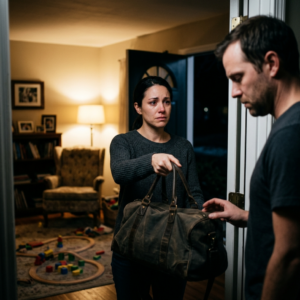
The confrontation was short but devastating. Daniel’s defense was the classic refrain of the unfaithful: I was drunk. It didn’t mean anything. It just happened. But Maya, despite the shaking in her voice, held her ground. “You kissed another woman, Daniel.” She didn’t shout; she didn’t need to. The weight of the fact was enough. She picked up his bag and pointed to the door. Even as he begged, mentioning their daughter Lily, Maya’s resolve didn’t flicker. “This house is mine, and you—you made your choice.” He walked out into the night, looking broken, but for the first time in nine years, Maya was sleeping in a house that contained no lies.
THE PRESSURE OF TRADITION VS. THE SANCTITY OF SELF
In the days that followed, Maya became a fortress. Daniel bombarded her with messages of regret, but it was the call from her mother-in-law that proved the most insulting. “All men make mistakes,” the older woman pleaded, citing her own husband’s past infidelity as a reason to stay. It was an ancient, cultural pressure—the idea that a woman must swallow her pain to keep a family “intact” for the sake of the children.
But Maya’s breath was steady when she replied. “I don’t want to live with a man who kisses other women.” She understood a truth that the previous generation had ignored: a child doesn’t just need a father in the house; a child needs to grow up in a home built on respect. Some friends called her too serious; some said she was too harsh. But they weren’t the ones who had to lie in a bed that felt “dirty” with the memory of another woman’s presence. Maya chose the calm of being alone over the chaos of being betrayed.
THE MAN WITH THE WHITE LILIES
Months passed. The initial fire of anger cooled into a steady, watchful peace. Then, one morning, Daniel appeared at the door. He wasn’t the confident man she had married, nor the defensive man who had cheated. He was pale, tired, and holding a bouquet of white lilies—Maya’s favorite. He didn’t ask for forgiveness; he asked to talk. He admitted his selfishness without the shield of alcohol. “I wasn’t confused,” he said, his hands shaking. “I just acted selfishly.”
He placed the flowers on the porch and walked away when Maya told him he couldn’t take back his choice. That night, Maya lay in the dark, haunted by the “was.” He was the man who held her during bad study nights. He was the man who held Lily like she was made of light. He was the man who sang off-key lullabies. The tragedy of betrayal is that it doesn’t just destroy the present; it taints every beautiful memory of the past. Daniel had become a stranger inhabiting the body of her best friend.
THE SLOW LABOR OF REDEMPTION
Daniel didn’t give up, but he stopped using words. He realized that the damage he had caused couldn’t be patched with a “sorry” or a text message. He began to show up—not as a suitor, but as a father and a man attempting to fix his own broken character. He volunteered at Lily’s school. He learned to braid her hair. He was steady, quiet, and consistently on time. He stopped making big promises and started making small, meaningful changes.
One sunny afternoon, while they worked in the garden in a heavy, shared silence, Daniel spoke. “I’ve been rebuilding my heart without lies, without excuses,” he said. He looked at Maya and admitted she was stronger now—that the woman he had betrayed had been forged into someone he barely recognized, but deeply admired. He didn’t ask to come home. He asked for the “smallest place in her heart” that might still remember them. Maya looked at her daughter, Lily, whose laughter rose like music in the garden air, and felt the ice around her heart finally begin to crack.
THE NEW CHAPTER: FORGIVENESS WITHOUT FORGETTING
“I’m not choosing you because I need you,” Maya finally said, her voice echoing the strength she had found in her months of solitude. “I’m choosing you because I believe in growth.” This wasn’t a return to the old marriage. That marriage was dead. This was the beginning of a second chance, earned through months of consistent, honest effort. When Lily asked if they were a family again, Maya’s answer was the perfect reflection of their journey: “We never stopped being one. We just needed time to find our way back.”
Forgiveness, Maya realized, isn’t about erasing the past. It isn’t about pretending the kiss never happened or the bags were never packed. It is about acknowledging the scar but choosing to believe in the healing. They are not the same people who walked into that weekend months ago, but in the wreckage, they found a different kind of strength—one that doesn’t rely on the illusion of perfection, but on the reality of growth.
Is there such a thing as a mistake that is “too big” to forgive, or do you believe that anyone can change if they are willing to do the work? Maya chose to protect herself first, and only then did she allow room for Daniel to return. We want to hear your thoughts. Have you ever had to rebuild trust from the ground up? Share your stories and your strength with us in the comments below.
Disclaimer : This content may be created by AI for entertainment purposes. Any resemblance to real persons, events, or places is coincidental.






