Real File Was Finally Opened
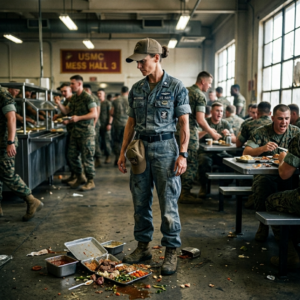
The August heat at Camp Lejeune didn’t just rise; it pressed down like a wet, suffocating blanket, thick with the relentless humidity of North Carolina. Inside the main enlisted mess hall—a squat, cinder-block structure smelling of industrial bleach and reheated meat—the atmosphere was a chaotic symphony of clattering silverware and the rhythmic scuff of combat boots. Under the harsh buzz of flickering fluorescent tubes, hundreds of Marines moved with purposeful aggression.
In a back corner, Petty Officer First Class Vera Taskin sat with her back to the wall. At twenty-nine, she was wiry and sun-scarred, her dark brown hair threaded with premature gray at the temples. She wore the blue-gray digital pattern of the Navy, marking her as an outsider in a sea of Marine camouflage. She ate with a methodical, joyless efficiency, her eyes never resting on her food, but instead scanning the room, cataloging exits, and measuring distances.
Lance Corporal Marcus Webb didn’t just walk past her; he chose a trajectory of collision. He was twenty-four, a product of the gym and an ego inflated by quiet deployments to Okinawa and Djibouti. To him, Vera was a “squid,” a desk sailor who didn’t belong in his Marine Corps. He lunged forward, his shoulder slamming into hers with enough force to send her stumbling. Her tray clattered to the floor, food scattering across the government-issue linoleum in a mess of baked chicken and rice.
“Watch where you’re going, sweetheart,” Webb spat, the words landing like a slur. He didn’t see the crescent-shaped surgical scar on her forearm. He didn’t know he had just provoked a woman who had survived seventy-two hours in a kill zone that had swallowed legends. He thought he was humiliating a clerk. He had no idea he was standing in the presence of a ghost.
THE WEIGHT OF A HIDDEN HISTORY
Vera Taskin’s journey to that mess hall floor began in a double-wide trailer in Kingman, Arizona, smelling of gun solvent and her father’s Camel cigarettes. Her father, Daniel, had been Force Recon in the 80s, a man who returned from Lebanon and Grenada carrying ghosts that never let him sleep. He didn’t tell her bedtime stories; he taught her land navigation by the stars and how to field-strip an M4 in total darkness.
“Don’t assume backup is coming,” he had told her. “Don’t trust equipment you haven’t personally checked. And never believe someone will save you just because they should.”
By eighteen, Vera wasn’t looking for direction; she was looking for a test. She joined the Navy as a Cryptologic Technician, but her brilliance in pattern recognition caught the eyes of the Joint Special Operations Command (JSOC). They offered her work that would never appear in official records. For six years, Vera vanished into “denied areas.” She wasn’t just analyzing signals; she was on the ground with SEAL elements, breaching doors and providing real-time intelligence while lead flew.
The crescent scar on her arm was a souvenir from Helmand Province in 2021. She had been part of a five-person team that held a compound for three days against overwhelming militia forces to extract a high-value target. They survived on grit and improvised medicine. They saved hundreds of lives by stopping an attack on Kabul. But eight months later, her team leader, Lieutenant Marcus Brooks, was killed by an IED in Ramadi.
When Brooks died, the light went out for Vera. She requested a rotation out of the shadows, trading the classified life of an elite operator for a sanitized desk job at Camp Lejeune. She made a pact with herself: keep her head down, do the paperwork, and try to be a human being instead of a weapon.
THE ARCHITECTURE OF INTIMIDATION
Marcus Webb, however, was a man who measured worth by the volume of a voice and the size of a bicep. To him, Vera’s silence was a sign of weakness. Over the weeks, he escalated his harassment, throwing jabs in the corridors and blocking her path at the exchange.
“Probably never left a nice safe ship,” he would whisper loud enough for his subordinates to laugh.
Vera never responded. She would look through him with flat, analytical eyes that measured his center of gravity and the distance to his throat, then she would move past him as if he were nothing more than a change in the weather. This lack of fear infuriated Webb. He needed her to break. He needed to prove his dominance.
The mess hall incident was supposed to be his masterpiece of humiliation. But as Vera stood slowly, brushing grains of rice off her uniform, she didn’t scream. She didn’t cry. She held his gaze for three agonizing seconds—a span of time in which she silently decided not to end his life. She simply turned and walked out, her control so absolute it felt like a threat in itself.
Staff Sergeant Clayton Morris, a combat engineer with two Fallujah tours, watched the exchange from three tables over. He didn’t laugh. He had worked with JSOC operators before. He recognized the “economy of motion” in Vera—the way she moved like someone who knew exactly how much force it took to break a human being. He saw the storm coming long before Webb did.
THE FIELD OF TRUTH
The following morning, Captain Vincent Reeves, a “Mustang” who had risen through the ranks of Force Recon, called a mandatory company formation. He didn’t give a speech about respect. Instead, he announced a grueling three-day leadership evaluation exercise in the Carolina pines—a field assessment designed to break the arrogant and reveal the true.
“Lance Corporal Webb, since you’re so vocal about standards, you’ll volunteer,” Reeves commanded. Then, he turned to the back rank. “Petty Officer Taskin, I’m requesting you participate as both an evaluator and a participant. Your file suggests ‘instructor-level’ qualifications.”
The air left the parade deck. Webb looked struck; Vera remained a mask of neutrality.
The assessment was a descent into hell. It began with a twelve-mile tactical movement through swamps and pine forests under full combat loads. Webb led out with aggressive speed, trying to show off, but by mile eight, his form was shattering. Vera stayed in the middle of the pack, moving with a rhythmic, tireless grace. She wasn’t breathing hard; she was simply executing a task she had done a thousand times in much worse places.
During the tactical problem-solving phase, Webb tried to command the unit like a movie hero, issuing chaotic, nonsensical orders. Vera watched for two minutes, then stepped forward. She sketched a plan in the dirt with a stick, detailing fatal funnels, overlapping fields of fire, and phased movement. She spoke with the cold precision of someone who had planned raids on hardened compounds. When Staff Sergeant Morris ordered the team to follow her plan, they cleared the objective without a single simulated casualty.
THE REVELATION OF THE GHOST
On the final day, under the haze of sleep deprivation and simulated mortar fire, the group was tasked with combat casualty care. As pyrotechnics exploded around them, Webb panicked, fumbling with medical gear. Vera moved like a ghost through the smoke. She triaged by severity, applied tourniquets with bone-crushing tension, and corrected Webb’s errors with a calm, terrifying authority.
When the sun rose on the third day, only four participants were still functional. Vera looked like she could go for another week.
Captain Reeves assembled the unit on the parade deck. Standing beside him was a woman in Navy Service Dress Whites: Commander Elizabeth Whitaker. Her chest was a mosaic of ribbons—Silver Stars, Bronze Stars with “V” devices, and classified citations. She was a legend in the Naval Special Operations community.
Whitaker walked directly to Vera and signaled for her to show her arm. The crescent scar caught the morning light. Whitaker then turned to the exhausted Marines.
“You don’t know the name Operation Crosswind,” Whitaker began, her voice cutting through the wind. “In 2021, a five-person team was surrounded in Helmand. They were cut off, outmanned, and left for dead. They held that compound for seventy-two hours. They prevented an attack that would have killed two hundred Americans.”
She paused, her eyes locking onto Webb, whose face had gone ghostly white.
“The intelligence specialist who breached those doors and held that line wasn’t a ‘sweetheart.’ It was Cryptologic Technician First Class Vera Taskin. She has spent six years in places that don’t officially exist, saving lives you’ll never even hear about. She requested a transfer here because she wanted to try living as something other than a weapon.”
The silence on the parade deck was absolute. The Marines stared at Vera as if the earth had opened up beneath them. They had seen a “desk sailor”; they were now looking at one of the most lethal assets in the United States military.
THE REFLECTION: THE POWER OF THE UNSEEN
The story of Vera Taskin is a testament to the silent giants among us. We live in a world that screams for attention, where we measure worth by social media “clout” or the loudest voice in the room. But true strength—the kind that saves nations and endures the unendurable—often wears a plain uniform and sits in the corner with its back to the wall.
Vera didn’t need Webb’s respect; she knew who she was. The tragedy wasn’t her humiliation, but Webb’s blindness. When we judge others by their “rank” or their appearance, we miss the scars that tell the real story. We forget that the quietest person in the room might be the one who kept the world from ending while we were sleeping.
As Vera turned to leave the parade deck, her service record finally unsealed, she wasn’t looking for an apology. She was looking at the horizon, a ghost finally stepping into the light, reminding us all that the most powerful weapons are the ones that hope they never have to be used again.
How many heroes have you walked past without a second glance? Let’s honor the quiet professionals who carry the weight of our world in silence. Share your thoughts below.
Disclaimer : This content may be created by AI for entertainment purposes. Any resemblance to real persons, events, or places is coincidental.






