The Hook: The Theater of the Absurd
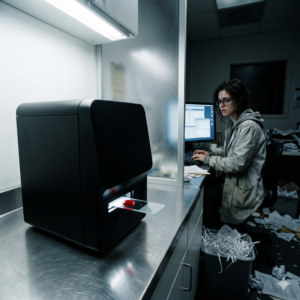
Listen to the ambient hum. It is a low, ceaseless, mechanical purr vibrating through the sterile, aggressively white-walled laboratories of a Silicon Valley industrial park. The air inside this room smells faintly of ozone, sharp rubbing alcohol, and the metallic tang of unspoken panic. Resting on a stainless-steel countertop is a sleek, matte-black box, no larger than a standard desktop printer. Inside this monolithic casing, a single, crimson drop of human blood sits pooled on a microscopic glass slide, illuminated by the harsh, cold glare of a fluorescent LED. A miniature robotic arm whirs to life, descending with jerky, automated precision. A red light blinks. A motorized pipette lowers.
And then, absolutely nothing happens.
The machine is a hollow shell. It is a plastic tomb of dead wires, useless microfluidics, and broken promises, currently spitting out a cascade of fatal error codes onto a hidden terminal. Meanwhile, two floors below, inside a windowless, subterranean back room, a sleep-deprived human technician with trembling hands furiously types fabricated, estimated numbers into a crude Excel spreadsheet. How does a plastic box containing nothing but algorithmic hallucinations command a corporate valuation of nine billion dollars? How does a single, terrifyingly confident voice convince the most powerful men on the planet to ignore the fundamental laws of chemistry? Why do we, as a society, willingly surrender our lives, our venture capital, and our literal blood to the altar of an illusion?
The Contrast: The Paradox of the Black Turtleneck
They speak of the black turtleneck. They speak of the unblinking, sapphire stare that locked onto investors and refused to break contact, a gaze so intense it felt less like eye contact and more like a tractor beam of pure, weaponized ambition. They speak of the calculated, artificially deepened baritone voice that commanded oak-paneled boardrooms filled with grizzled four-star generals, former Secretaries of State, and aging billionaire titans of industry. On the glossy covers of Fortune, Forbes, and Time, she was hailed as the undisputed heir to Steve Jobs, a luminary bathed in the golden, mythic light of Silicon Valley innovation. She was the pristine, flawless manifestation of the modern American Dream: a Stanford dropout destined to democratize healthcare, disrupt a stagnant medical oligopoly, and eradicate the universal terror of the unknown disease. She promised a utopian world where no one ever had to say goodbye too soon.
Yet, beneath this impenetrable, meticulously curated armor of supposed genius lay a private, suffocating hell of frantic deception. The public saw a revolutionary, frictionless medical device poised to save millions of lives with a painless pinprick. The private reality was a sinking ship taking on icy water at an agonizing, daily rate. The tension between these two worlds was physical, vibrating through the very floorboards of the headquarters. Behind cipher-locked glass doors, sleep-deprived engineers wept in bathroom stalls, their hair thinning and falling out from the sheer, crushing stress of attempting to bend the unbreakable laws of physics to match a marketing brochure. They were bound by ironclad, multi-million-dollar non-disclosure agreements, terrified into absolute silence by roaming teams of ruthless corporate litigators who acted more like a secret police force than a legal department.
In the darkest shadows of the glass cage she had built, the magnificent paradox reached its terrifying zenith. The supposed miracle technology—the proprietary machines touted to run hundreds of tests on a single drop of blood—was a catastrophic failure. Instead, the blood was secretly carried out the back door. It was secretly diluted with saline to inflate its volume, secretly transported to commercial, commercially available Siemens machines that had been physically hacked and modified, and tested using traditional methods. It was a terrifying, multi-billion-dollar theater of the absurd. It was a hallucinatory world where scientific error rates were systematically deleted, where dissenting data was categorized as a “glitch,” and where the actors were forced to smile for visiting politicians and television crews while the stage around them was actively consumed by fire.
The Roots: The Psychological Starvation for Immortality
The psychological trap was set long before the first patent was ever filed; it was forged in the quiet desperation of a childhood bedroom. Raised in a household that worshipped at the altar of ancestral legacy and relentless, unforgiving ambition, she was terrifyingly burdened by the fear of mediocrity. Her family lineage boasted historic entrepreneurs and prominent figures, yet the modern generation had lost its immense wealth, leaving behind only the crushing weight of expectations. To her, to be average was to be invisible. To be ordinary was a fate worse than physical death.
She was taught, explicitly and implicitly, that history only remembers the disruptors, the titans who possess the sheer force of will to bend reality until it shatters. It was not merely a desire to invent a medical device; it was a pathological, psychological starvation for immortality. This desperate, hollow hunger forged a “reality distortion field” so dense, so gravity-defying, that she fundamentally began to believe her own prophecies. She lacked the capacity to differentiate between an aspirational goal and an empirical fact. When the science stubbornly, mathematically failed to yield to her ambition, she did not see a brick wall; she saw a temporary test of faith. She believed that the universe simply needed time to catch up to her vision, and therefore, faking the results was not a crime—it was a necessary, noble bridge to a preordained destiny.
The Descent: The Asphyxiation of Truth
The corruption was not a sudden explosion of malice; it was a slow, agonizing asphyxiation of the truth, executed one minor compromise at a time. It began with a slight, seemingly harmless exaggeration to secure early seed funding from family friends. The prototype works, she said, when it only worked ten percent of the time. This minor sin mutated into hiding catastrophic chemical failures from the board of directors. Then came the systemic, weaponized gaslighting of her own workforce.
The descent was orchestrated with the precision of a totalitarian regime. Employees who raised concerns about the diluted blood samples were not just fired; they were legally hunted. They were isolated, surveilled by private investigators who parked black SUVs outside their homes, and psychologically dismantled. The pristine glass cage of her headquarters became a suffocating echo chamber of extreme paranoia. The architecture itself reflected the deceit: frosted glass prevented departments from seeing what others were doing. Information was siloed. Security guards actively shadowed senior scientists when they walked to the restrooms. Internal emails were aggressively monitored for any keywords resembling dissent.
To question the machine was to question the mission. She wrapped her massive, sprawling fraud in the sacred, unimpeachable language of “saving lives.” She weaponized the nobility of healthcare to bludgeon anyone who dared to ask for empirical proof. She created a culture where loyalty was measured by a willingness to lie, a sinking ship where the captain demanded the crew sing hymns of victory while the water rose above their knees. The manipulation was so absolute that highly educated, brilliant chemists began to question their own sanity, wondering if their failure to make the black box work was a personal flaw rather than a scientific impossibility.
The Collateral Damage: The Blood on the Altar
We must look away from the magazine covers and the billion-dollar valuations; we must look directly at the wreckage left in her wake. We must feel the sheer, crushing emotional weight of the innocent lives offered as collateral damage to feed her ego.
They speak of the frantic, heavily pregnant mother who received a false HIV diagnosis from a rigged machine. We must imagine the smell of the sterile clinic where she sat, the cold sweat on her palms, spending agonizing weeks staring at the ceiling in the dead of night, mourning the life of an unborn child she believed was doomed. We must look at the elderly man whose phantom, falsely elevated cancer markers sent him into a spiral of unnecessary, highly toxic chemical treatments that ravaged his fragile body, stealing years from his life for a disease he never had. We must look at the patients who adjusted their blood-thinning medication based on fabricated data, walking around like ticking time bombs of internal hemorrhaging.
And we must look at the brilliant, gentle British biochemist, the primary whistleblower who saw the rot from the inside. We must understand the agony of a man whose entire life was dedicated to scientific truth, suddenly forced to either lie to the world or destroy the company he helped build. Driven to the absolute precipice of despair, his career destroyed, his reputation threatened by vicious corporate lawyers, he found no way out. We must feel the devastating silence of his widow, left to navigate the ruins of a life bankrupted by exorbitant legal fees, crying silently in the dark because her husband chose the unbearable burden of telling the truth in a house built entirely of lies.
The Climax & Decay: The Paper Avalanche
The collapse arrived not with a thunderous, cinematic bang, but with the quiet, devastating rustle of newsprint. A single, meticulously researched investigative expose by a determined Wall Street Journal reporter pierced the impenetrable armor of the reality distortion field. It was a single pebble that triggered a catastrophic, billion-dollar avalanche.
The moment of total decay was visceral, chaotic, and utterly humiliating. Imagine the scene: federal inspectors from the Centers for Medicare & Medicaid Services marching through the pristine glass doors, their clipboards acting as shields against the frantic protests of highly paid executives. The sudden freezing of laboratory licenses. The chaotic, desperate whirring of paper shredders running hot in the dead of night, the air thick with the smell of burning plastic and panicked, acidic sweat as decades of deception were hurriedly fed into the blades.
The unblinking, sapphire stare finally, irreparably fractured. During the final board meetings, the artificially deepened voice wavered, cracking under the weight of federal indictments. The emperor was dragged into the public square and stripped naked under the blinding lights of congressional hearings and criminal courts. Her nine-billion-dollar empire, built on a foundation of diluted blood and hubris, instantly vaporized, turning into nothing but ash, endless litigation, and mountains of indicted paper.
The Silent Aftermath: The Ghost in the Khaki
Today, the grand, architectural marvel of the Palo Alto headquarters is entirely empty. The sweeping glass staircases lead nowhere; the laboratories have been gutted, leased out to another generation of hopeful, naive startups. The visionary, the woman who once commanded the attention of the globe, now wears the drab, ill-fitting khaki uniform of a federal inmate.
She walks the perimeter of a dusty, sun-baked prison yard in Texas, entirely and permanently severed from the private jets, the armed security details, the sycophants, and the global adulation. Her name, once synonymous with revolutionary genius, is now a punchline, a cautionary tale taught in business ethics classes across the world. The silence that surrounds her now is absolute. It is the deafening roar of irrelevance—the very thing she feared most as a child. The organization she built is nothing but a ghost story whispered in the affluent cafes of Silicon Valley, a dark, permanent warning etched deep into the sun-drenched pavement of Sand Hill Road.
Final Reflection: The Seduction of the Silver Bullet
We are a species desperate for saviors. In an age of crushing biological complexity, rampant disease, and the terrifying fragility of the human body, we do not want to hear about peer-reviewed studies, incremental progress, and margin errors. We want magic. We want a hero in a black turtleneck to stand on a stage and tell us that the impossible is actually easy, that our pain can be eradicated with a single, painless drop of blood.
The profound, lingering tragedy of the blood illusion is not just that one woman, blinded by an insatiable hunger for legacy, lied to the world. The far greater, more terrifying truth is that the world—the smartest investors, the sharpest politicians, the most established journalists—was so heartbreakingly, desperately eager to be lied to. We surrendered our skepticism because the lie was simply too beautiful to resist.
Disclaimer : This content may be created by AI for entertainment purposes. Any resemblance to real persons, events, or places is coincidental.






