THE HOOK (PROLOGUE)
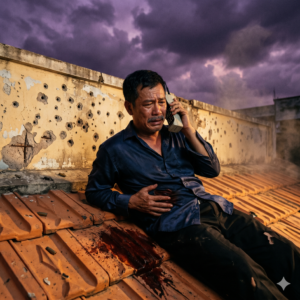
How does a god die? Is it with a thunderclap that shakes the heavens, or is it with the soft, pathetic whimper of a severed phone connection? I stand in the suffocating heat of a Medellín afternoon, staring at a dark, oxidized smear of blood baked into a chipped terracotta roof. The air here does not smell of myth or legend. It smells of hot clay, diesel exhaust, and the lingering, metallic tang of an era that violently cannibalized itself. I run my fingers over the bullet holes scarred into the stucco. Why do we build monuments to men who only knew how to excavate graves? What is it about the human condition that makes us worship the very hands that hold the match to our own homes?
The genesis of empires never begins in the immaculate, air-conditioned hallways of power. It begins in the dirt. It begins with the burning of a single, damp hundred-dollar bill in a jungle so thick it chokes the moonlight. I have spent my life as a silent shadow, walking through the aftermath of these titans, observing the shattered glass and the weeping mothers left in their wake. But to understand the end of Matteo, one must first touch the white dust that built him. It possessed a gravitational pull. It was dense enough to warp the fabric of reality, heavy enough to alter the fate of an entire continent. This was not merely narcotics; this was compressed time. This was a forged passport out of a life where breathing was a luxury and starvation was the only inheritance. But the ticket was always a lie.
THE CONTRAST (THE PARADOX)
They speak of his charity. They speak of his mercy. They speak of the immaculate soccer fields he paved over the mud of the slums, where children chanted his name as if he were a patron saint descended from the clouds. In the public eye, Matteo was a Robin Hood forged in blood and spun gold. He poured his rotting millions into the barrios, building sterile hospitals for those the government had long ago discarded to the gutters. I walked through those neighborhoods. I saw the altars glowing with candlelight. I saw the framed photographs of a smiling, charismatic man draped in rosaries, elevated above the crucifix itself. He was an untouchable folk hero, a man who commanded a private army and forced the highest generals in the land to kiss his ring. He was the sun around which the Colombian economy orbited.
But step away from the blinding light of his public mythology. Step into the stifling, paranoid architecture of his private hell. Behind the iron gates of his sprawling, fortified hacienda, the god was terrified of the dark. While the masses sang his praises in the streets, Matteo sat at the head of a twenty-foot mahogany dining table, profoundly alone. He built a kingdom where every man answered to him, yet he had never felt more intensely hunted. The wealth had devolved from a tangible lifeline into a suffocating, abstract nightmare. They were clearing four hundred and twenty million dollars a week. I watched his men build entire, cavernous warehouses just to store the rotting paper. The smell of damp, molding hundred-dollar bills is a sickeningly sweet perfume of decay that permeated his clothes, his food, his very pores.
He had purchased the infrastructure of the state. He had introduced the terrifying corporate philosophy of Plata o Plomo—Silver or Lead. Accept the bribe, or catch the bullet. A man cannot be bought if he has already purchased the currency. Yet, the absolute power he wielded had severed his connection to humanity. The millions buried beneath the earth could not buy him a single night of dreamless sleep. Every shadow in his mansion held a knife. Every whisper between his guards was interpreted as a conspiracy.
The paradox was absolute: he was the most powerful man on the continent, yet he lived like a cornered rat. He could dictate the foreign policy of nations, but he could not trust the man pouring his coffee. He had built a fortress to keep the violence out, entirely unaware that he had locked the ultimate violence inside with him. The public saw a king adorned in gold; the quiet, empty rooms of his safehouses saw a hollow, exhausted man jumping at the sound of his own heartbeat.
THE ROOTS (THE PSYCHOLOGICAL TRAP)
To understand the monster, you must first look at the ghost. Before the empires, before the imported luxury cars and the exotic zoo filled with displaced hippos, Matteo was merely twenty years old, standing on a hillside overlooking a sea of vibrating green coca leaves. A trail of sweat carved a jagged, dirty path down his spine, disappearing beneath the collar of a frayed, faded cotton shirt that had belonged to a dead brother. His life before this morning was a looped, degrading film of generational poverty. He lived in the suffocating subtext of the underclass.
Every month, he watched his father—weary, hollowed out, lungs failing from hauling sugar cane—crawl to the local boss to beg for loans just to keep a single, flickering light bulb illuminated. He watched his mother’s hands, once soft, harden into commercial sandpaper as she peddled maize in the screaming market exhaust. Poverty is the most violent cartel of all. It breaks the mind long before it starves the body. And then came the neighbor. A boy with the same empty stomach, walking out one morning wearing a thick, heavy gold chain that caught the sun like a flare. No university. No factory. Just a nod across a dusty street.
When Matteo first held that heavy brick of white powder, his internal monologue ran like a fever dream. It doesn’t feel like powder. It feels like revenge. He looked at his boots, caked in the same red mud that buried his grandfather, and decided he would not be buried there. He traded his soul for agency. The cocaine was merely the vehicle; the god-like feeling of possessing value was the true, inescapable addiction. He was driven by a desperate, pathological need to never be small again. It was a psychological trap set in his childhood, a desperate overcompensation that decreed he must control the entire world, simply to ensure the world could never again make him starve.
THE DESCENT (MANIPULATION AND CORRUPTION)
The descent did not happen overnight; it was a slow, agonizing asphyxiation inside a glass cage. The first delivery felt like carrying a live grenade through a crowded cathedral, but by the tenth, the fear had mutated into the cold, unfeeling precision of a mathematician. He scaled his operation, drowning the board of directors in their own blood. But as the empire grew, the cage shrank.
The process of his internal corruption was a masterclass in self-destruction. He began to gaslight his own instincts. The silence is deafening, he would think, staring at the bodyguard who had taken a bullet for him in Cali. The guard was merely making a quiet phone call, perhaps telling his wife goodnight, but in Matteo’s decaying mind, the guard was whispering coordinates to the DEA. In a world governed by the Kingpin strategy, trust was a vulnerability he could no longer afford.
He ordered the loyal bodyguard’s execution that very night. The metallic crack of the pistol echoing through the courtyard was the sound of a man conceptually cutting off his own fingers to save his hand. It was the beginning of a violent purge. He cannibalized his own ranks, creating a terrifying vacuum of isolation. He manipulated his followers, demanding absolute, blind loyalty while actively slaughtering those who provided it. The empire became a sinking ship, weighed down by the paranoia of its captain. The DEA didn’t need to outsmart him; they only needed to wait for him to drown his own crew. He was managing a spectacularly efficient logistics company, but the CEO was rapidly descending into clinical madness.
THE COLLATERAL DAMAGE
And what of the wake? What of the bodies left behind in the violent current of his ascension? The true tragedy of Matteo’s reign is not found on the terracotta roof, but in the collateral damage—the invisible mass of humanity ground into mortar for his monuments.
Think of the mothers in the slums, lighting candles for the man who paid for their clinics, oblivious to the fact that the same man had ordered the drive-by shootings that claimed their eldest sons. Think of the foot soldiers, desperate versions of his younger self, manipulated into fighting street wars for a fraction of a penny while the real wealth flowed above their heads. They died in the mud, clutching cheap weapons, believing they were fighting for honor, when they were merely numbers on a rapidly deteriorating balance sheet.
But the heaviest pain rested on the shoulders of his own blood. His son, a boy forced to grow up inside a gilded fortress, isolated from the world, watching his father transform from a savior into a phantom. The boy lived in a perpetual state of terror, spirited away to damp, cold safehouses in the dead of night, his childhood sacrificed on the altar of his father’s ego. The collateral damage was not just physical; it was a generational trauma, a psychic wound inflicted upon millions, bleeding out into the soil of a nation that would take decades to heal.
THE CLIMAX AND DECAY
The world eventually shifted beneath his feet. The emperor of dirt and analog shadows was forced into a terrifying, invisible grid of digital surveillance. The modern war was fought with algorithms and microwave intercepts. He lived a suffocating regimen of burner phones, exhausted, starving, and profoundly alone.
The climax arrived not with an operatic battle, but with a momentary, fatal relapse into human sentiment. He was a king without a kingdom, hiding in a city he used to own. The isolation was a poison worse than any bullet. In the stifling silence of a safehouse, the armor finally cracked. He picked up the emergency phone. He dialed the number he had memorized but never dared to use.
He knew the protocol. He knew the satellites would pivot the moment the connection was made. He knew the electronic tether would draw a map straight to his head. But the primal ache of a father overrode the logic of a CEO. He stayed on the line just to hear his son’s small, trembling voice ask when he was coming home. He traded his empire for a lullaby. Love, the very thing he had spent a decade purging from his system, became the ultimate informant.
The Special Search Block shattered the doors. The air grew thick with pulverized plaster and cordite. Fleeing to the hot terracotta tiles, the first bullet shattered his leg; the second found his ear. As he bled out under a bruised, heavy purple sky, the illusion evaporated. The money was rotting. The cars were rusting. He had built a wall high enough to keep the poverty out, but he had merely locked himself inside and handed the keys to his own paranoia.
THE SILENT AFTERMATH
Go to his sprawling Hacienda today. The silence is absolute. It is a graveyard of hubris. The immense iron gates are rusting, seized by vines that are slowly reclaiming the metal. The exotic zoo he built is an empty shell; the hippos have broken out, wandering feral through the local rivers, an invasive, destructive legacy of a dead man’s vanity.
His vast network of sicarios has fractured into smaller, infinitely more violent splinter groups, fighting over the scraps of a broken machine. His son lives in exile, hiding under assumed names, forever looking over his shoulder, carrying the unbearable weight of a poisoned bloodline. The money, the hundreds of millions buried in the mud, remains largely untouched, slowly decaying back into the earth from which the coca sprang. Matteo is survived only by the ghosts of his contemporaries—Carlos rotting in a concrete box in Florence; Octavio betrayed by his failing kidneys; Elena gunned down by her own violent invention. They are all statues in an empty museum.
FINAL REFLECTION
When I look back at the script of this bloodline, it acts as a devastating mirror for the human condition. We are obsessed with the accumulation of power, wholly believing that if we can just control enough of our environment, we will finally be safe.
But this story is not just a chronicle of a cartel king; it is a profound warning. The ruthless CEO destroying employees out of insecurity, the controlling partner suffocating love through jealousy, the hollow influencer meticulously curating a fake life—they are all operating on Matteo’s exact psychological trap. We desperately grip onto control, believing it is our armor, when in reality, it is our chain. None of these titans were conquered by a superior tactical force. They were undone by the inescapable human traits that wealth can never shield you from: ego, illness, and ultimately, love.
We build our fortresses to escape our vulnerabilities, entirely unaware of the walls closing in. In the end, we are all the architects of our own prisons. The crown is always heavier than the guillotine.
Disclaimer : This content may be created by AI for entertainment purposes. Any resemblance to real persons, events, or places is coincidental.






