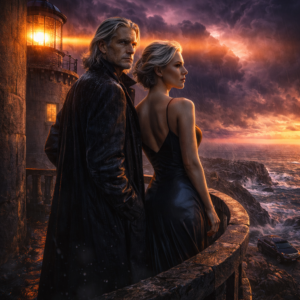
The Lighthouse Contract: She Bought My Name To Save Her Empire, But I Was The One Who Owned The Shore
They say that in the Pacific Northwest, the mist doesn’t just settle; it possesses. It clings to the jagged cliffs of Cape Sorrow like a secret you can’t quite forget. For three years, I, Julian Thorne, 28, was the master of that mist. I lived in a lighthouse that had belonged to my family for a century, spending my days restoring salvaged ship parts and my nights listening to the rhythmic pulse of the Atlantic. I was a man of grease-stained jumpsuits and saltwater-weathered hands, a soul that had retreated from the world after the tragedy that took my parents. I thought I had found peace in the isolation. I didn’t realize that the world was about to crash against my shore in the form of a woman who carried a storm in her eyes and a contract in her hand. I thought I was just a ghost in a tower; I didn’t know I was the only man who could stop an empire from sinking.
The afternoon was a bruised purple, the kind of sky that promised a gale. I was in the workshop at the base of the lighthouse, welding a brass porthole from a 1920s steamer, when the sound of an engine broke the silence. It wasn’t the chug of a fishing boat; it was the high-performance purr of something that cost more than my entire property.
A sleek, obsidian-black SUV pulled up the gravel path. The door opened, and a woman stepped out. She was tall, wearing a tailored charcoal trench coat and heels that looked like weapons. Her silver-blonde hair was pulled back in a severe bun, but her hands were trembling as she clutched a leather portfolio.
“Are you Julian Thorne?” she asked. Her voice was like crystal—beautiful, but capable of cutting.
“Depends on who’s asking,” I said, wiping my hands on a rag.
“My name is Elena Vance,” she said, stepping forward onto the damp grass. “I am the CEO of Vance Global Architecture. And I need a husband by tomorrow.”
I laughed, a dry sound that felt foreign in my throat. “Lady, the nearest church is ten miles away, and I’m pretty sure they require a lot more than a fancy car to perform a miracle.”
She didn’t smile. She handed me the portfolio. Inside were legal documents, a copy of a grandfather’s will, and a board directive.
“My 30th birthday is tomorrow,” Elena said, her eyes locking onto mine with a terrifying intensity. “If I am not married by midnight, my cousin, Marcus Vance, takes the majority share of the company. He’s already planning to sell our historic preservation sites to a strip-mall developer. Your lighthouse borders our most protected coastal reserve. If he wins, he’ll bulldoze the cliffs to build a casino. I researched you, Julian. You’re an ex-Marine, a restoration specialist, and most importantly, you’re the only man in this county who hasn’t been bribed by Marcus.”
I looked at the documents, then at the lighthouse looming behind me. “Why me?”
“Because,” she whispered, “you know what it’s like to lose a legacy. And because you’re the only person I can trust not to want a piece of mine.”
“Fine,” I said, the ghost of my father’s voice echoing in my mind about protecting the coast. “On one condition. If we do this, it’s not just a signature. You come and live here. If Marcus has investigators, he needs to see a man and a wife, not a business arrangement.”
Elena looked at the crumbling stone of the lighthouse, then at her pristine heels. “Deal.”
The wedding was a silent affair at the county clerk’s office. No flowers. No music. Just the scratch of pens on paper and a judge who looked like he’d seen it all before. When we walked out, the air felt different. I was no longer a hermit; I was the husband of the most powerful woman in the regional industry.
The first week at the lighthouse was a lesson in friction. Elena was a creature of glass and steel—she spent her mornings on satellite calls with London and Tokyo, her voice sharp and commanding, while I was out in the spray, hauling salvaged timber.
“The Wi-Fi is medieval, Julian!” she shouted on the third day, holding her laptop like a piece of useless scrap metal.
“It’s a lighthouse, Elena, not a server farm,” I replied, coming in with a crate of fresh oysters. “Try breathing the air instead of the data. It’s better for the soul.”
Something shifted on the fifth night. A massive storm hit the coast—a true Pacific Northwester. The power failed, and the backup generator sputtered. I found Elena in the kitchen, huddled by a single candle, looking smaller than I had ever seen her.
“I’ve spent my whole life building structures that are ‘hurricane-proof,'” she admitted, her voice trembling as the wind howled against the glass. “But I realized tonight… I’ve never actually felt the wind.”
I sat across from her and told her about the night the lighthouse saved my life during a solo sail gone wrong. She told me about her grandfather, the man who built Vance Global from a single drafting table, and how Marcus had spent years poisoning the board against her. In the flicker of the candlelight, the CEO and the hermit vanished. We were just two people seeking shelter.
The peace didn’t last. Marcus Vance wasn’t a man who accepted defeat.
A week later, a group of “environmental inspectors” showed up at the lighthouse. They claimed my restoration work was violating coastal codes. It was a transparent move to have me evicted, which would invalidate our “shared residence.”
Elena handled them like a general. She walked out in her work boots and a denim jacket she’d borrowed from me, citing three different obscure 19th-century maritime laws that protected my workshop.
“You have ten minutes to leave this property,” she told the lead inspector, “before I file a suit for corporate harassment that will bankrupt your firm.”
They left, but Marcus escalated. Two days later, while I was out on a salvage dive, I saw smoke rising from the cliffs. I raced back to find the storage shed—filled with the historic blueprints Elena had brought to protect—in flames.
I fought the fire with the lighthouse’s industrial extinguishers, but I was nearly overcome by smoke. Elena pulled me out, her face streaked with soot, her expensive coat ruined.
“He’s trying to kill you, Julian,” she sobbed, holding me in the mud. “I should never have brought this to your door.”
“He didn’t kill me,” I said, coughing. “He just made me realize I’m not just protecting a contract anymore. I’m protecting my wife.”
We had forty-eight hours until the final board meeting in Seattle, where Marcus intended to present evidence that our marriage was a sham.
I spent the night in my workshop, cleaning the soot off an old brass chest I had salvaged years ago but never opened. It had belonged to Elena’s grandfather—he had spent his summers at this very lighthouse when my father was a boy.
Inside was a ledger and a series of letters.
“Elena, look at this,” I said as the sun began to rise.
The plot twist hit us like a tidal wave. Marcus wasn’t just a greedy cousin. According to her grandfather’s private journals, Marcus wasn’t a Vance at all. He was the son of a rival architect who had been “adopted” into the family as a way to settle a historic debt. The will that gave Marcus a claim to the company was actually a forgery; her grandfather had intended for the lighthouse and the coastal reserve to be the sole headquarters of a new Vance Foundation, with Julian Thorne’s family as the permanent stewards.
Marcus had known this. He had orchestrated the car accident that killed my parents because my father held the original, un-forged will in the lighthouse safe.
The board meeting was held in a penthouse overlooking the rainy Seattle harbor. Marcus sat at the head of the mahogany table, looking smug.
“The marriage is a farce,” Marcus announced to the directors. “Julian Thorne is a simpleton living in a ruin. Elena is desperate. I move for an immediate dissolution of her shares.”
The doors swung open. Elena walked in, wearing a dress of midnight silk, her hair a silver halo. I followed her, dressed in a sharp suit I hadn’t worn in years, carrying the brass chest.
“You’re right about one thing, Marcus,” I said, my voice echoing with a military authority that made the room go cold. “The marriage started as a deal. But the fraud started with you.”
I laid the grandfather’s journals and the original will on the table. Elena’s legal team presented the forensic evidence of the forgery. But I had one more thing.
“The night of the fire at the lighthouse,” I said, pulling out a digital recorder. “I didn’t just fight the flames. I caught the man you sent. He was very talkative when I reminded him that I was a Marine before I was a watchman.”
The recording played. It was Marcus’s voice, clear and cold, ordering the “elimination” of the Thorne assets to “clean up the remaining loose ends.”
Marcus’s face drained of color. Security—actual police this time—entered the room.
One year later, the Cape Sorrow coastal reserve is the most beautiful park in the country. Vance Global didn’t sell out; they became the world leader in sustainable, historic architecture.
I still live in the lighthouse. But the workshop is now the headquarters of the Vance-Thorne Foundation. Elena doesn’t spend her mornings on satellite calls to London. She spends them on the porch, brewing coffee while I calibrate the light.
We had a second wedding. No lawyers this time. Just a few friends, the salt air, and a wide-open sky.
I realized then that sometimes, the things we try to hide from the world are the very things that lead us to the person who can finally see us.
“I came here for a husband,” Elena whispered as we watched the first light of the evening sweep across the waves.
“And you stayed,” I replied, taking her hand, “because we chose the storm together.”
Disclaimer : This content may be created by AI for entertainment purposes. Any resemblance to real persons, events, or places is coincidental.






