The Prologue: The Weight of the Blue Ink
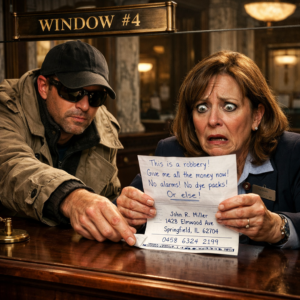
What is the precise chemical composition of self-destruction? How does the human eye process the agonizing, instantaneous realization that a man has just authored the definitive, indisputable manuscript of his own demise? It is 10:14 AM on a crisp, unremarkable Tuesday morning at the First Fidelity Bank in Columbus, Ohio. The interior of the bank is a cathedral of quiet, intimidating finance. The air smells of polished marble, ozone from the high-speed currency counters, and the faint, metallic scent of heavily guarded air conditioning. The acoustic landscape is dominated by the hushed whispers of commerce and the rhythmic, authoritative thump of rubber stamps hitting carbon paper. Approaching Teller Window #4 is Ronald Bivins, a thirty-six-year-old man wearing an oversized trench coat, a pulled-down baseball cap, and a pair of dark sunglasses that belong on a beach, not inside a financial institution. He is trembling. He slides a piece of paper across the smooth, cold surface of the mahogany counter. It is a demand note. It is the crucial, cinematic prop of the great American bank heist.
The note is handwritten in blue ballpoint ink. It reads, in frantic, jagged letters: THIS IS A ROBBERY. PUT ALL THE HUNDREDS IN A BAG. NO DYE PACKS. NO ALARMS. I HAVE A WEAPON. But the tragedy of Ronald Bivins does not lie in the threatening words written on the front of the paper. The silent cry of this scene, the profound, unmitigated disaster of the moment, lies on the back of the paper. Because Ronald did not write his manifesto of crime on a blank piece of printer paper. He did not write it on a torn scrap of a brown paper bag. In a moment of frantic, pre-robbery preparation inside his idling 1998 Ford Taurus, Ronald grabbed the first piece of paper he could find in his glove compartment. And as the teller, Diane, reads the threat, her hands shaking, her eyes dart down to the bottom edge of the paper, where the ink has bled through from the other side. She slowly turns the note over. Printed in crisp, federally mandated, standardized typeface is Ronald’s full legal name, his current residential address, his routing number, and his checking account number. He has not just handed her a threat; he has handed her his personalized, pre-printed deposit slip. The door to his prison cell has just swung shut, and he has provided the exact, localized coordinates for the authorities to find the key.
The Paradox: The Fortress and the Stationary
They speak of the impenetrable architecture of modern banking. They speak of time-locked vaults forged from foot-thick tungsten steel, of silent alarms wired directly to tactical dispatch centers, of biometric scanners and explosive dye packs designed to permanently mark the guilty. They speak of the federal government insuring these institutions, backing every dollar with the overwhelming, awe-inspiring might of the United States Treasury. But they do not speak of the profound, staggering paradox that occurs when this multi-million-dollar infrastructure of security and surveillance is deployed against a man who has voluntarily surrendered his biography before the crime has even concluded.
From the outside, First Fidelity is a fortress designed to withstand the assaults of criminal masterminds. The public glory of the bank is its aura of absolute invulnerability. The security cameras track every angle, recording in high-definition digital arrays. The guards stand near the revolving doors, their hands resting near their holsters.
Yet, the private reality—the absurd, excruciating decay of the situation—is playing out in the one-on-one interaction at Window #4. The gap between the bank’s preparation for a violent siege and the reality of Ronald’s administrative blunder is a masterpiece of the absurd. The state has built a financial citadel to protect against John Dillinger; Ronald is attacking it with the logistical acumen of a man who cannot successfully mail a postcard. The tension between the heavily armed response units waiting for the silent alarm and the sheer, staggering incompetence of a thief who brought his own return address to the heist creates a theater of unparalleled tragicomedy. The bank is treating him as a Level 1 existential threat; Ronald is treating the robbery as an extension of his personal filing system.
The Roots: The Psychological Trap of the Bureaucratic Mind
How does a human being arrive at a point where committing a major federal felony becomes entangled with his own household paperwork? To understand the administrative shipwreck of Ronald Bivins, one must analyze the architecture of his lifelong psychological trap. Ronald was not born a daring outlaw; he was born into the crushing, inescapable machinery of modern bureaucracy. The roots of his vulnerability lie in his absolute, unshakeable conditioning as a compliant, administrative subject.
Ronald was a man who lived his entire life filling out forms in triplicate. He was a man who stood in lines at the DMV, who meticulously filed his taxes, who understood that in society, nothing happens without the proper paperwork. This was the tragedy of his early years: the conditioning of a mind that believed legitimacy is derived entirely from printed documents. When the desperation of debt finally pushed him to the unthinkable act of robbing a bank, his brain could not entirely abandon its bureaucratic programming. The vulnerability that led him to use his own deposit slip was not merely an oversight; it was a deep, psychological regression to his comfort zone. In the chaotic, terrifying moments before walking through the revolving doors, his mind demanded order. He needed a slip of paper. The bank had provided him with slips of paper. It was an act of profound, subconscious institutionalization. He was a man who had spent thirty-six years asking for permission, entirely unaware that you cannot formally submit a requisition form for a felony.
The Descent: The Agonizing Detail of the Transaction
The process of Ronald’s descent into madness within the bank was not a sudden explosion of violence, but a slow, excruciating theater of customer service. As the seconds ticked by, the robbery transformed from a kinetic threat into an intensely awkward administrative transaction. This was his sinking ship, and it was sinking at the speed of a teller checking a computer monitor.
The manipulation in this scenario was inflicted by the teller upon the robber. Diane, a fifty-two-year-old veteran of the banking industry, recognized the profound absurdity of the situation instantly. She gaslit him into believing the robbery was proceeding according to protocol. “I’m going to need to see some ID to process this, sir,” she whispered, her voice trembling but her mind operating with the sharp, survivalist clarity of a seasoned professional.
This was the slow, agonizing detail of his failure. Ronald, trapped in his bureaucratic mindset, did not vault the counter. He did not scream. He reached into his back pocket, pulled out his worn leather wallet, and slid his state-issued Ohio Driver’s License across the marble. The corruption of his grand plan was absolute. Diane looked at the ID. She looked at the deposit slip. They matched perfectly. She hit the silent alarm with her knee while politely informing him that she needed to get the “manager’s approval for a withdrawal of this size.” The ship was sinking not because the police were actively breaking it apart, but because the captain was willingly providing his passport to the iceberg. He was trapped in a self-imposed glass cage, standing patiently behind the velvet ropes of the queue line, waiting for his robbery to be officially approved by a middle manager.
The Collateral Damage: The Theft of Adrenaline
We must look away from the patient, idiotic thief and focus on the true victim of this localized madness. The collateral damage of this absurdity fell heavily upon the shoulders of Diane. The victims left behind in these scenarios are the frontline workers whose psychological endurance is ground to dust by the bizarre, contradictory nature of the trauma. Describe her pain with the high emotional weight it demands. It is not the sharp, piercing pain of a physical assault; it is the dull, throbbing, existential whiplash of preparing to die, only to realize your murderer is an absolute buffoon.
Diane is a woman trained to handle the darkest moments of the human condition. She has attended active shooter seminars; she has memorized the protocols for preserving her own life during a violent hostage situation. When Ronald first slid the note across the counter, she experienced the cold, paralyzing terror of a woman who believes she might not go home to her children. But when she flipped the paper over, that terror was immediately, violently replaced by a profound, soul-crushing confusion. The pain is the exhaustion of this emotional rollercoaster. It is the theft of her adrenaline. She was forced to endure the physiological symptoms of a near-death experience, only to realize she was dealing with a man who had effectively arrested himself. The collateral damage is the erosion of her reality. She stood there, pretending to count non-existent bills, feeling not relief, but a profound, hollow despair regarding the evolutionary trajectory of the criminals she was supposed to fear.
The Climax and Decay: The Polite Surrender
The climax of the transaction arrived not with a dramatic shootout or a screaming getaway driver, but with the brutal, uncompromising force of municipal law enforcement entering a quiet lobby. By 10:19 AM, three Columbus Police cruisers had silently pulled up to the curb. Four heavily armed officers entered the revolving doors. They did not need to secure the perimeter; they did not need to shout commands to the crowd. Diane simply made eye contact with the lead officer and pointed a single, trembling finger at the man standing patiently at her window.
The moment of total collapse was spectacularly anti-climactic. “Ronald Bivins?” the lead officer asked, stepping up behind him.
Ronald turned around, adjusting his dark sunglasses. “Yes?” he replied, his voice a mixture of surprise and polite deference.
The decay of Ronald’s grand escape was instantaneous. He did not reach for his pockets. He did not attempt to run. When the officer asked him to place his hands behind his back, he complied with the exact same administrative obedience he had used when handing over his driver’s license. The greatest loss he suffered in that fraction of a second was the complete and total annihilation of his outlaw persona. The magic spell of his criminal mastermind fantasy was shattered by the cold, heavy click of the handcuffs. He was defeated not by the overwhelming firepower of the state, but by the undeniable, printed evidence of his own checking account.
The Silent Aftermath: The Evidence in the Plastic Bag
How do they live now? The survival in solitude is a stark, humiliating reality. Ronald Bivins sits in a sterile, concrete holding cell at the county jail. The empty shell of his grand heist has been replaced by the crushing, inescapable silence of the penal system. There is no trial strategy to discuss. There is no brilliant defense attorney who can twist the facts.
The true aftermath lives in the evidence room at the precinct. Inside a clear, plastic evidence bag sits the artifact of his demise. The detectives do not need to dust for prints. They do not need to analyze handwriting samples or pull security footage to prove his identity. The case is closed before the ink on the arrest report is dry. The police department survives the dark reality of their daily jobs by framing a photocopy of the deposit slip and hanging it in the breakroom. They laugh to keep from drowning in the grim reality of the streets. Ronald becomes a digitized punchline, a permanent monument to the absurdity of the criminal mind, forever remembered as the man who brought his own receipt to a robbery.
Final Reflection: The Inescapable Paper Trail
In the end, the bureaucratic tragedy of Ronald Bivins forces us to confront a deeply uncomfortable, philosophical lesson about human nature, identity, and the inescapable paper trail of our own lives. We spend our days dreaming of reinvention. We harbor secret fantasies of stepping outside the boundaries of our mundane existences, of pulling down a mask and becoming someone entirely different—someone dangerous, untethered, and free from the crushing weight of our daily obligations.
Yet, true anonymity is the most fragile illusion of all. We are tethered to the world by thousands of invisible threads of administration. Our names, our addresses, our digital footprints—they are woven into the very fabric of our reality. Ronald Bivins tried to step out of the system, but he carried the system with him in his pocket. We laugh at the absurdity of a man using his own deposit slip for a holdup, but in our laughter, we must recognize our own reflection. How often do we try to escape who we are, only to sabotage our own reinvention by clinging to the very habits, insecurities, and identifying markers we are trying to leave behind? We survive not by attempting to erase our names in a dramatic blaze of glory, but by accepting the weight of our own identities, recognizing that the paper trail we leave behind is not just a record of our existence, but the inescapable anchor of our own humanity.
Disclaimer : This content may be created by AI for entertainment purposes. Any resemblance to real persons, events, or places is coincidental.






