The Gypsum Breach: The Anatomy of a Suspended Surrender
The Prologue: The Architecture of an Invisible Collapse
What is the precise acoustic signature of a catastrophic failure of judgment? How does the human ear process the agonizingly slow, microscopic tearing of compressed gypsum and paper backing, just moments before the illusion of safety violently evaporates? It is 11:42 PM in a quiet, aggressively manicured subdivision in Aurora, Colorado. The night is perfectly still, the kind of suburban silence that feels heavy, almost synthetic. Inside the living room of 442 Maple Drive, the atmosphere is a study in domestic trauma. A floor lamp casts a warm, amber glow over a beige sectional sofa. On that sofa sits Mrs. Eleanor Gable, a sixty-eight-year-old retired librarian, clutching a floral teacup with trembling hands. Standing opposite her are two patrol officers, their tactical vests rigid, their notebooks open, speaking in the hushed, clinical tones reserved for victims of property crime. The back door is splintered. A television is missing. The scene is static, secure, and seemingly concluded.
But there is a fire burning invisibly in this room. The oxygen is being systematically consumed not by flames, but by the frantic, shallow breathing of a man hidden exactly four feet above the officers’ heads. Up in the pitch-black, suffocating void of the attic, pressed flat against the wooden joists and buried under a sea of pink fiberglass insulation, lies Marcus “Shadow” Vance. He is a twenty-two-year-old burglar who has made a profound miscalculation regarding the structural integrity of residential architecture. He is sweating. The sweat drips into his eyes, mixing with the abrasive glass dust, creating a blinding, burning paste. He does not move. He cannot move. Below him, the officers discuss perimeter sweeps and pawn shop protocols. Above him, the low-sloping roof radiates the stored heat of the day. And right beneath his chest, the half-inch layer of painted drywall—the only barrier between his phantom existence and an immediate felony conviction—begins to groan. It is a sound so soft it is almost imperceptible. A crk… crk… crk… It is the silent cry of physics preparing to exact its revenge.
The Paradox: The Ghost in the Machine and the Fool in the Fiberglass
They speak of the phantom thief. They speak of the invisible infiltrator who slips through the cracks of the city, evading the multi-million-dollar dragnet of the modern police apparatus. They speak of thermal imaging drones hovering in the night sky, painting the neighborhood in ghostly hues of crimson and white. They speak of Belgian Malinois K9s, their muscles coiled like steel springs, noses pressed to the damp earth, capable of tracking a single drop of adrenaline-laced sweat across a concrete jungle. The public glory of the Aurora Police Department is operating at maximum capacity outside the house. A six-block perimeter has been established. Radios crackle with tactical coordinates. The machinery of the state is hunting a mastermind.
Yet, the private reality—the absurd decay of the situation—is playing out in the claustrophobic darkness of Mrs. Gable’s crawlspace. The gap between the police’s assumption of a highly mobile, sophisticated threat and the reality of Marcus’s physical predicament is a staggering paradox. Marcus is not outrunning the hounds; he is currently attempting to perform a flawless, high-stakes plank across two wooden beams spaced twenty-four inches apart. His core muscles are shaking violently. His left knee has slipped off the solid wood and is now resting entirely on the fragile, brittle surface of the ceiling drywall. The tension between the militarized search party scouring the alleys and the sheer, staggering incompetence of a man slowly crushing himself to death under a low-hanging rafter creates a theater of the absurd. The police are treating him like a hostile specter; Marcus is treating half an inch of plaster like a load-bearing foundation. He is a master of stealth who has successfully cornered himself in a dusty, fiberglass coffin.
The Roots: The Psychological Trap of Elevation
How does a human being arrive at a point where climbing into a lightless, unventilated trap seems like a viable tactical retreat? To understand the suspended siege of 442 Maple Drive, one must analyze the architecture of Marcus Vance’s lifelong psychological trap. Marcus was not born an acrobat; he was born into a world where running away was the only reliable survival mechanism. But the roots of his specific vulnerability lie in a childlike misunderstanding of spatial reality. It is the psychological phenomenon of the “ostrich effect” combined with the playground logic of a game of hide-and-seek.
If you are out of the line of sight, you cease to exist. This was the tragedy of his early years: the conditioning of a mind that believed elevation equated to salvation. When trouble came—be it an angry landlord, a debt collector, or the wail of a siren—Marcus always went up. Fire escapes, rooftops, fences. He grew up in a system that taught him the authorities only look at eye level. The vulnerability that led him to kick open Mrs. Gable’s backdoor and, upon hearing the approaching sirens, shove himself through the square access hatch in the hallway ceiling, was a deep, psychological regression. He was a man who had spent twenty-two years running from consequences, entirely unaware that you cannot outrun gravity. The attic was not a strategic hideout; it was the physical manifestation of his refusal to face the music on solid ground. He climbed into the dark because he believed the darkness would erase him.
The Descent: The Agony of the Suspended Trench
The process of Marcus’s descent into madness within the attic was not a sudden capture, but a slow, agonizing suffocation of the body and mind. As the minutes ticked by—five minutes, then fifteen, then thirty—the crawlspace transformed from a clever hiding spot into an intensely hostile environment. This was his sinking ship. The air was thick, stagnant, and heavily particulate. Every inhalation dragged microscopic shards of glass into his lungs. The heat was oppressive, climbing well past one hundred degrees.
The manipulation in this scenario was inflicted by Marcus upon himself. He gaslit his own survival instincts. As his muscles screamed in lactic agony from holding his body weight suspended between the joists, his mind whispered that he was winning. “They don’t know,” he told himself, listening to the muffled voices of the officers below. “Just hold on.” But the corruption of his physical state was undeniable. His arms trembled uncontrollably. The sweat poured off him, dripping directly onto the drywall, softening the paper, turning the sturdy plaster into a damp, fragile sponge. This was the slow, agonizing detail of his failure. The ship was sinking not because it was taking on water, but because the captain was physically melting the hull. He was trapped in a self-imposed torture chamber, suspended by a thread of pure delusion, waiting for a miracle in a place where only physics governed.
The Collateral Damage: The Violation of the Sanctuary
We must look away from the sweating burglar and the oblivious officers to focus on the true center of gravity in this midnight circus: Mrs. Eleanor Gable. The collateral damage of this absurdity fell squarely upon the shoulders of a woman who simply wanted to drink her chamomile tea in peace. The victims left behind in these scenarios are rarely acknowledged for the specific, bizarre trauma they endure. Mrs. Gable did not just experience the violation of a home invasion. She experienced the crushing, exhausting weight of having her sanctuary turned into a slapstick comedy stage.
Describe her pain with the high emotional weight it demands. It is the pain of a woman who spent forty years maintaining a pristine home, vacuuming the beige carpets, dusting the porcelain figurines, only to be subjected to the psychological terror of the unknown directly above her head. It is the silent, agonizing scream of realizing that the safety the police officers are promising her is entirely illusory, because the threat is currently hovering over her antique coffee table. The collateral damage is the theft of her peace of mind. Every creak of the house, for the rest of her life, will sound like a man preparing to fall from the sky. And for the officers below, the collateral damage is the impending erosion of their professional dignity. They stand there, projecting authority, completely unaware that they are the unwitting straight men in a cosmic joke about structural engineering.
The Climax and Decay: The Rupture of the Facade
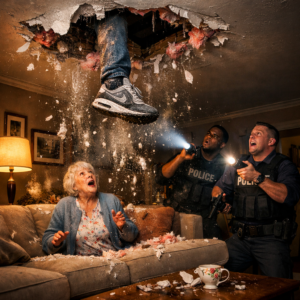
The climax of the siege arrived not with the kicking down of a door, but with the violent, spectacular shattering of the domestic illusion. At exactly 11:48 PM, Marcus’s left thigh muscle finally cramped. It was a vicious, seizing spasm that overrode his conscious control. His leg slipped completely off the wooden joist. The moment of total collapse was thunderous, chaotic, and utterly humiliating.
CRACK-BOOM. The officers mid-sentence stopped. Mrs. Gable dropped her floral teacup; it shattered against the hardwood floor. Directly above the center of the beige sectional sofa, the ceiling exploded outward. A cloud of white gypsum dust, pink fiberglass, and decades of accumulated attic debris billowed into the living room like a volcanic eruption. And there, emerging through the jagged, ragged hole in the pristine white ceiling, was a single, solitary limb. It was a leg, clad in a dirty denim jean and a scuffed Nike Air Max sneaker. It did not drop all the way; it dangled, swinging slightly, like a bizarre, modern-art pendulum.
The decay of Marcus’s grand escape was absolute. He was stuck. His torso was wedged between the joists above, while his leg hung helplessly in the living room below. The greatest loss he suffered in that fraction of a second was the complete and total annihilation of his stealth persona. The officers drew their weapons, stepping back, aiming their flashlights not at the doors, but at the ceiling. “Police! Show me your hands!” one officer yelled, an inherently ridiculous command given that only a foot was visible. From the darkness above, a muffled, defeated, and dust-choked voice rasped, “I’m stuck, man. Please don’t shoot my foot.”
The Silent Aftermath: The Arrest in the Debris
How do they live now? The survival in solitude is a brutal, dusty reality. Marcus Vance sits in the back of a police cruiser, his hair matted with pink insulation, his clothes coated in white powder, coughing up drywall. The empty shell of his phantom persona has been replaced by the crushing humiliation of his extraction. It took the fire department twenty minutes to cut the ceiling open wider to pull him down, a process watched by six heavily armed officers struggling intensely to suppress their laughter.
The true aftermath lives in the living room of 442 Maple Drive. The officers have left, but the hole remains. A massive, jagged wound in the architecture of the house, raining a slow, steady drizzle of dust onto the ruined beige sofa. The police department survives the dark, traumatic reality of their daily jobs by recounting the legend of the “Attic Acrobat” in the locker room. They laugh to keep from drowning in the grim reality of the streets. Marcus’s dangling sneaker becomes a digitized photograph, passed around group chats, a permanent monument to the absurdity of the criminal mind.
Final Reflection: The Inescapable Weight of Reality
In the end, the gypsum breach at Maple Drive forces us to confront a deeply uncomfortable, philosophical lesson about human nature, power, and the inescapable pull of our own gravity. We spend our lives trying to outrun our mistakes. We climb into the dark spaces of our own denial, constructing elaborate psychological attics where we believe the consequences of our actions cannot find us. We convince ourselves that if we just hold our breath and stay perfectly still, the world will move on without us.
Yet, the universe demands equilibrium. The laws of physics, much like the laws of morality, cannot be suspended indefinitely. The drywall of our delusions is fragile. It can only support the weight of our lies for so long before the sweat, the fatigue, and the sheer, agonizing pressure of reality cause it to buckle. Marcus Vance believed that elevation was his salvation, but he forgot that the higher you climb to hide, the more spectacular the eventual collapse. We survive not by clinging to the shadows above, hoping the floor holds, but by planting our feet firmly on the ground, stepping into the light, and carrying the weight of our own humanity before it crashes down upon us.
Disclaimer : This content may be created by AI for entertainment purposes. Any resemblance to real persons, events, or places is coincidental.






