The Glass Bastion: The Anatomy of the Push-Pull Siege
The Prologue: The Immovable Barrier
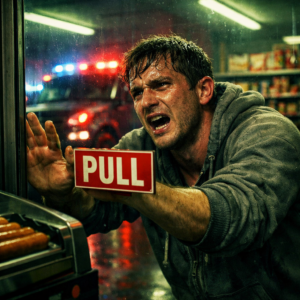
What is the precise sound of a man’s destiny locking him inside his own failure? How does the mind process the sudden, violent realization that the only thing standing between freedom and a concrete cell is a quarter-inch thick sheet of transparent plexiglass? It is 3:14 AM in Tampa, Florida. The neon buzz of the “OPEN 24/7” sign flickers like a dying heartbeat, casting an unforgiving, radioactive green glow across the cracked asphalt of the Gas-N-Go parking lot. The air smells intensely of humidity, ozone, and the stale, artificial sweetness of rolling hot dogs that have been turning on metal heated grates since the previous afternoon. Inside the store stands Kevin “Two-Shoes” Miller, aged twenty-nine, a man whose ambition vastly outpaced his basic literacy. He is sweating. The sweat drips from his brow, stinging his eyes, soaking into the collar of his faded grey hoodie. He presses his hands against the glass door. He pushes. The door rattles, a sharp, metallic clatter that echoes through the empty aisles of potato chips and engine oil. The door does not open. He pushes again, harder this time, putting the full weight of his frantic, terrified body against the frame. Nothing. He is a predator who has successfully raided the nest—his pockets bulging with thirty-four dollars in crumpled bills and a stolen roll of scratch-off lottery tickets—but he cannot escape. He is trapped. Not by the police. Not by a locking mechanism. But by a small, faded red sticker at eye level that reads, in simple, bold, white letters: PULL.
The Paradox: The Artillery and the Absurdity
They speak of the militarization of the modern police force. They speak of the overwhelming, awe-inspiring might of the state, equipped to handle terrorist insurgencies and sophisticated syndicates. They speak of millions of dollars in federal grants poured into local precincts to transform ordinary patrolmen into tactical commandos. But they do not speak of the profound, almost farcical paradox that occurs when this monolithic machinery of war is deployed against a man who is currently losing a physical altercation with a swinging hinge.
Outside the Gas-N-Go, the response is apocalyptic. By 3:45 AM, the perimeter has been secured by twelve heavily armed officers. A Lenco BearCat armored personnel carrier idles menacingly by the unleaded gas pumps, its diesel engine rumbling with the suppressed violence of a caged beast. Snipers, draped in dark tactical gear, have taken positions on the flat roof of the neighboring Wendy’s, their high-powered rifle scopes trained flawlessly on the fluorescent-lit interior. The flashing red and blue lights slice through the muggy Florida night, turning the convenience store into a surreal, strobe-lit disco of impending doom. The public glory of the police force is on full display: the coordination, the radios crackling with crisp, professional jargon, the unyielding perimeter.
Yet, the private reality—the absurd decay of the situation—is playing out in the precinct’s mobile command center. On the live feed from the store’s CCTV cameras, the commanding officers are not analyzing the movements of a tactical mastermind. They are watching Kevin. They are watching him push the door. They are watching him step back, panting, and then charge the door shoulder-first, bouncing off the plexiglass like a confused bird striking a living room window. There is no hostage. There is no explosive device. There is only a man, thirty-four dollars, and a fundamental misunderstanding of physics. The tension between the fifty-thousand-dollar thermal imaging cameras aimed at the building and the sheer, staggering incompetence of the threat within it creates a theater of the absurd. The police are treating him like a hostile combatant; Kevin is treating the door like an impenetrable fortress.
The Roots: The Psychological Trap of the Shortcut
How does a human being arrive at a point where a simple mechanical action becomes an insurmountable barrier? To understand the siege of the Gas-N-Go, one must analyze the architecture of Kevin Miller’s lifelong psychological trap. Kevin was not born a criminal; he was born a victim of his own unrelenting impatience. The roots of his vulnerability lie in a childhood defined by the frantic search for the shortcut. If a model airplane required glue and patience, Kevin used duct tape and anger. If a math problem required long division, Kevin guessed the answer and tore the paper when he was wrong.
This was the tragedy of his early years: the conditioning of a mind that believed brute force could always compensate for a lack of observation. He grew up in a system that did not have the time to teach him how to read the signs of the world—both literally and metaphorically. The vulnerability that led him into that convenience store was not just poverty, though poverty was the undeniable backdrop of his life. It was a deep, psychological conditioning that taught him to push blindly against the world, expecting it to eventually yield. He was a man who had spent twenty-nine years pushing against locked doors, authority figures, and bad decisions, never once pausing to consider if he just needed to step back and pull. The door of the Gas-N-Go was not just glass and aluminum; it was the physical manifestation of his life’s ultimate flaw.
The Descent: The Agony of the Glass Cage
The process of Kevin’s descent into madness within the store was not an explosion of violence, but a slow, agonizing suffocation of dignity. As the hours ticked by—4:00 AM, then 5:00 AM—the convenience store transformed from a scene of a crime into a brightly lit psychological torture chamber. This was the glass cage. He was surrounded by thousands of calories he could not eat, gallons of sugary drinks he could not stomach, and the constant, mocking hum of the industrial refrigerators.
The manipulation came from the outside. The police negotiator, a seasoned veteran named Officer Higgins, established contact through the store’s PA system. “Kevin,” Higgins’ voice boomed, distorted and god-like over the speakers. “We have the building surrounded. There is no way out. We know you’re heavily fortified.” Higgins knew the door was unlocked. The entire SWAT team, suppressing laughter behind their ballistic shields, knew the door was unlocked. But the protocol of the standoff required them to play the game. They gaslit Kevin into believing he was a dangerous, cornered animal. This systemic corruption of reality—the police inflating the suspect’s ego to manage the scene—accelerated his breakdown. Kevin paced the aisles. He began talking to the security mirror in the corner. He ate a stale, cold taquito from the roller, chewing on the cardboard-like meat while tears of sheer frustration streamed down his face. The ship was sinking, not because it was taking on water, but because the captain refused to turn the steering wheel. He was slowly losing his mind in an ocean of Mountain Dew and beef jerky.
The Collateral Damage: The Weight of the Ridiculous
We must look away from the barricaded thief and the armored police to focus on the true victims of this midnight circus. The collateral damage of this absurdity fell squarely on the shoulders of those forced to participate in the charade. Focus on Brenda, the twenty-two-year-old night shift cashier who had managed to slip out the back door the moment Kevin had demanded the money. Brenda did not experience the glamorous adrenaline of a Hollywood heist. She experienced the crushing, exhausting weight of working for minimum wage only to have her life disrupted by a profound idiot.
Describe her pain with the high emotional weight it demands. It is the pain of standing shivering behind a police cruiser in the damp morning dew, wearing a polyester polo shirt smelling of old coffee, answering the same questions from detectives while desperately calculating if she will still get paid for the remaining three hours of her shift. It is the silent, agonizing scream of the taxpayers sleeping in the surrounding neighborhoods, entirely unaware that thousands of dollars of municipal funds are currently being burned to facilitate a standoff with a man who has been defeated by a two-syllable instruction. The collateral damage is the theft of time, the theft of sleep, and the profound erosion of community dignity. Brenda watched the tactical team aiming assault rifles at her workplace, feeling not safe, but utterly hollowed out by the sheer, unadulterated stupidity of the human race.
The Climax and Decay: The Collapse of the Ego
The climax of the siege arrived not with a hail of gunfire, but with the quiet, devastating shattering of a man’s ego. By 6:15 AM, the sun began to bleed over the horizon, casting a pale, unforgiving light on the scene. Kevin was exhausted. The adrenaline had completely metabolized, leaving behind a hollow, trembling fatigue. He stood in the center aisle, flanked by displays of seasonal candy. The PA system crackled one final time. “Kevin,” Officer Higgins said, his voice softer now, almost pitying. “It’s time to come out. Just open the door.”
Kevin walked to the front. He looked at the mass of flashing lights. He looked at the armored vehicle. And then, for the first time in three hours, his eyes focused on the red sticker. PULL. The moment of total collapse was entirely internal. You could see the exact second the realization hit him on the CCTV footage. His shoulders slumped. The stolen lottery tickets slipped from his numb fingers, fluttering like dead leaves onto the linoleum floor. The greatest loss he suffered that night was not his freedom; it was the complete annihilation of his self-respect. He reached out, grabbed the metal handle, and gently pulled. The door swung open smoothly, silently, welcoming the humid morning air. He did not run. He simply walked out, fell to his knees in front of a promotional cardboard cutout of an energy drink model, and placed his hands behind his head, surrendering not to the police, but to his own catastrophic ineptitude.
The Silent Aftermath: The Digital Autopsy
How do they live now? The survival in solitude is a brutal reality. Kevin Miller sits in a sterile, concrete holding cell at the county jail. The echo of the slamming iron door—a door he knows exactly how to operate—is his only company. The empty shell of his grand robbery has been replaced by the crushing silence of incarceration.
But the true aftermath lives in the digital realm. Back at the precinct, the atmosphere is not one of solemn victory, but of raucous, cynical survival. The officers gather around the computer monitors in the breakroom. They are downloading the CCTV footage. They are cutting the video, setting the moment Kevin bounces off the glass to a comical soundtrack, preparing to upload it to the internet where it will live forever in the pantheon of “dumb criminal” compilations. The police department survives the dark, traumatic reality of their daily jobs by finding the humor in the abyss. They laugh to keep from drowning. The Gas-N-Go has reopened. Brenda is back behind the counter, sweeping up the fallen lottery tickets, moving through the hollow shell of the crime scene as if nothing had ever happened.
Final Reflection: The Invisible Cages We Build
In the end, the siege of the Tampa Gas-N-Go forces us to confront a deeply uncomfortable, philosophical lesson about human nature and the prisons we build for ourselves. We are terrified of the external forces of the world—the armored vehicles, the snipers, the absolute power of the state. We spend our lives bracing for the heavy doors to slam shut on us from the outside.
Yet, the most impenetrable cages are rarely made of iron, and they are rarely locked by our enemies. The most terrifying prisons are the ones constructed by our own refusal to read the signs in front of us, our own stubborn insistence on pushing when the universe is begging us to pull. Kevin Miller was physically free for three hours, but he was trapped by his own mind. We laugh at his absurdity, but in our laughter, we must recognize our own reflection. How many doors do we batter ourselves against in our careers, our relationships, and our lives? How often do we rage against a perceived barrier, exhausted and defeated, entirely unaware that the path forward requires not more force, but a simple, humbling change of direction?
Disclaimer : This content may be created by AI for entertainment purposes. Any resemblance to real persons, events, or places is coincidental.






