The Standing Silence: When the Ghost Walker Finally Made the Colonel Stand
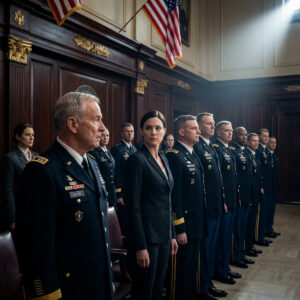
The air inside Red Rock Command Hall was pressurized by the weight of a thousand brass buttons and the suffocating scent of floor wax and starch. It was a room where history was usually written in loud, echoing proclamations and the rhythmic clinking of medals. But that morning, the most powerful force in the room was a silence so absolute it felt like a physical presence, heavy and cold, pressing against the sternums of the most decorated men in the country.
I was sitting in row three, seat 4. To any observer, I was just a woman in a plain fabric suit, a blurred face in a sea of focused intensity. My name, Rachel Caldwell, wasn’t on the program. I wasn’t expected. I was a ghost by trade and a rumor by reputation. For thirty-six years, I had perfected the art of existing in the negative space of other people’s lives—especially the life of the man seated three rows in front of me in the VIP section: Colonel Henry Caldwell, retired. My father.
He didn’t know I was there. He wouldn’t have known me if I had tapped him on the shoulder. To him, I was the “useless” daughter who had failed to fit into his rigid, military architecture. He didn’t know that while he spent decades polishing his medals, I had been busy becoming the most dangerous set of ears in the Defense Intelligence Directorate. I was the Ghost Walker, a code that appeared in two countries at once, a set of footprints in the digital snow that no one could trace.
Until the podium microphone popped—a sound like a clean break in bone—and a voice as cold as a Syrian winter cut through the room:
“We need Ghost Walker in the room.”
I grew up in a house where silence was never peace; it was a tactical weapon. My mother died when I was ten—lupus, they said—but the real cause felt like a gradual evaporation. I remember the smell of her medications, a cloying, medicinal scent that fought with the dust of the old Milwaukee house. I remember the way her voice started to lose its edges, becoming a rasping whisper before it vanished entirely.
After her funeral, the house lost its softness. My father, a man who viewed emotion as a breach in security, filled the void with military order. Boots were to be aligned at the door with surgical precision. Meals were scheduled to the minute, eaten in a silence that felt like a trial. He didn’t hit me; he simply deleted me with his eyes whenever I disappointed him. If I wasn’t “useful” in the way a soldier was useful, I ceased to exist.
I used to wait for him in the shadows of the hallway, clutching books like they were shields. I’d practice French idioms or Italian weather reports I’d picked up from a broken shortwave radio I found near the fire station. Once, I worked up the courage to show him an essay I’d written on semantic code-switching in conflict zones. He didn’t even look at the second page.
“Does it include anything on field maneuvers?” he asked, his voice flat and disinterested.
When I said no, he set the paper back down next to the grocery list as if it were junk mail. By the time I was eleven, I stopped trying to speak his language. I started building my own. I taped verb charts to the back of my closet door and learned Russian from a janitor who had once fought in the Red Army. In that house, I learned the most important lesson of my life: silence is a structure. It is calculated. And if you learn how to navigate it, you can hear the things everyone else is trying to hide.
The acceptance letter arrived on a Tuesday, tucked inside a plain government-issued envelope. It was a full scholarship to the Department of Defense linguistics program, with an ROTC commitment attached. It was my exit strategy, a lifeline I had carved out of secondhand dictionaries and radio static.
That night, I placed the letter on the hallway table where my father dropped his keys. I stood in the kitchen, heart thudding against my ribs, imagining a moment of human recognition. Maybe he would finally see that I had built something out of the “useless” curiosity he loathed.
He walked in at 8:20 p.m., mud on his boots, the smell of the motor pool clinging to his uniform. He picked up the envelope, scanned it for maybe five seconds, and then folded it in half with a sharp, casual flick of his wrist.
“Guess you’ll be up to ten languages by the time they’re done with you,” he muttered, reaching for a glass of orange juice.
No “congratulations.” No flicker of pride. Just a dismissal. I stood there, shoes still wet from the rain, realizing that he would never ask what it cost me to get that letter. I chose a school six states away. I didn’t want his approval anymore; I wanted to be so precise, so accurate, that eventually, he wouldn’t be able to look away.
When I joined the Defense Intelligence Directorate, they didn’t give me a badge; they gave me a clearance I wore like a second skin. My official title was Strategic Linguistic Support Specialist, but in reality, I was a ghost. I spent my twenties in shipping containers in Croatia and black-site communication cells in Georgia.
I learned that fear has a rhythm. I could listen to an intercepted radio exchange between black-market negotiators and tell you who was lying based on the placement of their breaths. In Syria, I caught a verb shift in a hostage negotiation that revealed the captors were lying about the location of the prisoners. We pulled the team out just in time. My notes saved lives, but my name never appeared on the mission briefs. I was “the language girl,” the quiet one with the notebook.
I didn’t mind. Accuracy was my currency. Precision was my armor. I was sharpening my silence, turning it into a force that could dismantle an empire, and I didn’t even realize that the first empire I would dismantle was my father’s.
The turning point happened in a disputed corridor near Hamara, Syria. I was embedded with a cultural liaison team when a voice came through our secure channel—low, accented, and utterly wrong.
It said my name. Not “Ghost Walker.” Rachel.
The sound of my legal name in a war zone where it shouldn’t exist felt like a physical blow. Thirty minutes later, our checkpoint went dark. A shot from a ridgeline took a strip of skin off my teammate Keller’s arm. We were airlifted out under blackout conditions, suspicion hanging heavy in the hold of the plane.
Back at base, I was treated like a leper. Containment. Questioning. They thought I had leaked. But as I sat in exile in a holding post in Germany, I began to pull at the threads of that encrypted transmission. The encryption lattice used in the breach was a legacy model from a project called Horizon Echo.
I dug through the authorization chains, deep into the technical policy approvals buried years ago. And there it was. A name that made my breath leave me in pieces: Caldwell, Henry. Clearance level C4.
My father had signed the implementation log for the exact encryption mirror used to expose me. The signature was dated January 12th, signed at 2:13 a.m. from a terminal registered to a consultancy suite leased by retired officers he had served with in Kandahar. It wasn’t just a vulnerability; it was a back door.
I remembered him telling me when I was a child: “A man’s name is his oath.” I stared at his oath on my screen and realized he had sold mine for a retirement favor.
I didn’t go to the authorities right away. I knew how the chain of command swallowed inconvenient truths. Instead, I built a report under a dormant identity, a clinical, eight-page autopsy of the breach, and routed it to OCU3—the Oversight Compliance Unit. They don’t make arrests; they orchestrate reckonings.
Which led me to row three, seat four, at Red Rock Command Hall.
The ceremony was a sham, a closed-door event officially honoring contributors to national encryption protocols. My father stood when his name was called, his chest out, his posture perfect, basking in the kind of pride that thinks it has nothing left to hide.
Then General Anders stepped to the podium. He didn’t look at his notes. He looked at the room like a judge measuring a sentence. “This next recognition is not ceremonial,” he said, the air in the hall turning brittle. “It is corrective.”
My father shifted forward, his hand curling around the edge of his program.
“We need Ghost Walker in the room.”
I stood up. The sound of my chair scraping against the floor was the only noise in the hall. As I stepped into the aisle, the entire row of senior officers—men my father had spent his life trying to impress—stood up. It was a reflex, a protocol for an operative of my standing that they had never seen but always feared.
My father turned slowly. He looked at me, and I saw recognition bloom in his eyes—too late for pride, too stunned for denial. He rose, stiff and silent, because everyone else already had. I walked past him without a word. I didn’t need to yell. I didn’t need to cry. The silence he had weaponized against me for thirty-six years had finally turned on him. In that room, my silence was his judgment.
The aftermath was a quiet shuttering of a legacy. Three days later, my secure inbox pinged with a one-line message: If I sign a confession, will you go public?
I wrote back: No, but I’m not the child afraid of the light anymore.
He appeared before an internal ethics tribunal that week. He didn’t spin the story. He admitted he had fast-tracked a contractor he didn’t vet as a favor. He asked for only one thing: to keep my name off the record. It was the closest he ever came to an apology.
A week later, a package arrived at my door. Inside was his West Point pin, the one I had reached for as an eight-year-old only to be told, “This is for soldiers, not spectators.” Now, it sat in my palm.
I realized then that true strength isn’t found in a foxhole or a field maneuver. It’s found in the courage to be seen clearly by the people who tried to make you invisible. My father finally stood for me, not because he understood my work, but because I had survived the storm he helped create and I hadn’t flinched.
In every life, there is a language we speak to survive and a language we speak to be free. Have you ever had to build your own “backbone” in the face of someone who refused to see your value? Have you ever had a moment where your silence became your greatest strength? Share your journey in the comments. Let’s talk about the power of being seen.
Disclaimer : This content may be created by AI for entertainment purposes. Any resemblance to real persons, events, or places is coincidental.






