The Star-Reader’s Revenge: How a Floating Ghost Reassembled a 30-Year-Old Betrayal
The Pacific does not forgive. It is a vast, rhythmic machine of salt and indifference that existed long before the first sailor dared to cross it and will continue to pulse long after the last ship has rusted into silt. To the ocean, a human life is merely foam—a temporary warmth destined to be consumed.
But at 0312 hours, 40 nautical miles off the coast of San Diego, the USS Resolute encountered something that refused to be consumed. The radio operator hadn’t expected a person; the thermal scanner usually picked up the bloated remains of pleasure boats or the cold steel of lost shipping containers. What they found instead was a young woman, lying flat on a section of hull plating, her hair a salt-dried halo of brine, her eyes wide open and moving with a terrifying, rhythmic precision. She wasn’t praying, and she wasn’t screaming. She was reading the stars.
Petty Officer Second Class Colt Briggs was the first to hit the water. He was a man who prided himself on never being surprised, but when he reached the makeshift raft and told the woman she was going to be okay, she didn’t weep with relief. She didn’t even flinch. Instead, her voice—scraped raw by three days of thirst—carried a chillingly composed question: “Which direction is north?”
When Briggs pointed, she didn’t just look; she calculated. Her eyes darted, reconciling her mental map against the fixed points of the horizon like a cartographer correcting a masterpiece. “Okay,” she finally whispered, “I’m ready.” It wasn’t the voice of a survivor; it was the voice of someone waiting for a scheduled extraction, mildly annoyed by a three-day delay.
Back on the deck of the Resolute, Commander Reed Stroud waited. Stroud was a man carved from granite, a veteran of SEAL Team 8 who had seen every flavor of human trauma. He looked at the tiny woman—barely 120 pounds and salt-stained beyond recovery—and reserved his judgment. He watched as the team medic, Daly, checked her vitals. She permitted the examination with the cold patience of a scientist allowing a child to play with a microscope. Her name was Tessa Kane. Rank: HM2, Navy Corpsman.
But Stroud knew something was wrong. A survivor of 72 hours at sea should be in shock. Tessa Kane was assessing his rank. She was reading the deck. And then, she spoke.
“The man in the third position from the left,” she said, her eyes fixed on Derek Marsh, one of Stroud’s best operators. “He has passed heat exhaustion. He is moving into heat stroke.”
Silence fell over the deck. Marsh insisted he was fine, but Tessa’s gaze was flat, clinical, and undeniable. “Your body has stopped trying to cool itself,” she said. When Daly checked, she was right. Marsh’s core temperature was 104.1 degrees. He was ninety minutes from neurological collapse. Stroud felt the categories in his mind shift. He hadn’t just rescued a victim; he had brought a ghost aboard who knew his own team better than they did.
In the medical bay, the air smelled of antiseptic and salt. Tessa sat on the examination table, watching Daly run an IV line. When he reached for a cooling pack for Marsh, she didn’t hesitate. “Occipital region first, then axillary,” she directed. “You get better core temperature reduction that way.”
It was a small instruction, but it carried the weight of a different kind of training. When Stroud’s Chief, Everett Wade, entered the room, the air became heavy. Wade was 47, a man of profound silences. He looked at Tessa, and for a micro-moment, the mask of a Chief Petty Officer slipped.
“You’re alive,” Wade said. “I’m alive,” she agreed.
Wade left without another word, but the exchange was a key fitting into a lock. Tessa looked at the door and whispered to the room, “My father knew him.”
The mystery deepened an hour later when Colt Briggs walked into the bay to find Tessa standing at a supply cabinet. The armorer had left a disassembled Glock 17 on the counter. Tessa had her back to him. Her hands were moving with a flat, absent efficiency that bordered on the hypnotic. She wasn’t exploring the weapon; she was verifying it. Briggs timed her reassembly. A trained operator takes 15 to 25 seconds. Tessa was done in nine.
“The extractor spring has corrosion starting,” she said, not even turning around. “Left unaddressed, it will cause ejection problems.”
Briggs took the weapon, his heart thudding against his ribs. “Who are you?” he asked, the professional doubt in his voice finally breaking. “A corpsman,” she said. It was a fact that was completely true and completely incomplete.
The truth arrived in two parts via a restricted intelligence flag on Tessa’s file. The first part was her service record—unremarkable. The second part was a wall of encryption that required a DIA notification protocol. The contact name: Director Alan Vickers.
Stroud knew the name. Vickers was a shadow in the intelligence community, a man who lived where information became a death sentence. Stroud sought out Chief Wade on the deck.
“You knew her father,” Stroud said. “Frank Kane,” Wade replied, staring at the gray Pacific. “Rear Admiral, SEAL Team 6. Reported dead in 2012. Classified operation.”
Wade’s voice was hollow. He told Stroud about the training. Frank Kane had started training Tessa when she was nine years old. It wasn’t just physical; it was the cognitive architecture of survival. He had taught her how to read a room, how to find a signal in the noise, and how to hold both a tourniquet and a rifle with equal steadiness. When Frank “died,” Tessa had made a promise to her mother to put that part of herself away. She became a corpsman. But the “other part” hadn’t disappeared. It had been waiting.
“Whatever she was doing on that vessel,” Wade said, “has something to do with why her father is not.”
The vessel Tessa had jumped from was the Aldebaran, a ghost ship with scrubbed registration. She had been aboard for six days, posing as a marine biologist, but she was actually there to find a name. A code name: Cardinal.
Thirty years ago, on October 3, 1993, while the world was focused on the tragedy in Mogadishu, an 11-man SEAL unit was running a parallel mission in the Horn of Africa. Their coordinates had been deliberately corrupted. They were walked into an ambush. Eight men died in seven minutes. The person who gave the order, the person who had managed a discretionary fund that grew fat off the blood of those sailors, was Cardinal.
Tessa had spend fourteen years building the picture. Account numbers in Liechtenstein, shell companies in Delaware, and the signature on the original elimination order for her father in 2012. Her father hadn’t died; he had faked his death to buy her time.
“The survivors of the ’93 operation are still alive,” Tessa told Stroud in the operations room, her voice a steady, rhythmic pulse. “My father located them. They are waiting for the signal. Me. Alive and in a protected position.”
The window for justice was measured in minutes. The DIA notification protocol meant that Alan Vickers—Cardinal himself—already knew Tessa had surfaced.
The Aldebaran was closing in, running dark 11 miles out. They weren’t coming to rescue her; they were coming to neutralize the information she carried in her mind.
Stroud looked at his team. They were operators, but they were also sailors who believed in the debt of the fallen. “Northeast seawall,” Wade said, pointing to a map. “40 feet of elevation.”
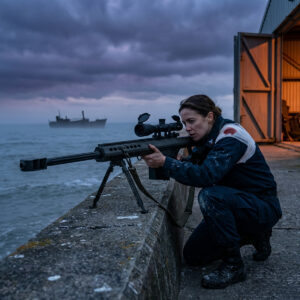
Tessa picked up the Barrett M82A1 case. Her left shoulder was injured from a fragment of concrete, but she didn’t make a performance of the pain. She set up on the seawall, her cheek against the stock, her breathing slow and deliberate. The Aldebaran came into focus at 10 power.
The first shot was a data point. It struck the rock high and left. “Wind is stronger than the 12-knot estimate,” she muttered, her fingers making a surgical adjustment to the scope.
She found the bottom of her exhale. She squeezed. At 1,160 meters, the forward position on the Aldebaran went dark. The vessel immediately changed course. They knew the ghost was no longer alone.
Inside the operations room, the tension shifted from combat to high-stakes chess. Tessa needed a secure line that Vickers couldn’t intercept. Master Chief Harmon, a retired legend who had been tracking Tessa’s thermal signature since dawn, provided his personal encrypted channel—the one he used for running assets in the dark.
Tessa spoke for 11 minutes. She gave a military attorney in Washington everything: account numbers, witness locations, and the documentation Frank Kane had spent fourteen years compiling. “It is done,” she said, setting the handset down.
The door opened. Alan Vickers walked in.
He was 66, silver-haired, and possessed of the unhurried ease of a man who believed he owned the room. He looked at Tessa with a warmth that was precisely calibrated. “Ms. Kane,” he said, “procedural interest only. Procedural interest.”
Tessa didn’t move. She looked at him with the same clarity she had used to range the Aldebaran.
“October 3rd, 1993,” she said. Vickers paused. A half-second. The tell. “Operation Designation: Cardinal,” she continued. “Eight operators dead. Account number 7741, Cayman National Bank. Beneficial owner: Alan David Vickers.”
Vickers’ expression shifted. The mask of the elder statesman didn’t break; it simply fell away, revealing a cold operational assessment. He looked at her as if deciding if she was a liability or a loss.
“The document archive my father compiled,” Tessa said, “was transmitted to the Senate Oversight Channel eighteen minutes ago. Under a whistleblower protection order. You won’t be leaving this base, Mr. Vickers. Not the way you planned.”
Stroud stepped forward, his massive frame a wall between the girl and the monster. “Mr. Vickers, I’d like you to wait in the outer room while I confirm the transmission receipt.”
It wasn’t a request.
Six months later, at the Naval Medical Center in San Diego, the air was warm and smelled of the nearby eucalyptus trees. Tessa Kane stood at a lectern before eighteen young medics and corpsmen. She looked healthy, the shadows under her eyes gone, the scar on her left shoulder fading to a proud white line.
The board behind her read: DRAG THEM OUT ALIVE.
“What you are going to learn in this program,” she told them, her voice clear and resonant, “is not a set of skills. It is judgment. You will be in situations where someone is bleeding out in front of you, and there is a threat behind you that will kill you both. You have three seconds to decide.”
She paused, her hands resting flat on the wood. “This program exists because someone decided a long time ago that the answer was not to choose. The answer is to be capable of both things without hesitation.”
A young corpsman raised his hand. “Ma’am, has there ever been a time when you had to do both?”
Tessa looked out the window at the silver Pacific. Beneath her notes sat an envelope with no return address, containing nine words: Well done, Tessa. The work continues. I’m proud of you.
“Yes,” she said.
She didn’t tell them the story. She didn’t need to. The story was written in the way she moved—with the steadiness of someone who had spent 14 years learning that both hands belong to the same person. One to heal, one to protect. The Pacific hadn’t forgiven her, but she had conquered its indifference.
The work continues.
Reflection: The story of Tessa Kane is a haunting reminder that we are more than the labels the world gives us. We are often taught that we must be one thing—a healer or a warrior, a student or a teacher. But true strength lies in the refusal to be limited. Tessa carried a burden for 14 years, using her “healing” hands to hide the “protecting” hands her father had trained.
In your own life, have you ever felt forced to hide a part of who you are? Have you ever discovered that your greatest “burden” was actually your greatest strength?
Share your thoughts and stories below. Let’s talk about the power of being whole.
Disclaimer : This content may be created by AI for entertainment purposes. Any resemblance to real persons, events, or places is coincidental.






