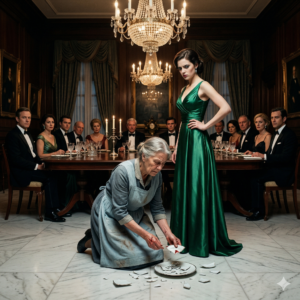
THE BLOOD ON THE ITALIAN MARBLE
ACT I: THE GRAVEYARD OF WHITE BOUGAINVILLEA
I have observed the rise and collapse of modern dynasties, and I can tell you that the rot never begins at the foundation; it begins at the roof, where the air is thin and the inhabitants forget the smell of the earth. To understand the catastrophic implosion of the Garza family, you must first stand where Doña Elena stood on that humid Tuesday morning. She stepped out of a yellow city taxi and planted her worn leather shoes on the pristine, sun-baked pavement of San Pedro Garza García. Before her rose the towering wrought-iron gates of her son’s estate. The walls were blindingly white, crawling with imported bougainvillea that looked less like flowers and more like bloodstains against the stucco. This was not a home. It was a fortress built to intimidate the poor and impress the hollow.
Elena swallowed, a knot of absolute dread pulling tight against her windpipe. Crossing the threshold of those heavy iron gates meant executing her own identity. She was Doña Elena. She was the matriarch who had forged an empire out of nothing but boiling water, corn masa, and relentless, agonizing grit. I know the scent of her history: the heavy, comforting steam of tamales sold from a street cart at four in the morning, the metallic smell of copper coins counted with cracked fingers, the dusty atmosphere of a neighborhood where power was measured in survival, not stock options. She had sacrificed her youth, her joints, and her dreams to mold her son, Mauricio, into a titan. And now, she had to erase it all.
I am burying myself today, Elena’s internal monologue was a frantic, whispered prayer against the deafening silence of the affluent street. The second I press that buzzer, the mother dies. The grandmother dies. I become a ghost in my own bloodline. I become Margarita. A woman with no past, no voice, no right to love the children sleeping inside. I built my son a kingdom, and he has locked my flesh and blood inside a tower. I must become nothing, so that I can see everything.
She adjusted the plain, coarse blue apron over her silver hair. The fabric scratched against her neck, a physical reminder of her demotion. She reached into her pocket, her fingers finding the smooth, worn beads of her late husband’s wooden rosary. It was the only piece of truth she was allowed to carry into the lie. She pressed the brass intercom button. The sound echoed through the sprawling property like a stone dropped into a bottomless, empty well. Two agonizing minutes passed. The heavy, stagnant air of wealth pressed down on her shoulders. She was standing at the gates of hell, and it was paved in limestone.
A mother’s love is not a comfort; it is a violent, unforgiving religion.
ACT II: THE ANATOMY OF A SILENT MAUSOLEUM
The massive oak doors did not open with a welcoming creak; they swung inward with a heavy, mechanized hum, revealing the cold, cavernous throat of the mansion. Valeria stood in the doorway. She was Mauricio’s wife, a woman constructed entirely of sharp angles and expensive fabrics. She wore a slip dress of emerald silk that draped over her collarbones—a garment that cost more than the total sum Elena had earned in her first five years on the street.
There was no smile. There was no polite, patronizing greeting. Valeria crossed her arms, her eyes scanning Elena with the sweeping, clinical detachment of an auctioneer inspecting a piece of damaged, waterlogged furniture.
Look at this creature, Elena thought, keeping her eyes fixed firmly on the tips of Valeria’s designer heels. She is made of ice and credit cards. She sleeps in the bed I paid for with my broken fingernails, and she looks at me like I am an infection. My son is a fool. He looked for a queen and married a guillotine.
“So you’re the new one,” Valeria stated. Her voice was devoid of moisture, a dry, abrasive sound.
Elena lowered her eyes, a practiced submission that tasted like battery acid in the back of her throat. “Yes, ma’am. My name is Margarita.”
Valeria turned on her heel without another syllable, stepping into the cavernous foyer. The sharp, aggressive click of her stilettos against the imported Italian marble echoed through the house like a rhythmic warning. Elena followed, pulling her worn suitcase over the threshold.
The interior of the mansion was a magazine spread rendered in terrifying three-dimensional space. It was immaculate. It was breathtakingly expensive. But the atmospheric pressure was entirely wrong. It lacked the chaotic, beautiful friction of human life. There was no laughter embedded in the walls. There were no brightly colored plastic toys scattered recklessly across the rugs. Seven-year-old Sofía and five-year-old Leo lived here, yet the house bore no evidence of their existence. It did not feel like a sanctuary. It smelled faintly of ozone and expensive lilies, feeling exactly like the waiting room of a high-end private hospital where people go to hear terminal news.
“We work from six in the morning until ten at night,” Valeria dictated flatly, not bothering to look back as she led Elena down a narrow, windowless corridor to the service quarters. “You do not give opinions. You do not talk to the children more than necessary. You are a shadow.”
She pushed open a door to a cramped, narrow room that smelled violently of industrial bleach and stale, trapped air. Elena nodded, gripping the plastic handle of her suitcase until her knuckles turned a stark, bruised white.
That very afternoon, as Elena unpacked her meager belongings, the house offered its first confession. Taped to the plaster wall beside the narrow cot was a photograph. It had been torn violently down the middle, the edges jagged and raw. It depicted Sofía and Leo, their faces bright and unguarded, hugging a smiling woman in a housekeeper’s apron. Their former nanny. The woman whose name the children had abruptly, fearfully stopped mentioning on their Sunday phone calls months ago. The torn paper was a tombstone.
You can buy the world, but you cannot purchase a heartbeat.
ACT III: THE BRUISE BENEATH THE VELVET
The sun had not yet breached the horizon when Elena stood in the cavernous, stainless-steel kitchen. The ambient temperature of the room was freezing, the massive refrigerators humming like sleeping beasts. She began to cook. It was a tactical strike of love. She chopped tomatoes and onions, the sharp, acidic smell cutting through the sterile air. She scrambled eggs and warmed flour tortillas directly on the gas burner, just the way her grandchildren liked them. The smell of toasted corn and melting butter was an insurgency of warmth in a house of ice.
Sofía materialized in the doorway first. She was seven years old, but she moved with the heavy, calculated steps of an exhausted soldier. Her tiny shoulders were pulled inward, her chin tucked to her chest. It was the posture of a child perpetually bracing for an impact. Leo followed silently behind his sister. He was only five, yet his dark eyes held a blank, thousand-yard stare. He had already learned the tragic, survivalist mathematics of an abusive household: silence is always safer than sound.
“Mom eats upstairs,” Sofía whispered. The casual, deadened tone in which she delivered the statement sent a physical shockwave of grief through Elena’s chest.
Where are you, Mauricio? Elena’s internal monologue screamed, a ferocious, maternal rage waking up and stretching its claws inside her ribs. You sit in boardrooms in New York, commanding thousands of men, moving millions of dollars across oceans, and you cannot see that your own blood is dying of thirst in your own home. Have you become so blinded by the gold that you cannot see the rot? I raised a conqueror, but I forgot to raise a father.
Elena poured a glass of cold milk and reached across the marble island to hand it to the little girl. As Sofía reached up to take the glass, the oversized sleeve of her pajama top slipped down her thin arm.
The air left Elena’s lungs.
There, on the pale, tender skin of the inner bicep, was a dark, horrific bruise. It was mottled with deep purples and sickening yellows. It was not the kind of mark a child earns from a reckless tumble on a playground. The geometry of the violence was too specific. It was the distinct, unmistakable imprint of adult fingers, pressed hard enough to crush capillaries.
Elena felt a cold, jagged block of ice drop directly into her stomach.
Leo still had not spoken a single syllable. He sat at the counter, his legs dangling, and slowly slid a crumpled, lined piece of notebook paper across the smooth stone surface toward his undercover grandmother. It was a drawing done in heavy, frantic strokes of red crayon. It depicted a woman with her mouth wide open in a monstrous, jagged scream. Her arms were extended, ending in giant, sharp hands stretched out like predatory claws.
Elena stared at the terrifying artifact for several agonizing seconds, the silence of the kitchen ringing in her ears. With hands that shook uncontrollably, she folded the drawing and tucked it deep into her pocket, pressing it against the wooden rosary.
Monsters do not hide in the dark; they sit at the breakfast table.
ACT IV: THE ARCHITECTURE OF COMPLICITY
The days leading up to Friday were a masterclass in psychological torture. I watched Elena navigate the sprawling corridors like a spy behind enemy lines, absorbing the crushing weight of the family’s secrets. Mauricio was a phantom, trapped in the glass-and-steel canyons of New York, completely oblivious to the terror reigning in his absence. Valeria ruled the mansion with absolute, sociopathic control. The cruelty was not always physical; it was atmospheric. It was the way she looked right through the children, the way she weaponized her silence, the way she made them feel like trespassing refugees in their own home.
I must be patient, Elena counseled herself, scrubbing the baseboards of the grand hallway until her knees throbbed. If I reveal myself now, she will spin a web of lies. She will call the police. She will have me thrown out, and the iron gates will close forever. I must gather the evidence. I must witness the absolute depth of the darkness so that when I finally bring the hammer down, there is nothing left of her to salvage. I am carrying the weight of my son’s ignorance, and it is heavier than the stones of this house.
By Friday morning, the mansion was buzzing with a frantic, aggressive energy. Valeria was hosting a formal dinner party for twelve of San Pedro’s most elite aristocrats. The preparations were a logistical nightmare of excess. Exotic floral arrangements were delivered. Crates of vintage French champagne were unpacked. The air grew thick with the cloying, expensive scent of designer perfumes and roasting truffles.
Elena moved invisibly through the chaos, a ghost in a blue apron. As the sun set and the guests began to arrive, she stood in the shadows of the dining room. The table was a battlefield of silver and crystal. The conversations drifting through the air were sickeningly shallow—debates about wintering in Paris, the nuisance of luxury resort taxes, and the performance of offshore stock portfolios.
Meanwhile, separated by two floors and an ocean of neglect, Sofía and Leo were locked inside their darkened bedroom, eating cold leftovers from plastic containers.
Look at them, Elena’s mind burned with a quiet, lethal fury as she poured water into crystal goblets. Look at these lords and ladies of Monterrey. They drape themselves in diamonds and speak of art, yet they cannot sense the misery bleeding through the floorboards beneath their expensive shoes. They are complicit by their very existence. They worship at the altar of wealth, and Valeria is their high priestess.
The pressure in the house was building to a catastrophic crescendo. The air tasted of ozone and impending violence. Elena’s body, battered by seventy years of hard labor and five days of relentless emotional terror, was reaching its breaking point.
Silence is the most expensive currency in the world, and everyone here is bankrupt.
ACT V: THE SHATTERED CRYSTAL SACRAMENT
The execution arrived with the dessert course.
The dining room was a theater of gluttony and performative laughter. Elena, carrying a heavy silver tray laden with delicate, spun-sugar confections, felt the exhaustion finally betray her muscles. The arch of her worn shoe caught the thick, raised edge of a million-peso Persian rug. Time dilated. The world moved in a vicious, agonizing slow motion.
The tray dipped. A crystal glass tipped past the point of no return.
It fell.
The shattering of the crystal against the Italian marble was louder than a gunshot. It cut through the ambient hum of the dinner party like a guillotine blade. The string quartet music pouring from the hidden speakers seemed to choke and die. The entire room went graveyard silent. Twelve heads snapped toward the old woman in the blue apron.
Valeria rose from her velvet-upholstered chair. Her movements were unnervingly slow, deliberate, and theatrical. Her face was completely devoid of anger. It was a mask of placid, absolute control. It was the terrifying calm that a predator exhibits when it knows the prey has absolutely nowhere to run.
She has been waiting for this, Elena realized, her heart stalling in her chest as the matriarch of the house approached. She doesn’t just want a clean floor. She wants a sacrifice. She wants to demonstrate her power to her peers. I am not a person to her; I am a prop in her twisted play.
“You useless woman,” Valeria hissed. The whisper carried across the dead silence of the room, vibrating with venom.
Then, without a fraction of a second’s warning, Valeria grabbed a clean, porcelain dessert plate off the table. She raised it and smashed it directly at Elena’s feet with explosive, violent force.
Ceramic shrapnel exploded across the polished marble. One sharp, jagged shard flew upward, slicing deeply across the meaty part of Elena’s palm. The pain was sharp and bright. A thick, brilliant line of crimson blood welled up and ran down her lifeline, dripping onto the pristine floor.
“Pick it up,” Valeria commanded, her voice dropping to a low, guttural register.
Elena stood frozen, staring at her own blood.
Valeria’s eyes hardened into chips of obsidian. “With your hands. On your knees.”
I watched the twelve guests. The titans of industry. The philanthropists. The socialites. Not a single one of them moved. Not a single one of them spoke. They sat in their tailored suits and silk gowns, swirling their wine, and watched a wealthy woman force a bleeding, elderly housekeeper to her knees.
The humiliation was a physical fire burning down Elena’s throat. She slowly, agonizingly lowered herself to the floor. The broken glass and jagged ceramic bit through the cheap fabric of her skirt, digging into her old, arthritic knees. Her injured, bleeding hand trembled violently as she reached toward the glittering shards.
Power is not making a woman bleed; it is making twelve people watch and say nothing.
ACT VI: THE RECKONING AT THE GATE
The blood from Elena’s palm hit the white Italian marble with a wet, heavy finality. It was a sacrament of the poor spilled in the cathedral of the rich.
I will collect every piece of this glass, Elena’s internal voice was no longer a prayer; it was a promise of absolute annihilation. I will bleed on your floor, Valeria. I will let them watch. I will let the universe record this moment. Because the time for gathering evidence is over. You have shown your true face to the world, and I will make sure it is the last time you ever wear the crown in this family. Mauricio will see the blood on my hands, and he will know it is the same blood that runs in his children’s veins.
And in that exact fraction of a second—just as Elena’s bleeding fingers closed around the largest shard of porcelain—the acoustics of the mansion violently changed.
The heavy, reinforced oak front doors of the estate did not just open. They burst inward with a thunderous, explosive boom that shook the crystal chandeliers above the dining table. It sounded as though the gates of the compound had been breached by a battering ram.
The sudden vacuum of sound in the dining room was terrifying. Every head, previously frozen in complicit silence, whipped toward the grand foyer.
I watched the atmosphere in the room shift. The heavy, dusty air of unchecked power evaporated, replaced instantly by the cold, sharp oxygen of consequence. Whoever had just crossed the threshold, whoever had bypassed the security team and shattered the sanctity of the dinner party, was not an invited guest.
Elena, still on her knees, the blood pooling in her palm, looked up.
She turned her gaze to Valeria.
For the first time all week, the mask of the ice queen cracked. The arrogant, sociopathic calm that had defined Valeria’s existence completely shattered. Her face lost all its color, draining to the sickening, pale hue of old bone. The wine glass she held in her hand trembled, the red liquid sloshing dangerously close to the rim.
The era of silence was over. The era of the blue apron was dead.
The devil may wear silk, and the rich may build fortresses of marble, but the earth has a way of violently reclaiming its own. The matriarch was bleeding on the floor, but the reckoning had just walked through the front door.
The devil may wear silk, but God always comes knocking with a heavy hand.
Disclaimer : This content may be created by AI for entertainment purposes. Any resemblance to real persons, events, or places is coincidental.






