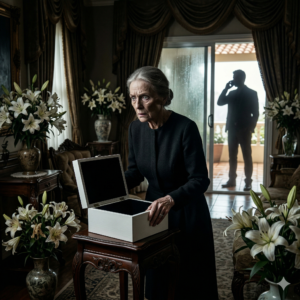
THE TOMB OF THE UNWANTED BLOODLINE
ACT I: THE ARCHITECTURE OF A WIDOW’S BLINDNESS
I have spent my entire life building a cathedral out of my own bones, only to discover I had constructed a slaughterhouse. To understand the monstrous end of my family line, you must first smell the earth from which it grew. It began with the sharp, metallic tang of twisted steel and the scent of rain on hot asphalt. I was thirty-eight when my husband died. They pulled him from the wreckage of a highway collision, leaving me with a mortgage, a suffocating silence, and a son named Timothy. In the weeks that followed, I learned the bitter taste of neat whiskey, poured alone in a dark kitchen, letting it burn the grief out of my throat so I could function by dawn. I did not have the luxury of collapse.
I will make him into a king, I told myself in those quiet, desperate hours, staring at my boy’s sleeping face. I will absorb every blow, every humiliation, every ounce of exhaustion this world has to offer, so that he will never know the taste of dirt. I worked until the cartilage in my knees ground together like crushed glass. I surrendered my youth, my romantic desires, and my very identity to the altar of motherhood. I was a mason, and Timothy was my monument. I wanted a legacy. I hungered for it with the kind of primal, feral desperation that blinds a person to the cracks in the foundation. I wanted the family name to survive, to rise above the dusty atmosphere of powerlessness that had defined my early years.
Timothy grew tall, handsome, and impeccably polished. He possessed the smooth, practiced charm of a man who knows how to wear expensive suits and manipulate boardrooms. When he brought Sarah home at the age of thirty-four, I believed the final stone had been laid. She was elegant, sharp-edged, and carried an icy perfection that I mistook for aristocratic grace. I did not see the predatory absolute zero in her eyes. I did not recognize that her smile was a calculation.
Look at what I have made, my internal monologue sang, a proud, foolish hymn. Look at this beautiful, successful man. The sacrifices were not in vain. The sleepless nights, the calloused hands, the hollow ache in my chest—it all bought this pristine, untouchable future. I have defeated death by ensuring life.
They lived exactly thirty minutes away in a sprawling, sterile house that smelled of expensive floor wax and cold ambition. It was close enough to project the image of a close-knit family, yet far enough to maintain a fortress of privacy. When they announced they were expecting their first child, I wept tears of profound, unadulterated joy. I thought the bloodline was secure, a bridge extending into eternity. I thought the ghosts of my past were finally asleep.
I did not know the devil was just putting on a suit.
ACT II: THE HEAVY SILENCE OF THE WRONG BLOOD
The turning point did not arrive with a scream, but with an absence of sound. We were gathered in their immaculate, sun-drenched living room for the gender reveal. The air was thick with the scent of catered canapés and the suffocating perfume of expectation. The doctor’s envelope lay on the granite island like a loaded pistol. When Timothy finally tore it open, I braced myself for the joyous eruption of laughter, for the tears, for the chaotic celebration of new life.
“It’s a girl,” Timothy said.
The words did not float; they dropped like lead weights onto the hardwood floor.
I waited for the smile. I waited for the warmth. Instead, a heavy, glacial silence descended upon the room. The temperature seemed to physically plummet. I looked at my son’s eyes—the eyes I had kissed a thousand times in the dark when he was afraid of monsters—and I saw a coldness so profound it made my breath hitch. It was the flat, dead stare of a CEO looking at a bad quarterly report.
What is this? my mind frantically whispered, the first hairline fracture appearing in my perfect monument. Why is the room so quiet? Why does Sarah look like she has just been handed a spoiled piece of fruit? It is a child. It is our blood. It is a miracle.
“I was hoping for a boy,” Timothy added, his voice devoid of any inflection.
Sarah simply nodded, her jaw tight, her hands resting defensively over her slightly swollen stomach. There was no maternal glow. There was only the bitter resentment of a failed transaction. They wanted an heir. They wanted a miniature king to inherit the dusty empire of their wealth and ego. A daughter was a miscalculation. A liability.
They will change, I lied to myself, engaging in the cowardly gymnastics of a mother who refuses to see the monster she raised. When they hold her. When they smell the sweet, milky scent of her skin. When she opens her eyes and looks at them, the ice will melt. They are just modern, pragmatic people. They just need time.
When Olivia was born, she was a masterpiece of fragile, pink perfection. She had soft, dark hair and eyes that held the innocent depth of the ocean. I held her in the sterile, bleach-scented hospital room, tears streaming down my face, whispering promises of unconditional love into her tiny ear.
But I was the only one weeping. Timothy stood by the window, checking emails on his phone. Sarah complained about the pain and requested the nurse take the baby to the nursery so she could sleep. There was no bonding. There was no joy. There was only the clinical detachment of people enduring an inconvenience.
The curse had been cast.
ACT III: THE STARVING GHOST IN THE UPSTAIRS HALL
The descent into hell is rarely a sudden drop; it is a slow, agonizing slide down a razor blade. As the months bled into years, the atmosphere inside their house grew increasingly toxic. It was the smell of old, sour milk hidden beneath layers of expensive lavender air freshener. It was the hollow, rhythmic sound of a baby crying in a distant room, unanswered, echoing like a ghost in a mansion.
“She’ll get used to it,” Sarah would snap, flipping the pages of a magazine while Olivia wailed upstairs.
“We are following modern parenting methods,” Timothy would recite, his voice a wall of patronizing arrogance. “Self-soothing builds independence. Stay out of it, Mother.”
I am a coward, my internal voice screamed, an endless, agonizing loop of guilt that tasted like bile in the back of my throat. I sit in their designer chairs, drinking their imported tea, while my own flesh and blood starves for affection thirty feet above my head. Why don’t I scream? Why don’t I take her and run? Because I am terrified of losing my son. I am terrified that if I push too hard, the iron gates of this house will close forever, and I will be left in the dark, severed from the only family I have left.
As Olivia grew into a toddler, the neglect morphed into a quiet, calculated cruelty. I noticed the clothes that were two sizes too small, digging into her fragile ribs. I felt the unnatural coldness of her hands when I smuggled her pieces of bread from the kitchen. She looked at me with massive, hollow eyes that understood far too much about the brutality of the world. She was a three-year-old ghost haunting the periphery of their perfect lives.
Then, shortly after Olivia’s third birthday, Sarah became pregnant again.
This time, the envelope revealed a boy.
The transformation was sickening. Suddenly, the house was filled with golden light, laughter, and the clinking of champagne glasses. Timothy’s eyes burned with a manic, victorious fire. Sarah glowed with the smug satisfaction of a queen who had finally produced the crown prince. And Olivia, desperate for scraps of the sudden warmth, clapped her tiny hands, smiling at a brother she did not yet understand would be her executioner.
This is it, I thought, a desperate, pathetic hope blooming in my chest. The boy will soften them. The boy will make them a real family, and the overflow of their love will finally reach Olivia.
I was wrong. The arrival of the male heir did not bring warmth; it brought a death sentence. Suddenly, Olivia began getting “sick.” Visits were abruptly canceled. My calls went to voicemail. When I finally forced my way into the house, I barely recognized the skeletal, fading child shivering in an oversized t-shirt.
“Shouldn’t she be in a hospital?” I begged, the smell of sickness and unwashed sheets burning my nose.
Timothy looked at me with the dead, shark-like eyes of a man who had already balanced the ledger. “We want her to spend her remaining time at home.”
The slaughter had begun.
ACT IV: THE THEATER OF MANUFACTURED ASHES
“Olivia passed away.”
The message arrived not with a phone call, but via a sterile, impersonal text message on a Tuesday afternoon. The words hung on the glowing screen, completely divorced from the monumental tragedy they represented. My entire world shattered into jagged, bleeding pieces. Three years old. Three years of coldness, hunger, and silent tears. That was the entirety of her existence.
The grief that consumed me was not just sorrow; it was a violent, suffocating blanket of absolute failure. I tasted ash. I felt the dusty atmosphere of my own complicity clogging my lungs. I drove to their house in a blind panic, my hands gripping the steering wheel until my knuckles turned white. I needed to see her. I needed to beg the lifeless shell of my granddaughter for forgiveness.
But when I arrived, Timothy blocked the doorway. He wore a dark, tailored suit, looking more like a man preparing for a hostile takeover than a father mourning a child.
“No,” he said, his voice a flatline of authority. “You cannot see her. Her body… isn’t in good condition. The disease was aggressive at the end.”
He is lying, a small, primal instinct whispered deep within my gut, scratching at the walls of my denial. Look at his posture. Look at the lack of moisture in his eyes. There is no grief here. There is only the tense, calculated energy of a man managing a crisis. But what crisis? A child is dead. The tragedy is absolute. What is there left to manage?
The next morning, I returned to the house early to help with the final arrangements. The atmosphere was surreal, a grotesque pantomime of mourning. The air was choked with the sickly-sweet, oppressive perfume of white lilies and burning incense—a desperate attempt to mask the rotting stench of their sins. There were no neighbors arriving with casseroles. There were no extended family members. There was no congregation from the church.
“We want this to stay private,” Timothy had commanded, dismissing the world with a wave of his hand.
The small white coffin sat in the center of the living room, resting on a polished wooden stand. It looked less like a resting place and more like a piece of high-end luggage waiting to be discarded. Sarah was nowhere to be seen, supposedly sedated upstairs, resting her body to protect the golden boy growing in her womb.
Timothy’s phone buzzed. He glanced at the screen, a flicker of annoyance crossing his face. “I have to take this. Do not touch anything.”
He stepped outside onto the patio, sliding the heavy glass door shut behind him.
I was alone.
Alone in the heavy, suffocating silence of a house that had consumed a child. Alone with the white box that held the ultimate proof of my failure as a mother and a protector. I walked toward it, the bitter taste of neat whiskey from decades past suddenly coating my tongue, a phantom memory of the day my husband died.
The bloodline was ending in a closed white box.
And then, the silence broke.
ACT V: THE WHISPER BENEATH THE LILIES
At first, I thought grief had finally fractured my sanity.
It was a sound so faint it could have been the rustle of the silk curtains or the settling of the hardwood floor. I stood frozen, my breath caught in my throat, staring at the brass clasps of the pristine white coffin.
“Help me…”
My blood turned to ice. The temperature in the room plunged. I looked frantically toward the window, praying to hear children playing in the street, or the drone of a television from the upper floor. Anything to explain the impossible sound.
“Grandma…”
The whisper was closer this time. Clearer. It vibrated through the dense, perfume-choked air. It was not coming from the street. It was not coming from upstairs.
It was coming from inside the coffin.
This cannot be real, my mind violently rejected the sensory input, desperate to maintain the laws of physics and death. The doctor pronounced her dead. The funeral directors prepared the body. Dead children do not speak. Dead children do not beg. You are a broken old woman losing her mind in a room full of dying flowers.
But the voice came a third time, weaker, laced with a familiar, terrified whimper that I had heard a hundred times when she was locked alone in her upstairs bedroom.
I took one step. My knees threatened to buckle. The silence of the house was now deafening, roaring in my ears like a jet engine. I reached the wooden stand. My hands were shaking with such violent tremors that I could barely grip the edge of the lid.
Panic and adrenaline eradicated whatever hesitation I had left. With a guttural sob, I threw the lid open.
What I saw stopped the rotation of the earth.
Olivia was inside.
She was alive.
Her tiny, emaciated body was swathed in a cheap white dress. But it was not the pale pallor of her skin that sent a shockwave of absolute horror through my spine. It was the metal. Her tiny wrists were bound tightly by thin, industrial steel chains, the ends bolted securely into the reinforced wood of the coffin’s interior. The metallic echo of the links shifting as she breathed sounded like the clanging of hell’s own bells.
She looked up at me, her massive dark eyes wide with a terror that no human being, let alone a three-year-old, should ever possess. But the moment she recognized my face, the sheer, crushing weight of relief washed over her so fast it broke my heart into a thousand irreparable pieces.
“Grandma…” she rasped, her lips cracked and dry.
I plunged my hands into the coffin, touching her face. The skin was warm. Living, pulsing, terrified warmth.
“They told me I had to stay quiet,” she whispered, a tear leaking from the corner of her eye, tracing a path through the dust on her cheek.
Reality imploded.
ACT VI: THE SLAUGHTER OF THE FAMILY MYTH
I stood over the open grave of my own living flesh, and in that singular, agonizing moment, the grandmother died, and an avenger was born.
A rage so pure, so violent, and so absolutely blinding tore through my chest that I felt physically dizzy. The puzzle pieces, soaked in blood and betrayal, violently snapped together. There was no aggressive disease. There was no tragic passing. There was only a wealthy, arrogant man and his cruel wife who had manufactured an illness, bribed a private physician, and staged a death because an unwanted daughter was an inconvenience to their perfect, male-dominated narrative. They were burying her alive. They were locking a breathing child in a box to rot in the earth, simply to clear the stage for the golden boy.
I built this, the internal monologue was no longer a hymn; it was a terrifying, apocalyptic drumbeat. I poured my blood, my sweat, and my absolute devotion into raising a son. I thought I was forging a king, but I forged a psychopath. I fed his entitlement until it devoured his humanity. I am the architect of this monster. And now, I must be his executioner.
I did not scream. I did not cry. The operatic intensity of the moment demanded an absolute, terrifying silence. I grabbed the heavy brass candelabra resting on the memorial table next to the coffin. The metal was cold and heavy in my hands.
Outside, on the patio, Timothy laughed into his phone. The sound was casual, relaxed, the arrogant chuckle of a man who believed he had successfully played God. He was finalizing a business deal while his daughter lay chained in a box three feet away.
I looked down at Olivia. I brushed the hair from her sweaty forehead. “I am here, my love,” I whispered, my voice sounding like grinding stones. “You do not have to be quiet anymore.”
I turned toward the glass doors. The dusty atmosphere of power that Timothy wielded over me evaporated into nothingness. The era of my silence, of my cowardly complicity, of my desperate clinging to the myth of a perfect family, experienced its final sunset. The bloodline was completely, irreparably infected, and I was holding the cure.
I stepped away from the coffin, raising the heavy brass candelabra, and waited in the shadows for my son to open the door.
The funeral was just beginning, but it wasn’t for her.
Disclaimer : This content may be created by AI for entertainment purposes. Any resemblance to real persons, events, or places is coincidental.






