THE EMPIRE OF DUST AND SILENCE
ACT I: THE ARCHITECTURE OF A STERILE TOMB
I have documented the ascent of warlords, the silent coups of boardrooms, and the violent birth of modern dynasties, but there is a specific, terrifying scent to a kingdom that is waiting for its king to die. It is not the smell of blood. It is the smell of industrial lemon wax, sterilized air, and the cold, breathless vacuum of unspent billions. The mansion in Jardines del Pedregal was not a home; it was a mausoleum constructed of dark mahogany and imported Italian marble. And at its center sat Alejandro Garza, a man who had once held the sun in his hands, now reduced to a monument of paralyzed rage.
To understand the silence of that house, you must understand the noise of the man’s past. Alejandro was not born into wealth. He was born into the blistering, unforgiving dirt of Jalisco. He built his tequila and real estate empire with a ruthlessness that made older, softer men weep. He knew the bitter taste of neat mezcal, the metallic echo of a warning gunshot in the agave fields, and the dusty, suffocating atmosphere of pure power. He had conquered the earth, only for his own nervous system to betray him. Now, for two years and three months, his universe was confined to a custom-built wheelchair by a massive window in his study.
I am a prisoner in a fortress I paid for in blood, Alejandro’s mind churned endlessly, a violent storm trapped inside a motionless vessel. I look out at these manicured gardens, the perfect, agonizing green of it all, and I feel nothing but bile. They look at me and see a decaying asset. A ledger entry waiting to be closed. My hands built the cities they sleep in, yet I cannot swat the fly that lands on my cheek. I have accumulated all the gold in the world, only to discover I cannot buy a single, functioning nerve.
Outside his heavy doors hung a laminated sheet of paper. It was a testament to his remaining, desperate grip on control: thirty-seven strict rules. Rule number 4: Do not speak unless spoken to. Rule number 12: Keep the curtains closed. Rule number 37, the most terrifying of all: Do not ask questions about his condition. He wielded these rules like a machete. He had fired twelve professional caregivers in less than two years. They crumbled under his silent, radiating hostility. One veteran nurse lasted merely forty-eight hours before dropping her badge on the pristine kitchen counter and fleeing into the Mexico City smog.
The house was not peaceful.
It was a loaded gun, waiting for someone to pull the trigger.
ACT II: THE ANATOMY OF DESPERATE CLOCKWORK
Poverty does not allow for the luxury of grief, nor does it tolerate the disruption of a schedule. For Carmen, survival was a violent, exact science. She entered the service entrance of the Garza estate at exactly 6:02 a.m. Every morning was a battle fought in the dark. The smell of exhaust fumes and damp concrete in Iztapalapa always clung to her coat, a sharp contrast to the filtered, lavender-scented oxygen of the Pedregal mansion.
Her internal clock was governed by sheer terror. If I miss the 5:15 bus, I lose the hour. If I lose the hour, I lose the shift. If I lose this job, we starve. Her internal monologue was a frantic tally of coins and calories. The rent is due in four days. The electricity is hanging by a thread. This man, this frozen billionaire, pays three times the going rate because nobody else can stand the frostbite of his presence. I can endure the cold. I can endure the silence. I can endure anything but the look of hunger in my daughter’s eyes.
Her alarm had screamed at 4:47 a.m. Fourteen minutes to dress in the pitch black of her single-room apartment. Six minutes to pack the faded, pink backpack. Twelve minutes to sprint over cracked sidewalks to catch the first bus. But the fragile architecture of the working poor is easily shattered. Her neighbor, an elderly woman who smelled of stale tortillas and cheap soap, had canceled. The third time in two weeks. Carmen had no safety net. She had no backup plan.
She brought Sofía with her.
Sofía was three years old, a tiny ghost in hand-me-down clothes, clutching a worn stuffed rabbit by one drooping ear. Carmen’s plan was built on a foundation of desperate hope. She would hide the child in the cavernous laundry room near the kitchen. Doña Rosa, the sixty-one-year-old cook who had served the Garza family for nineteen years, had nodded silently when Carmen arrived. Rosa’s eyes held the deep, unspoken solidarity of the invisible class. She would watch the girl.
But a sprawling mansion is an ocean to a child, and poorly closed doors are sirens calling to sailors. The smell of boiling masa and industrial detergent could not hold Sofía’s curiosity. While Carmen was scrubbing the baseboards of the west wing, her hands raw and smelling of bleach, the child slipped away.
In her tiny socks, the little girl wandered down the forbidden east hallway, her footsteps completely swallowed by the suffocating silence.
Fate was wearing pink socks.
ACT III: THE BREACH OF THE IRON GATES
The east hallway was a corridor of shadows, deliberately kept dim to match the decaying spirit of its master. The thick Persian runners absorbed sound, turning the mansion into a sensory deprivation chamber. Alejandro sat in his chair, his jaw locked tight, staring out the window. The gardens outside were a mocking display of life—vibrant, unbothered, and entirely out of his reach.
What is the point of memory when the body is a tomb? Alejandro thought, his dark eyes tracing the morning mist rolling off the manicured lawns. I remember the heat of the sun on my neck in the agave fields. I remember the weight of a gold watch, the sharp, authoritative crack of a gavel closing a billion-peso deal. Now, I am nothing but an obstacle. I can hear the vultures circling. I can smell their expensive cologne in the air vents. They are waiting for my heart to stop so they can feast on the carcass of my labor.
Then, the impossible happened. The heavy mahogany door—the door guarded by thirty-seven rules and a legacy of terror—creaked open.
Alejandro’s entire body went rigid. The intrusion was a violation of his most sacred law. Nobody enters without knocking. Nobody. He expected to see a terrified maid, a trembling nurse, or the slick, opportunistic grin of an executive.
Instead, he saw a child.
Sofía stopped directly in front of the wheelchair. She tilted her head, her huge, dark eyes reflecting the dim light of the study. She did not see a monster. She did not see a crippled titan of industry. She saw a man sitting alone in the dark. The air in the room, usually thick with fear and intimidation, shattered entirely.
She dragged her worn stuffed rabbit forward, standing so close Alejandro could smell the cheap baby shampoo in her hair—a scent so jarringly human, so devastatingly innocent, it felt like a physical blow.
Then, she asked the question that dismantled an empire.
“Are you sad?”
Alejandro trembled. It was not a medical spasm; it was the violent, seismic shock of a soul being perceived for the first time in years. His hands, always stiff, always dead, violently twitched. Sad? his mind screamed, the ice cracking. I am a king buried alive! I am a god reduced to a statue!
Before he could force his paralyzed throat to form a syllable, Sofía climbed onto the cold metal footrest of his wheelchair. She reached out, took his heavy, dead hand in both of her tiny, warm ones, and simply held it. No disgust. No pity.
The monster wept in the dark.
ACT IV: THE ROT OF UNEARNED INHERITANCE
There is a distinct difference between those who build an empire and those who inherit it. The builder smells of sweat, strategy, and survival. The inheritor smells of entitlement, impatience, and the rotting, sweet stench of unearned victory. Just as the child’s warmth seeped into Alejandro’s deadened nerves, the double doors of the study flew open with violent, explosive force.
Enter Mauricio.
He strode into the room wrapped in custom Italian tailoring, flanked by two lawyers in razor-sharp suits and two enormous bodyguards whose knuckles were white with tension. Mauricio was Alejandro’s nephew. He was a creature of boardrooms and country clubs, polished, ambitious, and fundamentally empty.
This ends today, Mauricio’s internal monologue was a frantic, greedy pulse. Six months. Six months of watching this decrepit old man refuse to die, refusing to let go of the reins. The company is stagnating. The board is restless. I am the future. He is a vegetable sitting in the dark, hoarding the sunlight. Today, the doctors sign the papers. Today, I declare him mentally incompetent. I will rip the crown off his frozen head and finally breathe.
Mauricio had spent his entire life in the shadow of his uncle’s terrifying greatness. He hated the old man with the specific, burning resentment of the inferior. He did not want to learn the business; he wanted to consume it. He wanted the status without the grit, the gold without the blood.
He stepped into the study, fully prepared to deliver the killing blow to his uncle’s autonomy. He had rehearsed the speech. He had the legal documents crisp and ready in a leather portfolio. But the scene before him short-circuited his perfectly manicured narrative.
He did not see a pathetic, broken man. He saw a filthy, unauthorized variable altering the pristine equation of his inheritance. He saw a child in cheap clothes, standing on the footrest of the billionaire’s chair, holding the king’s hand.
The sight of poverty touching his gold triggered a primal, aristocratic disgust.
The mask of the polished executive slipped, revealing the rabid dog beneath.
ACT V: THE COLLISION OF TWO WORLDS
“What is this TRASH doing in your office?” Mauricio roared.
The word echoed off the high ceilings, sharp and violent, severing the fragile peace the child had brought. Before anyone—the lawyers, the guards, or the paralyzed man—could process the command, Mauricio lunged. He crossed the Persian rug in three furious strides, his face twisted in a mask of ugly, aristocratic rage.
He grabbed Sofía by her thin, fragile arm and yanked her into the air.
The child screamed—a high, piercing sound of pure terror that tore through the sterile air of the mansion. The force of the pull ripped the worn stuffed rabbit from her grip. It sailed across the room, hitting the mahogany wall with a dull, pathetic thud.
No, Alejandro’s mind exploded. No. This piece of soft, cowardly filth. He dares to touch the only clean thing in this rotting house. The paralysis that held him prisoner suddenly felt less like a medical condition and more like a dam holding back an ocean of liquid fire. Deep within the deadened circuitry of his spine, a spark ignited.
Down the hallway, the scream hit Carmen like a physical bullet. She dropped her bucket. The mop clattered to the floor. She ran. She ran with the speed of a mother watching her world catch fire.
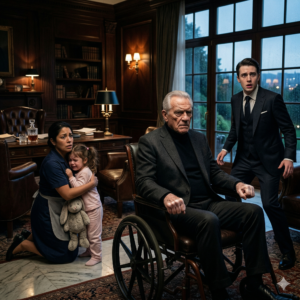
She breached the doorway just in time to see the suited man holding her weeping daughter in the air.
“My daughter! Let her go!” Carmen shrieked, launching herself forward, her apron soaked in cleaning fluid, her eyes feral.
Mauricio sneered. He dropped the little girl onto the rug and turned his wrath on the mother. He shoved Carmen. It was not a push; it was a violent, dismissive strike intended to break. Carmen crashed hard onto the unforgiving marble floor, her shoulder taking the brunt of the impact.
“Get these parasites out of here!” Mauricio bellowed, the veins in his neck bulging against his silk collar. He turned to his muscle. “Security! Throw this garbage into the street right now!”
His face was flushed with the intoxicating thrill of unchecked power. He looked down at the maid, groveling on his marble, crying for her child. The arrogance of his bloodline boiled over. He lifted his hand, balling his manicured fingers into a fist.
He was going to strike her.
The room held its breath.
ACT VI: THE RESURRECTION OF THE TITAN
Time stopped. The dust motes floating in the shafts of light froze. The metallic click of the bodyguard stepping forward hung suspended in the air.
I did not build this empire to hand it to a coward who strikes women and children, Alejandro thought, the fury in his blood turning into pure, unadulterated adrenaline. I survived the cartels. I survived the desert. I will not be buried by a boy who has never bled for a single peso in his life.
The twitch in Alejandro’s fingers escalated. The stiffness in his jaw cracked. The medical impossibility of the moment was eclipsed by the sheer, terrifying force of a patriarch’s absolute will. The silence of the mansion was finally broken.
“DO NOT… TOUCH HER.”
The voice was rough, choked with disuse, sounding like grinding stones and tearing metal. But the volume was devastating.
Mauricio froze, his hand still suspended in the air. He turned his head, his eyes widening in absolute, paralyzing horror. The lawyers stumbled backward. The bodyguards dropped their hands.
Alejandro Garza was sitting up.
His paralyzed hand, the same hand the little girl had warmed with her own, was gripping the armrest of his wheelchair so tightly his knuckles were white. The man who had not spoken a word in over two years, who had stared blankly at the garden waiting for death, was looking at his nephew with the eyes of a starving wolf.
There is my legacy, Alejandro realized, his gaze shifting briefly from the trembling, pathetic nephew to the bruised maid clutching her sobbing child on the floor. The blood in my veins means nothing if it is cowardly. True inheritance is not DNA; it is grit. It is survival. This woman, bleeding on my floor for her child, has more of my spirit in her fingernail than this suit-wearing parasite will ever possess.
Mauricio backed away, his face the color of wet ash. “Uncle… you… you can’t…”
“I… am… still… here,” Alejandro growled, the effort making his entire frame shake, but the authority in the room had violently, permanently shifted back to the throne. The era of silence was over, and the reckoning had arrived.
The king was not dead; he was just waiting for a reason to wake up.
Disclaimer : This content may be created by AI for entertainment purposes. Any resemblance to real persons, events, or places is coincidental.






