The Billionaire’s Son and the Teacher with Holes in Her Shoes: The Secret Behind the Crumbling Community Center
The November sun was setting behind the Philadelphia skyline, casting long, jagged shadows that looked like ink bleeding across the concrete. Richard Westfield, a man whose name was synonymous with steel and glass skyscrapers, gripped the hand-stitched leather steering wheel of his black Escalade. He wasn’t looking at the horizon. His eyes were fixed on his twelve-year-old son, Dylan.
Through the heavy tint of the window, Richard watched Dylan slip through a rusted metal door of a building that looked more like a tomb than a community center. This was the fourth day in a row. The fourth time Dylan had lied about soccer practice. At 5:15 p.m., Dylan should have been on a manicured field in Gladwyne, under the watchful eye of a high-paid coach. Instead, he was in the heart of South Philadelphia’s most forgotten neighborhood.
“What are you doing here, son?” Richard whispered to the empty, climate-controlled interior of his car.
The building was an eyesore of chipped paint and broken railings. Above the door, a hand-painted sign swayed in the biting wind: Lighthouse After School Program. All Welcome. Richard pulled out his phone and hit record, his jaw tight with a mixture of fear and suspicion. He thought he was documenting a betrayal. He had no idea that inside that basement, a woman with holes in her shoes was about to dismantle his definition of wealth and show him exactly what his son had been searching for in the dark.
For Janelle Harper, the day didn’t begin with a luxury SUV; it began with the scream of a 5:30 a.m. alarm. She slapped the plastic button silent and lay still, staring at the water-stained ceiling of her studio apartment. A new crack had appeared overnight, snaking across the plaster like a river on a map, a silent reminder that everything around her was slowly surrendering to gravity.
Janelle didn’t move for a full minute. She just breathed, her breath forming small, translucent puffs in the frigid November air. The space heater in the corner rattled and coughed, a dying mechanical heart that barely fought off the chill. When she finally sat up and swung her feet onto the cold linoleum, she caught sight of an envelope on the counter. In her own careful handwriting, it was marked: Electric Bill.
She opened it and counted the crumpled bills. $47. The bill was $63.
Janelle did the math she’d been doing for three months straight—a frantic mental dance between rent, bus fare, program supplies, and her own basic survival. Something had to give. She reached for a protein bar—her breakfast, lunch, and dinner more often than not lately—and split it in half. She told herself it was a diet, but the truth sat heavier in her stomach. Every dollar she didn’t spend on herself was a dollar that kept the lights on for twenty-three children who needed her more than she needed a hot meal.
The bus ride to South Philly took forty minutes. Janelle pressed her forehead against the glass, watching the city transition from the gleaming glass towers of Center City to the weathered brick of the 52nd and Chester. She used to be one of the people in the business suits. For six years, she had taught fourth grade at Martin Luther King Elementary. She had been Teacher of the Year. She had found her purpose.
Then came the budget cuts. “Last hired, first fired,” the principal had said, refusing to meet her eyes.
Janelle blinked hard against the memory. She didn’t cry on buses anymore; she had used up those tears in March. She unlocked the Lighthouse door at 6:45 a.m. and flipped the switches. Only half the lights hummed to life, illuminating a basement that was a testament to the power of “nothing.” Mismatched tables, folding chairs with ripped vinyl, and buckets in the corners catching the rhythmic drip-drop from overhead pipes.
“Good morning, Lighthouse,” she whispered to the empty room. She straightened the bookshelves she had built herself from milk crates and plywood. This place was her baby, started with her final paycheck and a refusal to let her students fall through the cracks of a broken system.
By 3:30 p.m., the basement was a riot of noise and life. The Lighthouse was a sanctuary for the children of parents working two jobs, kids in foster care, and those the school system had labeled “difficult.” Janelle moved between them like a conductor, settling arguments about markers and helping with the complexities of long division.
She felt the weight of the eviction notice in her pocket—$8,000 in back rent due in thirty days—but she kept her smile in place. The kids couldn’t see the ceiling falling.
Then, she noticed the boy.
He had been watching from the sidewalk for three days. He wore expensive athletic gear—the kind that cost more than Janelle’s monthly rent—and carried a backpack that looked brand new. He looked lonely in a way that had nothing to do with money. Today, the door creaked open, and the boy finally stepped inside.
The room went silent. Twenty-three pairs of eyes fixed on the outsider in the North Face jacket. Janelle approached him slowly.
“Hey, sweetheart,” she said softly. “Can I help you?”
The boy, Dylan, looked around the room, his eyes darting toward the peeling paint and the buckets. “Can I stay?” he whispered. “Stay here with them?”
“Does someone know where you are, Dylan?”
“My driver, Thomas,” the boy replied, gesturing toward the black Escalade Richard Westfield was currently sitting in. “He’s outside.”
Dylan unzipped his backpack, and the room gasped. He began pulling out professional art supplies, sketching pads, and graphing calculators still in their plastic wrap. “I bought these,” Dylan said, his voice cracking. “With my allowance. I’ve been watching you guys through the window… you needed supplies. Please… please let me help.”
Janelle saw it then—not the wealth, but the desperation in his eyes. A loneliness so profound it made her own hunger feel insignificant. “Okay,” she said softly. “You can stay.”
The welcome was cut short by a thud.
Seven-year-old Aisha, a tiny girl with a Type 1 insulin pump on her hip, stumbled and fell. Her face was waxy, her eyes rolling back into her head. Janelle was by her side in a heartbeat.
“Aisha, baby, when did you check your sugar?”
The girl was slipping into a hypoglycemic shock. Janelle knew the protocol: glucose, fast. But Miss Rosa, the volunteer who usually brought juice, had fallen and couldn’t make it. Janelle checked the fridge. Empty. The nearest pharmacy was eight blocks away, the bus wasn’t running, and Janelle had no car.
“I’m getting you help, baby,” Janelle murmured, scooping the limp girl into her arms.
Dylan stepped forward, his face pale. “My driver,” he said, his voice shaking. “He can take you. He’s right outside.”
Janelle didn’t hesitate. She ran through the door and into the rain. Thomas, the driver, didn’t ask for a work order. He saw the child in Janelle’s arms and opened the door to the $100,000 SUV. “Get in.”
Inside the car, the contrast was staggering. Spotless leather, climate control, a privacy partition. Janelle held Aisha close, feeling her pulse weaken. “Stay with me, baby girl. We’re almost there.”
They reached the CVS on Broad Street in record time. Janelle rushed inside, Dylan at her heels. She grabbed juice and glucose tablets, her hands trembling. When she reached the checkout, she swiped her debit card.
Declined.
She felt the world tilt. She tried again. Declined. She fumbled for cash. $23. She was forty-seven cents short.
“I’m short,” she whispered to the teenage clerk, tears finally blurring her vision. “Please, it’s an emergency.”
Dylan didn’t say a word. He reached into his pocket and slid a black American Express card across the counter. “My dad won’t care,” the boy said firmly. “That’s what money is for, right? Helping people.”
Back at the Lighthouse, after Aisha had been stabilized and returned to her mother’s frantic embrace, Janelle sat Dylan down. He was crying quietly, the adrenaline finally leaving his system.
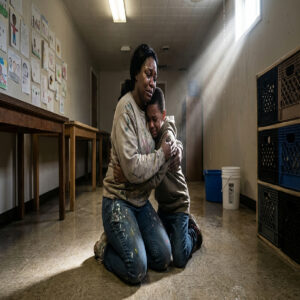
“You were so brave today,” she whispered, pulling him into a hug.
“I’ve never helped someone like that before,” Dylan sobbed into her shoulder. “Everyone always just wants my dad’s money. That’s all anyone ever wants from me.”
Janelle’s heart cracked. “Not from you, baby. Not from you. Your heart is your real wealth, Dylan. Not what’s in your wallet.”
The door burst open. Richard Westfield entered.
He didn’t look like a man moved by grace. He looked like a man ready to sue. He took in the basement with a look of pure disgust. “I wasn’t aware my son was spending his afternoons in a… condemned building,” he barked.
Janelle stood her ground, the fire of a thousand double-shifts rising in her chest. “This is a safe place for twenty-three children, Mr. Westfield.”
“A safe place with code violations and a closure notice on the desk?” Richard countered. “You’re taking donations from children.”
“Dad, stop!” Dylan screamed, stepping between them. “You don’t understand! I lied because this is the only place that feels like Mom!”
The room went deathly silent. Richard froze, his face turning a ghostly pale.
“Mom used to take me to her programs,” Dylan was hysterical now. “We’d read to kids and make sandwiches. She said helping was the only thing that mattered. Then she died, and you shut it all down. You locked yourself away! I just wanted to feel close to her again! Miss Janelle is like Mom. She has nothing, but she gives everything!”
Richard sank into a small, plastic child’s chair, his hands shaking. The “Deep State” of his own grief was finally exposed.
Richard stayed in that basement for an hour after the kids had gone. He looked at Janelle, really seeing the paint-stained clothes and the exhaustion. He had spent three years running from the ghost of his wife, Catherine. He had closed the Westfield Foundation—forty-three programs serving 2,000 kids—because the buildings reminded him of her absence.
“I saw the dashcam footage on the way over,” Richard said quietly. “I watched you carry that girl. I watched you refuse my son’s money.” He looked at the ceiling, at the water stains. “Catherine used to say that every child needs purpose. Rich or poor, purpose is what makes us human.”
He pulled out his phone. “Jenkins? I need a contractor at 52nd and Chester. Tonight. Full building assessment. Emergency repairs. I don’t care what it costs.”
He turned back to Janelle. “I’m not offering charity, Ms. Harper. I’m investing. I want to reopen the Westfield Foundation, and I want you to run it. Not just this basement. All of it. A $15 million annual budget. DESIGN the curriculum. Hire the staff. Show me and Dylan how to honor Catherine by actually living her values.”
Janelle couldn’t breathe. “Mr. Westfield, I’m not qualified. I don’t have an MBA.”
“You have heart,” Richard said, extending his hand. “And a refusal to give up on kids the world has ignored. That’s the only qualification that matters. Will you help us find our way back?”
Janelle looked at the mismatched tables. She looked at Dylan, who was watching her with a desperate hope. She reached out and took Richard’s hand.
“Then yes. Let’s honor her the right way.”
Six months later, the Lighthouse Center gleamed. New paint, fixed railings, and a heating system that hummed with a steady, warm pulse. There were art studios, a library with hundreds of books, and a kitchen where Miss Rosa was now the paid head chef.
Janelle stood in the main room, now the Executive Director of a foundation that served nearly 900 children across three states. She still wore simple clothes. She still knew every kid’s name.
“Resources go to kids, not status,” she had told Richard when he offered her a corporate car.
The most powerful moment of the year came at the graduation ceremony for the original twenty-three Lighthouse kids. Dylan stood at the podium to present the Catherine Westfield Compassion Award. “My mom believed one person could change the world,” Dylan said, his voice steady for the first time in years. “Miss Janelle proved her right.”
Richard stood in the back of the room, looking at a portrait of his wife that now hung in the entrance hall. A plaque beneath it read: She taught us what wealth really means.
Janelle walked up to him as the room erupted in cheers. “I never met her,” she whispered. “But I feel like she led me here.”
“She did,” Richard replied, his eyes wet. “Through Dylan. Through me. Through a dream that refused to die because you refused to let it.”
The story of the Lighthouse is a profound reminder that the most significant investments we make are rarely found in a stock portfolio. Richard Westfield had all the money in the world, yet he was the poorest man in Philadelphia until a teacher with forty-five dollars to her name saved his son’s soul.
Janelle Harper didn’t change the world because she was a billionaire; she changed it because she was brave enough to stay in a cold basement when everyone else had moved on to warmer rooms. We often wait for “the right time” or “enough resources” to make a difference. But kindness isn’t an act; it’s a revolution. And as the Lighthouse proves, that revolution usually starts with a single person refusing to accept that ordinary people can’t do extraordinary things.
Wealth isn’t what you have in your bank account—it’s the ripples you create in the lives of others. The child you help today could be the one who saves a life tomorrow. Be the light. Be the Lighthouse.
What is one small act of kindness you could do today to start your own ripple effect? Have you ever had a teacher or a stranger see the “real you” when you felt invisible? Share your stories below—let’s inspire each other to be the light someone else needs.
Disclaimer : This content may be created by AI for entertainment purposes. Any resemblance to real persons, events, or places is coincidental.






