The Secret of the Peat: How a Handful of “Ghosts” Dismantled the CIA’s Predictions and Won the Falklands War
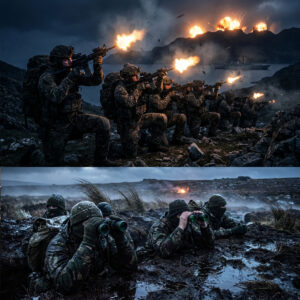
In April 1982, a thick, classified folder landed on a desk in the Oval Office. Inside, the CIA’s top intelligence analysts had laid out a grim reality for the British government. Their assessment was clinical and cold: Britain faced “major difficulties” in any attempt to retake the Falkland Islands. The logistics were a nightmare, the 8,000-mile supply line was precarious, and the Argentine defenses were too deeply entrenched. To the most powerful intelligence agency on Earth, the British mission was an anachronistic gamble—a “Gilbert and Sullivan battle” that was destined to fail.
But as the ink was drying on that American report, the reality on the ground was already shifting in ways the CIA’s satellites couldn’t see.
Deep in the waterlogged, freezing peat bogs of East Falkland, a group of men were living like ghosts. They weren’t approaching the islands; they were already there. They lay in shallow scrapes, wrapped in camouflaged netting, their breath hushing in the sub-Antarctic gale. They watched Argentine patrols pass so closely they could hear the click of their lighters and the cadence of their Spanish jokes. They ate cold rations in the pitch black and transmitted encrypted data to a task force still half an ocean away.
While the world’s superpowers were counting ships and planes, the Special Boat Squadron (SBS) was counting heartbeats. Three weeks before the first official British soldier set foot on the islands, these operators had already mapped the geography of victory. This is the story of the “Concrete Intelligence” that satellites couldn’t capture—the human element that proved the CIA wrong and turned a certain defeat into one of the most daring military successes of the 20th century.
The conflict began not with a roar, but with a calculation. General Leopoldo Galtieri and the Argentine military junta had looked at the declining British interest in the South Atlantic—specifically the planned withdrawal of the HMS Endurance—and concluded that Britain had lost its stomach for the far-flung reaches of its empire. They believed London would protest, perhaps negotiate, but never fight for a cluster of windswept rocks 8,000 miles from Portsmouth.
They were not alone. In Washington, the Reagan administration watched satellite photographs of half-hearted Argentine fortifications and reached a similar verdict. The South Atlantic was a hostile, unforgiving maritime environment. For Britain to launch a unilateral expeditionary force without a local land base or permanent air cover seemed irrational.
Argentina had deployed nearly 10,000 troops. They held the high ground around the capital, Port Stanley, and Goose Green. They had anti-aircraft batteries, a mobile helicopter reserve, and the deadly Exocet-armed Super Étendard jets. Conventional military doctrine, shaped largely by American thinking, suggested that if the British came, they would hit the eastern coast, near Stanley, where the beaches were most suitable for a modern amphibious assault.
Brigadier General Mario Menéndez, the Argentine commander, built his entire defensive wall around this “American Way” of war. He positioned his strength to meet a direct blow to the throat. He didn’t realize that the British were already looking for the gap in his armor—a gap he didn’t even know existed.
The answer to the Argentine defenses wasn’t found in a boardroom, but in the dark, salt-sprayed hull of the carriers HMS Hermes and HMS Invincible. On the 1st of May, as the British task force reached the limit of helicopter range, the real war began in silence.
Sea King helicopters lifted off into the frigid night. To avoid the sweeping emerald eyes of Argentine radar, the pilots flew “nap of the earth,” skimming just feet above the white-capped swells of the South Atlantic. They deposited four-man SBS patrols onto occupied ground—men laden with over 100 pounds of gear, dropped into a landscape that felt like the end of the world.
The Falklands in May is a purgatory of blowing snow, constant freezing drizzle, and a wind that never stops its mournful howl. The ground is a treacherous peat bog that swallows boots and leaches the energy from a man’s marrow with every step. There are no trees for cover, no buildings for warmth. The only concealment is the lie of the land and the sparse Tussac grass.
The patrols moved only at night, navigating by feel through the waterlogged terrain. Before the first light of the weak southern sun could betray them, they dug “hides”—shallow scrapes in the freezing earth. They lived in these holes for weeks, becoming part of the landscape. They watched Argentine intervals, weapons, and morale. Every detail was coded and sent back via encrypted signals, crossing the ocean to the ears of commanders who were desperately trying to find a way in.
The SBS had a primary mission that would determine the fate of the entire campaign: verify a landing site. Task force planners had their eyes on San Carlos Water, a deep inlet on the western side of East Falkland. On paper, it looked like a natural harbor, protected from the worst of the South Atlantic swells. But paper couldn’t tell them the gradient of the beach at low tide or if there were hidden sandbars that would gut a landing craft.
In sub-zero temperatures, SBS divers slipped into the black waters of the inlet. They moved through the kelp forests, taking hydrographic readings and measuring depths with the meticulousness of surveyors. While they worked in the surf, other teams climbed the surrounding ridges to peer through high-powered optics at the Argentine garrison.
What they found was the “unbelievable” gap. Because Menéndez was so certain the British would land in the east, he had left San Carlos almost entirely undefended. The beaches were clear. The anchorage was workable. The terrain behind the beach offered a natural fortress to hold a beachhead.
The “American Way” of war would have predicted a bloodbath at Stanley. The “SBS Way” had found a back door.
There was one thorn in the side of the San Carlos plan: Fanning Head. This massive ridge overlooked the northern entrance to the water. Perched on its heights was the “Eagle Detachment”—sixty Argentine soldiers armed with heavy machine guns and an 88mm anti-tank gun. If these men remained in position on the morning of May 21st, the British landing craft would be sitting ducks in a “kill zone” of enclosed water.
Fanning Head had to be neutralized.
On the night of May 20th, 25 SBS operators were inserted 6.5 kilometers from the ridge. Offshore, the Wessex helicopter of HMS Antrim swept the heights with thermal imaging. On the monitors, the Argentine positions appeared like glowing “glowworms”—clusters of body heat gathered around stoves and defensive posts.
The SBS moved in with a Royal Navy Forward Observer and Captain Rod Bell, a Spanish speaker. They offered the garrison a chance to surrender via loudspeaker. The Argentines, perhaps emboldened by their heavy weaponry, refused.
What followed was a masterclass in precision. HMS Antrim opened fire, the shells corrected in real-time by the SBS observer crouched on the hillside below. The rounds didn’t just fall; they moved with the precision of a scalpel, guided by the man on the ground who knew the terrain better than the defenders. The SBS assault went in simultaneously, clearing the feature in a whirlwind of coordinated violence. 11 Argentines were killed, six taken prisoner, and the rest scattered into the dark. The road to San Carlos was open.
While the SBS was clearing the landing route, G Squadron of the 22nd SAS was performing a feat of battlefield theater 60 kilometers to the south at Darwin.
Sixty SAS soldiers opened up a sustained, ferocious volume of fire using small arms, mortars, and rocket launchers. They moved constantly, creating a “battlefield signature” so large and aggressive that the Argentine commanders at Darwin radioed headquarters to report they were being attacked by a full infantry battalion.
By 2:30 a.m. on May 21st, every Argentine eye was fixed on the wrong horizon. Menéndez’s helicopter reserve was prepped to fly south to meet a ghost army, while the real invasion force was silently lowering its ramps at San Carlos.
As the sun began to peek over the grey horizon, 2,400 British soldiers—Commandos and Paratroopers—came ashore. They landed on beaches that had been surveyed, mapped, and cleared of enemies weeks before they even arrived.
The 10,000-man Argentine force was paralyzed. Their mobile plan couldn’t be executed against a landing site their intelligence told them was impossible to use. While Argentine pilots later attacked the fleet with incredible courage, sinking the HMS Ardent and HMS Antelope, the ground war had already been won in the peat.
Britain retook the islands on June 14, 1982. The 74-day campaign ended with a total Argentine surrender at Stanley.
In the aftermath, the CIA had to revise its understanding of “difficulty.” The agency had correctly identified the challenges, but they had failed to account for a type of warfare that doesn’t show up on a ledger: the ability of small, elite groups to dismantle a defensive picture from the inside.
The history of the Falklands War is often remembered as a story of ships, missiles, and massive troop movements. But that history starts too late. The victory was actually forged three weeks earlier, when a few men in rubber boats and Sea Kings stepped onto a freezing island and dared to stay invisible.
The universal lesson of this campaign is that the most powerful intelligence is not gathered from the silence of space, but from the silence of a man in a hole 200 meters from his enemy. The CIA saw “major difficulties” because they were looking at the world through the lens of traditional doctrine. The SBS saw a “workable anchorage” because they were looking at the world with their own eyes.
In an age of AI, satellite surveillance, and digital signals, we often forget that the most consequential information still comes from the ground. Sometimes, victory isn’t about having the most power; it’s about knowing exactly where your enemy isn’t looking.
What do you think is more important in modern warfare: high-tech satellite surveillance or the “boots on the ground” intelligence provided by elite units? Could a mission like this still succeed in the age of thermal drones and constant digital connectivity? Share your thoughts and your own stories of “invisible heroes” in the comments below—let’s keep the history of these “ghosts” alive.
Disclaimer : This content may be created by AI for entertainment purposes. Any resemblance to real persons, events, or places is coincidental.






